About Munich Football Arena
The stadium in Fröttmaning, on the northern edge of Munich, was designed by the Basel architects Herzog & de Meuron and built from October 2002. It opened on 30 May 2005 with a friendly between TSV 1860 München and 1. FC Nürnberg; the first Bundesliga match followed on 5 August 2005. It replaced the Olympiastadion, where Bayern had played since 1972. Bayern shared the new ground with their city rivals 1860 until 2017, when the rental contract was ended and Bayern became the only tenant. It cost about €340 million, with roughly another €210 million spent by the city and state on infrastructure.
Its look comes from the skin. The roof and the sides are covered with several thousand rhomboid cushions of ETFE foil, each only 0.2 millimetres thick and kept permanently inflated. Sources give about 2,760 to 2,874 cushions, depending on whether and how the roof is counted. Each cushion can be lit from behind in white, red or blue, so the whole building changes colour: red for Bayern, blue for 1860 in the years they played here, and white for Germany’s national team and for neutral events such as the 2012 Champions League final, which Chelsea won on penalties against Bayern in their own stadium.
Inside there are three tiers whose slope gets steeper towards the top, about 24°, 30° and 34°, under a roof that covers all seats. Part of the Südkurve, home of Bayern’s most committed fans, is standing-only for domestic matches. The arena has hosted games at UEFA Euro 2020 and at UEFA Euro 2024, including the opening match, Germany’s 5–1 win over Scotland.
The name needs a note. “Allianz Arena” is the sponsor’s name, and the insurer holds the naming rights until 2041. UEFA and FIFA do not use sponsor names for their competitions, so in those matches it is called Munich Football Arena (Fußball Arena München in German). That is the name used on this page.
The diorama
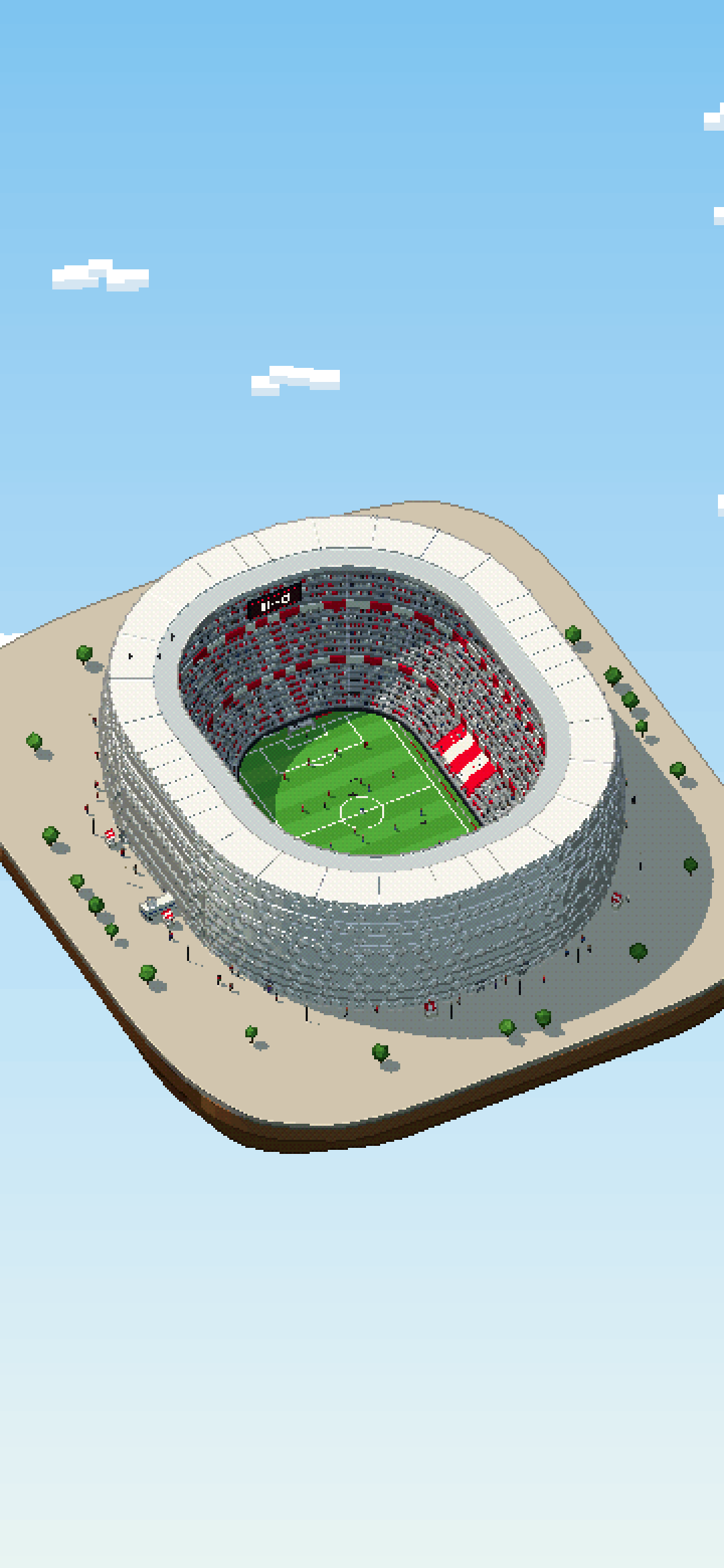
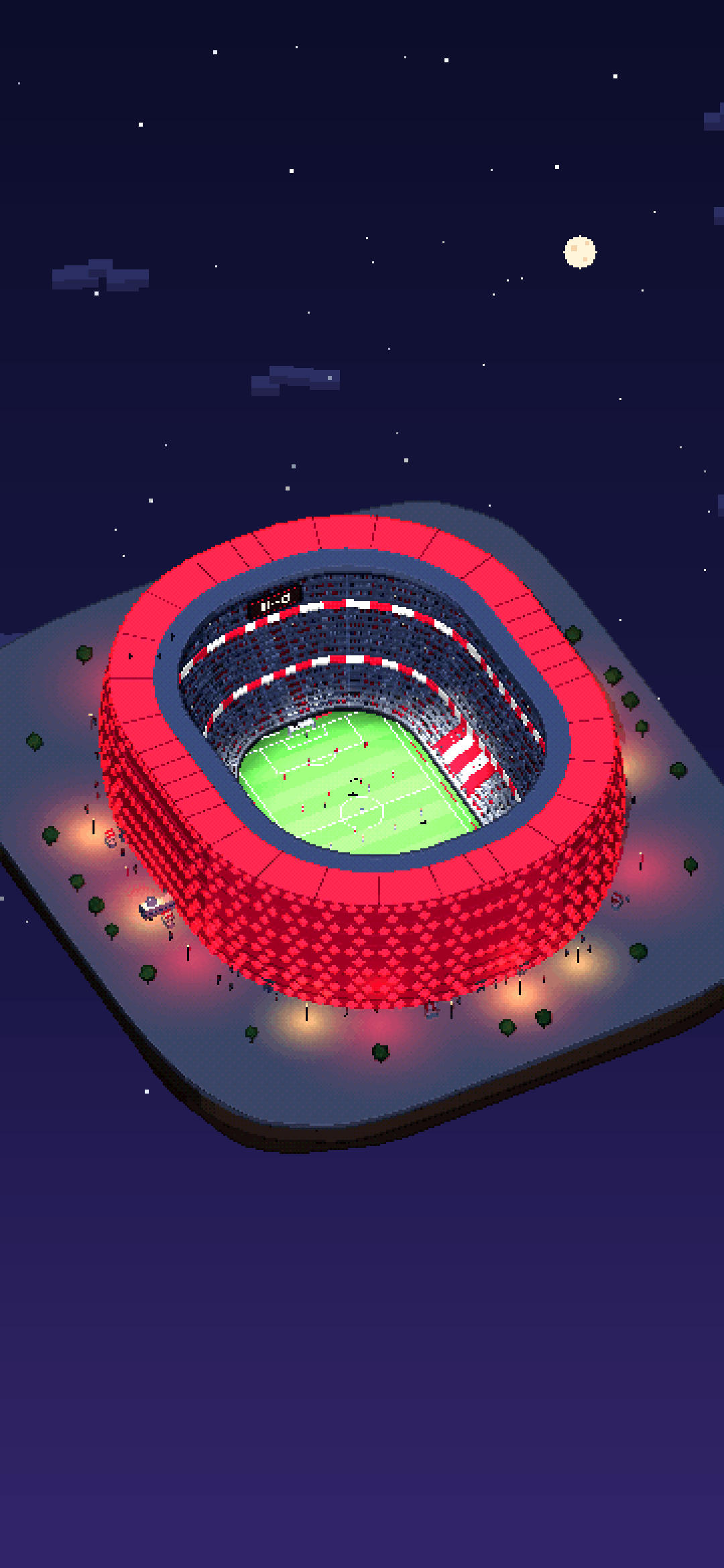
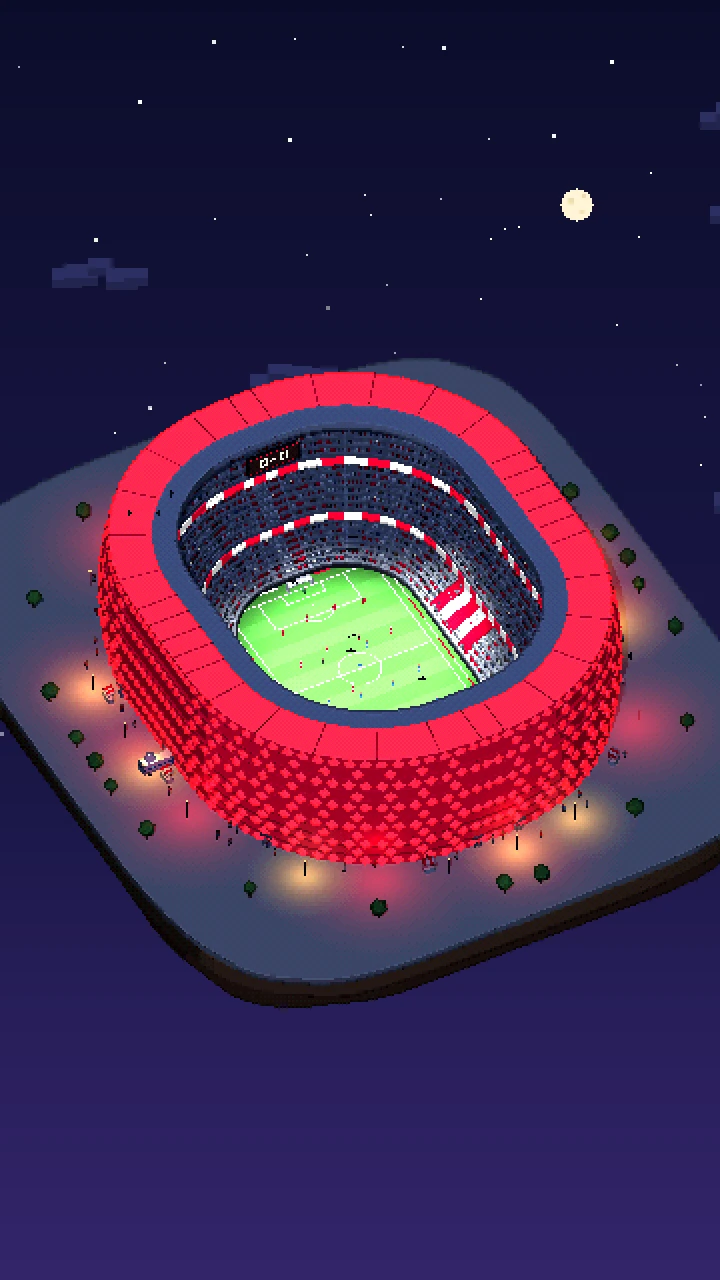
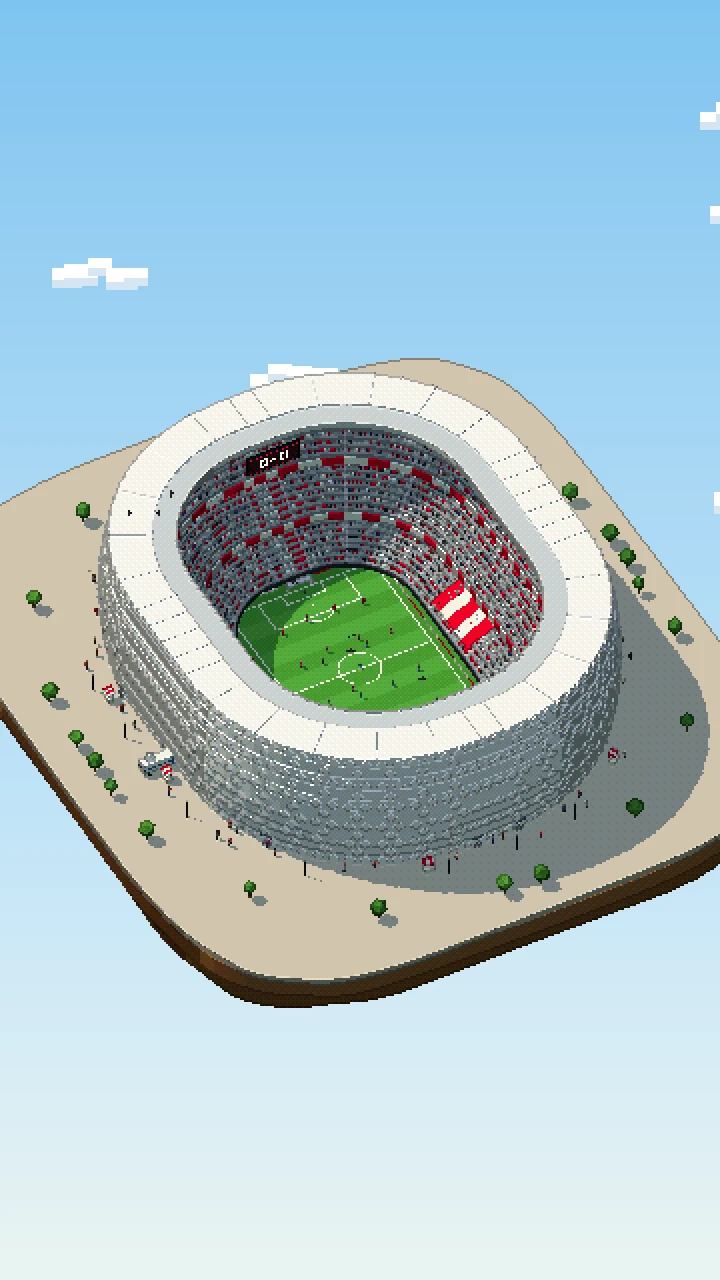
The diorama puts the arena on a floating island, built in Three.js and rendered as pixel art: a low-resolution picture with dark outlines, a small palette and no smoothing when scaled up. The bowl has three steep tiers, with a translucent inner roof edge. Over it all, the shell is built from rows of staggered diamond-shaped cushions that bulge outwards at mid-height, like an inflated dinghy, and fold over the roof edge. By day they are white; at night the cushions themselves turn red, the seams between them a deeper red, and red light spills onto the forecourt.
A match plays on the pitch, 22 players and a referee in red and white against blue and white, and repeats every 15 seconds: the ball is moved up the field, the home side score, the scoreboards flip from 0–0 to a flashing goal message and then 1–0, the crowd jumps and confetti flies out of the stands. A tifo of red and white stripes covers one stand, a giant flag drifts along another and the ultras bounce for the whole match. The light runs from day to dusk to night; the floodlights come on and phone lights twinkle in the stands. Outside, stalls, turnstiles, a TV van, lamps and walking fans fill the forecourt.
Things to spot
- White cushions turning red as the light fades
- The glowing ring of the roof edge
- Red-and-white tifo and the giant flag on the stands
- The goal at 10 seconds: the scoreboards flip to 1–0 and the confetti goes up
- Red light spilling onto the forecourt at night
What we simplified
- The skin has far fewer, larger cushions than the real one, and the diamonds are drawn as flat tilted boxes in staggered rows; the real count is around 2,800.
- The bowl is a rounded oval of generic proportions; the real building has its own distinct footprint, and the roof and seam details are only suggested.
- The real facade can also show white and blue, and the model only does white by day and red at night. Munich police have asked for single-colour lighting because of the nearby A9 motorway; the model does not show any of the real lighting modes or its changes.
- The seats, the interior and the tifo are invented, not copied from the real stadium, and the Südkurve is not modelled as a separate block. The opponent’s blue shirts are generic.
- No club crests, sponsor names or real kits are shown, only red and white. The scoreboard goal message is a generic “GOL!”. The surroundings are invented and do not show Fröttmaning or the real car parks.
Questions
Is Munich Football Arena the same as the Allianz Arena?
Yes. Allianz Arena is the sponsor’s name. UEFA and FIFA competitions use Munich Football Arena (Fußball Arena München in German), because they do not allow sponsor names.
When did the arena open?
It opened on 30 May 2005 with a friendly between TSV 1860 München and 1. FC Nürnberg. The first Bundesliga match was played on 5 August 2005. A few sources give 31 May as the opening date.
How many people does it hold?
The capacity is 75,024 for Bundesliga matches, which includes standing places. For international and European matches it is about 70,000, as the Südkurve is turned into seating.
Why does the arena glow red?
The facade is made of air-filled ETFE foil cushions that can be lit from behind. For Bayern matches they are red; for the national team and neutral events they are white, and for 1860 matches they used to be blue.
Who played here before Bayern became the only tenant?
TSV 1860 München shared the arena with Bayern from 2005 until 2017, when Bayern ended the rental contract and became the sole tenant.
What does the pixel-art diorama of the arena show?
It is a real-time Three.js scene running on this page: a looping match with a goal every 15 seconds, a jumping crowd, confetti and a scoreboard that goes from 0–0 to 1–0. The cushion skin is white by day and glows red at night. Press “Explore in 3D” to drag it round.