About Römer
The Römer has been Frankfurt’s city hall for more than six centuries. On 11 March 1405 the city council bought two merchant houses, the Haus zum Römer and the Goldener Schwan, and turned them into its town hall. Over the following centuries the city added neighbouring houses one by one, so that today the Römer is a complex of several connected buildings around courtyards, with its famous row of stepped gables facing the old town square.
Three gables stand in the middle of that row: Alt-Limpurg, the Haus zum Römer and Löwenstein. The central house got its neo-Gothic front around 1900, with a balcony, a clock, the city’s coats of arms and statues of four emperors, including Frederick Barbarossa and Charles IV. Upstairs is the Kaisersaal, where newly crowned emperors of the Holy Roman Empire held their coronation banquets. It is hung with nineteenth-century portraits of the emperors.
The square in front, the Römerberg, was the heart of medieval Frankfurt, home to trade fairs and to the Christmas market, which is first recorded in 1393. In its middle stands the Justice fountain, built in 1543. Its Justitia was recast in bronze in 1887, and unusually she is not blindfolded. During coronations the fountain ran with wine. On the east side stands the Ostzeile, a row of half-timbered houses, with the small Gothic Old St Nicholas Church to the south.
On 22 March 1944 an air raid set off a firestorm that destroyed almost all of the old town, including most of the Römer. The city hall was rebuilt in a simplified form, and the Ostzeile was reconstructed after its old models in the early 1980s. A few streets east rises the 95-metre tower of the cathedral, where emperors were crowned from 1562 to 1792, and just south of the square the Eiserner Steg footbridge, opened in 1869, crosses the Main.
The diorama
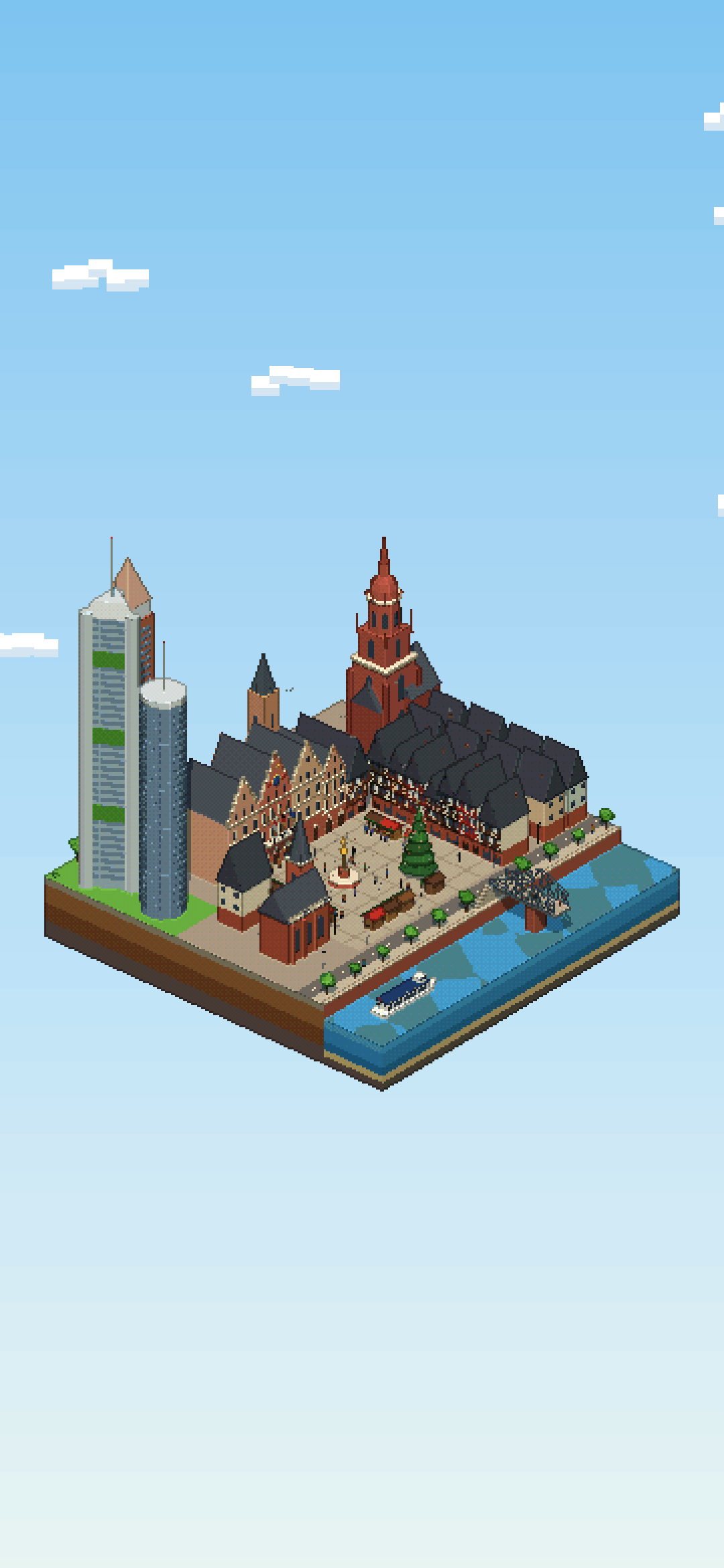
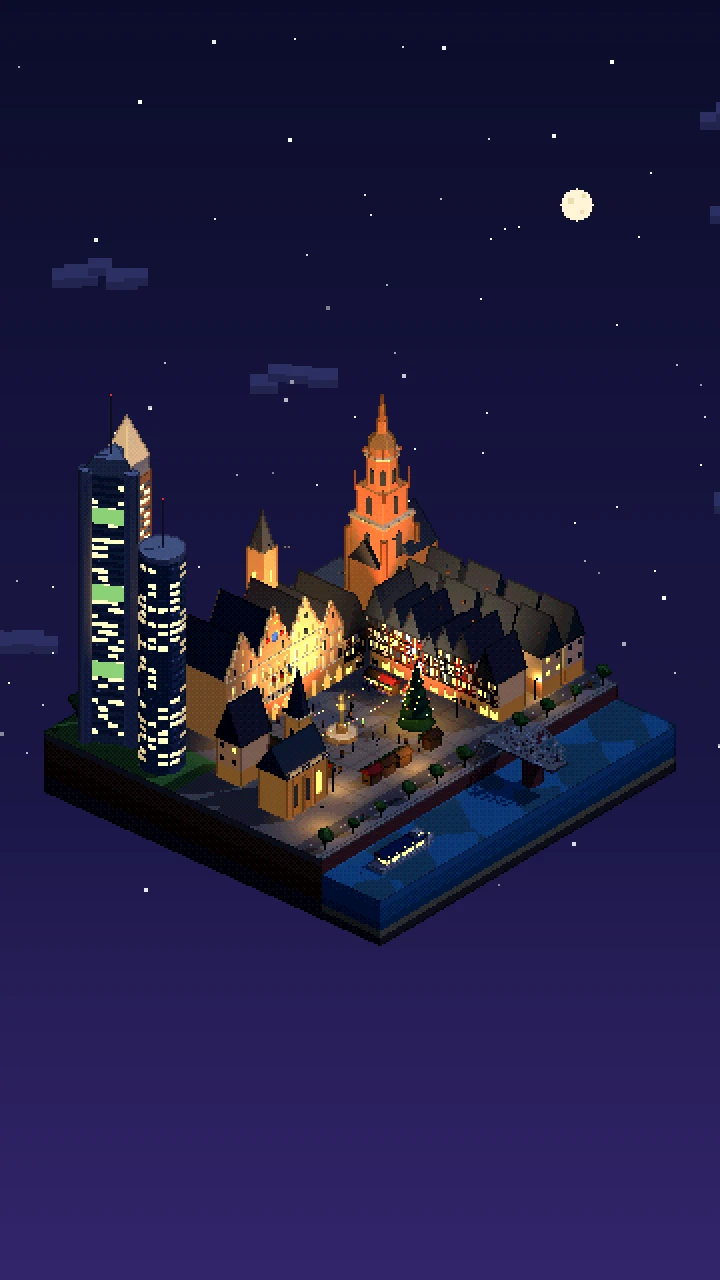
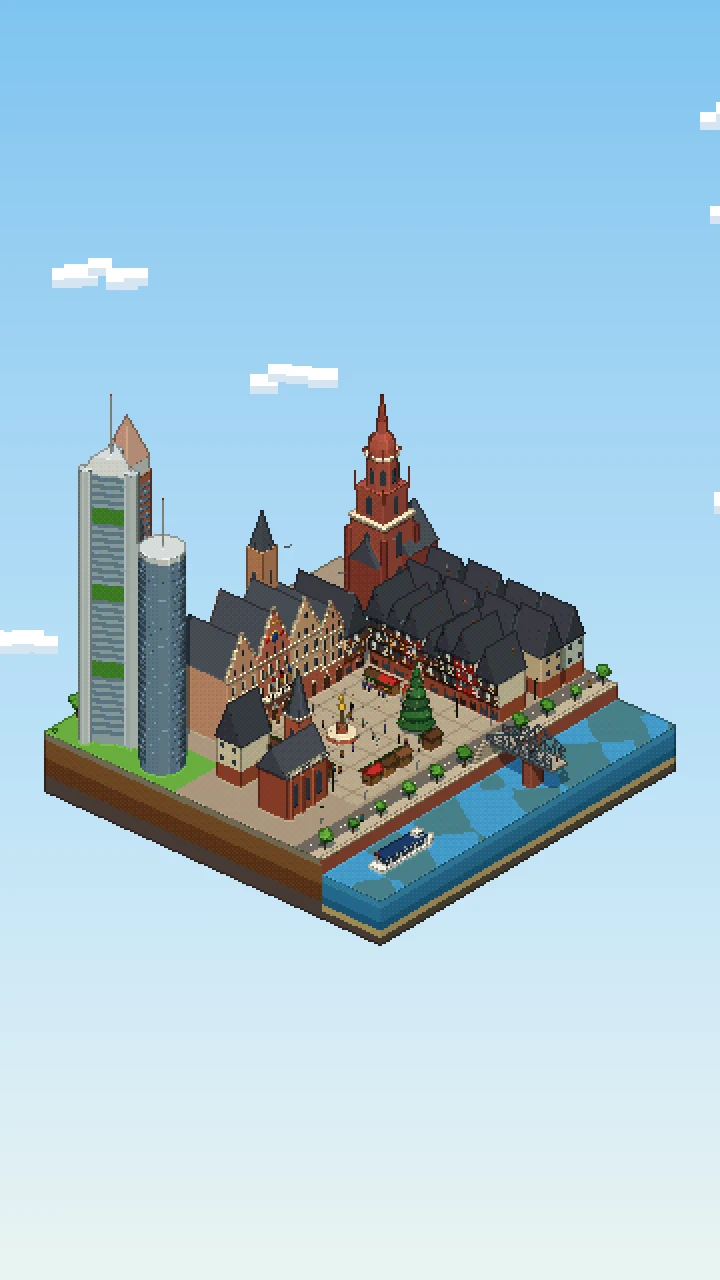
The diorama shows the Römerberg on a floating block with the Main cut open along its front, at roughly one unit to 1.3 metres. The Römer has its stepped gables with stone finials, Gothic windows, a red sandstone ground floor with pointed doorways, and on the central house the balcony with flags, four small emperor statues, coats of arms and a blue clock. The square is turned so the Römer faces the river. Opposite stand six jettied half-timbered houses of the Ostzeile, each with its own timber pattern and colour.
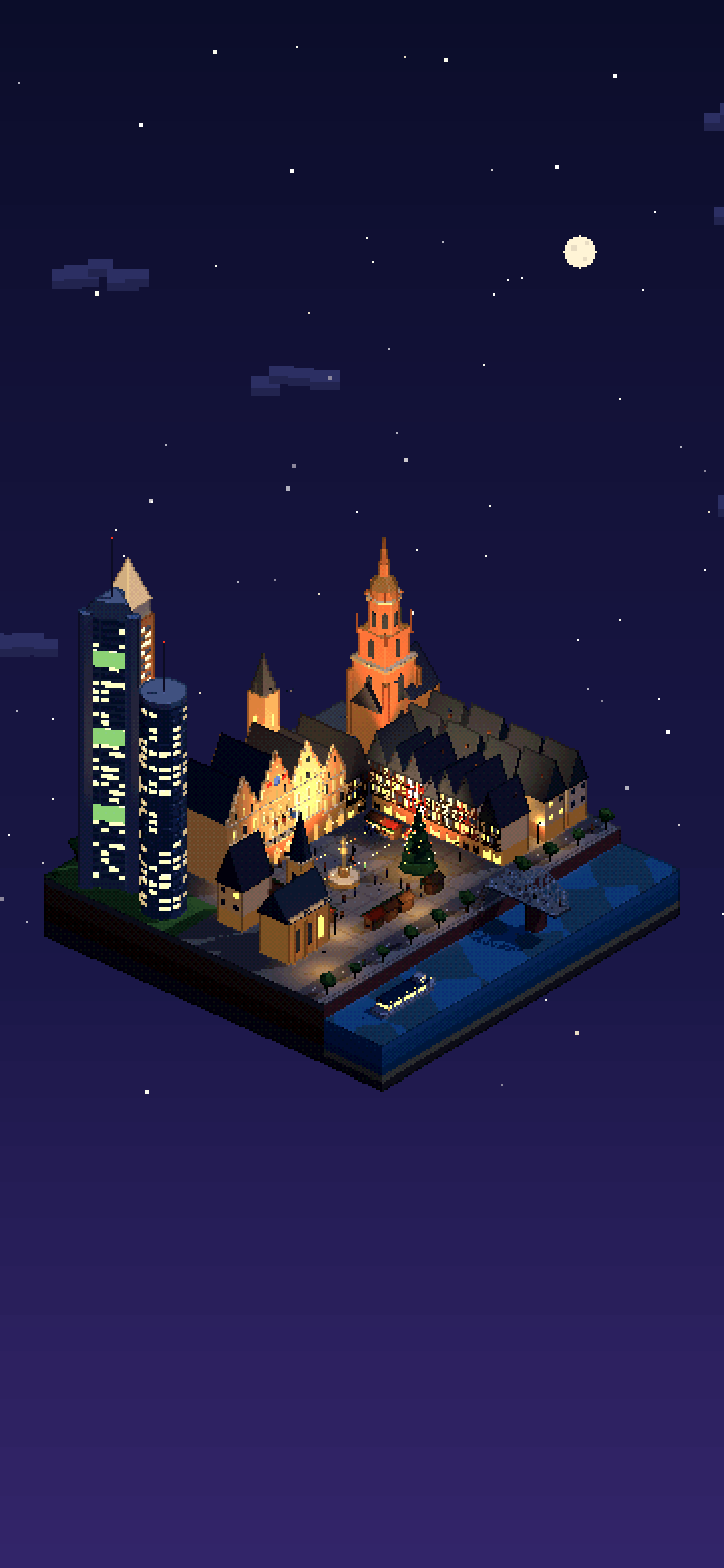
In the square there is the Justice fountain with a gold Justitia holding sword and scales, a Christmas market with wooden stalls and a big lit tree, strings of lights and pigeons. Around it are the Old St Nicholas Church with its gallery and slim spire, the cathedral tower with its dome and lantern, the Eiserner Steg with a tour boat passing beneath, and a corner of skyscrapers. At night the facades are floodlit, the stalls glow and the towers light up window by window.
Things to spot
- The blue clock and the flags on the Römer balcony
- Justitia on the fountain, with her sword and scales
- The lit Christmas tree and the glowing market stalls
- Pigeons pecking around the fountain
- Love locks on the railings of the Eiserner Steg
- A tour boat sliding under the footbridge
What we simplified
- The square is turned and squeezed: the Römer faces the river here, the Ostzeile stands at the side, and the Old St Nicholas Church has moved to the corner.
- The cathedral and the skyscrapers are much lower than in reality, and the towers are moved right next to the old town as a contrast.
- The Römer’s facades, statues and courtyards are simplified, and the Ostzeile’s timber patterns are generic rather than copies of the real houses.
Questions
Why is Frankfurt’s city hall called the Römer?
It is named after the Haus zum Römer, one of the two merchant houses the city council bought in 1405 to use as its town hall. The square in front, the Römerberg, takes its name from the building.
Is the Römer original?
Much of it is not. Most of the Römer was destroyed in an air raid on 22 March 1944 and rebuilt in simplified form after the war. The half-timbered Ostzeile across the square was reconstructed in the early 1980s.
What is the Kaisersaal?
The Kaisersaal, or Emperor’s Hall, is a room on the upper floor of the Römer. Newly crowned emperors of the Holy Roman Empire held their coronation banquets there, and its walls carry nineteenth-century portraits of the emperors.
When is the Frankfurt Christmas market?
The market fills the Römerberg and the streets around it from late November until just before Christmas each year. It is one of the oldest in Germany and is first recorded in 1393.
How was this pixel-art diorama of the Römer made?
It is a real-time Three.js scene running on this page, drawn at 360 × 640 pixels with outlines and a small palette, then scaled up without smoothing. Press “Explore in 3D”, drag to turn it, and switch between day, dusk and night.
Isometric maps of Frankfurt
Frankfurt also has an isometric pixel-art map made by the community: the whole city drawn tile by tile in the same SimCity-like style. See the map of Frankfurt →