About Burano
Burano lies in the northern part of the Venetian lagoon, about seven kilometres from Venice. It is really four small islands, separated by three canals, the rio Pontinello, the rio della Giudecca and the rio Terranova, and joined by bridges; a longer bridge links it to the neighbouring island of Mazzorbo. Its only square, Piazza Baldassare Galuppi, named after the 18th-century composer who was born here, was made by filling in a canal. About 2,200 people live on the island.
Burano is famous for two things. The first is lace. The women of the island have made it since the 16th century, with a needle alone and no pillow, a technique called punto in aria. The trade declined in the 18th century and was revived when a lace-making school opened in 1872. The Lace Museum, opened in 1981 in the old Palazzo del Podestà on the main square, holds more than two hundred pieces from the 16th to the 20th century.
The second is colour. The low houses along the canals are painted in strong, flat colours, pink next to blue next to yellow next to green. The story most often told is that the bright colours helped fishermen find their way home in the lagoon fog; another is that each colour stood for a family. The colours are not left to chance: owners who want to repaint have to ask the local authority first, which decides which colours are allowed for the house.
Above the roofs rises the bell tower of San Martino, the island’s church, which holds a Crucifixion painted by Giambattista Tiepolo in 1727. The campanile was begun in 1703 to a design attributed to Andrea Tirali and is about 53 metres tall. Like many towers in the lagoon it stands on piles in soft ground, and as the ground settled it began to lean: its top is about 1.83 metres out of true.
The diorama
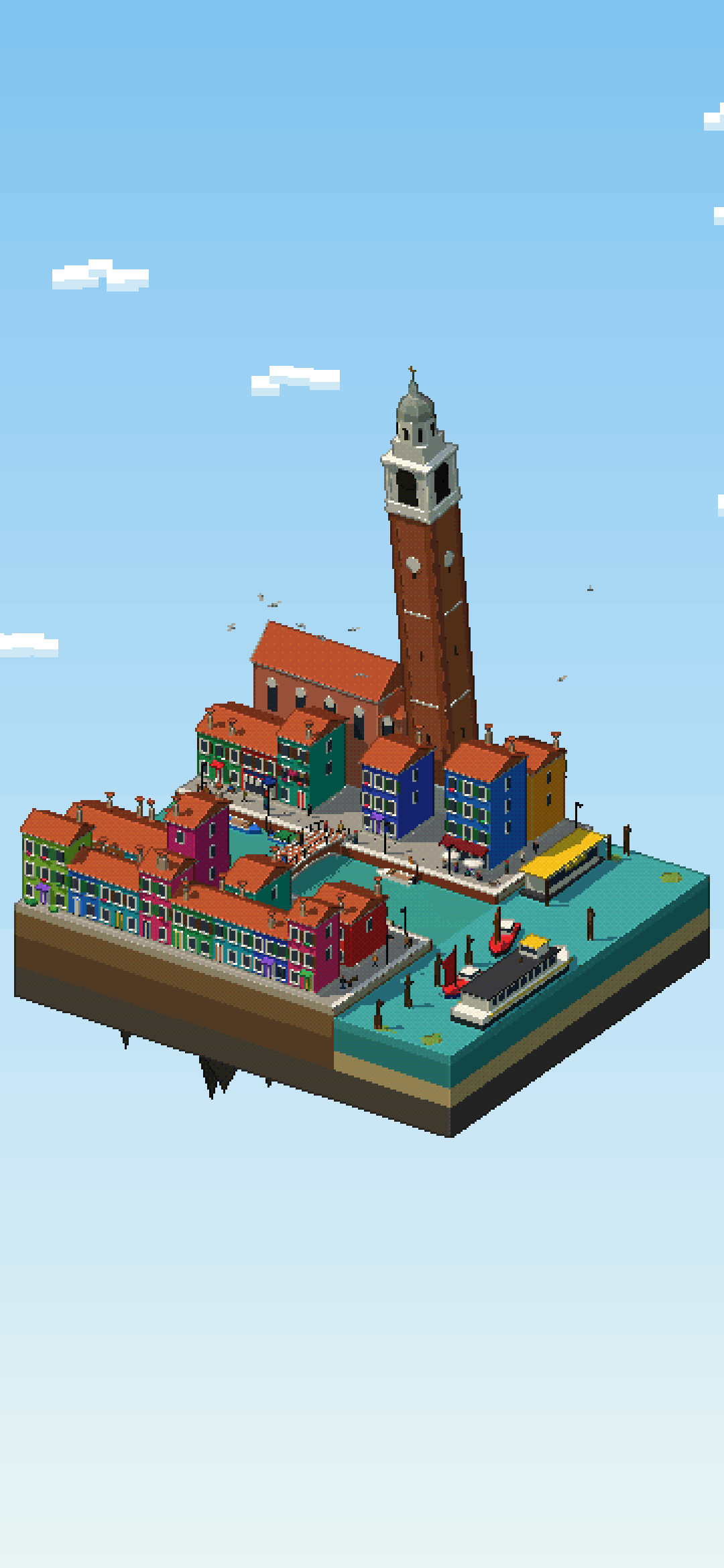
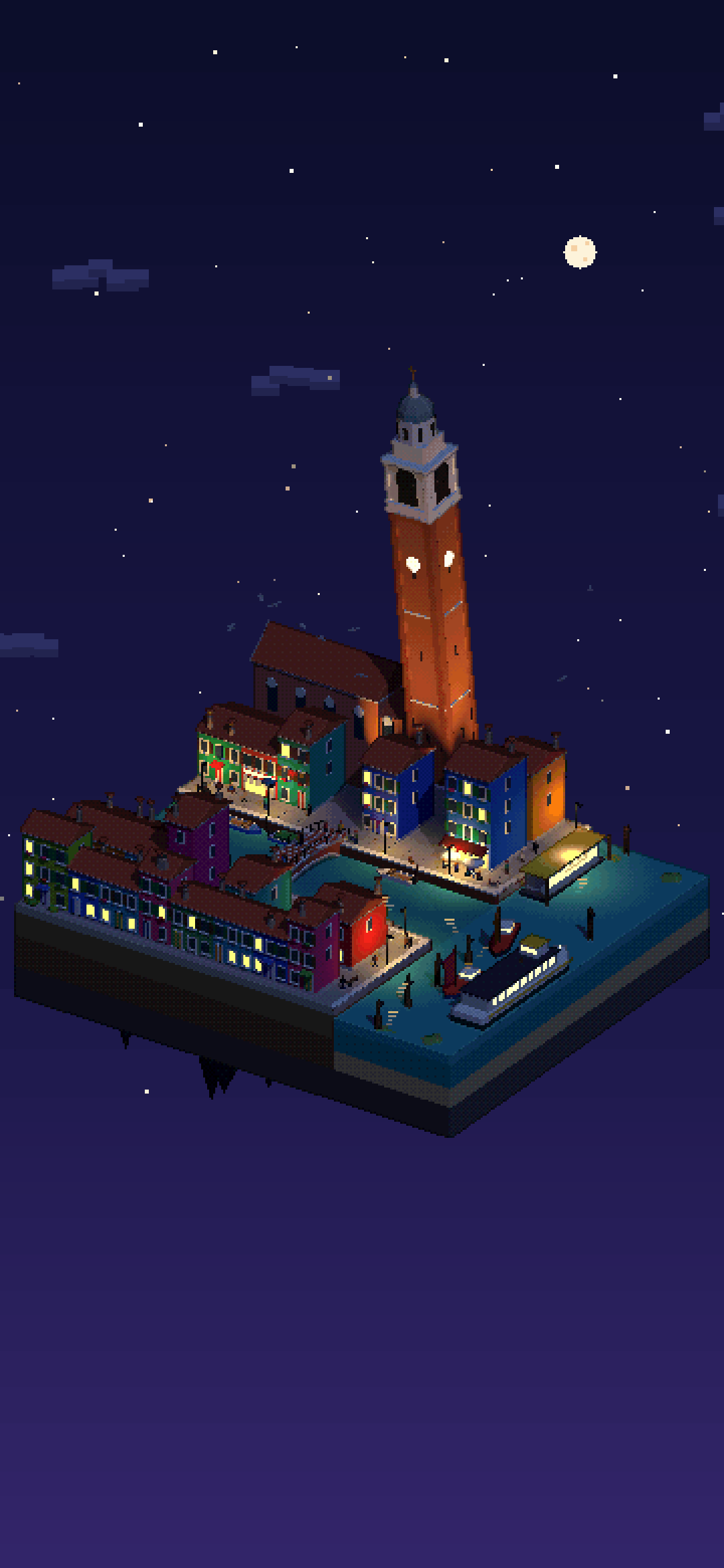
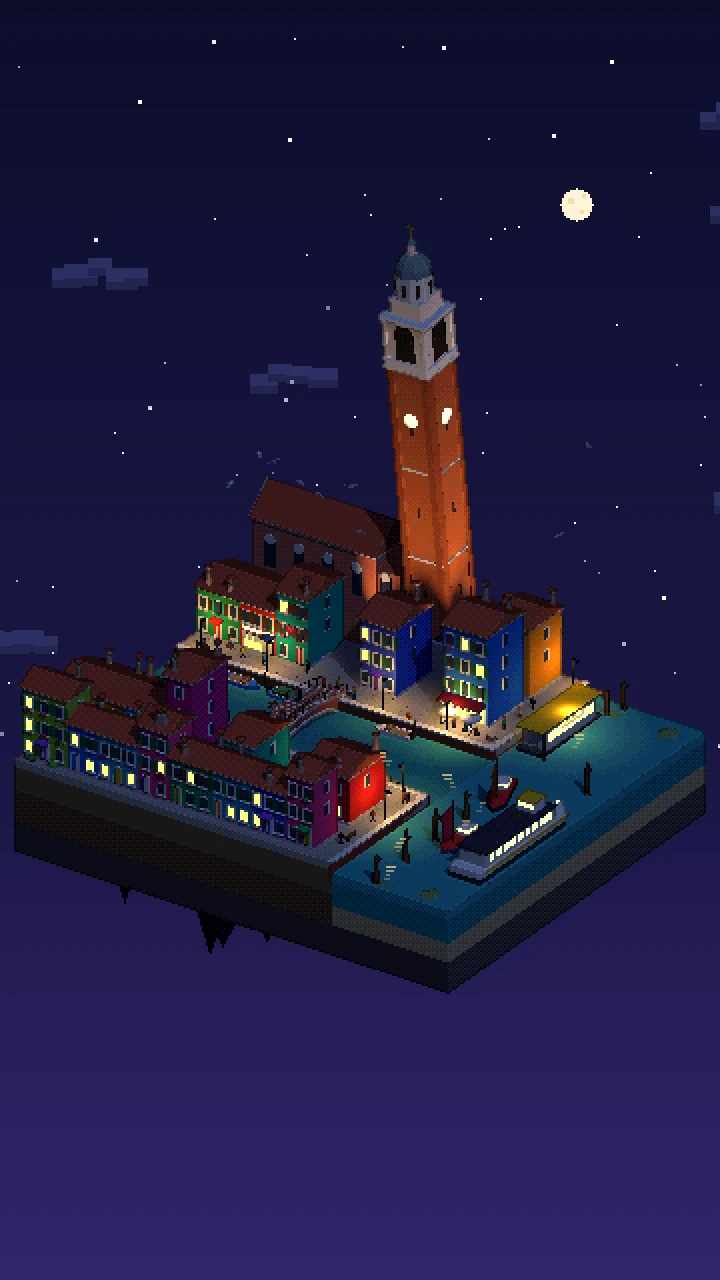
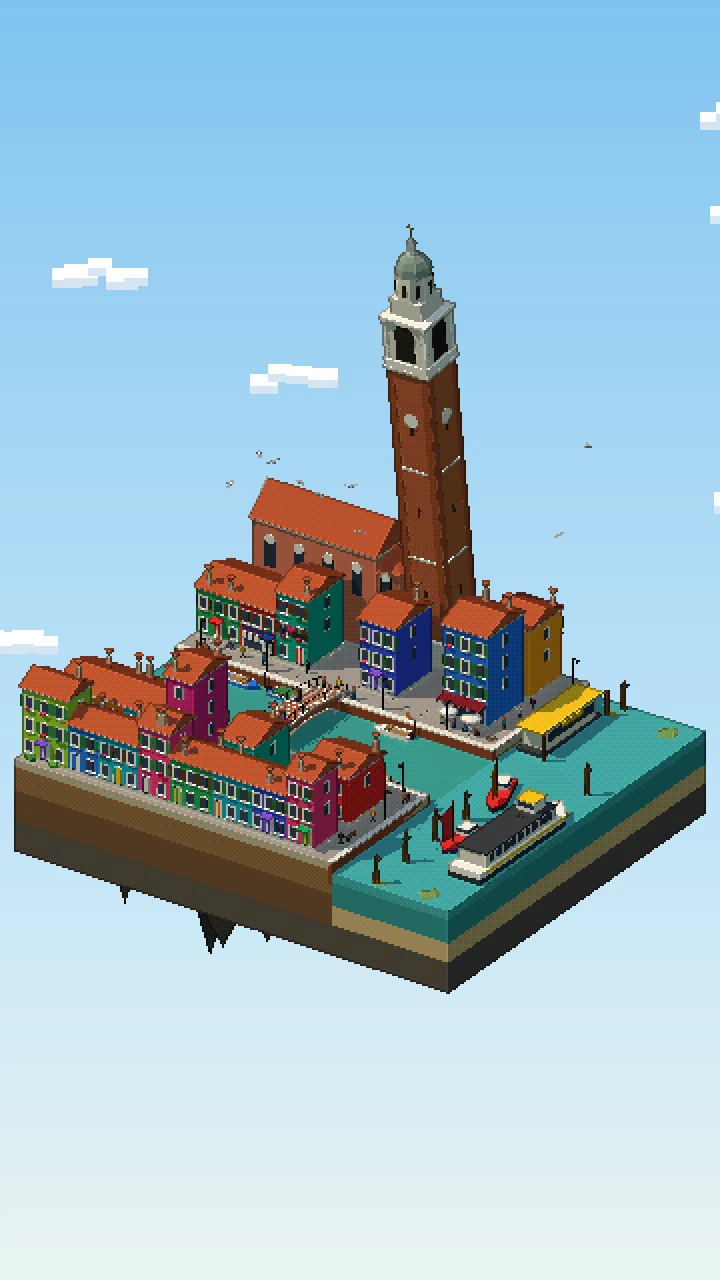
The diorama cuts a canal of Burano out of the island as a floating block, built in Three.js and rendered as pixel art: the scene is drawn at a low resolution, every edge gets a dark outline, the colours are reduced to a small palette, and the result is scaled up without smoothing. The canal runs through the middle between brick walls capped with white Istrian stone, cut open at the back so you see the water in section, and opens out at the front into the lagoon with a vaporetto stop, clusters of mooring posts (bricole) and fishing boats with painted sails.
Both quays are lined with two- to four-storey houses in pink, blue, green, yellow, purple, red and orange, with white window surrounds, green shutters, striped curtains in the doorways, Venetian funnel chimneys and low terracotta roofs. Washing hangs across some of the fronts, flower boxes sit under the windows, small wooden motorboats are moored along the walls, and a brick humpback bridge with white stone steps and iron railings crosses the canal. Behind the houses stand the brick church of San Martino and its leaning campanile, with a white stone belfry and an octagonal lantern. At night the campanile is floodlit and the lit windows shimmer in the canal.
Things to spot
- The lace shop, with white lace hung out on its front
- Lace makers sitting on chairs by their doors
- A cat sitting at the top of the bridge
- The vaporetto crossing the lagoon past the stop
- Striped curtains hanging in the doorways
- An old man fishing from the quay at the lagoon end
What we simplified
- The campanile leans about five degrees, more than twice as much as the real one, so the lean can be read at pixel scale.
- The canal is narrower than a real Burano rio so both rows of houses fit on the island, and the church and campanile are moved in close behind the houses.
- The houses are generic Burano houses, not the actual buildings on any particular canal, and the campanile is reduced to its main shapes.
Questions
Why are Burano’s houses painted different colours?
The story most often told is that the bright colours helped fishermen find their way home in the lagoon fog; another is that each colour stood for a family. The colours are still controlled: owners who want to repaint must ask the local authority, which decides which colours are allowed for the house.
Is the Burano bell tower leaning?
Yes. The campanile of San Martino stands on piles in the soft ground of the lagoon, and as the ground settled it began to lean. Its top is about 1.83 metres out of true. The tower is about 53 metres tall and was begun in 1703.
What is Burano famous for?
Burano is famous for its brightly painted houses and for its needle lace, made on the island since the 16th century. The Lace Museum on the main square, opened in 1981, shows more than two hundred pieces.
How far is Burano from Venice?
Burano is about seven kilometres from Venice, in the northern part of the lagoon. Vaporetto waterbuses run there from the city, and a bridge links it to the neighbouring island of Mazzorbo.
How was this pixel-art diorama of Burano made?
It is a real-time Three.js scene running on this page, drawn at 360 × 640 pixels with dark outlines and a small palette, then scaled up without smoothing. Every house is built from code with its own colour, shutters, chimneys and curtain, and the campanile leans more than the real one so it reads at pixel scale. Press “Explore in 3D” to drag it round and switch between day, dusk and night.