About Brooklyn Bridge
The Brooklyn Bridge was designed by John Augustus Roebling, who died in 1869 before building began. His son Washington Roebling took over as chief engineer, and when illness kept him confined to his room, his wife Emily Warren Roebling carried his instructions to the site and became central to the work. Construction started in 1870, and the bridge opened on 24 May 1883 to great celebration.
Its main span of about 486 metres made it the longest suspension bridge in the world when it opened, a title it held until the Williamsburg Bridge, just up the East River, was finished in 1903. It was also the first bridge to use steel for its cable wire. Besides the four main cables, diagonal stays run down from the tower tops, giving the bridge its familiar web pattern.
The two towers, of granite and limestone, rise about 84 metres above high water, and each is pierced by a pair of tall pointed Gothic arches through which the roadways pass. Above the traffic runs an elevated walkway with wooden boards, which has made the walk between Manhattan and Brooklyn one of the best-known strolls in New York. In 1884 P. T. Barnum led 21 elephants, Jumbo among them, across the bridge.
The bridge keeps changing. Its cables have carried strings of “necklace” lights for decades, converted to LEDs in 2021, and that September a two-way protected bike lane opened on the Manhattan-bound roadway, taking cyclists off the crowded promenade. On the Brooklyn side, the 1922 Jane’s Carousel has turned in a glass pavilion by Jean Nouvel in Brooklyn Bridge Park since 2011.
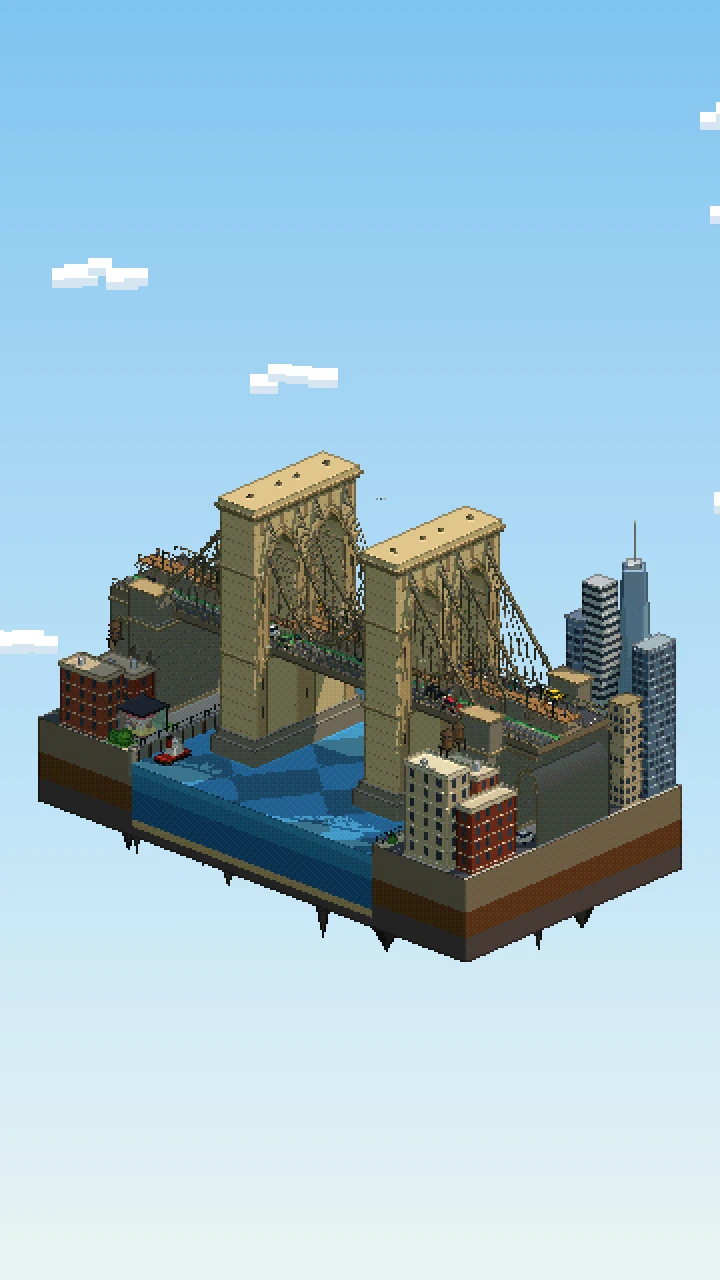
The diorama
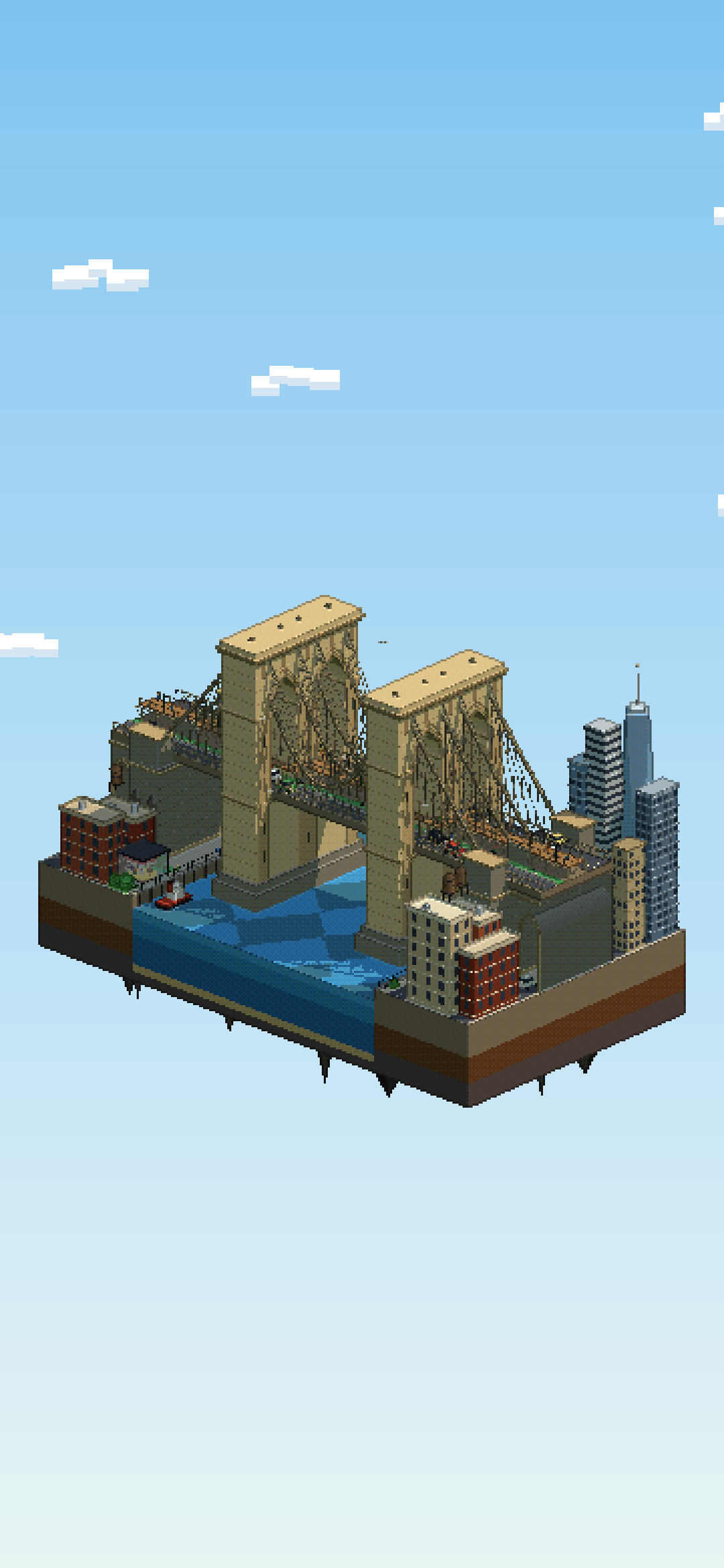
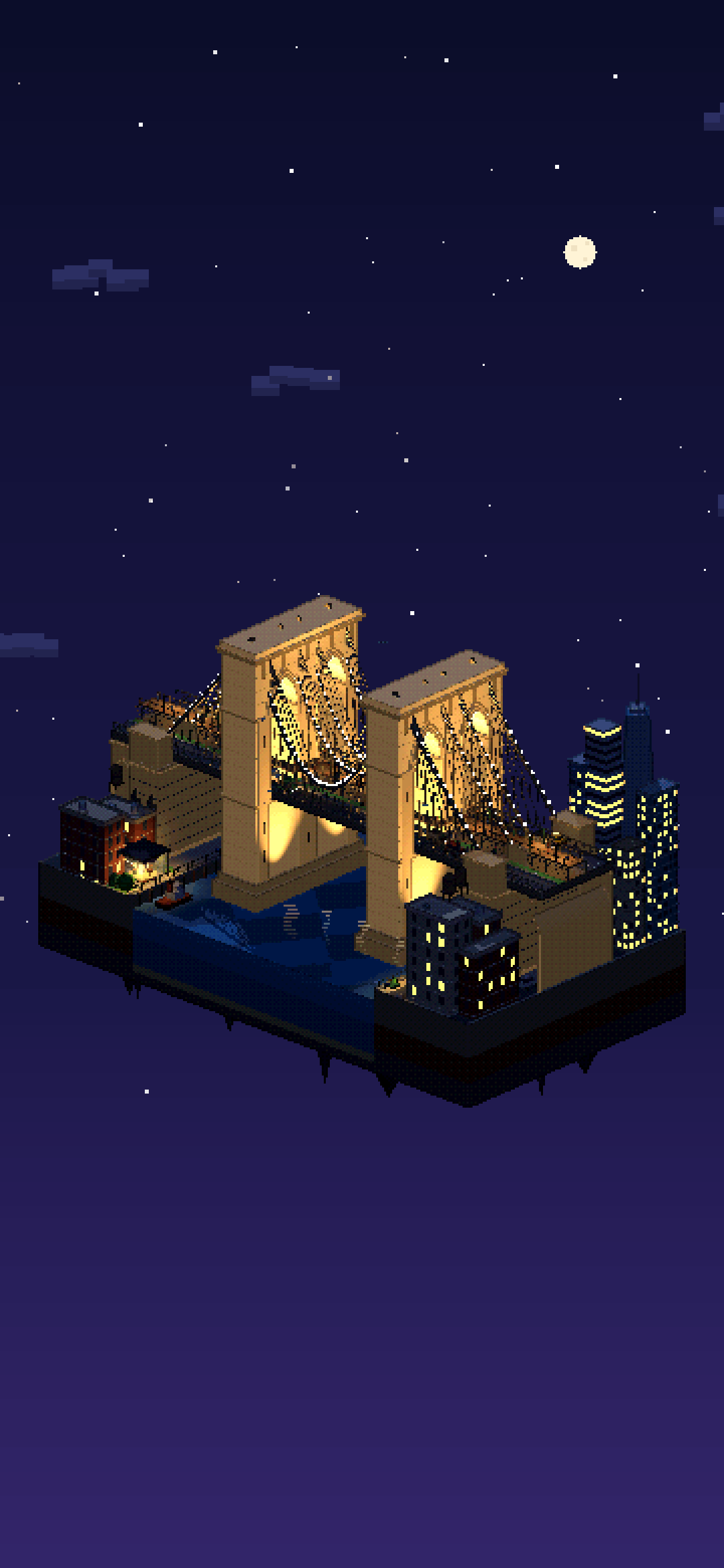
The towers are the centrepiece, at roughly one unit for 1.8 metres: stone walls with two pointed arches each, arch mouldings, pilasters, masonry coursing and a heavy cornice. Four tan cables hang between them, with vertical suspenders and diagonal stays forming the web. The deck carries two roadways with cars and yellow cabs, the green two-way bike lane with cyclists, and the raised wooden promenade, where people walk round the towers’ central piers. The spans are heavily shortened so the whole bridge fits on the island.
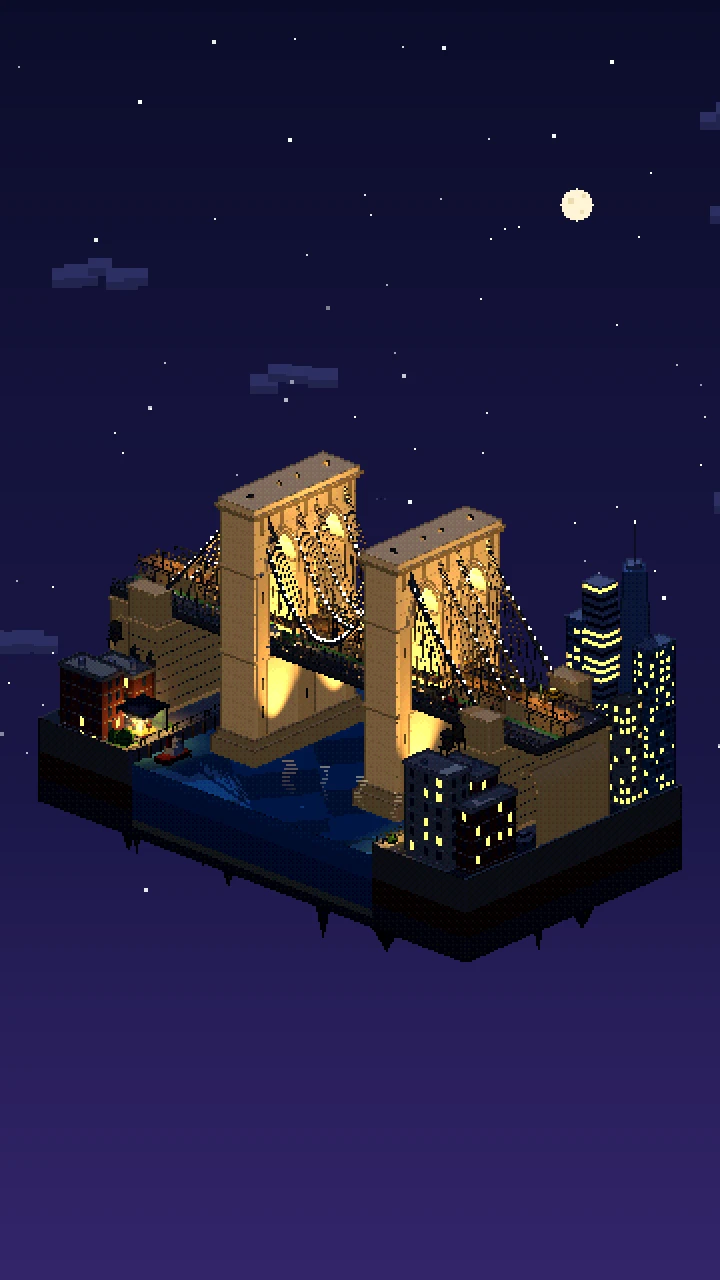
On the Brooklyn end stand DUMBO’s brick warehouses with a cobbled lane and a rooftop water tank, Jane’s Carousel turning in its glass box, and the park lawns. On the Manhattan end are the esplanade, South Street, Pier 17 and a slice of the Lower Manhattan skyline. An NYC Ferry, a checkered water taxi and a tug work the river. At night the floodlights come on, the towers glow and the necklace lights trace the cables.
Things to spot
- The necklace lights along the cables at night
- Yellow cabs on both roadways
- Cyclists in the green bike lane
- Jane’s Carousel turning in its glass box
- Rooftop water tanks in DUMBO and Manhattan
- A checkered water taxi and an NYC Ferry on the East River
What we simplified
- The main span and side spans are much shorter than in reality, and the towers are kept tall so the bridge fits the island.
- The Lower Manhattan skyline is reduced to a few simplified towers, kept far lower than the real ones, and the Manhattan Bridge and FDR Drive are left out.
- The deck has fewer lanes and simpler trusses than the real bridge.
Questions
How long is the Brooklyn Bridge?
Its main span between the two towers is about 486 metres (1,595.5 feet). When it opened in 1883 it was the longest suspension bridge in the world, until the Williamsburg Bridge took the title in 1903.
When did the Brooklyn Bridge open?
The bridge opened on 24 May 1883, after construction that began in 1870. It links Manhattan and Brooklyn across the East River.
Who built the Brooklyn Bridge?
John A. Roebling designed it but died in 1869. His son Washington Roebling completed it as chief engineer, and his wife Emily Warren Roebling played a key part in carrying the work through.
Can you walk or cycle across the Brooklyn Bridge?
Yes. Pedestrians use the elevated wooden promenade in the middle of the bridge. Since September 2021, cyclists have had a two-way protected bike lane on the Manhattan-bound roadway.
How was this pixel-art diorama of the Brooklyn Bridge made?
It is a real-time Three.js scene running on this page, drawn at 360 × 640 pixels with outlines and a small palette, then scaled up without smoothing. Press “Explore in 3D”, drag to turn it, and switch between day, dusk and night.
Isometric maps of New York
New York also has 3 isometric pixel-art maps made by the community: the whole city drawn tile by tile in the same SimCity-like style. See the maps of New York →