About Niagara Falls
Niagara Falls is the name for three waterfalls on the Niagara River, which drains Lake Erie into Lake Ontario along the border between Ontario and New York State. The largest is the Horseshoe Falls, a curved wall of water between Table Rock on the Canadian side and Terrapin Point on Goat Island in the United States. Goat Island splits the river, and the smaller American Falls and Bridal Veil Falls lie on the other side of it.
The Horseshoe Falls drops about 57 metres, and its curved crest is roughly 670 metres long. About 90 percent of the river goes over it; the rest falls over the American Falls, which lands on a heap of fallen rock rather than in deep water. Under a 1950 treaty between Canada and the United States, a large share of the river is diverted to hydroelectric plants, but a minimum flow must be left over the falls, higher in the daytime during the tourist season than at night.
The falls are young in geological terms. They formed at the end of the last ice age, roughly 12,000 years ago, when meltwater from early Lake Erie found its way over the Niagara Escarpment. A hard cap of Lockport dolostone sits over softer shale and sandstone; the soft rock wears away underneath, the cap breaks off, and the falls creep upstream. Over the millennia they have cut back about 11 kilometres, leaving the Niagara Gorge behind them.
Boats have taken visitors to the foot of the falls for well over a century. The Maid of the Mist, whose name goes back to a ferry launched in 1846, sails from the American side with passengers in blue ponchos, while Niagara City Cruises sails from the Canadian side in red ones. The falls have been lit every night since the Niagara Falls Illumination Board was set up in 1925; LED lights replaced the old xenon lamps in 2016 and can wash the water in changing colours.
The diorama
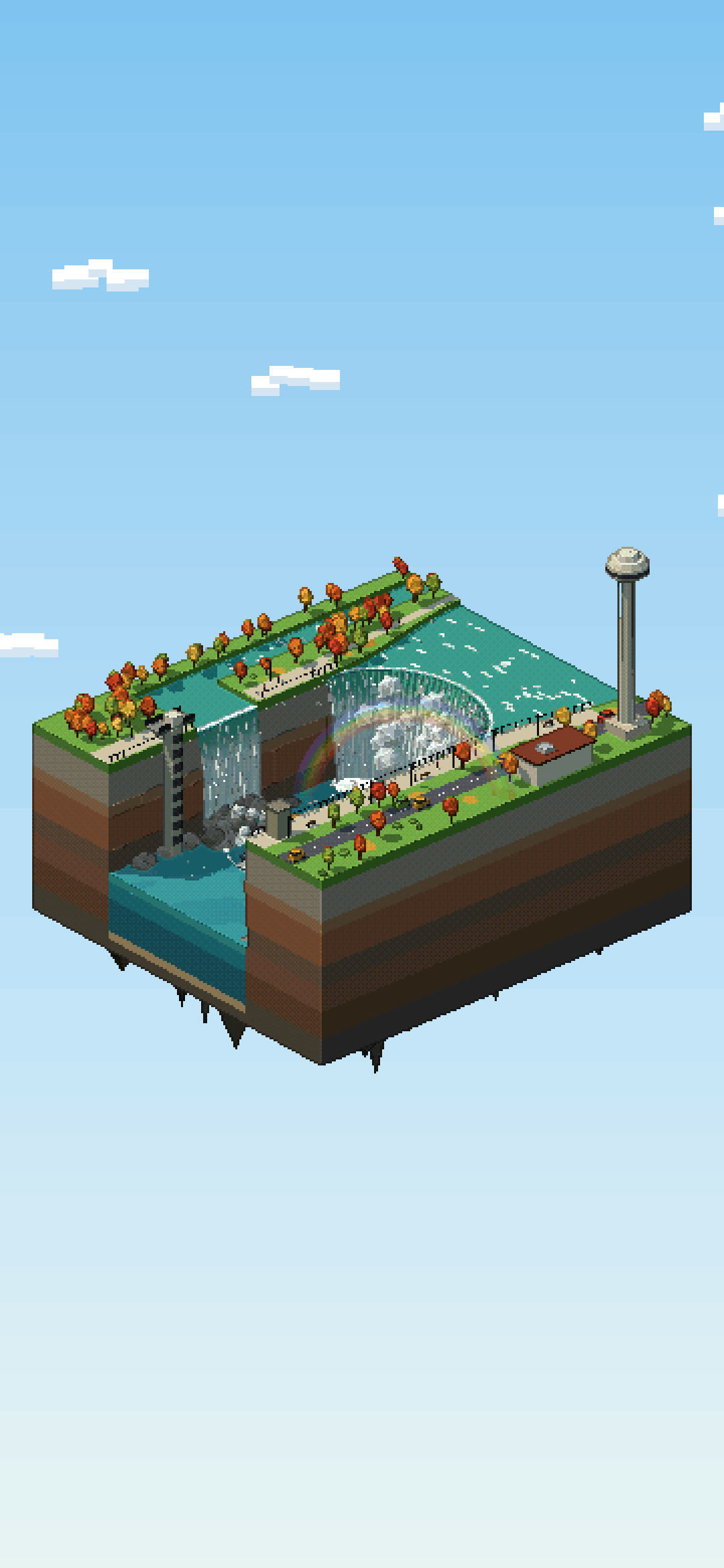
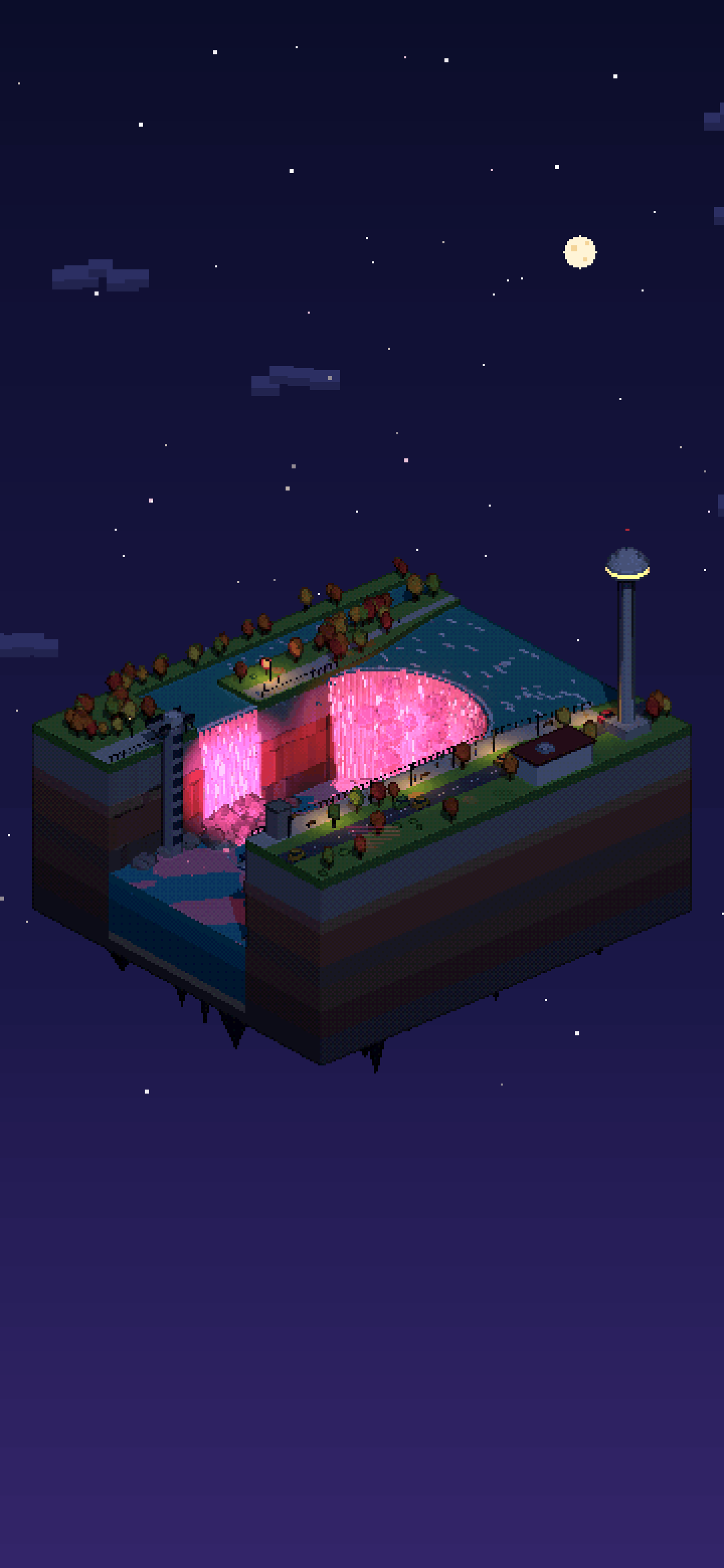
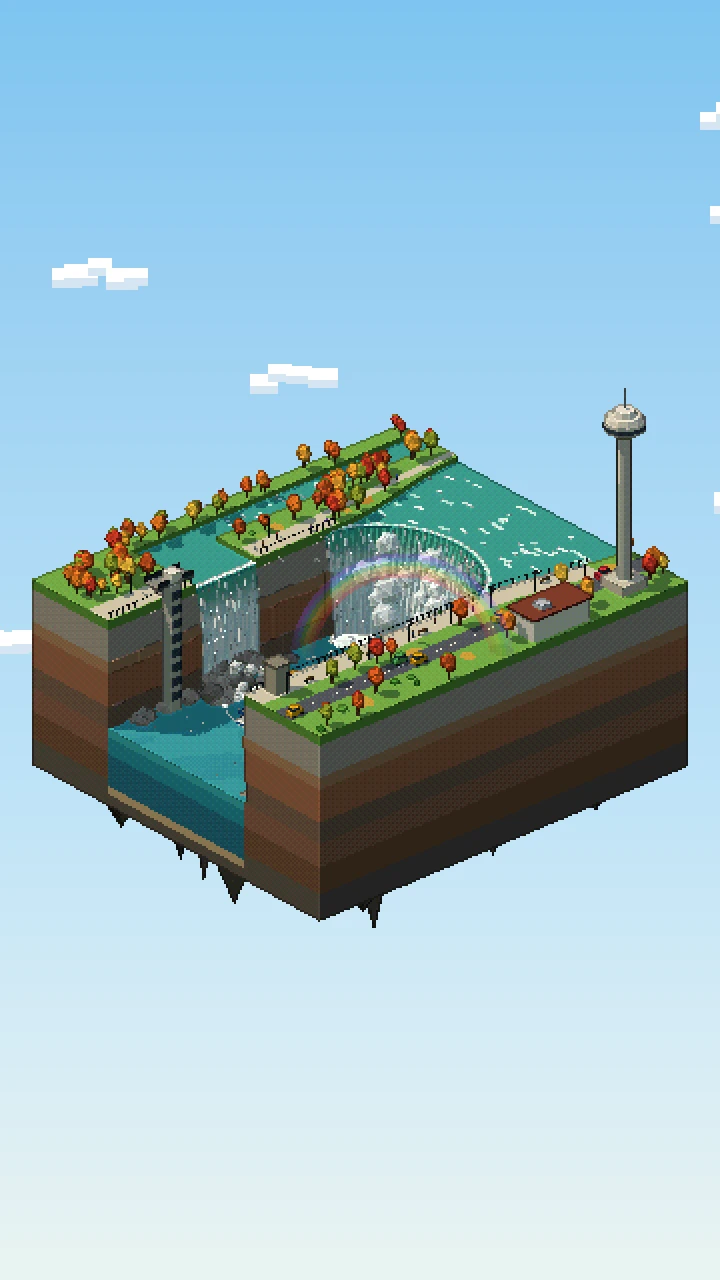
The diorama is a slice of the Niagara Gorge. The upper river runs over rapids to the curved green brink of the Horseshoe Falls, and the water pours down in moving white streaks into a turquoise pool where foam churns and mist rises out of the horseshoe. On the left, across Goat Island, a smaller channel tips over the gorge wall as the American Falls onto a pile of fallen rock, with the Prospect Point observation tower beside it. The cut faces of the block show the grey caprock over reddish shale.
Two tour boats loop up the gorge into the mist and back, one crowded with blue ponchos and the other with red. On the Canadian side tourists line the railing of the Table Rock promenade, cars drive along the parkway and a shrunken Skylon Tower rises from autumn maples. At golden hour a rainbow stands in the mist; at night the falls glow in slowly cycling colours from the illumination tower on the rim, and fireworks burst over the gorge.
Things to spot
- Two tour boats, one with blue ponchos and one with red
- A rainbow arching over the mist in daylight and at golden hour
- The green water at the brink of the Horseshoe
- Tourists with cameras at the Table Rock railing and at Terrapin Point
- The illumination tower on the rim, aimed at the falls
- Fireworks over the gorge at the end of the night
What we simplified
- The falls are drawn several times taller relative to their width so the curtain of water reads at pixel scale, and the gorge is shortened.
- The Skylon Tower, which stands back from the falls in the town, is shrunk and moved onto the rim, and the Rainbow Bridge and the towns of Niagara Falls are left out.
- The Bridal Veil Falls and Luna Island are merged into the American Falls.
Questions
How tall is Niagara Falls?
The Horseshoe Falls, the largest of the three waterfalls, drops about 57 metres. Its curved crest is roughly 670 metres long.
Is Niagara Falls in Canada or the United States?
Both. The border runs through the Horseshoe Falls, which lies between Table Rock in Ontario and Terrapin Point on Goat Island in New York. The American Falls and Bridal Veil Falls are entirely in the United States.
How old is Niagara Falls?
The falls formed at the end of the last ice age, roughly 12,000 years ago. Since then erosion has moved them about 11 kilometres upstream, carving out the Niagara Gorge.
Why is Niagara Falls lit up in colours at night?
The Niagara Falls Illumination Board has lit the falls every night since 1925. Since 2016 it has used LED lights, which can wash the water in changing colours.
Can I turn the Niagara Falls diorama around?
Yes. It is a real-time Three.js scene running on this page, drawn at 360 × 640 pixels with dark outlines and a small palette, then scaled up without smoothing. Press “Explore in 3D” to drag it round and switch between day, dusk and night.