About Statue of Liberty
The Statue of Liberty, officially Liberty Enlightening the World, was a gift from the people of France to the United States. The French sculptor Frédéric Auguste Bartholdi designed the robed figure holding a torch above her head and a tablet inscribed with the date of the Declaration of Independence, July 4, 1776, in Roman numerals. A broken chain lies at her feet. She was dedicated on Bedloe’s Island in New York Harbor on 28 October 1886.
Inside the thin copper skin is an iron skeleton designed by Gustave Eiffel’s company, a few years before the Eiffel Tower. The statue was built in Paris, taken apart and shipped across the Atlantic in hundreds of crates, then reassembled on a granite pedestal designed by the architect Richard Morris Hunt. Much of the money for the pedestal came from small donations collected by Joseph Pulitzer’s newspaper, the New York World.
The pedestal stands inside Fort Wood, an army fort from the early 19th century with walls in the shape of an eleven-pointed star. The statue was a reddish copper colour when it went up; over the following decades the metal weathered to the pale green it is known for today. The original torch was removed in 1984, during the restoration for the statue’s centenary, replaced with a copy, and is now on display in the museum on the island.
Bedloe’s Island was renamed Liberty Island in 1956. For millions of immigrants arriving by ship at nearby Ellis Island, the statue was the first thing they saw of America. Today visitors take the ferry out to the island, walk round the fort and climb the pedestal, and a limited number go all the way up to the crown.
The diorama
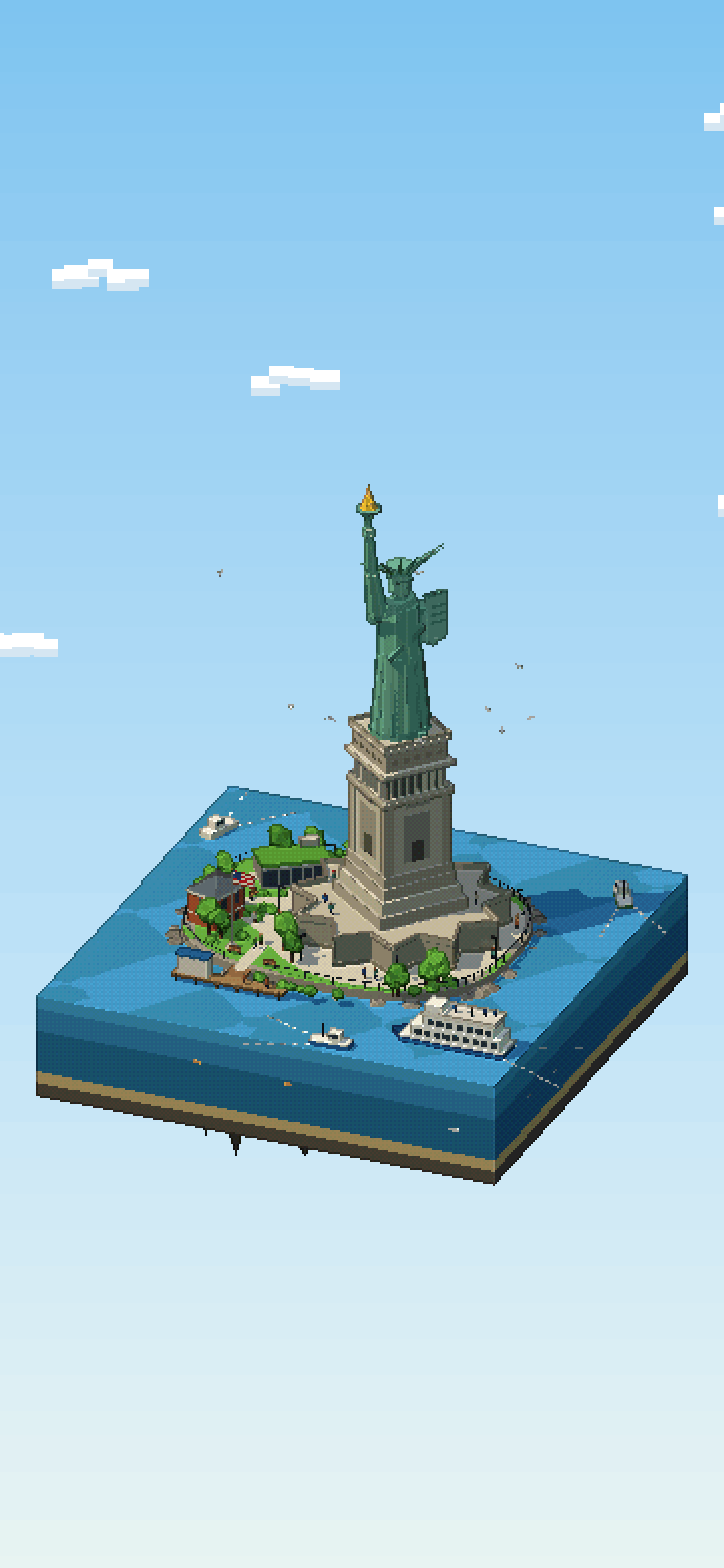
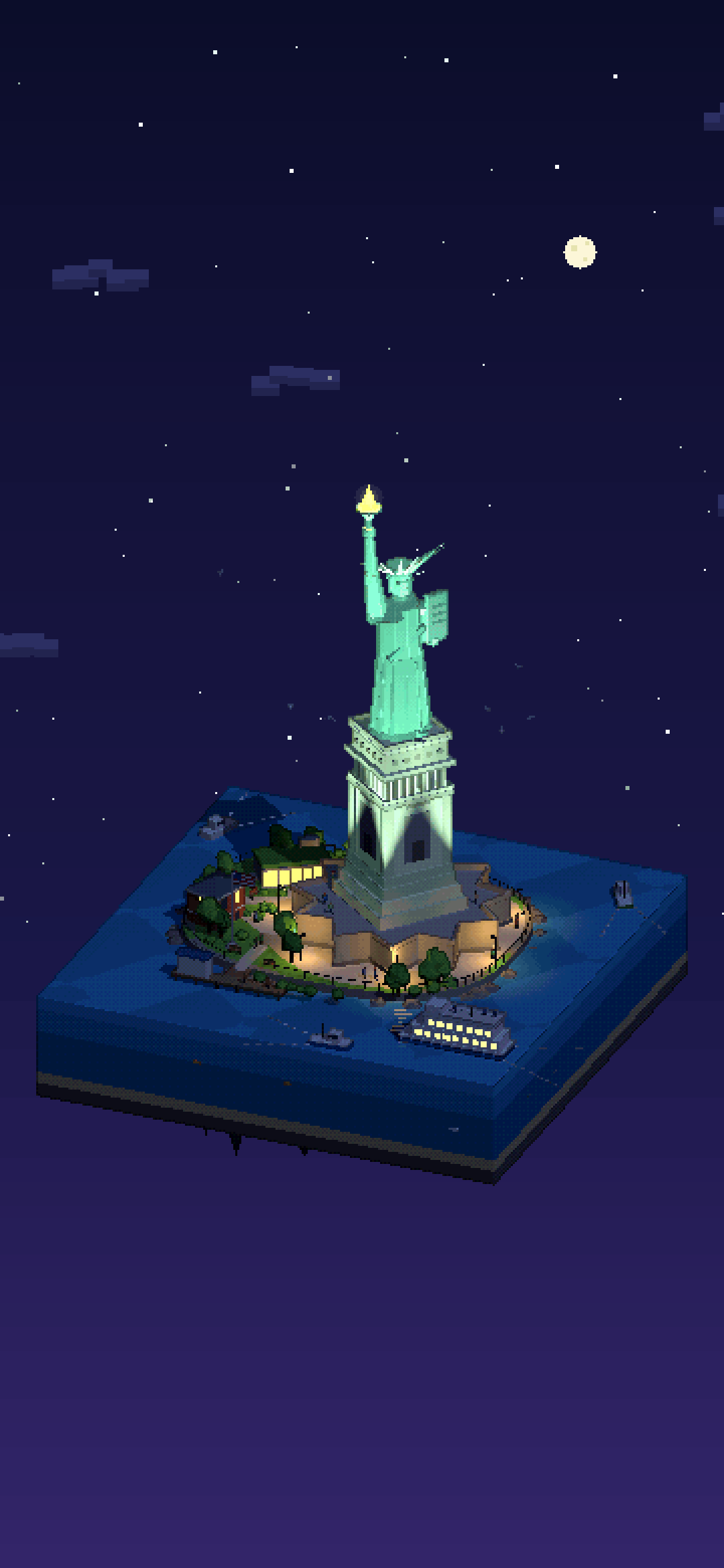
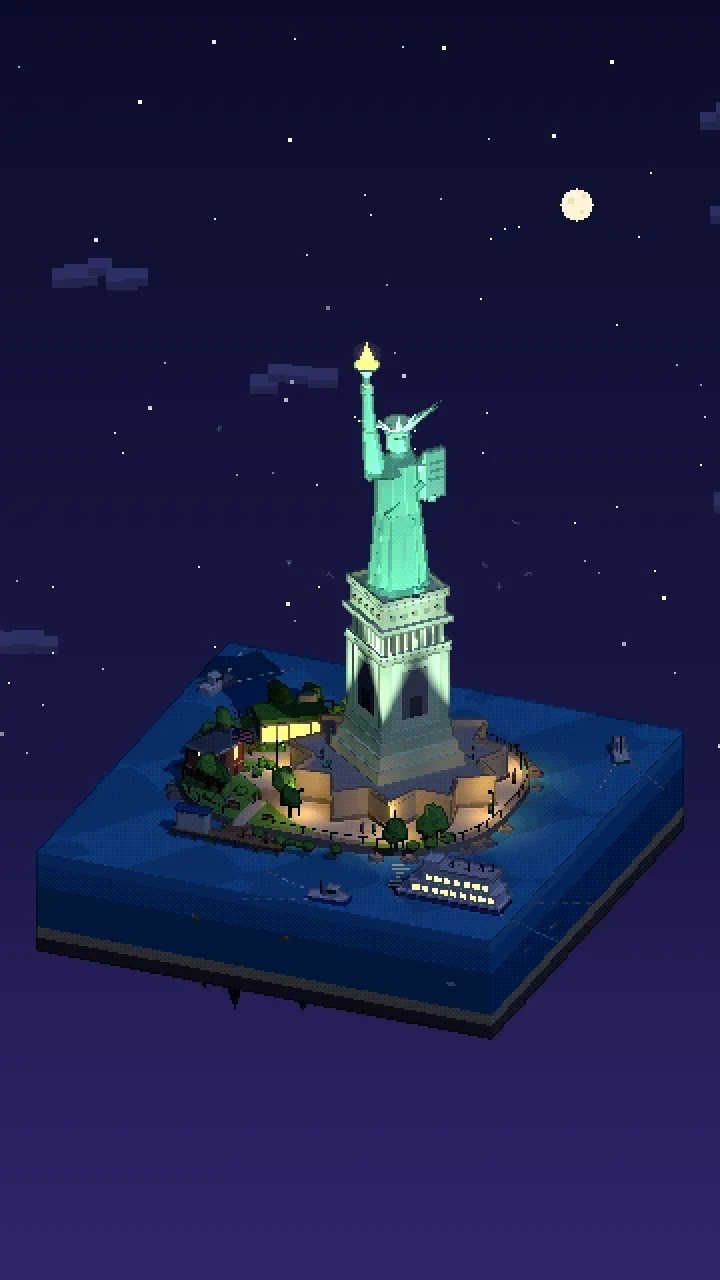
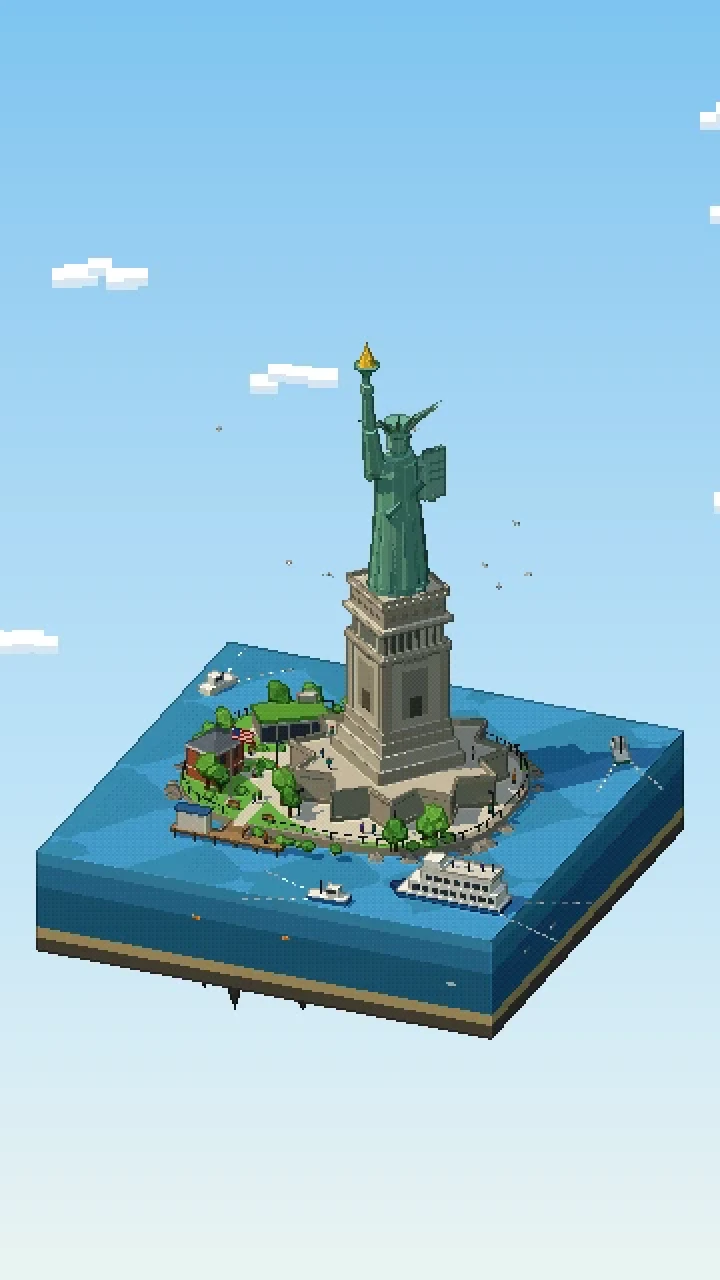
The diorama sets Liberty Island in a cut-out block of the Upper Bay, built in Three.js and rendered as pixel art with dark outlines and a small palette. The monument is stacked the way the real one is: the eleven-pointed star of Fort Wood, a stepped granite foundation, the pedestal with its corner pilasters, colonnaded balcony and row of discs below the top, and the statue itself. She is modelled in copper green with a flared, folded robe, the seven rays of the crown, the tablet held against her side and the torch raised high. The arm, the torch and the rays are slightly longer than life so they still read at pixel scale.
Around the fort runs a paved promenade with lamps, and to the west there are lawns, paths, the museum with its grass roof, an older red-brick building, a flagpole with the US flag and the ferry pier. A navy-and-white tour ferry slows down and pulls in to the pier while smaller boats circle the harbour. At night the statue is floodlit green, the torch burns gold and its light falls on the water.
Things to spot
- The tour ferry pulling in to the pier, with passengers on the top deck
- Three smaller boats looping round the harbour
- Visitors walking on top of the star-shaped fort
- The US flag waving on its pole by the pier
- Gulls circling the torch
- Fish swimming in the cut-away water
What we simplified
- Liberty Island is compressed: the museum, the pier and the lawns sit much closer to the statue than in reality, and Ellis Island and the Manhattan skyline are left out.
- The statue is simplified to a few dozen shapes; the broken chain at her feet and the lettering on the tablet are not modelled, and she turns to face the camera rather than out to sea.
Questions
How tall is the Statue of Liberty?
The Statue of Liberty is 46 m from heel to torch, and 93 m from the ground to the torch.
Who designed the Statue of Liberty?
The Statue of Liberty was designed by the French sculptor Frédéric Auguste Bartholdi. Its iron framework was designed by Gustave Eiffel’s company and its granite pedestal by the architect Richard Morris Hunt.
Why is the Statue of Liberty green?
The statue is made of copper sheets about 2.4 mm thick, which were a reddish copper colour when it went up. Over the following decades the metal weathered to the pale green patina it is known for today.
Can you go up to the crown of the Statue of Liberty?
Yes, a limited number of visitors go all the way up to the crown. Visitors take the ferry to Liberty Island, walk round the fort and climb the pedestal.
How was this pixel-art diorama of the Statue of Liberty made?
It is a real-time Three.js scene on this page, drawn at 360 × 640 pixels with outlines and a small palette and scaled up without smoothing. The arm, the torch and the crown’s rays are slightly longer than life so they still read at pixel scale. Press “Explore in 3D”, drag to turn it, and switch between day, dusk and night.
Isometric maps of New York
New York also has 3 isometric pixel-art maps made by the community: the whole city drawn tile by tile in the same SimCity-like style. See the maps of New York →