About Chichen Itza
Chichen Itza was one of the great cities of the Maya world, in the north of the Yucatán Peninsula in Mexico. It grew into a regional capital from about AD 800 to 1100, and its buildings mix Maya styles with features from central Mexico. The name is usually translated as “at the mouth of the well of the Itzá”, after the natural wells, or cenotes, that gave the city its water in a land with no rivers.
Its centre is El Castillo, the Temple of Kukulcán, the feathered serpent god. Nine square terraces rise on a base 55.3 m wide, with a stairway up each side to a temple on the summit, about 30 m above the plaza. Each stairway has about 91 steps, and with the top platform they add up to 365, the days of the year. The pyramid is built over an older one, and in the 1930s excavators found a temple inside it with a Chac Mool statue.
Around the great plaza stand the Temple of the Warriors, fronted by rows of carved stone columns, and the Great Ball Court, one of the largest in Mesoamerica at 168 m long with stone rings set high in its walls. A raised white road, a sacbe, leads north to the Sacred Cenote, a sinkhole about 60 m across. Gold, jade, pottery and human bones have been recovered from its water.
Today Chichen Itza is one of the most visited sites in Mexico. Climbing El Castillo has been banned since around 2006, but visitors walk the plaza among vendors selling textiles and carvings. At the spring and autumn equinoxes, the late afternoon sun casts a row of light and shadow triangles down the north stairway, like a serpent sliding towards the stone head at its foot.
The diorama
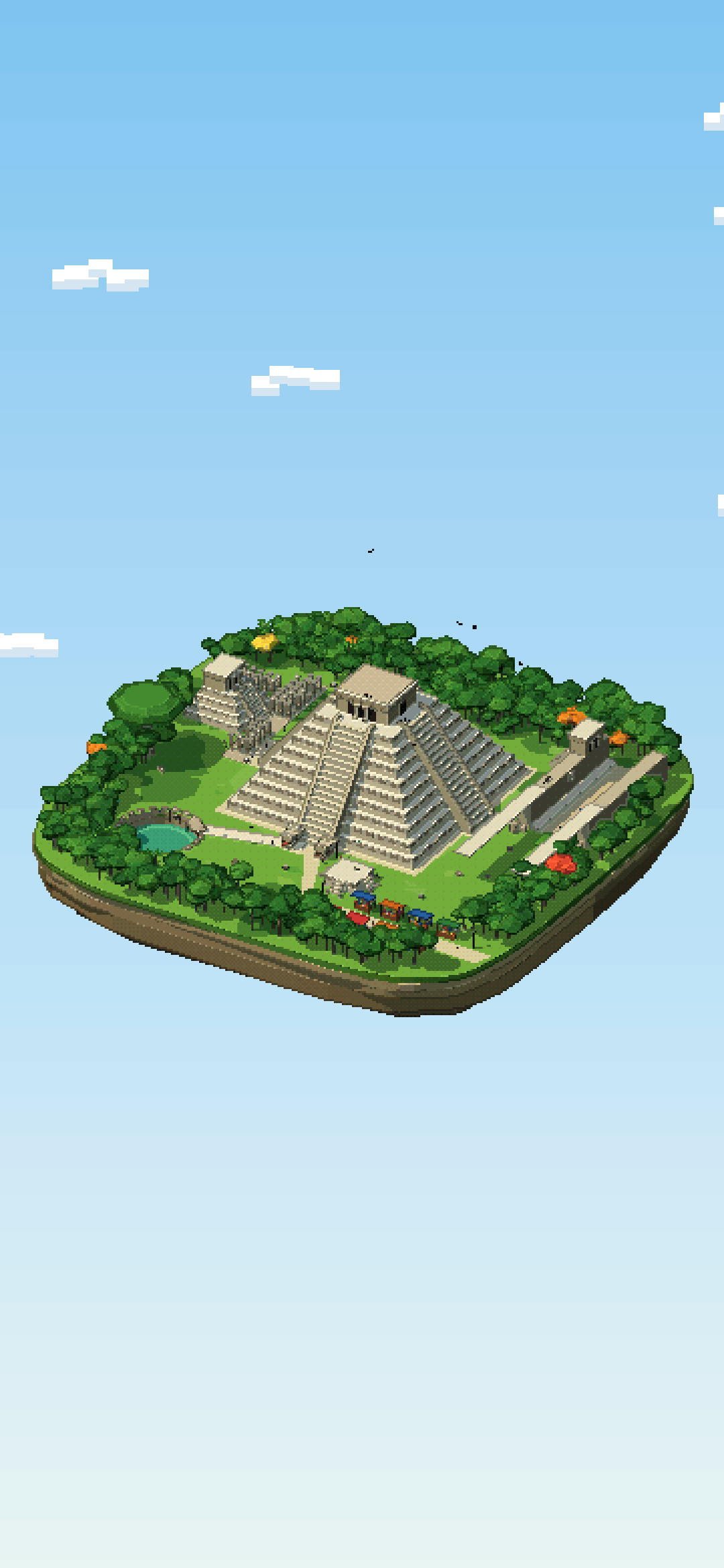
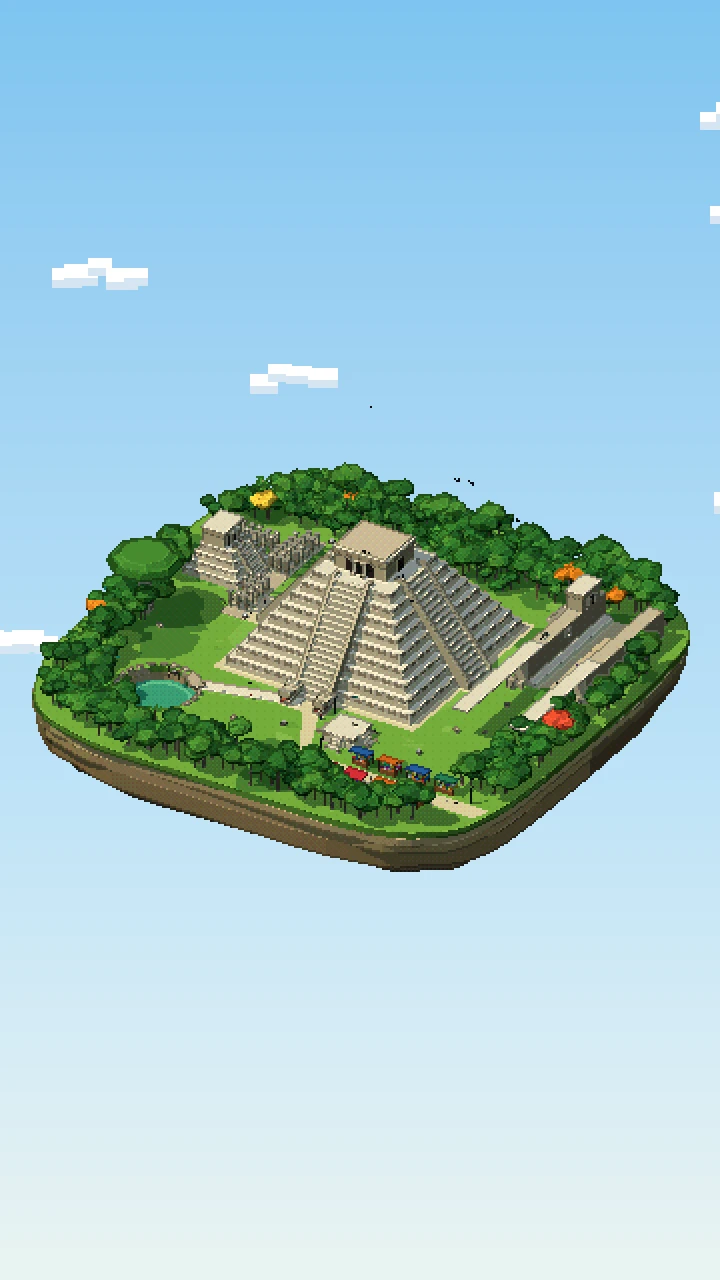
The diorama puts the great plaza on a floating island ringed by dense, low Yucatán forest, built in Three.js and rendered as pixel art with dark outlines and a small palette. El Castillo keeps its real base and its nine terraces, each with a sloping foot and a band of recessed panels, with four stairways, balustrades, the temple on top and two feathered-serpent heads at the foot of the north stairway. The terraces are drawn a little taller so the steps read.
Around it stand the Temple of the Warriors with its rows of square columns and a Chac Mool, a stretch of the Great Ball Court with a stone ring and the Temple of the Jaguars, the Platform of Venus, and the Sacred Cenote with green water at the end of a white sacbe. At golden hour, triangles of light run down the north balustrade to the glowing serpent head. At night, floodlights wash the pyramid in changing colours for the light-and-sound show.
Things to spot
- The serpent of light sliding down the north stairway at golden hour
- Iguanas basking on the stones and the Platform of Venus
- Vendors’ stalls with striped blankets and hammocks along the entrance path
- The stone ring high in the ball court wall
- A Chac Mool waiting at the top of the Temple of the Warriors
- A tall ceiba tree standing above the forest
What we simplified
- The buildings stand much closer together than on the real site, and the ball court and the cenote are drawn much smaller than they are.
- The stairways have 18 drawn steps instead of 91, and the equinox serpent shows up every evening instead of only around the equinoxes.
Questions
How tall is El Castillo at Chichen Itza?
El Castillo is about 30 m tall: 24 m to the top platform and a 6 m temple on top. Its square base is 55.3 m wide, and it rises in nine terraces.
Why does El Castillo have 365 steps?
Each of its four stairways has about 91 steps. Together with the top platform, that makes 365, the number of days in a year, and the pyramid is often read as a stone calendar.
What happens at Chichen Itza on the equinox?
In the late afternoon around the spring and autumn equinoxes, the sun casts a row of triangles of light and shadow on the north stairway’s balustrade. It looks like a feathered serpent crawling down towards the stone head at the bottom. It is not known whether the builders designed it on purpose.
Can you climb the pyramid at Chichen Itza?
No. Climbing El Castillo has been banned since around 2006, but you can walk all the way round it and the other buildings on the plaza.
How was this pixel-art diorama of Chichen Itza made?
It is a real-time Three.js scene on this page, drawn at 360 × 640 pixels with outlines and a small palette and scaled up without smoothing. El Castillo keeps its real base and nine terraces, but the other buildings stand much closer to it than on the real site. Press “Explore in 3D”, drag to turn it, and switch between day, dusk and night.