About Atomium
The Atomium was built for Expo 58, the Brussels World’s Fair that opened on 17 April 1958 on the Heysel plateau in the north of the city. Engineer André Waterkeyn came up with the idea, and the architects André and Jean Polak worked it out. It was meant as a symbol of the atomic age and of faith in science, and it was only supposed to stand for the six months of the fair.
The shape is a model of iron: nine atoms in the body-centred cubic unit cell of an iron crystal, magnified 165 billion times. The cube stands on one corner, so its long diagonal is vertical. Eight spheres sit at the corners and one in the centre, each 18 metres across, joined by tubes 3 metres wide that run along the twelve edges of the cube and from the centre to every corner.
Wind-tunnel tests showed that the structure could topple in a strong wind, so the three lower outer spheres were given supports. The vertical tube holds a lift that was the fastest in Europe when it opened, climbing at 5 metres per second to the top sphere in about 23 seconds. Six of the nine spheres are open to visitors; the top one has a restaurant with a panoramic view over Brussels.
After almost fifty years the Atomium was in poor shape. A renovation from 2004 to 2006 replaced the faded aluminium skin with stainless steel and added LED lights along the meridians of each sphere, which can flash in turn like electrons circling a nucleus. It reopened in February 2006 and now draws over 600,000 visitors a year, with the Mini-Europe miniature park at its feet.
The diorama
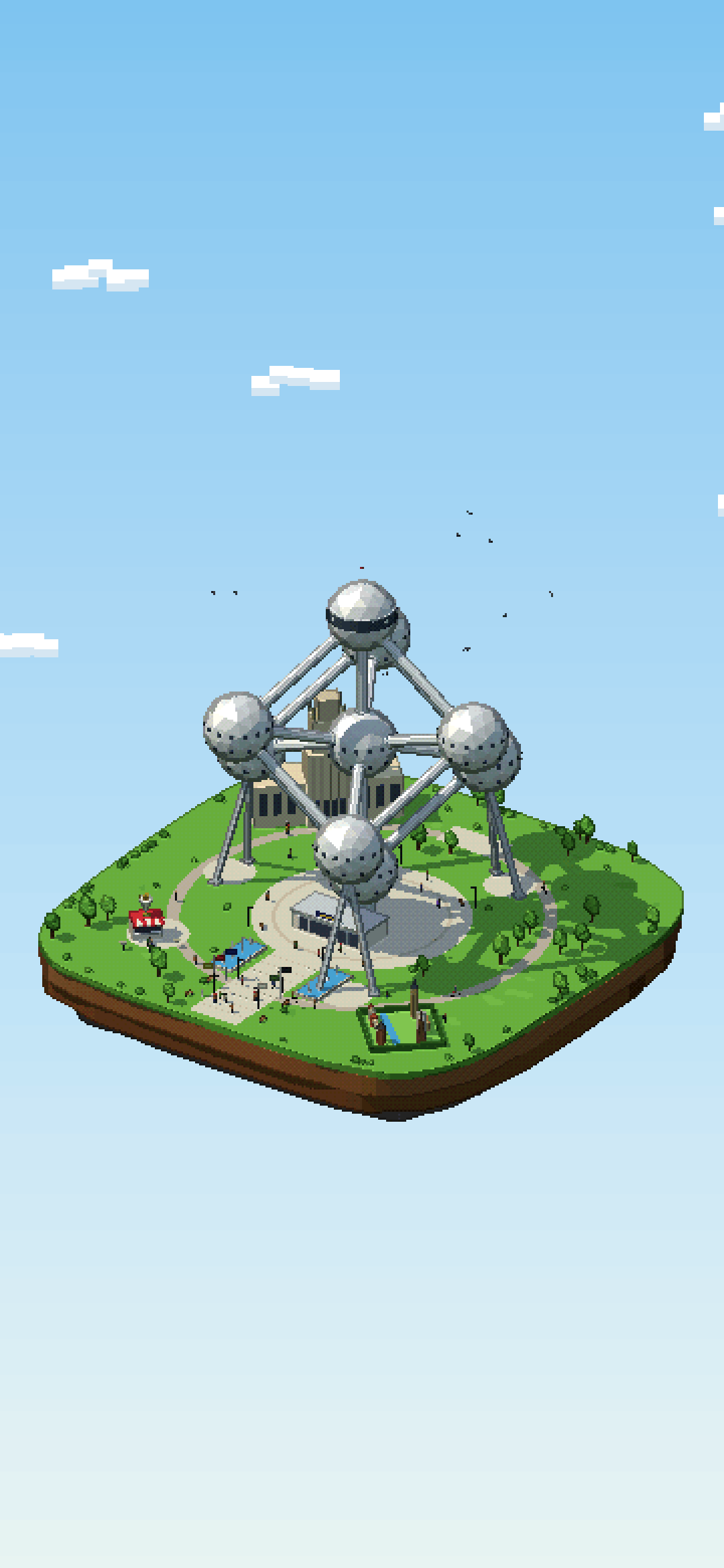
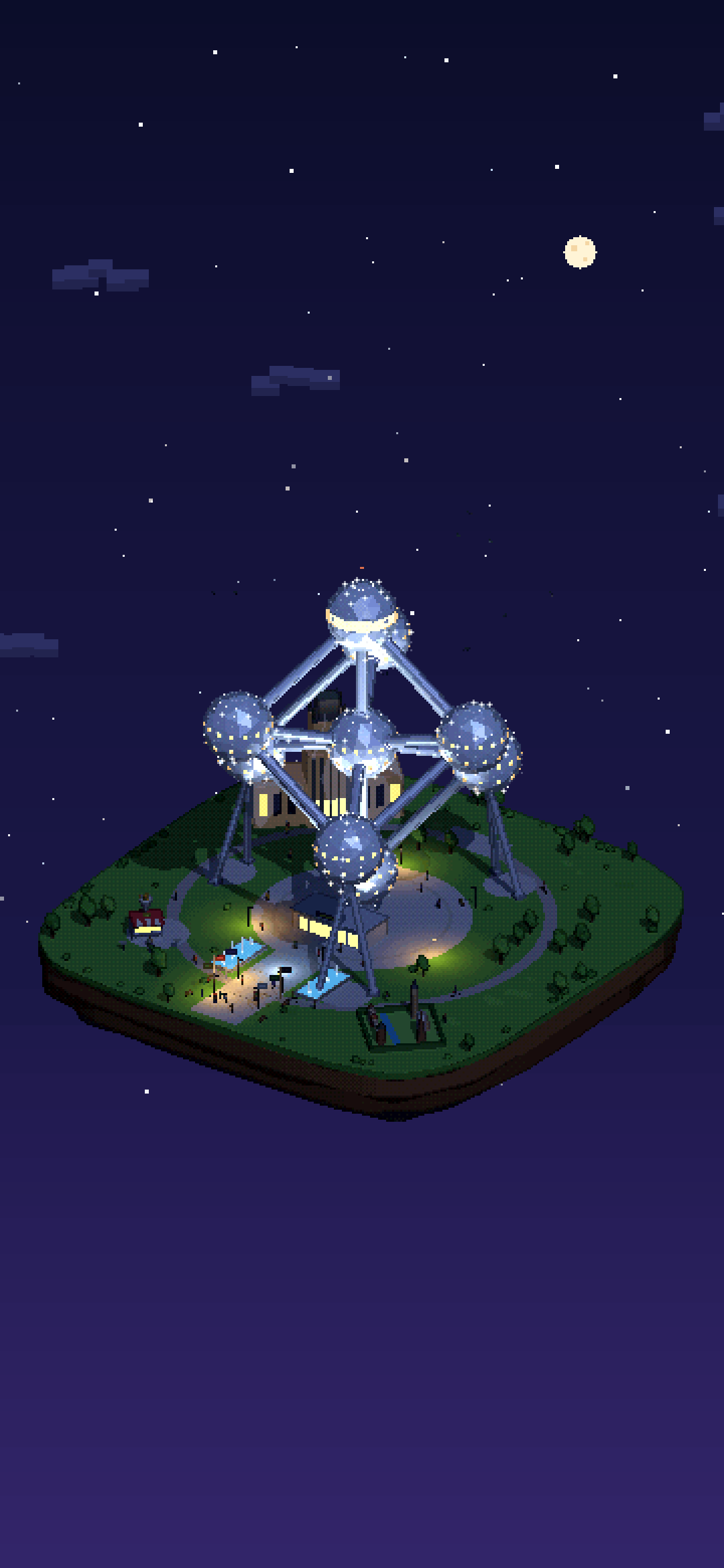
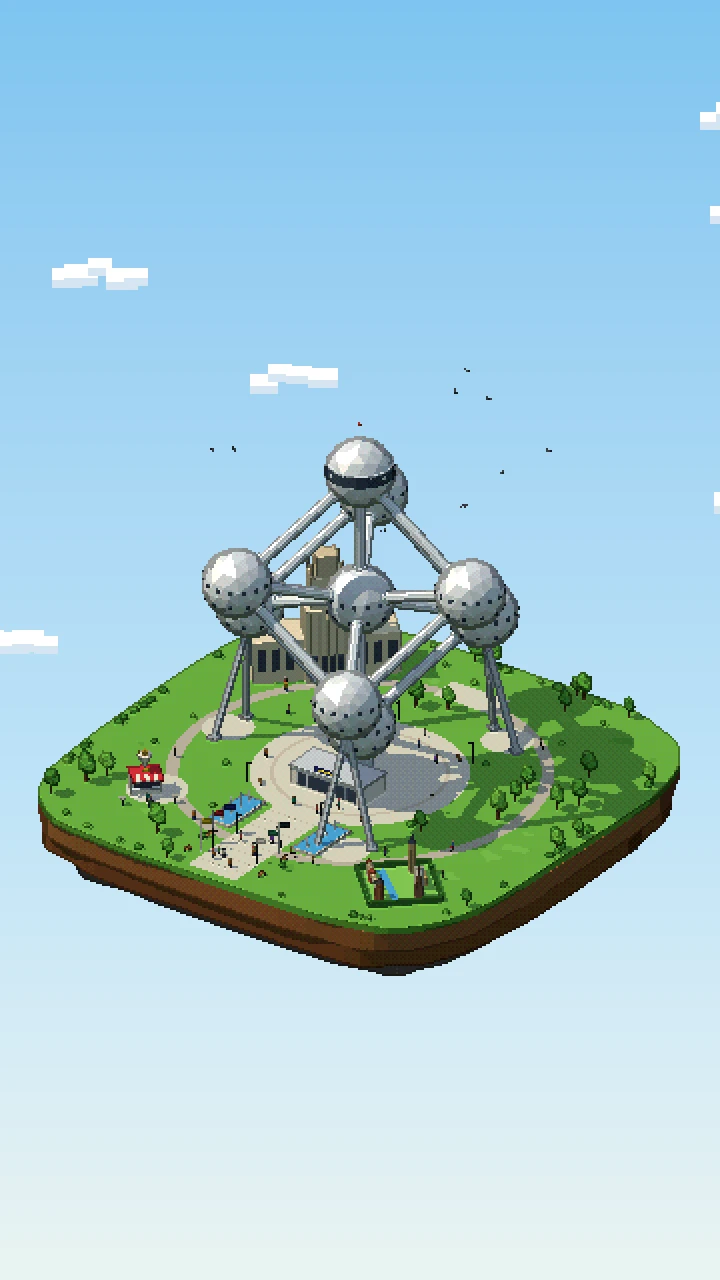
The diorama puts the Atomium on a floating island of the Heysel park, built in Three.js and rendered as pixel art: the scene is drawn at a low resolution, every edge gets a dark outline, the colours are reduced to a small palette, and the result is scaled up without smoothing. The nine spheres are faceted balls of polished steel that catch the sun, placed exactly as a cube standing on its corner, with tubes along the twelve edges and from the centre to each corner, bipods under the three lower spheres, rows of windows and a glazed panoramic band on the top sphere.
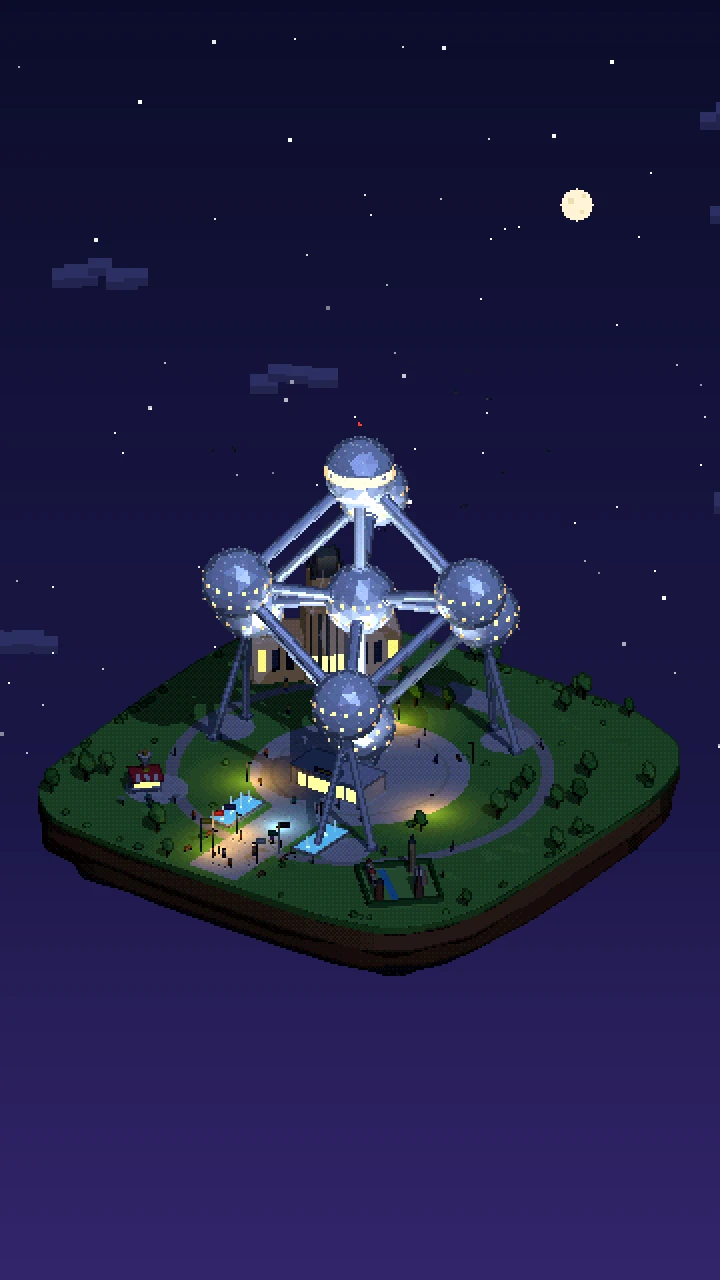
Around it lie a paved plaza with the entrance pavilion, an esplanade with flags and two fountain basins, an Art Deco exhibition hall with a stepped tower, a corner of Mini-Europe with a turning windmill and a frites stand with a queue. Tourists stroll, cyclists ride round the park and pigeons circle the top. At night the windows glow, the fountains light up blue and points of light chase up the meridians of every sphere.
Things to spot
- A frites stand with a giant cone of fries on its roof
- The tiny Big Ben, Leaning Tower and Eiffel Tower in Mini-Europe
- The windmill sails turning in Mini-Europe
- Cyclists riding round the park
- The red light on the mast above the top sphere
- Waves of light running up the spheres at night
What we simplified
- The surroundings are compressed: the exhibition halls, Mini-Europe and the fountains are much closer to the Atomium than in reality, and the park is drawn smaller.
- The spheres and tubes are drawn a little thicker than their real size so they read at pixel scale, and the bipods are simplified to two straight legs each.
- The night lights are drawn as a stylised pattern, not the real LED sequence.
Questions
What does the Atomium represent?
The Atomium is a model of the unit cell of an iron crystal, magnified 165 billion times. Its nine spheres are iron atoms in a body-centred cubic arrangement: eight at the corners of a cube standing on one corner, and one in the centre.
How tall is the Atomium?
The Atomium is 102 metres tall. Each of its nine spheres is 18 metres across, and the tubes that link them are 3 metres wide.
Why was the Atomium built?
It was built as the centrepiece of Expo 58, the Brussels World’s Fair, which opened on 17 April 1958. Designed by engineer André Waterkeyn with architects André and Jean Polak, it celebrated science and the atomic age, and was only meant to stand for six months.
Can you go inside the Atomium?
Yes. Six of the nine spheres are open to visitors, linked by escalators and stairs in the tubes. A lift in the vertical tube goes up to the top sphere, which has a restaurant and a panoramic view over Brussels.
How was this pixel-art diorama of the Atomium made?
It is a real-time Three.js scene running on this page, drawn at 360 × 640 pixels with dark outlines and a small palette, then scaled up without smoothing. The nine spheres sit exactly as a cube standing on its corner, with all twenty tubes and the three bipods. Press “Explore in 3D” to drag it round and switch between day, dusk and night.
Isometric maps of Brussels
Brussels also has an isometric pixel-art map made by the community: the whole city drawn tile by tile in the same SimCity-like style. See the map of Brussels →