About St. Stephen’s Cathedral
St. Stephen’s Cathedral stands in the middle of Vienna, on Stephansplatz. A first Romanesque church was dedicated to St. Stephen here in 1147. Its oldest surviving parts are on the west front: the Giant’s Door, the main entrance, and the two Heathen Towers beside it, about 65 m tall. In 1359 Duke Rudolf IV laid the cornerstone for a much larger Gothic church, and over the next century and a half the old building was replaced around and inside the new one.
The south tower, which the Viennese call the Steffl, took 65 years to build, from 1368 to 1433. At 136 m it is the cathedral’s highest point, and it rises in stepped stages into an openwork spire. Visitors climb 343 steps to the old watchmen’s room. A second, north tower was begun in 1450, but work stopped in 1511 at 68 m; in 1578 the stump was given a Renaissance cap. It now holds the Pummerin, a bell of about 20 tonnes cast in 1951.
The roof is the cathedral’s other signature. It is 111 m long and very steep, and its roughly 230,000 glazed tiles are laid in bold zigzag chevrons. On the south side of the choir roof the tiles form a double-headed eagle, dated 1831; on the north side they show the coats of arms of Vienna and of the Republic of Austria. St. Stephen’s became the seat of a bishop in 1469 and of an archbishop in 1722.
On 12 April 1945, in the last days of the Second World War, fire spread from burning shops nearby to the cathedral and the roof collapsed. Rebuilding was shared out among Austria’s provinces, and the cathedral fully reopened on 23 April 1952. Mozart was married here in 1782 and his funeral was held here in 1791. Since 2001 it has been part of the Historic Centre of Vienna World Heritage Site.
The diorama
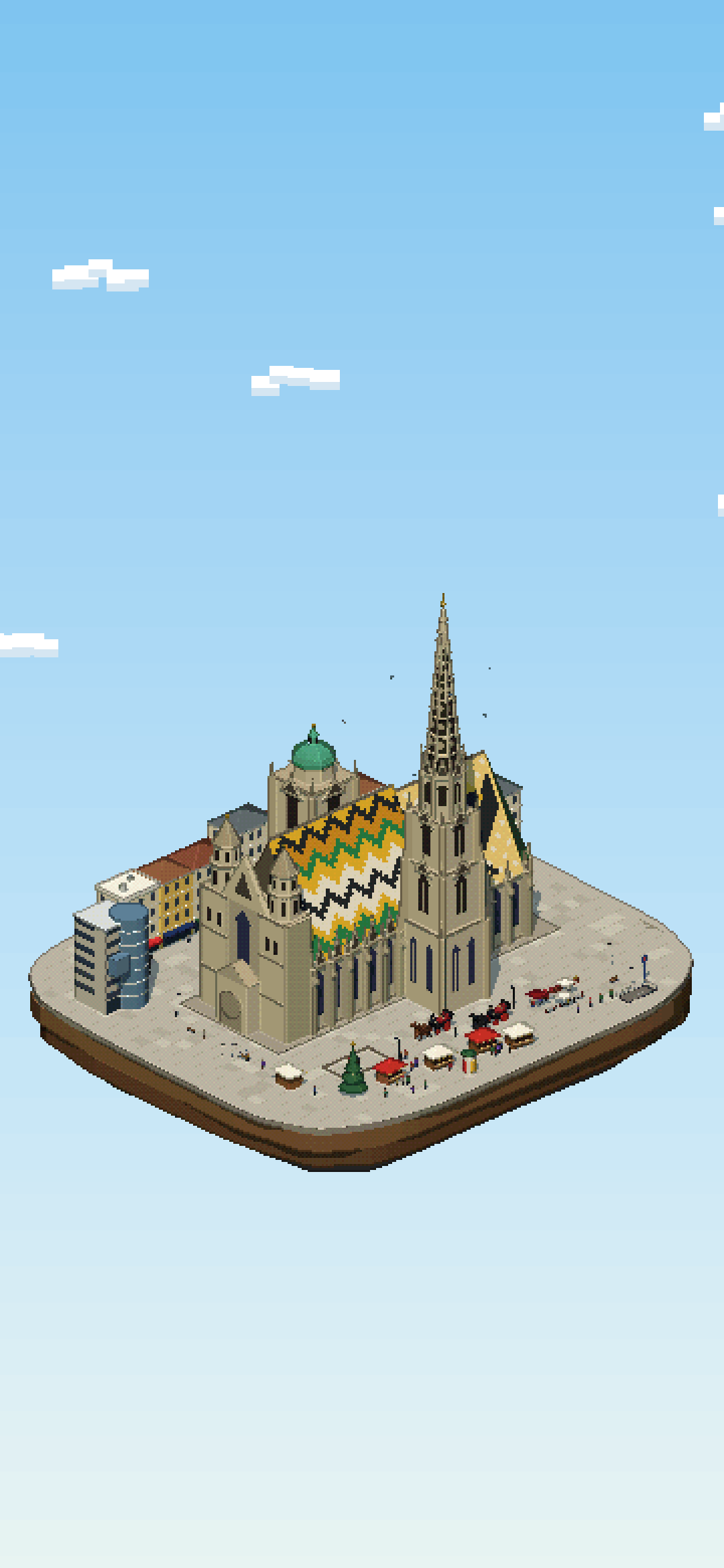
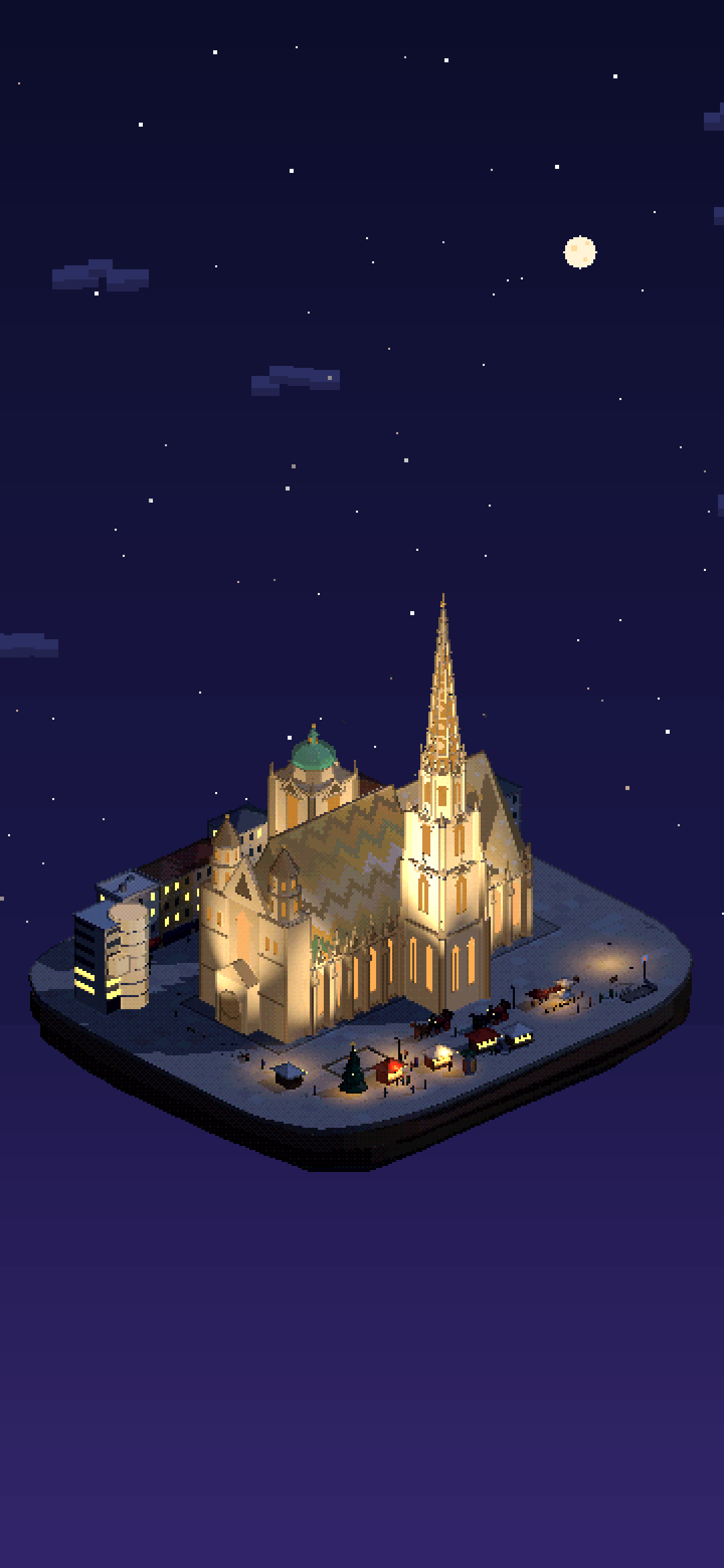
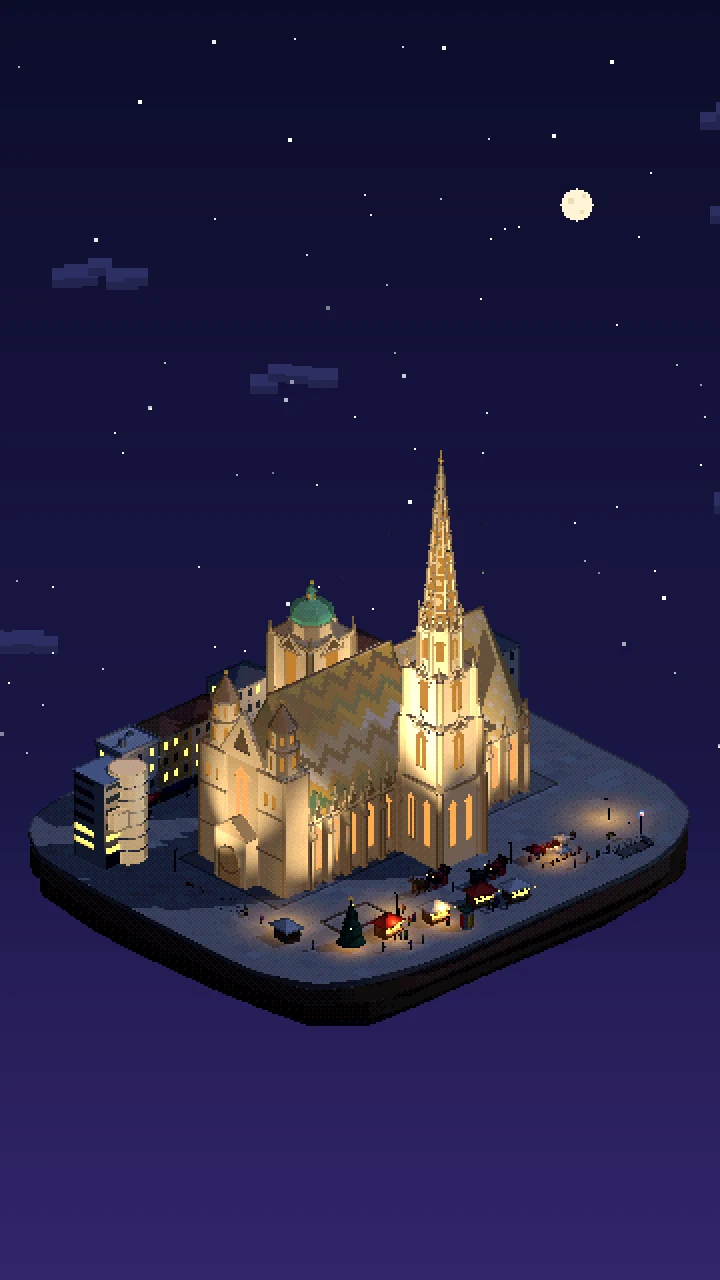
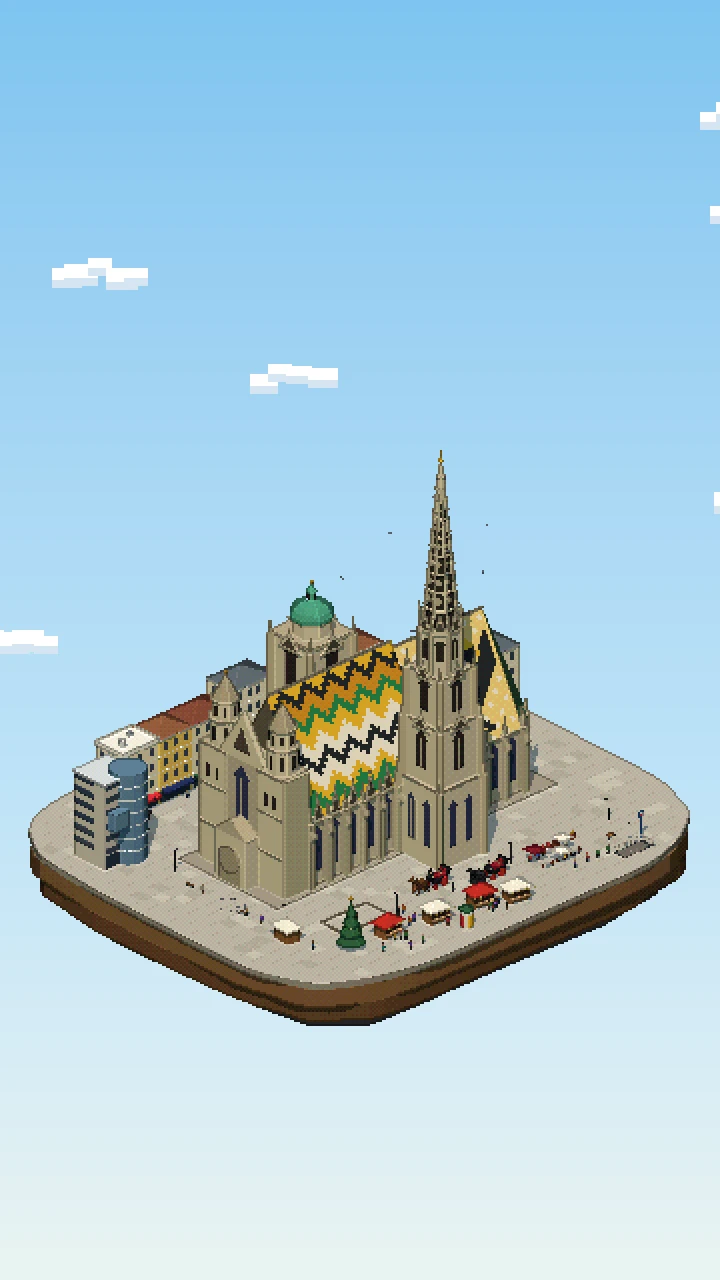
The diorama builds the cathedral along its east–west axis: the west front with the two Heathen Towers and the deep porch of the Giant’s Door, the long nave with its buttresses, pinnacles and tracery gables, and the choir with its polygonal end. The roof is laid tile by tile, with zigzag chevrons in yellow, green, black and white on the nave, the double-headed eagle on the south side of the choir and the red-and-white arms of Vienna and Austria on the north. The Steffl steps up in square stages to a crown of gables and an openwork spire; the north tower ends in its green copper cap.
Around it is a compressed Stephansplatz: pale granite paving with darker stones marking the outline of a lost chapel, the Haas-Haus with its glass corner, a row of Viennese houses with shop awnings, a café terrace, Christmas-market huts and a decorated tree, a U-Bahn entrance and an advertising column. Fiaker carriages trot round the cathedral while pigeons peck by the west door. At night floodlights turn the stone gold, the stained glass glows and the market lights come on.
Things to spot
- Three Fiaker carriages circling the cathedral, and a fourth parked by the café
- The double-headed eagle in the tiles of the choir roof
- The blue U-Bahn pole with its U sign
- A Christmas tree and market huts with strings of lights
- Pigeons pecking in front of the Giant’s Door
What we simplified
- Stephansplatz is squeezed: the houses and the Haas-Haus stand closer to the cathedral than in Vienna, and the Fiakers drive a loop round it that the real ones do not.
- The roof tiles are drawn as one coloured cell each, much larger than real tiles, so the chevrons and the eagle are simplified versions of the real patterns.
- The openwork tracery of the south tower is reduced to ribs, bands and a few stone diamonds on a dark core.
Questions
How tall is St. Stephen’s Cathedral?
The south tower, the Steffl, is 136 m tall and is the cathedral’s highest point. The unfinished north tower reaches 68 m, and the two Heathen Towers on the west front are about 65 m.
Why is the north tower of St. Stephen’s shorter?
Work on the north tower began in 1450 but stopped in 1511, leaving it at about half the height of the south tower. In 1578 it was finished off with a Renaissance cap instead of a spire.
What is on the roof of St. Stephen’s Cathedral?
About 230,000 glazed tiles laid in zigzag chevrons. On the south side of the choir roof they form a double-headed eagle dated 1831, and on the north side the coats of arms of Vienna and of the Republic of Austria.
Can you climb St. Stephen’s Cathedral?
Yes. 343 steps lead up the south tower to the old watchmen’s room, while a lift takes visitors up the north tower to the Pummerin bell and a view over the roof tiles.
How was this pixel-art diorama of St. Stephen’s made?
It is a real-time Three.js scene on this page, drawn at 360 × 640 pixels with outlines and a small palette and scaled up without smoothing. The roof is built from coloured tile cells so the chevrons and the eagle read at pixel scale. Press “Explore in 3D”, drag to turn it, and switch between day, dusk and night.
Isometric maps of Vienna
Vienna also has an isometric pixel-art map made by the community: the whole city drawn tile by tile in the same SimCity-like style. See the map of Vienna →