About Vienna Christmas Market
Vienna’s Christmas market tradition is old: city charters of 1296 already granted a market in December, and by 1600 a “Thomasmarkt” was held on the Graben. It became a crib market and, in the 19th century, the Christkindlmarkt, moving between the Freyung, Am Hof and Stephansplatz. In 1975 it settled on the Rathausplatz, the big square in front of the City Hall on the Ringstrasse, and opened there for the first time on 22 November that year. Today it is the city’s best-known Christmas market, with about a hundred stalls (96 in 2025, about a fifth of them for food and drink) selling Punsch and Glühwein, food, decorations and crafts.
Every year since 1959 a big spruce has stood in front of the City Hall, donated in turn by one of the Austrian provinces or South Tyrol. The 2026 tree comes from Damüls in the Bregenzerwald, in Vorarlberg: a spruce of more than 200 years, 31 metres tall, from a former alpine pasture at 1,350 metres. It is lit when the market opens. In the Rathauspark on either side of the square, the old trees are hung with light figures; the best known is the Herzerlbaum, a tree of about 200 glowing red hearts that is a favourite with couples. The Christmas world in the park adds a two-storey carousel about 12 metres tall, a reindeer train and a crib path.
Since the market opens in mid-November, skaters do not have to wait for January: the Eistraum am Christkindlmarkt lays about 3,000 square metres of ice as trails winding between the trees of the Rathauspark. After the market closes, the square itself turns into the much larger Wiener Eistraum, which in 2027 runs from 22 January to 7 March.
Behind it all stands the neo-Gothic City Hall, built in 1872–83 to designs by Friedrich von Schmidt. Its central tower is 98 metres high, kept just below the nearby Votivkirche, and on top stands the Rathausmann, an iron standard-bearer of 1882 that brings the total to about 103 metres. At Christmas time the building is floodlit at night behind the market.
The diorama
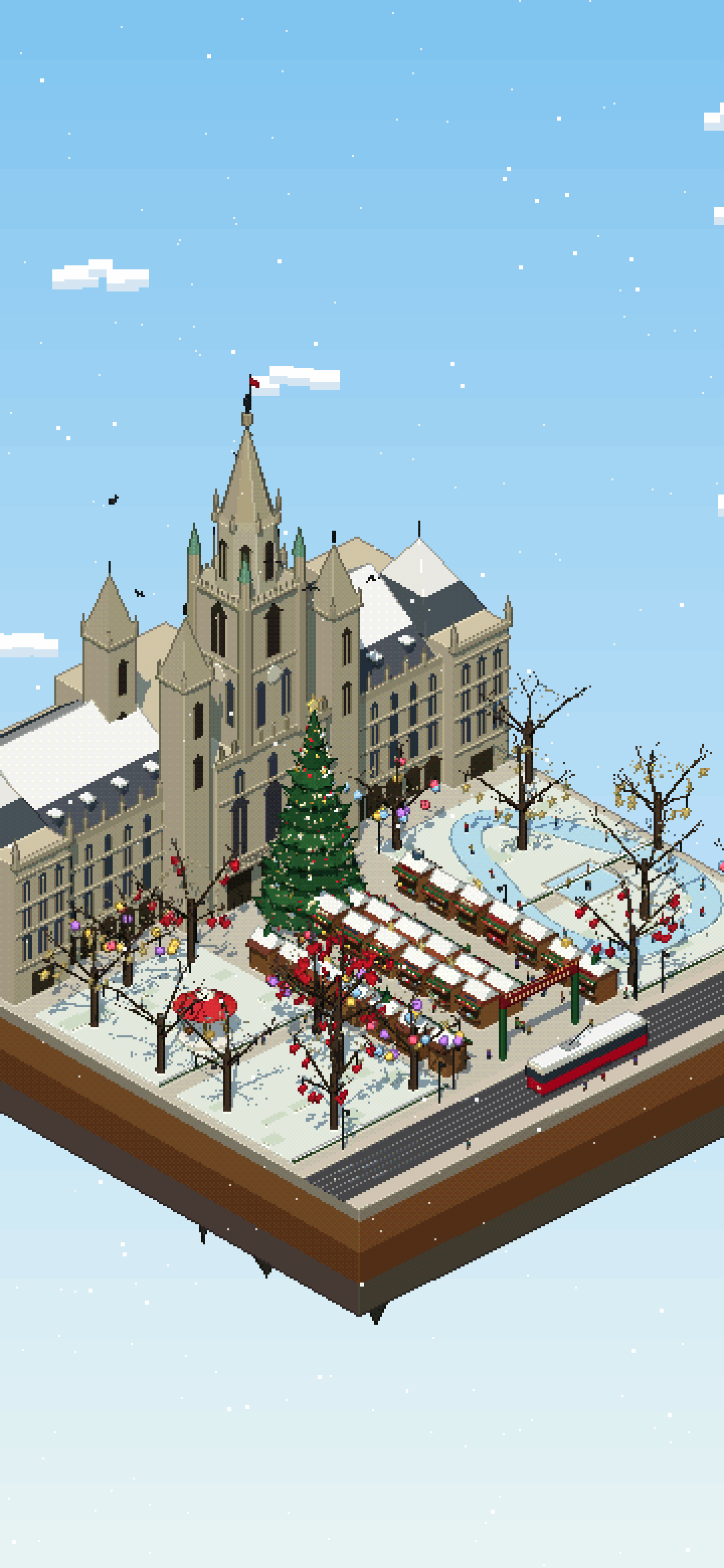
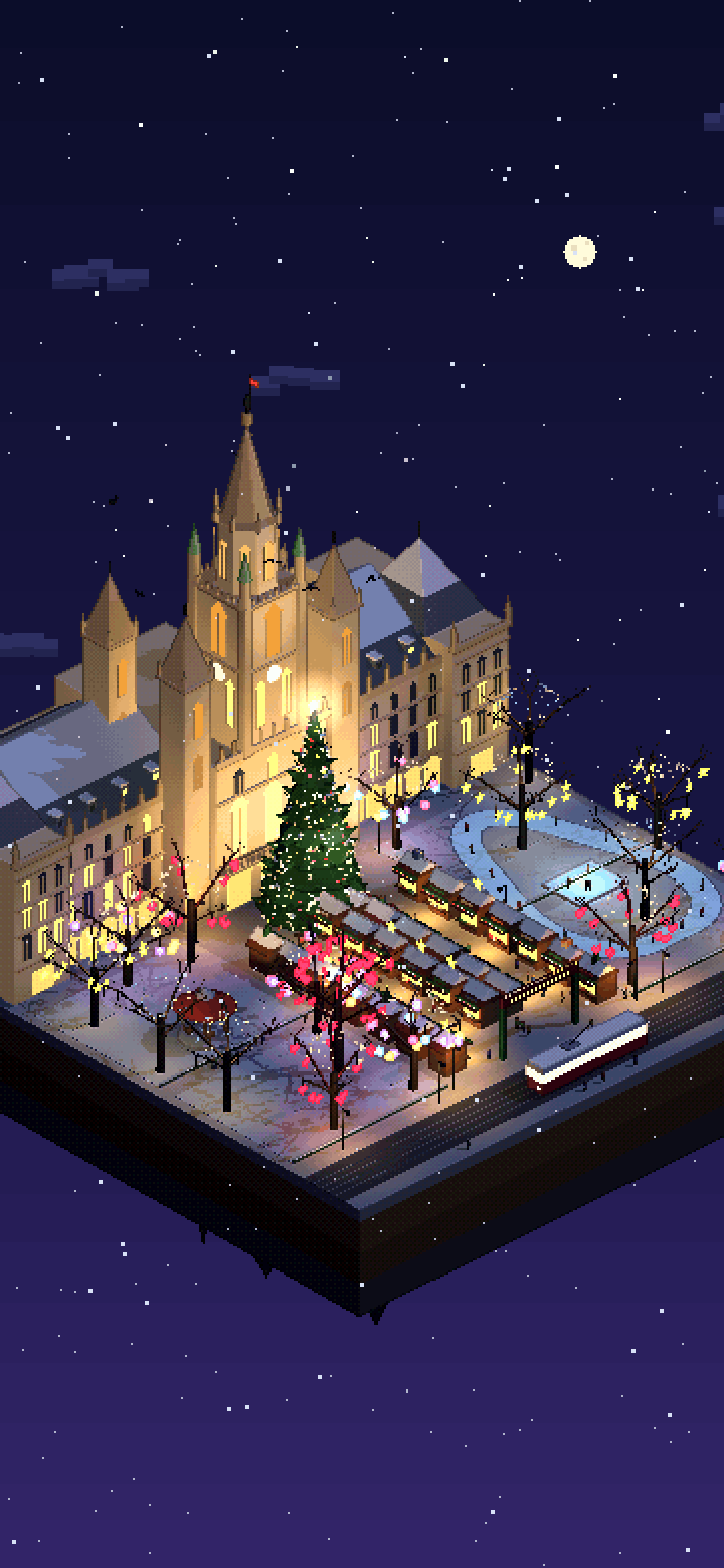
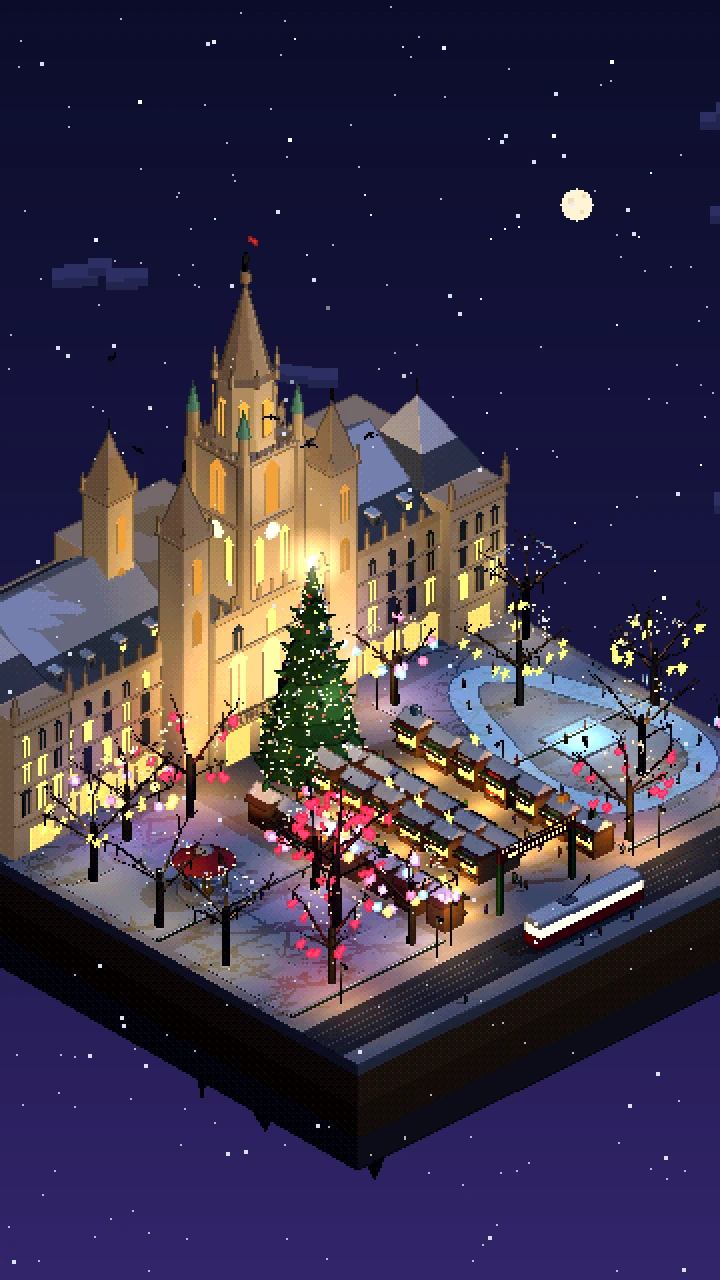
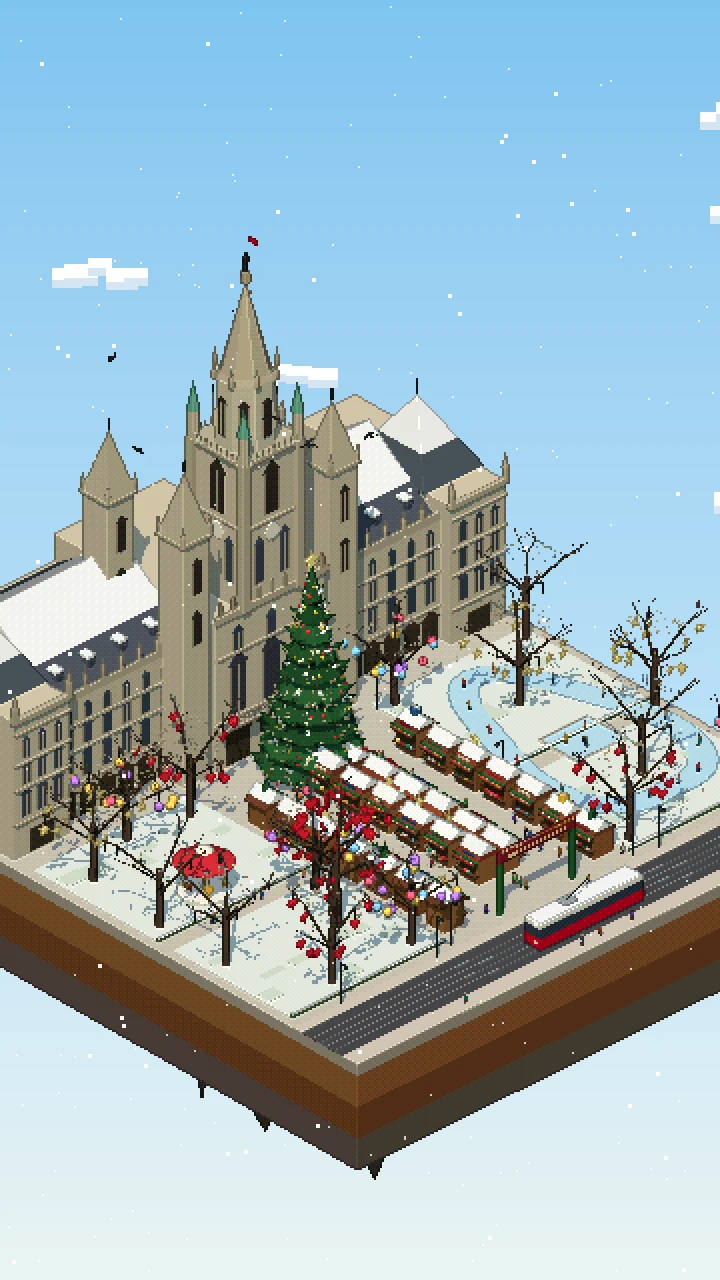
The diorama sets the Rathausplatz on a snowy floating island, built in Three.js and rendered as pixel art: the scene is drawn at a low resolution, every edge gets a dark outline, the colours are reduced to a small palette, and the result is scaled up without smoothing. At the back stands the City Hall, with its long stone front, open ground-floor arcades, pointed windows and pinnacles, steep roofs and corner pavilions, the central projection with the balcony and the tall windows of the Festsaal, the four smaller towers and the central tower with its octagonal top and the Rathausmann. In front of it stands the big tree, a spruce covered in warm white, red and gold lights with a star on top, and Punsch tables crowded with people.
Four rows of wooden huts run down the square towards the Ring, with fir garlands and lights along their eaves, signboards over their counters, and stars, little trees and parcels on their roofs, entered under a red arch from the Ring. On either side lies the Rathauspark, its bare trees dressed with hearts, glowing globes and stars, with the big Herzerlbaum in the south half next to a children’s carousel and, in the north half, an ice trail looping between the trees around a small rink full of skaters. Red-and-white trams run along the Ring at the front. At night the City Hall is floodlit, the huts glow and the light trees shine red, purple and gold.
Things to spot
- The Rathausmann with his red pennant on top of the tower
- The Herzerlbaum, a tree full of red hearts
- Skaters gliding along the ice trail through the park
- The children’s carousel turning in the south half of the park
- Two red-and-white trams passing on the Ring
- Crows circling high over the City Hall
What we simplified
- There are 26 huts in the diorama instead of about a hundred on the real square.
- The City Hall’s 152-metre front is narrowed and the square is shortened so that the building, the market and the Ring fit on one island; the tree is drawn a little taller in proportion to the tower.
- The ice trail, the carousel and the Herzerlbaum are placed in the park only roughly where they stand, and the light trees are a mix of the figures used in the real park.
- The snow is added for the winter look, and the trams are generic Vienna trams.
Questions
When is the Vienna Christmas market 2026?
The Wiener Christkindlmarkt on the Rathausplatz runs from 13 November to 26 December 2026. It is open daily from 10:00 to 22:00, and from 10:00 to 18:30 on 24 December.
Is there ice skating at the Vienna Christmas market?
Yes. During the market, the Eistraum am Christkindlmarkt has about 3,000 square metres of ice trails through the lit trees of the Rathauspark, open from 13 November 2026 to 6 January 2027. In 2027 the big Wiener Eistraum then takes over the square itself from 22 January to 7 March.
Where does the Vienna Christmas tree come from?
Since 1959 the tree on the Rathausplatz has been donated in turn by one of the Austrian provinces or South Tyrol. The 2026 tree is a 31-metre spruce of more than 200 years from Damüls in Vorarlberg, and it is lit at the opening of the market on 13 November.
How old is the Vienna Christmas market?
Vienna’s December market goes back to city charters of 1296, and a Christmas market has been held in the city in one place or another since at least 1600. The Christkindlmarkt has been on the Rathausplatz, in front of the City Hall, since 1975.
How was this pixel-art diorama of the Vienna Christmas market made?
It is a real-time Three.js scene running on this page, drawn at 360 × 640 pixels with dark outlines and a small palette, then scaled up without smoothing. The City Hall, the huts, the tree and the light figures in the park are built from code, and the skaters, the carousel and the trams move. Press “Explore in 3D” to drag it round and switch between day, dusk and night.
Isometric maps of Vienna
Vienna also has an isometric pixel-art map made by the community: the whole city drawn tile by tile in the same SimCity-like style. See the map of Vienna →