About Wawel Castle
Wawel Hill is a limestone outcrop on the left bank of the Vistula in the middle of Kraków, and for centuries it was the seat of Poland’s kings. The castle and the cathedral stand side by side on top, ringed by brick walls and towers such as the Sandomierska Tower, built around 1460 to guard the south side, and the Senators’ Tower. Together with the Old Town and Kazimierz, the hill is part of the Historic Centre of Kraków, one of the first sites on the UNESCO World Heritage List in 1978.
The castle you see today is largely the work of King Sigismund I the Old, who had the Gothic residence rebuilt as a Renaissance palace from about 1507 to 1536. Italian masters led the work, first Francesco Fiorentino, then Bartolommeo Berrecci, and after them Benedykt of Sandomierz. The heart of it is the great arcaded courtyard, two storeys of arcades topped by a floor with tall, slender double columns. Inside, the State Rooms still show the Flemish tapestries woven for Sigismund Augustus, and the Crown Treasury keeps Szczerbiec, the coronation sword.
Next to the castle, Wawel Cathedral was the coronation church of Polish kings from 1320 to 1764, and most of them are buried there, along with national heroes such as Tadeusz Kościuszko, Adam Mickiewicz and Józef Piłsudski. The present Gothic building was consecrated in 1364. Its best-known addition is the Sigismund Chapel, built by Berrecci from 1517 to 1533 and often described as the purest example of Renaissance architecture outside Italy, with its gilded dome. The Sigismund Bell, cast in 1520, hangs in the tower of the same name and rings only on special occasions.
The court moved to Warsaw at the end of the 16th century, and after the last partition of Poland in 1795 the Austrians turned the castle into barracks and walled up its arcades. It was restored in the 20th century and is now a museum. At the foot of the hill by the river is the Dragon’s Den, a cave linked to Kraków’s legend of the Wawel Dragon, and outside it stands Bronisław Chromy’s bronze dragon from 1972, which breathes real fire every few minutes.
The diorama
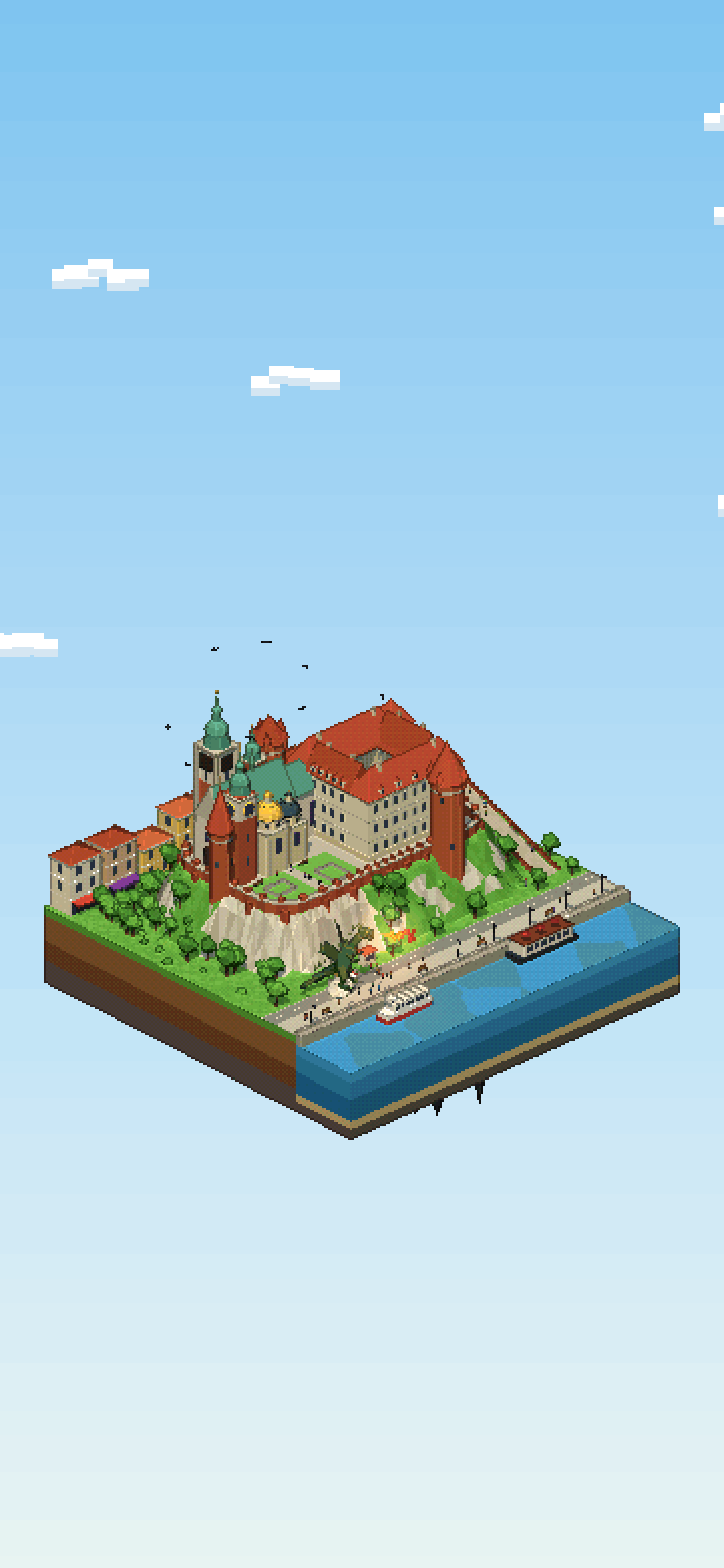
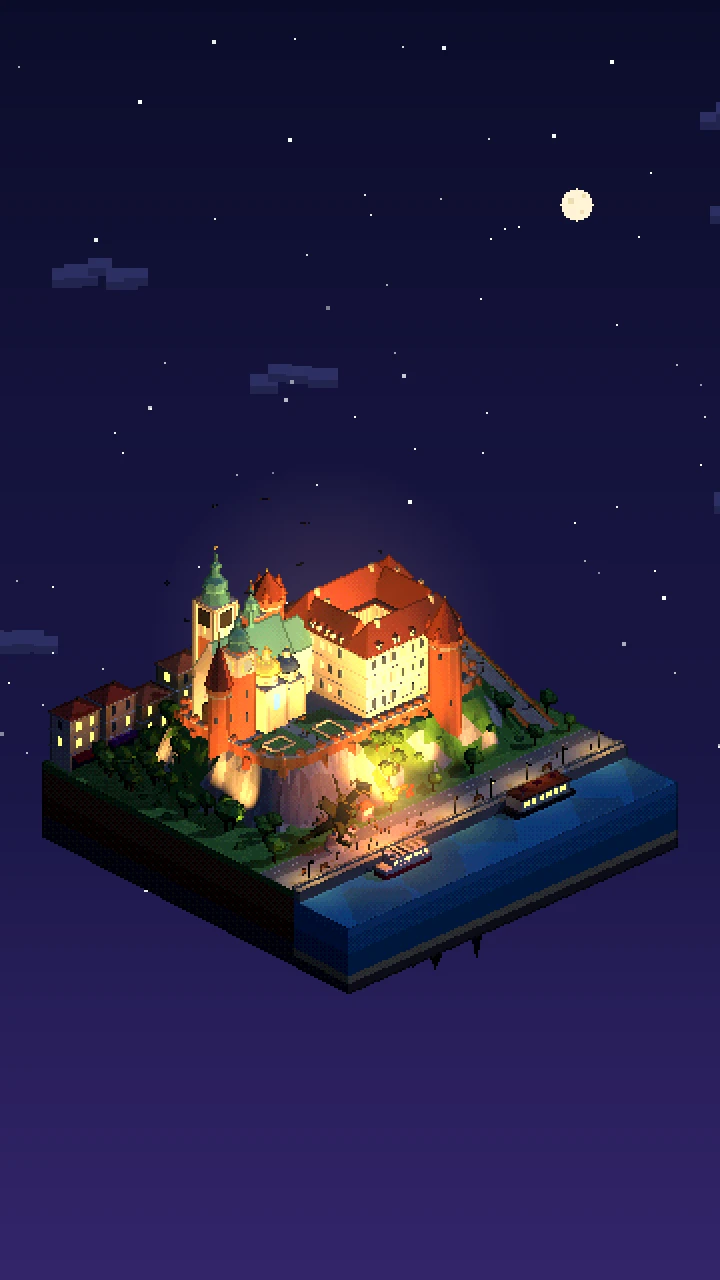
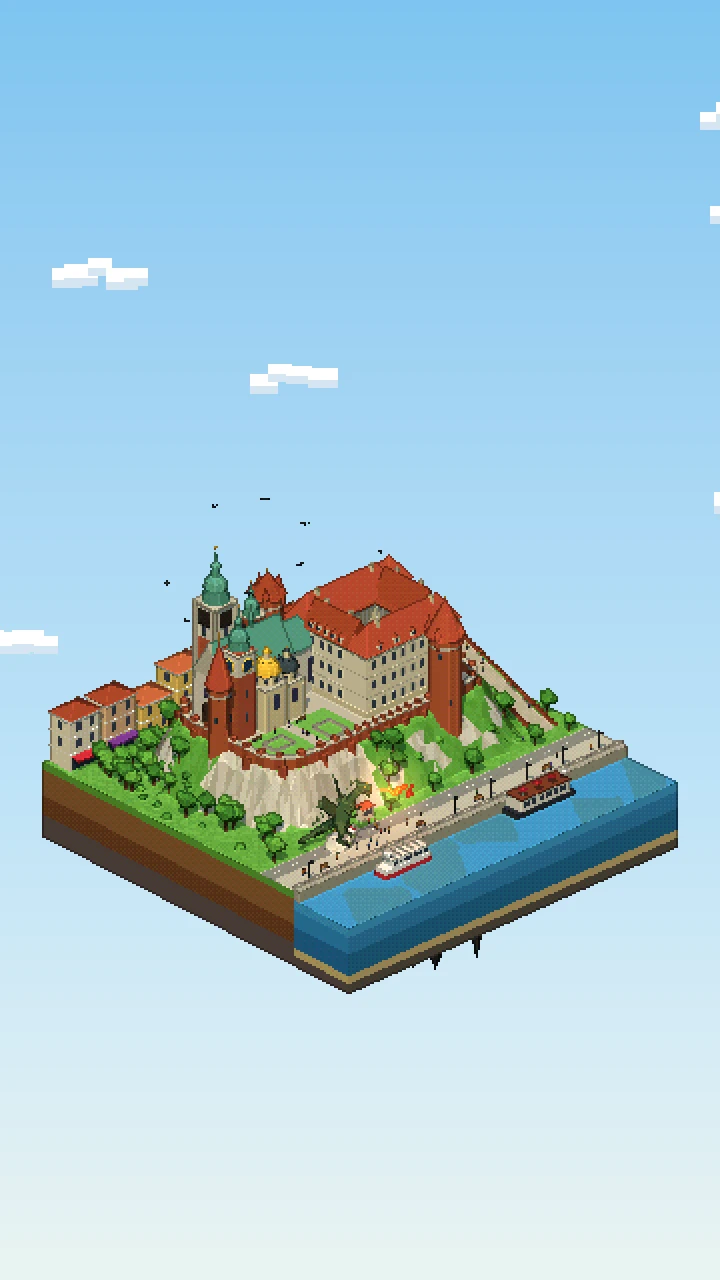
The diorama puts Wawel Hill on a floating island with the Vistula running along its front edge, cut open to show the water. Brick fortification walls follow the edge of the hill, with the Sandomierska Tower, the Senators’ Tower and the slender Thieves’ Tower, and a walled ramp climbs to the gate. On top stand the Renaissance castle with red-tiled roofs around its arcaded courtyard, and the Gothic cathedral with its green copper roof and caps on the Sigismund, Clock and Silver Bells towers, the gold dome of the Sigismund Chapel and the dark dome of the Vasa Chapel beside it.
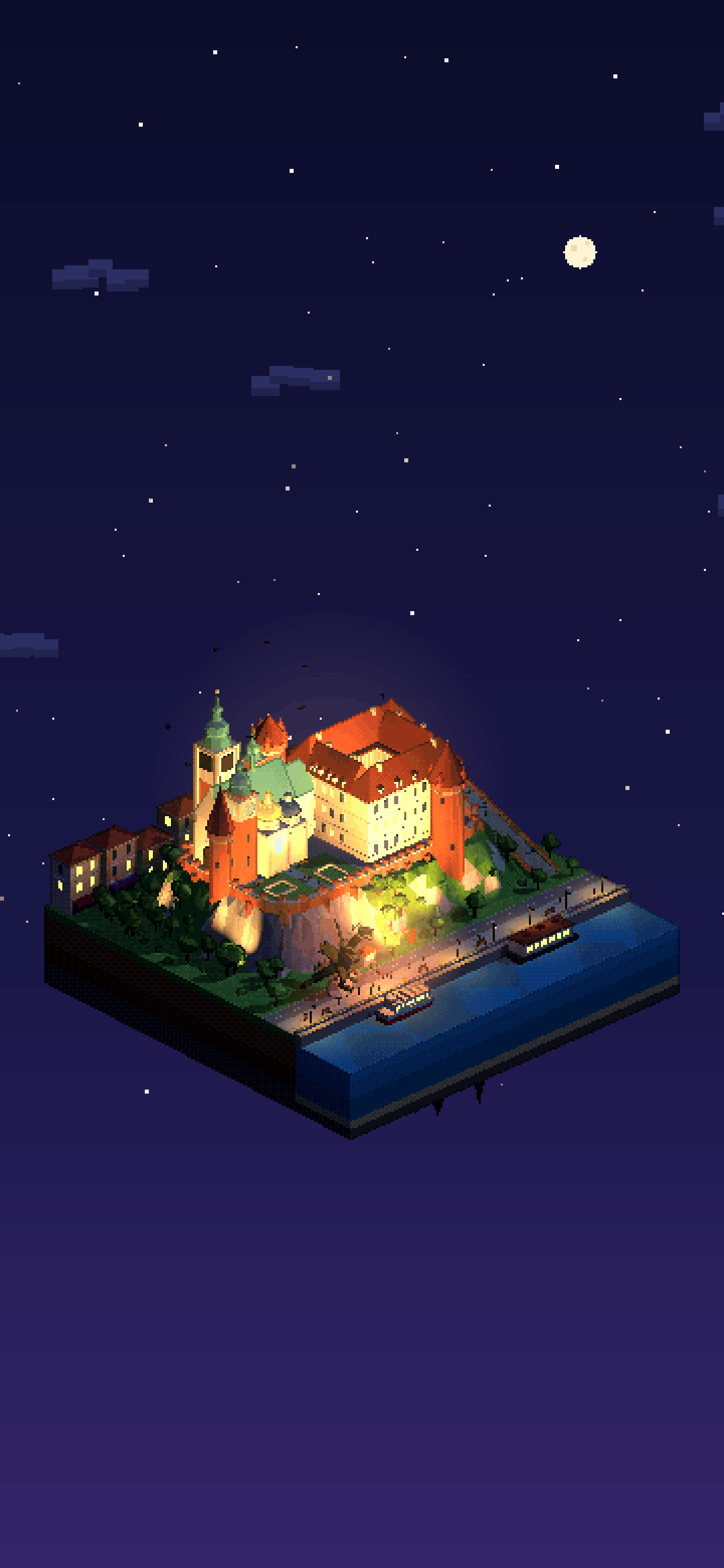
Below the limestone cliff are the mouth of the Dragon’s Den and the bronze Wawel Dragon on its boulder, breathing a puff of fire over the river every few seconds while a small crowd waits for it. Tour boats pass on the Vistula next to a moored restaurant barge, a white horse carriage drives along the riverside boulevard, and jackdaws circle the towers. At night the walls and towers are floodlit, the windows and stained glass glow, and the dragon’s fire lights up the riverbank.
Things to spot
- The Wawel Dragon breathing fire over the Vistula
- The gold dome of the Sigismund Chapel next to the dark Vasa Chapel dome
- The arcades of the castle courtyard
- The white horse carriage on the riverside boulevard
- The mouth of the Dragon’s Den in the limestone cliff
- Tour boats and a kayak on the river
What we simplified
- The castle, the cathedral and the towers are pulled closer together than in reality, and the towers and the dragon are made taller so they read at pixel size.
- The cathedral’s many side chapels, the castle’s interiors and much of the surrounding city are left out or reduced to a few houses.
- The real dragon breathes fire every few minutes; here it does so every few seconds.
Questions
When was Wawel Castle built?
There has been a royal residence on Wawel Hill since the Middle Ages, but the castle you see today was largely rebuilt as a Renaissance palace for King Sigismund I the Old from about 1507 to 1536, by Francesco Fiorentino, Bartolommeo Berrecci and Benedykt of Sandomierz.
What is the gold dome on Wawel Cathedral?
It is the dome of the Sigismund Chapel, built by Bartolommeo Berrecci from 1517 to 1533 on the south side of the cathedral. It is often described as the purest example of Renaissance architecture outside Italy.
Were Polish kings crowned at Wawel?
Yes. Wawel Cathedral was the coronation church of Polish kings from 1320 to 1764, and most of them are buried there, along with national heroes such as Tadeusz Kościuszko, Adam Mickiewicz and Józef Piłsudski.
Does the Wawel Dragon really breathe fire?
Yes. Bronisław Chromy’s bronze dragon, about 6 metres tall, stands at the foot of Wawel Hill by the Vistula, in front of the Dragon’s Den, and breathes a burst of gas fire every few minutes. It was installed in 1972.
How was this pixel-art diorama of Wawel Castle made?
It is a real-time Three.js scene on this page, drawn at 360 × 640 pixels with outlines and a small palette and scaled up without smoothing. The towers and the dragon are taller than scale so they read at pixel size. Press “Explore in 3D”, drag to turn it, and switch between day, dusk and night.
Isometric maps of Kraków
Kraków also has 2 isometric pixel-art maps made by the community: the whole city drawn tile by tile in the same SimCity-like style. See the maps of Kraków →