About Acropolis of Athens
The Acropolis is a flat-topped limestone rock in the middle of Athens, about 150 metres above sea level, with sheer cliffs on three sides and the only easy way up from the west. It was a fortress and a sanctuary long before the Classical age, but the buildings that made it famous were raised in the second half of the 5th century BC, in the building programme led by Pericles after the Persian Wars.
The Parthenon, the temple of Athena Parthenos, was begun in 447 BC and finished by 432 BC. The architects Iktinos and Kallikrates designed it and Phidias oversaw the sculpture. It is a Doric temple of Pentelic marble, 69.5 by 30.9 metres, ringed by eight columns at each end and seventeen on each side. Over the centuries it served as a church and then a mosque, until a Venetian mortar hit the Ottoman gunpowder store inside it on 26 September 1687 and blew out its centre.
Around it stand the other masterpieces of the same generation: the Propylaea, the monumental gateway designed by Mnesicles and begun in 437 BC; the small Ionic Temple of Athena Nike on its bastion; and the Erechtheion of 421–406 BC, whose south porch is held up by six marble maidens, the Caryatids. The figures on the building today are copies; five originals are in the Acropolis Museum and the sixth is in the British Museum.
On the south slope lie the Theatre of Dionysus and the Odeon of Herodes Atticus, completed in AD 161 and still used for summer performances of the Athens Festival. In May 1941 two students, Manolis Glezos and Apostolos Santas, climbed the rock at night and took down the swastika flag of the occupying army, one of the first acts of resistance in Greece. Large-scale restoration of the monuments has been under way since 1975.
The diorama
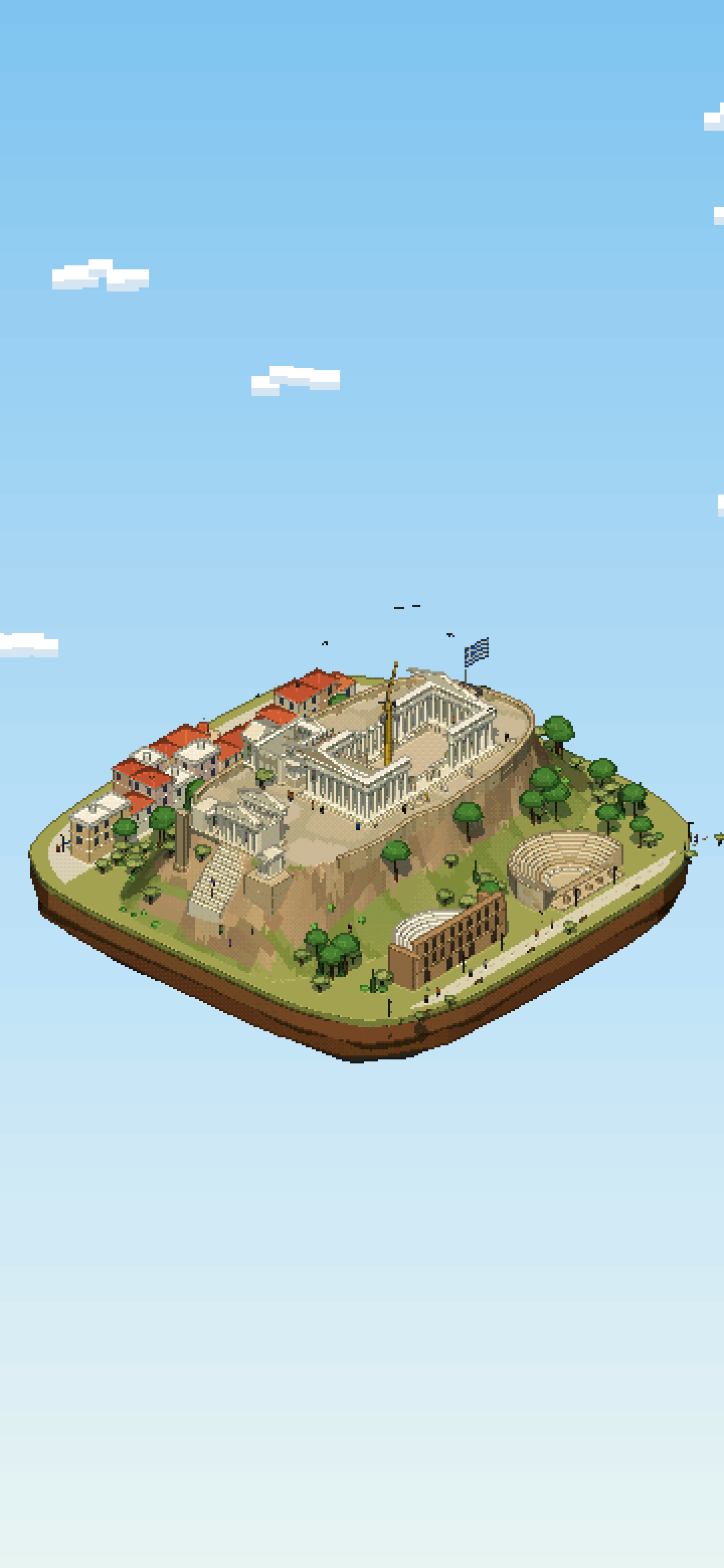
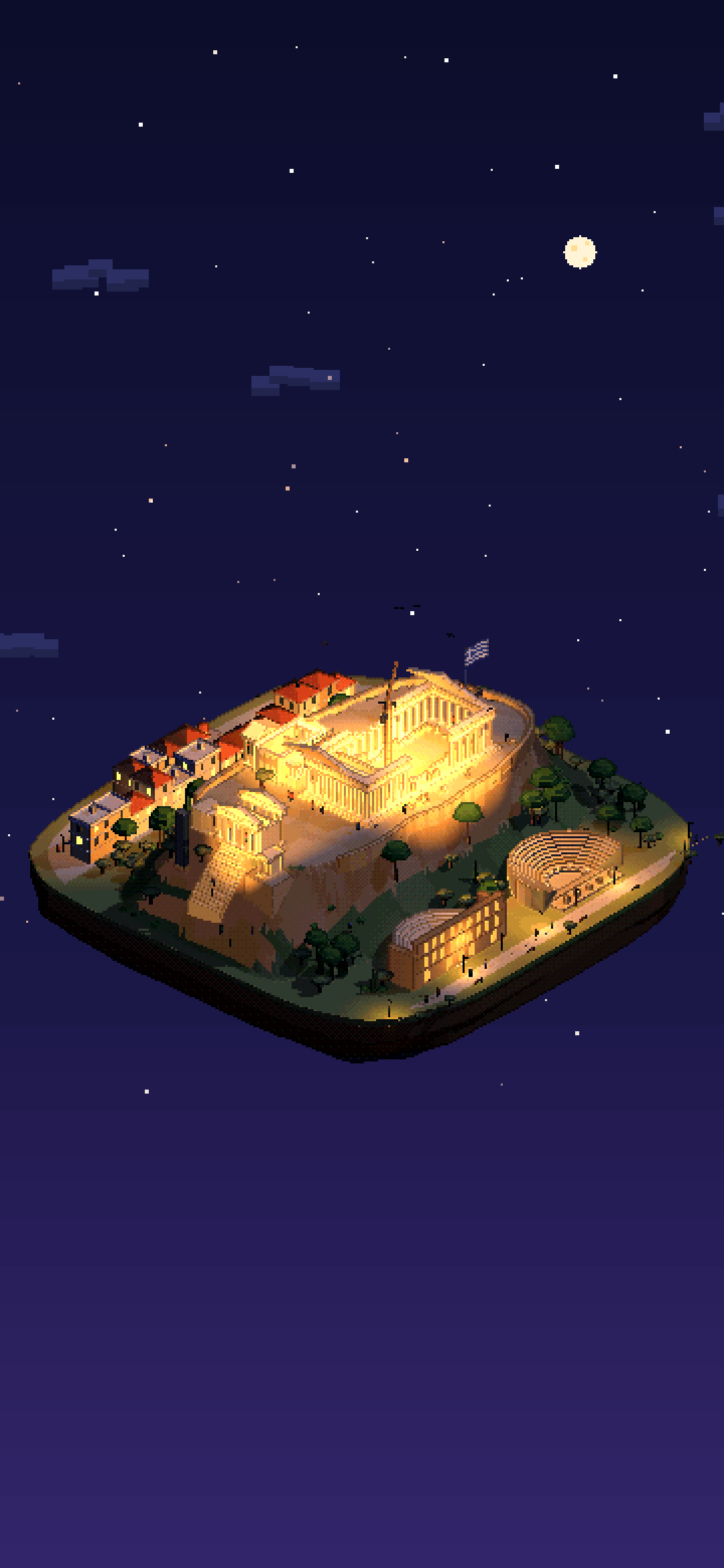
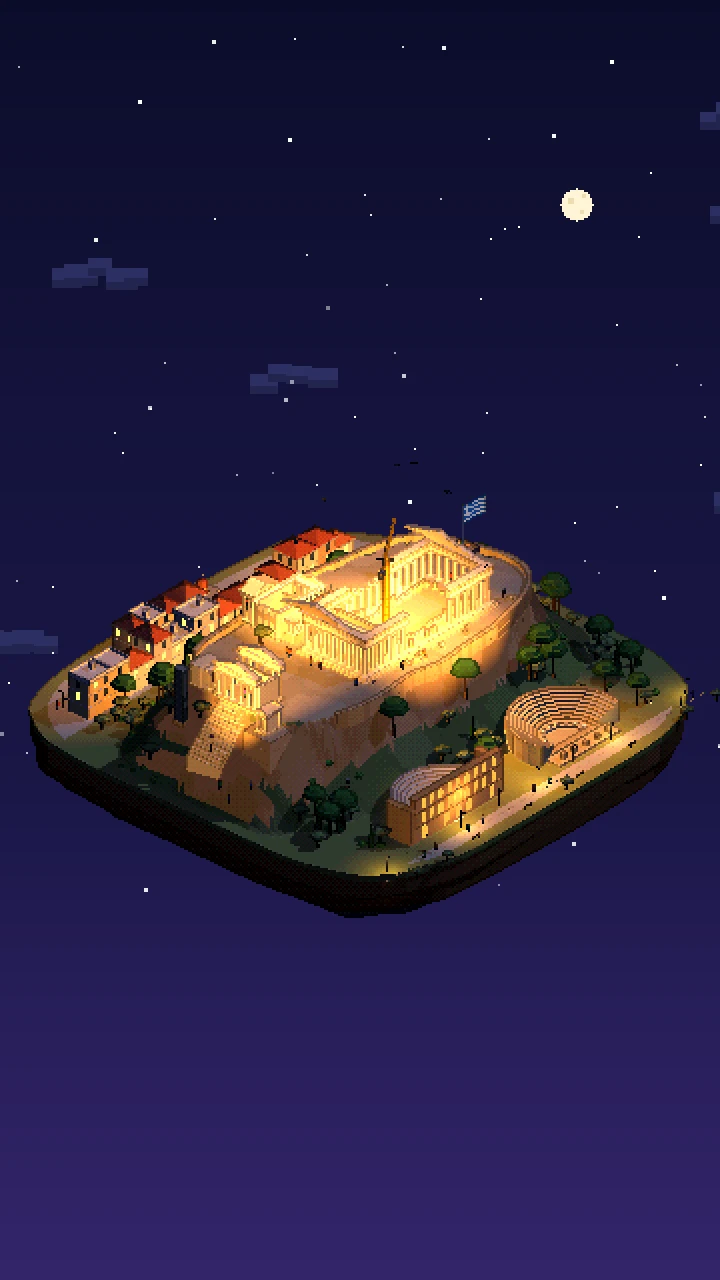
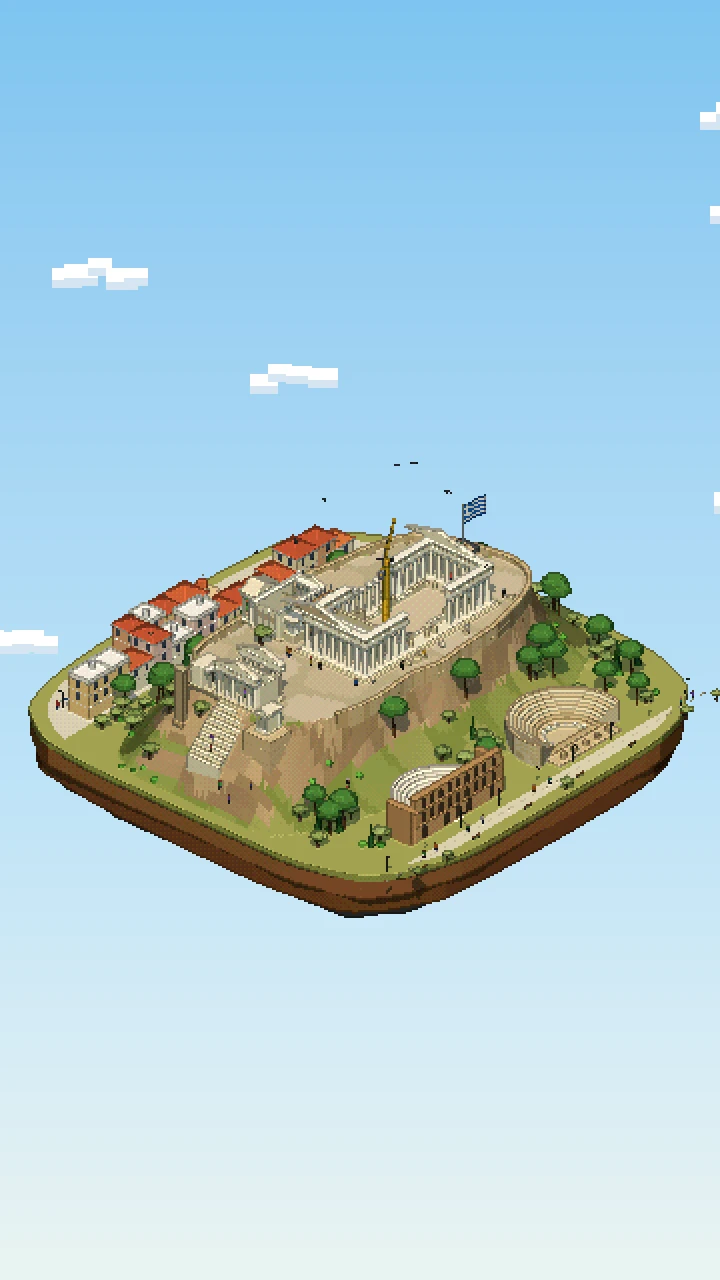
The diorama puts the whole rock on a floating island, built in Three.js and rendered as pixel art: the scene is drawn at a low resolution, every edge gets a dark outline, the colours are reduced to a small palette, and the result is scaled up without smoothing. The Parthenon is modelled with its 8 × 17 Doric columns on a three-step base, a triglyph frieze and both pediments, roofless and with the gaps in its long sides, a restoration crane inside and scaffolding on one corner. Beside it stand the Erechtheion with the Caryatid porch and the north porch, the Propylaea with its grand stairway, and the Temple of Athena Nike on its tall bastion.
The cliffs are topped by the honey-coloured walls, and olive trees, umbrella pines and cypresses cover the slopes. Below, the Odeon of Herodes Atticus shows its arched stage wall and white marble seats, the Theatre of Dionysus its ruined rings of stone, and Plaka and the little white houses of Anafiotika crowd the north side. As day turns to night, the marble glows gold under the floodlights while the Greek flag waves on the Belvedere.
Things to spot
- The six Caryatids holding up their porch
- A crane slowly turning inside the Parthenon
- The Greek flag waving on the Belvedere
- Tourists climbing the stairs to the Propylaea
- The Agrippa monument, a tall pedestal by the gate
- Two cats, one on the rock and one in Plaka
What we simplified
- The buildings are enlarged against the rock, and the rock itself is squashed vertically so everything fits on one island.
- Plaka and Anafiotika are generic houses, and the Stoa of Eumenes, the Acropolis Museum and many smaller ruins are left out.
- The Parthenon’s missing parts are approximated; restoration work on site changes from year to year.
Questions
How old is the Parthenon?
The Parthenon was begun in 447 BC and finished by 432 BC, in the building programme led by Pericles. That makes it nearly 2,500 years old.
Why is the Parthenon in ruins?
The Parthenon stood largely intact, as a temple, a church and then a mosque, until 26 September 1687, when a Venetian mortar hit the gunpowder the Ottoman garrison had stored inside it. The explosion blew out its centre. Restoration work has been under way since 1975.
Where are the original Caryatids?
The six Caryatids on the Erechtheion today are copies. Five of the originals are in the Acropolis Museum in Athens and the sixth is in the British Museum in London.
How high is the Acropolis?
The rock of the Acropolis rises to about 150 metres above sea level, and its flat top covers about 3 hectares. Cliffs surround it on three sides, so the entrance has always been at the west end, through the Propylaea.
How was this pixel-art diorama of the Acropolis made?
It is a real-time Three.js scene running on this page, drawn at 360 × 640 pixels with dark outlines and a small palette, then scaled up without smoothing. The Parthenon is modelled with its 46 outer columns, the Erechtheion with its six Caryatids, and the rock with the Odeon and Plaka at its foot. Press “Explore in 3D” to drag it round and switch between day, dusk and night.
Isometric maps of Athens
Athens also has an isometric pixel-art map made by the community: the whole city drawn tile by tile in the same SimCity-like style. See the map of Athens →