About Dubrovnik City Walls
Dubrovnik’s walls run without a break for about 1,940 metres around the Old Town, on a limestone promontory that juts into the Adriatic. They grew over several centuries, from the medieval town wall to the great towers and bastions added when the Republic of Ragusa feared Ottoman attack, and they reach up to about 25 metres high. On the land side they are four to six metres thick; towards the sea, where the rock does part of the work, they are thinner.
The towers each have a job. Round Minčeta, at the highest point of the landward walls, was finished in the 1460s and became the symbol of the city. Fort Bokar guards the Pile gate on the west, the St John fortress closes the old port to the south-east, and the Revelin stands outside the Ploče gate on the east. Across a small bay, Fort Lovrijenac sits on its own 37 metre rock; above its gate is the motto “Non bene pro toto libertas venditur auro”: freedom is not to be sold for all the gold in the world.
Inside, the Stradun, a street of polished limestone about 300 metres long, runs from the Pile gate to the Luža square, on the line of a marshy channel that once split the settlement in two. Most of what lines it was rebuilt after the earthquake of 1667, which killed thousands of people and destroyed much of the city. Steep stepped lanes climb north from it, packed with stone houses under terracotta roofs.
The city was shelled during the siege of 1991–92, and many of the roofs you see from the walls are newer, brighter tiles from the repairs. Today walking the full circuit of the walls is the classic Dubrovnik visit, and the Old Town is also known worldwide as a filming location for King’s Landing in Game of Thrones. A cable car climbs Mount Srđ behind the city for the view down onto the whole ring of walls.
The diorama
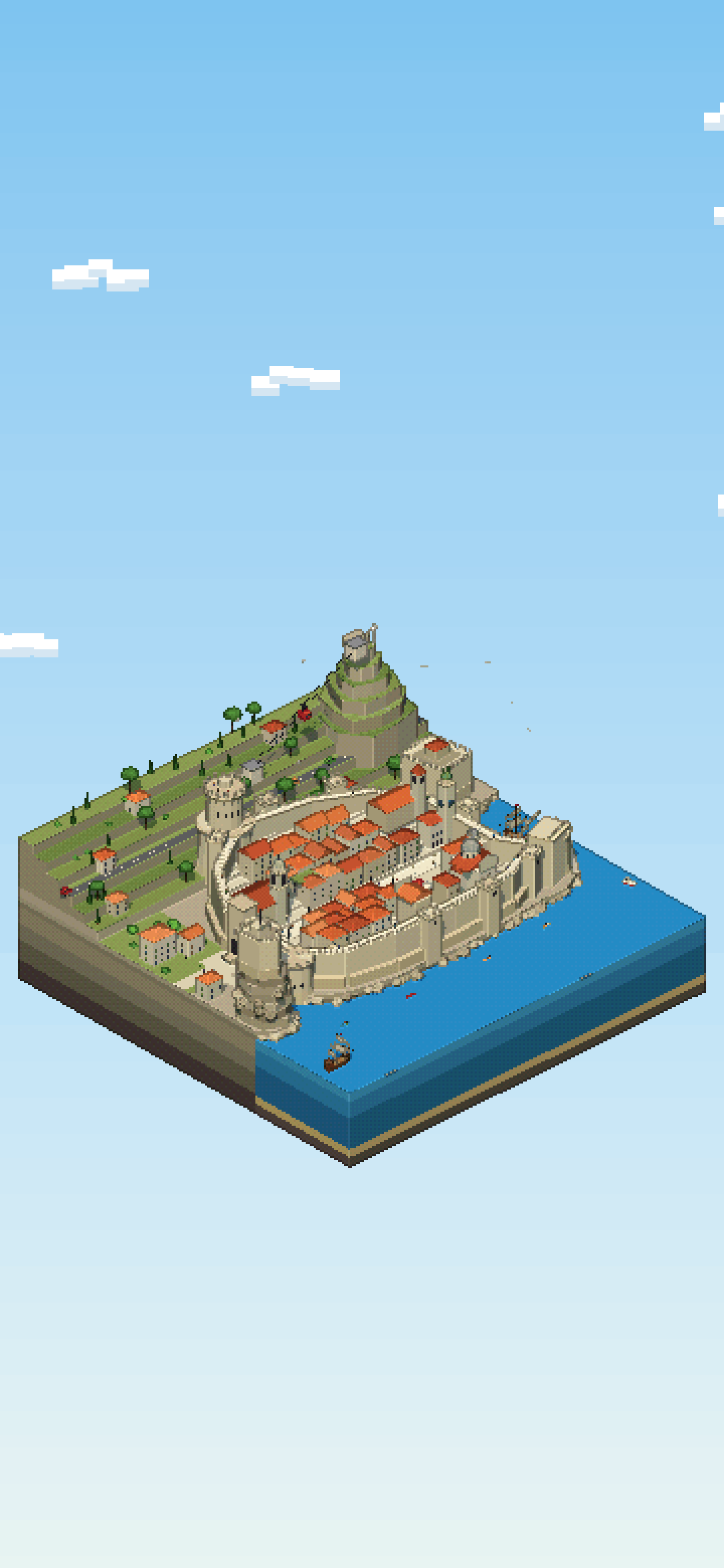
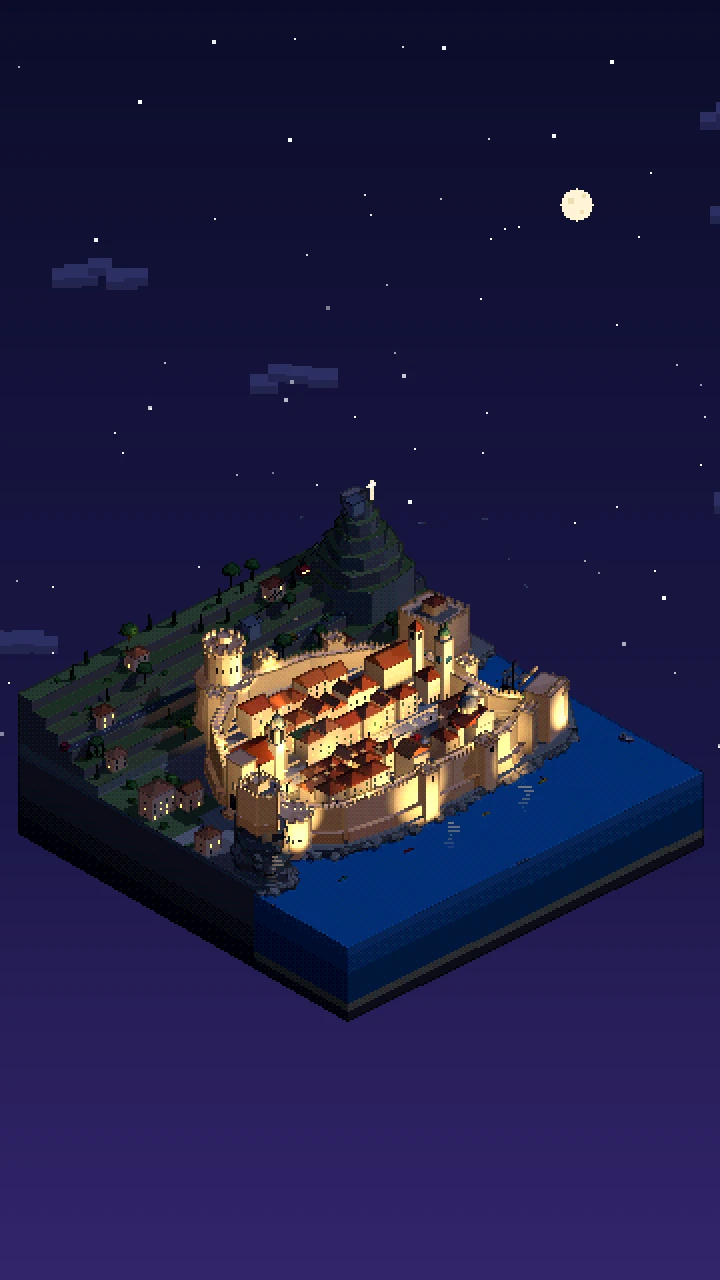
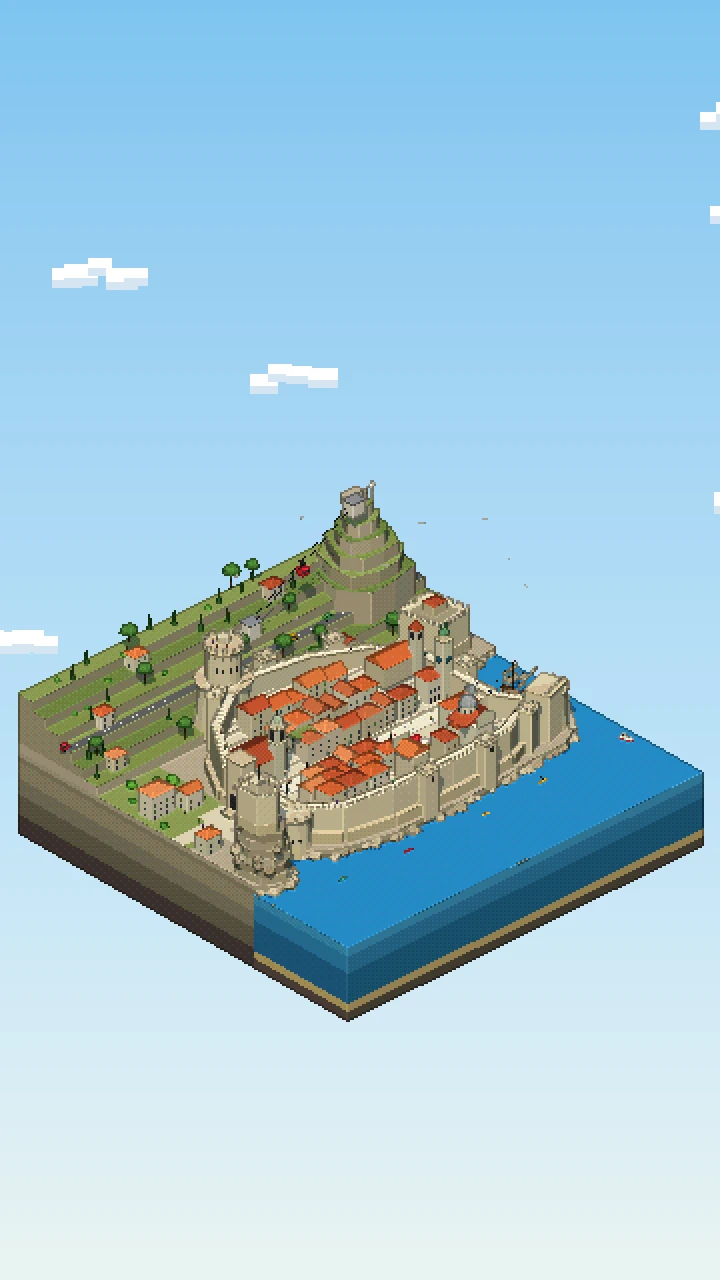
The diorama puts the Old Town on a floating block of the Adriatic coast, built in Three.js and rendered as pixel art: the scene is drawn at a low resolution, every edge gets a dark outline, the colours are reduced to a small palette, and the result is scaled up without smoothing. The walls run as one stepped circuit with a walkway, crenellations, a sloping base and square towers, around the round Minčeta with its crowned drum, the squat Bokar over the sea, the St John fortress at the mouth of the old port, the Revelin, and Fort Lovrijenac on its sheer rock across the little bay.
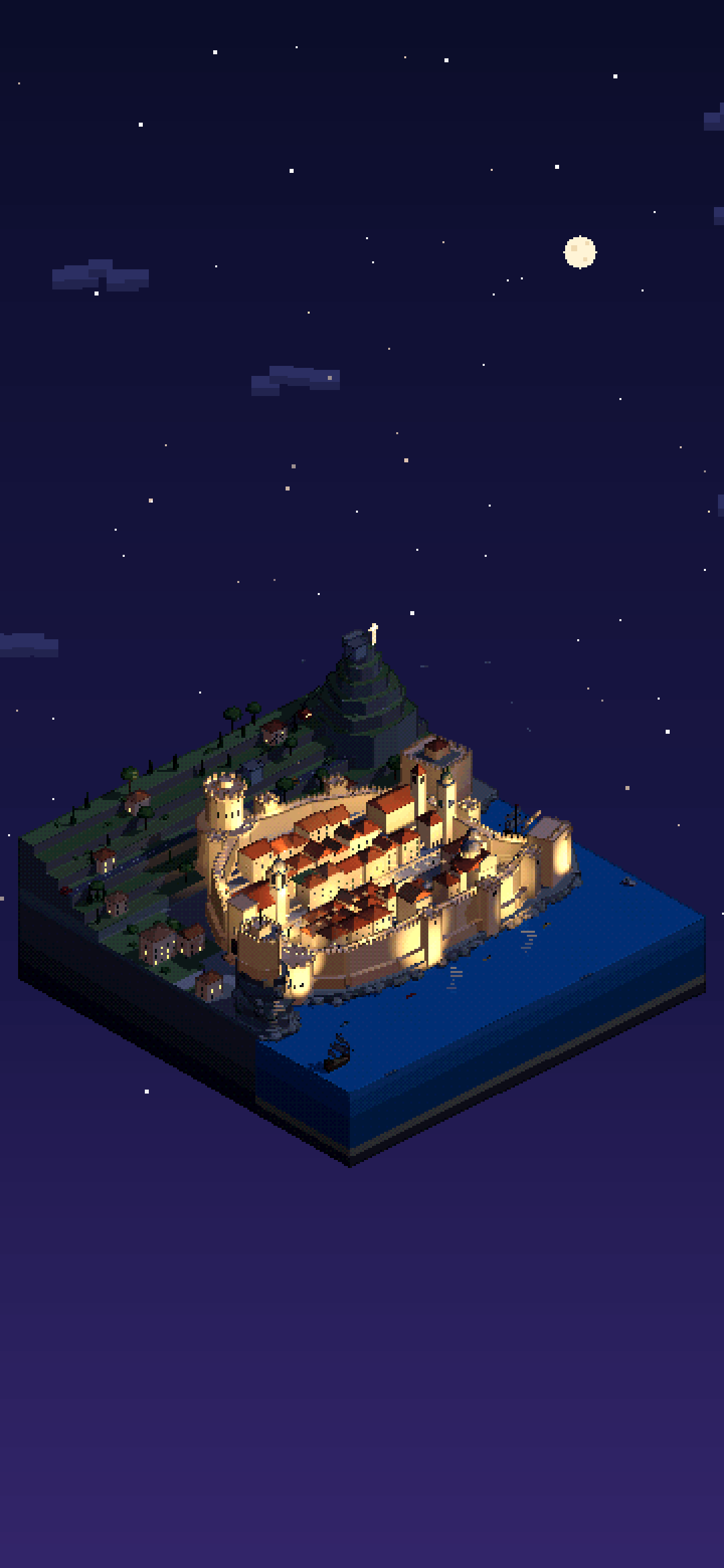
Inside, the pale Stradun runs from the Pile gate, past Onofrio’s domed fountain and the Franciscan bell tower, to the clock tower, the Sponza palace and St Blaise, with the cathedral dome, the Rector’s palace and a market square to the south and stone houses with green shutters packed under terracotta roofs. Visitors walk the wall-top circuit both ways, kayaks paddle under the sea walls, a carrack is moored in the old port while another sails past, and a red cable car climbs to the cross on Srđ. At night the walls are floodlit warm and the lamps glint on the polished Stradun.
Things to spot
- Visitors walking the wall-top circuit in both directions
- Kayaks paddling under the south walls
- Two sailing ships, one moored in the old port
- The red cable car cabins passing each other
- Market parasols on the square south of the Stradun
- The lit cross on top of Mount Srđ at night
What we simplified
- The houses and lanes are generic: the blocks are laid out in rows off the Stradun, not house by house as in the real town.
- Mount Srđ is a small stepped peak in the back corner; the real mountain rises 412 metres behind the city.
- Heights are exaggerated and the forts are moved closer together so they all fit on the block.
Questions
How long are the walls of Dubrovnik?
The walls of Dubrovnik run without a break for about 1,940 metres around the Old Town. They reach up to about 25 metres high and are four to six metres thick on the land side, and 1.5 to 3 metres towards the sea.
What is the highest point of the Dubrovnik walls?
The round Minčeta Tower, at the north-west corner of the landward walls, is the highest point of the circuit. It was finished in the 1460s and has become the symbol of the city.
Is Fort Lovrijenac part of the city walls?
Fort Lovrijenac stands outside the walls, on a 37 metre rock across a small bay west of the Old Town. Above its gate is the motto “Non bene pro toto libertas venditur auro”: freedom is not to be sold for all the gold in the world.
Is the Old Town of Dubrovnik a World Heritage Site?
Yes. The Old City of Dubrovnik was inscribed on the UNESCO World Heritage List in 1979. It was damaged during the siege of 1991–92 and has since been largely restored.
How was this pixel-art diorama of Dubrovnik made?
It is a real-time Three.js scene running on this page, drawn at 360 × 640 pixels with dark outlines and a small palette, then scaled up without smoothing. The walls are built as one stepped circuit with Minčeta, Bokar, St John, the Revelin and Lovrijenac around the Stradun. Press “Explore in 3D” to drag it round and switch between day, dusk and night.