About Hagia Sophia
Hagia Sophia, the Church of Holy Wisdom, was built in less than six years for Emperor Justinian I and consecrated in 537. Its architects, Anthemius of Tralles and Isidore of Miletus, were mathematicians as much as builders, and they set a huge dome over a square nave on four great arches and pendentives. For close to a thousand years it was the largest cathedral in the world and the heart of the Byzantine Empire.
The dome was a bold idea and it did not always hold. Earthquakes brought part of it down in 558, and it was rebuilt higher and steeper. Later collapses and repairs followed, and over the centuries heavy buttresses were added on the north and south sides to keep the walls from spreading. The ring of forty windows at the base of the dome makes it look as if it floats on light.
After Mehmed II took Constantinople in 1453, the church became a mosque. The Ottomans added the four minarets, a mihrab and minbar inside, and the tombs of sultans in the garden to the south. The great architect Mimar Sinan strengthened the building in the 16th century, and Hagia Sophia in turn shaped the domed mosques he and others built across the city.
In 1934 the Turkish Republic turned it into a museum, and in 2020 it became a mosque again. It faces the Blue Mosque across Sultanahmet Park, with its fountain and spring tulips, and the T1 tram stops at Sultanahmet, a short walk away.
The diorama
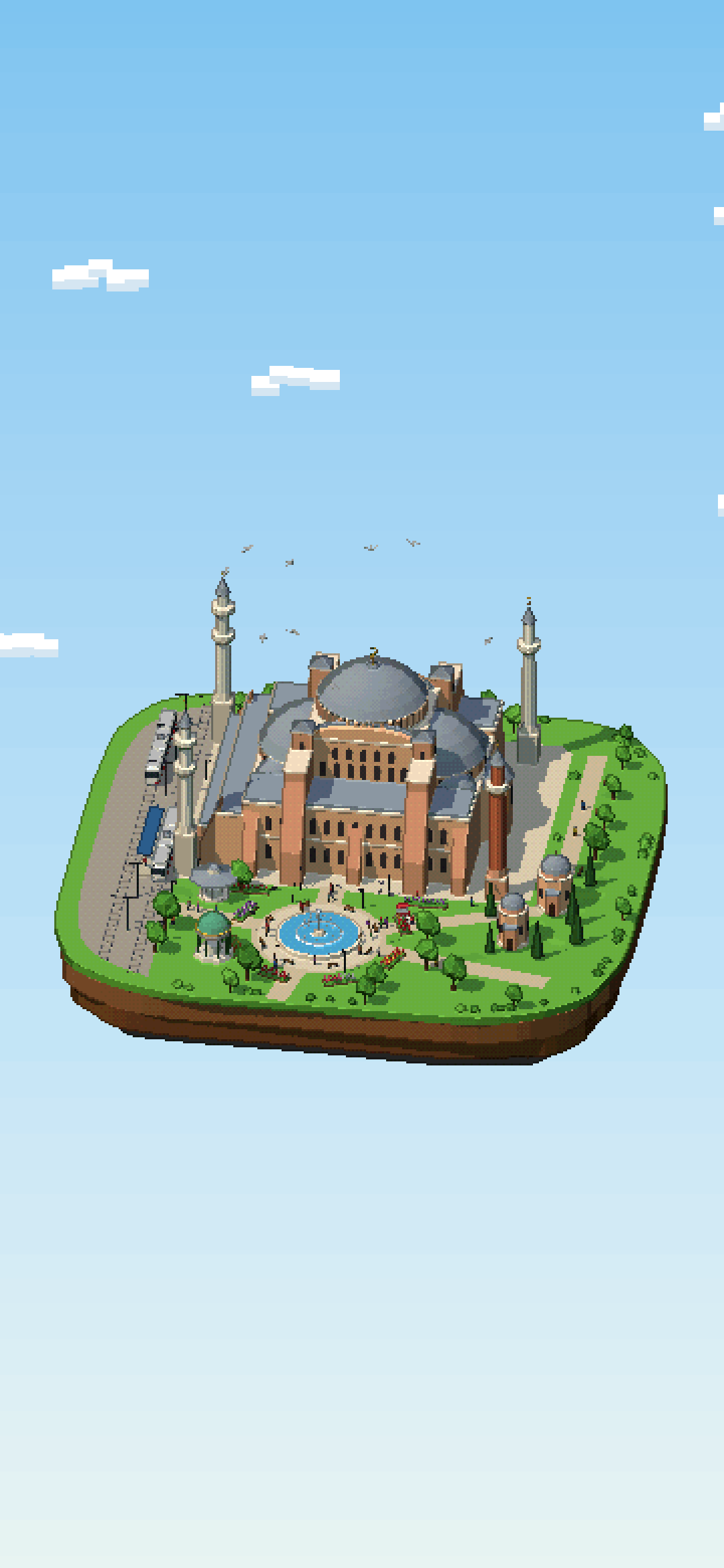
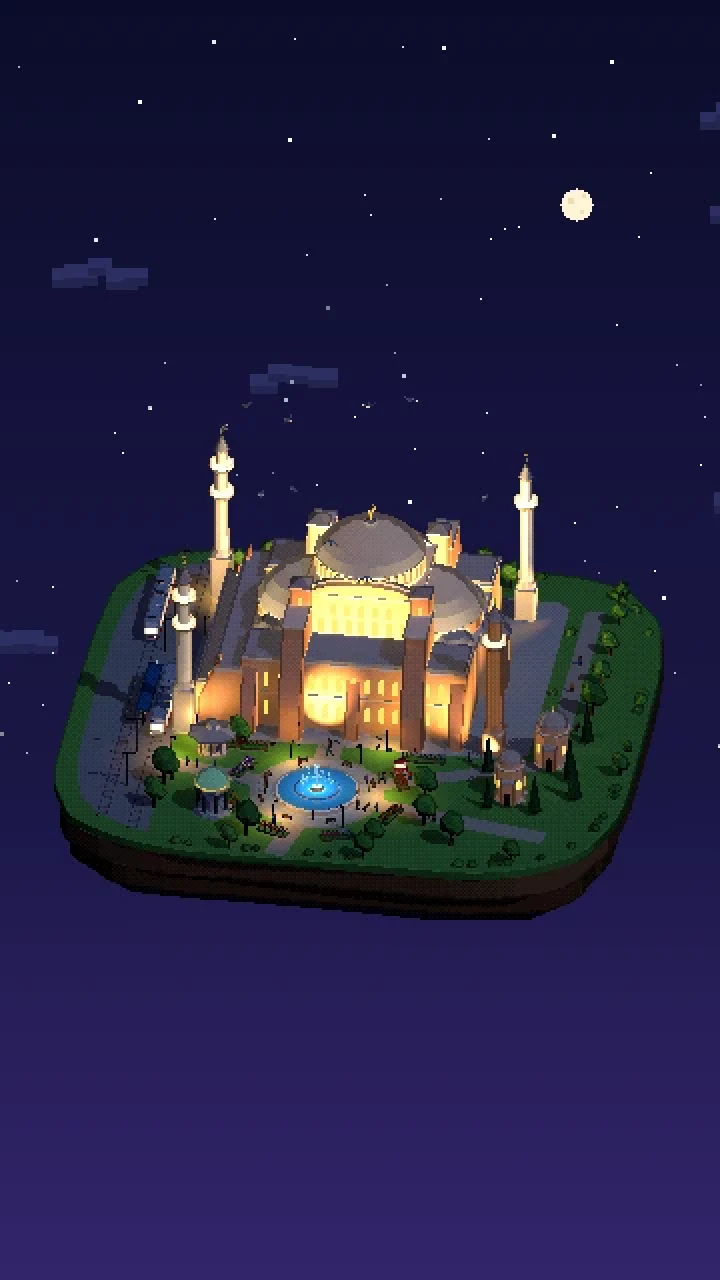
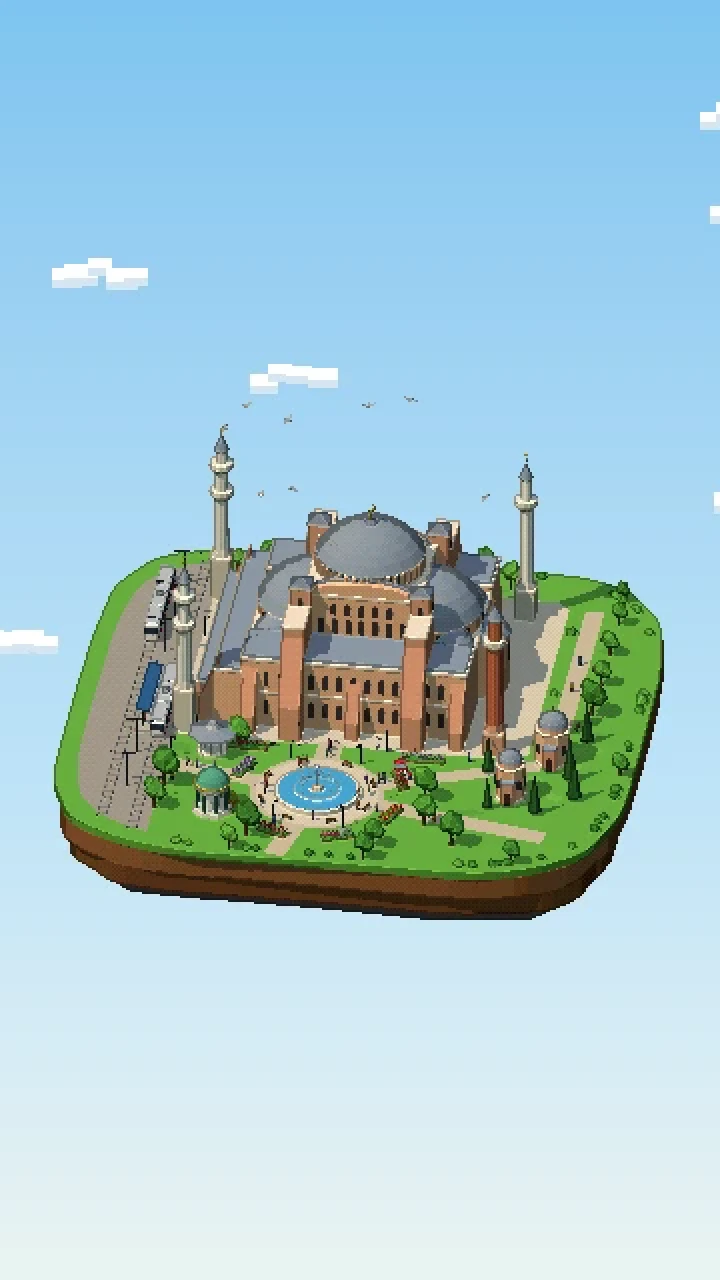
The building is modelled from its real plan at one unit for two metres, then drawn as low-resolution pixel art with dark outlines. The central dome sits on its drum with a ring of 40 little windows between small buttresses, topped by a gold crescent finial. East and west, semi-domes of the same span step down to smaller exedra half-domes and the eastern apse. The double narthex closes the west end, and stout buttresses, Byzantine and Ottoman, lean against the north and south walls.
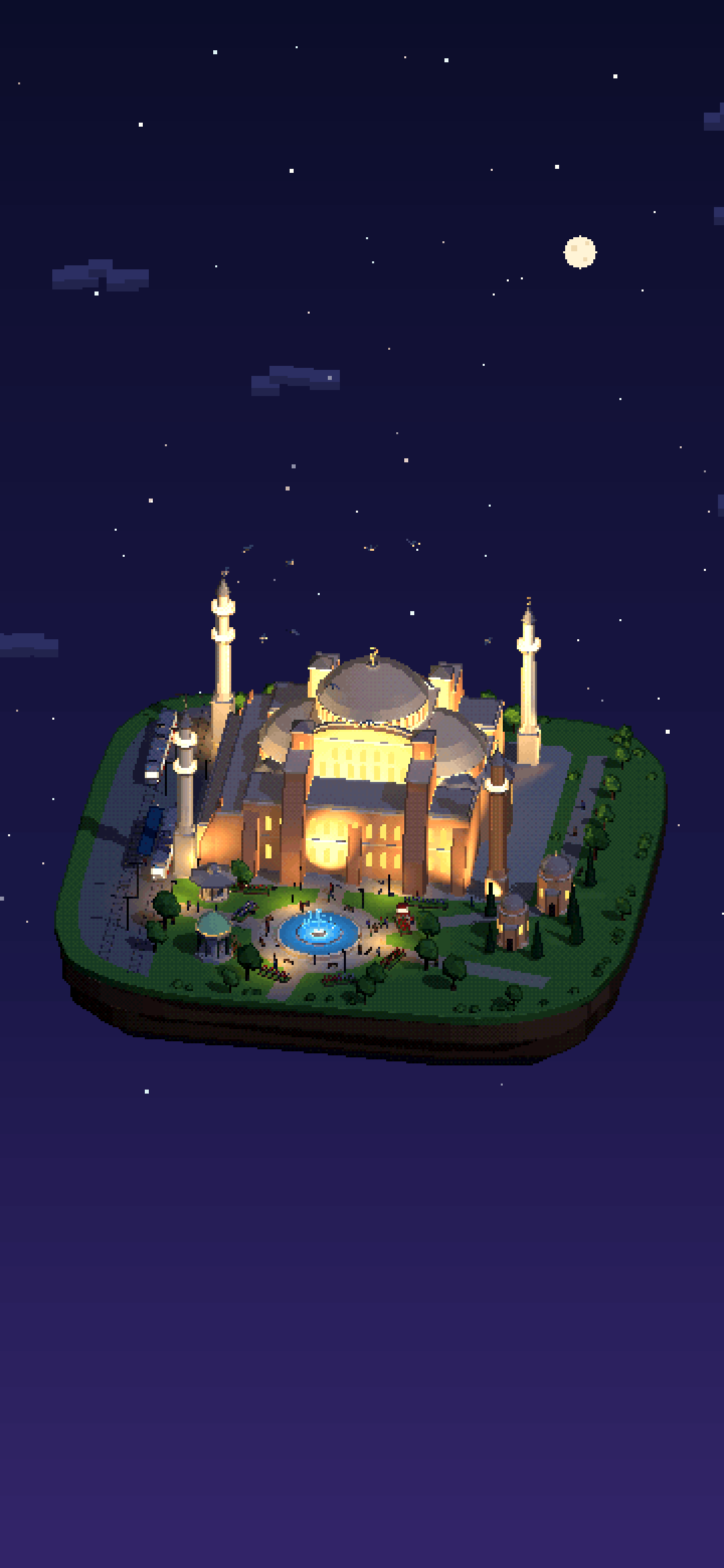
The four minarets are not all alike: the two western twins are drawn with two balconies each, and the south-east one is in red brick, as on the real building. Around them are the şadırvan for ablutions, octagonal Ottoman tombs among cypresses, the German Fountain with its green dome, and Sultanahmet Park with its round fountain, benches and tulip beds. As night falls, floodlights turn the walls warm, the dome windows glow and the minaret balconies light up in rings.
Things to spot
- The T1 tram waiting at Sultanahmet stop, then pulling away north
- A second tram arriving the other way
- A red simit cart with its seller
- Five cats, one of them out for a stroll
- The jet and ripples of the park fountain
- Gulls circling the main dome
What we simplified
- The park, the tram line and the German Fountain are pulled in close around the building, and the Blue Mosque across the park is left out.
- Windows, buttresses and minaret details are reduced to what still reads at pixel scale; the interior is not modelled.
Questions
When was Hagia Sophia built?
Hagia Sophia was built between 532 and 537 for Emperor Justinian I, in less than six years, and was consecrated in 537.
Who built Hagia Sophia?
Hagia Sophia was designed by Anthemius of Tralles and Isidore of Miletus, who were mathematicians as much as builders. They set a huge dome over a square nave on four great arches and pendentives.
How big is the dome of Hagia Sophia?
The main dome of Hagia Sophia is about 31 metres across, and its crown is about 55 metres above the floor. A ring of forty windows at its base makes it look as if it floats on light.
Is Hagia Sophia a mosque or a museum?
Hagia Sophia has been a mosque again since 2020. It was a cathedral from 537 to 1453, a mosque from 1453 to 1934 and a museum from 1934 to 2020.
How was this pixel-art diorama of Hagia Sophia made?
The building is modelled from its real plan at one unit for two metres. It is a real-time Three.js scene running on this page, drawn at 360 × 640 pixels with dark outlines and a small palette, then scaled up without smoothing. Press “Explore in 3D” to drag it round and switch between day, dusk and night.
Isometric maps of Istanbul
Istanbul also has 2 isometric pixel-art maps made by the community: the whole city drawn tile by tile in the same SimCity-like style. See the maps of Istanbul →