About Galata Tower
Galata Tower has watched over the Golden Horn for almost seven centuries. The Genoese built it in 1348 as the tallest point of the walls around their trading colony across the water from Constantinople, and called it the Tower of Christ. After the Ottoman conquest in 1453 it became a prison for captives put to work in the naval dockyard and, for most of its later life, a fire watch tower: from the top, guards could see a fire start anywhere in the wooden city and raise the alarm.
Fires and storms took the roof more than once. The pointed cap you see today was rebuilt during the restoration of 1965–67, which gave the tower its familiar silhouette again. The thick stone shaft carries an observation balcony right below the cap, and from it you look over the Golden Horn, the Bosphorus and the domes of the old city.
It is also the setting of Istanbul’s favourite legend. The 17th-century traveller Evliya Çelebi wrote that Hezârfen Ahmed Çelebi strapped on wings, jumped from the tower and glided across the Bosphorus to Üsküdar. Whether it happened or not, the story is why the tower shows up on everything from postcards to coffee cups.
Today the tower is a museum, and the narrow streets around it in Beyoğlu, with their bay-windowed apartment blocks, cafés and resident cats, are one of the busiest corners of the city.
The diorama
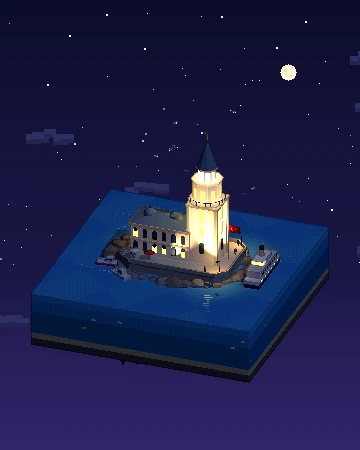
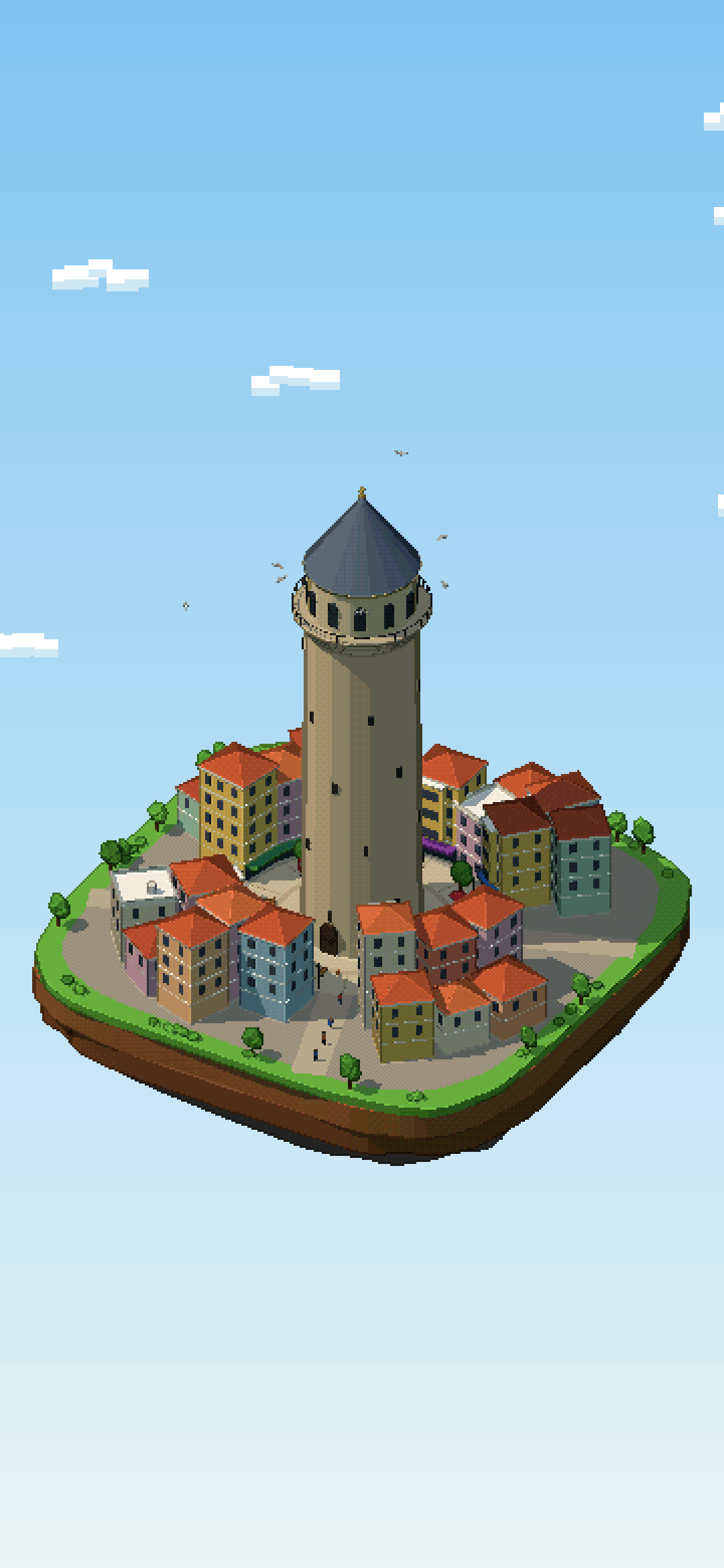
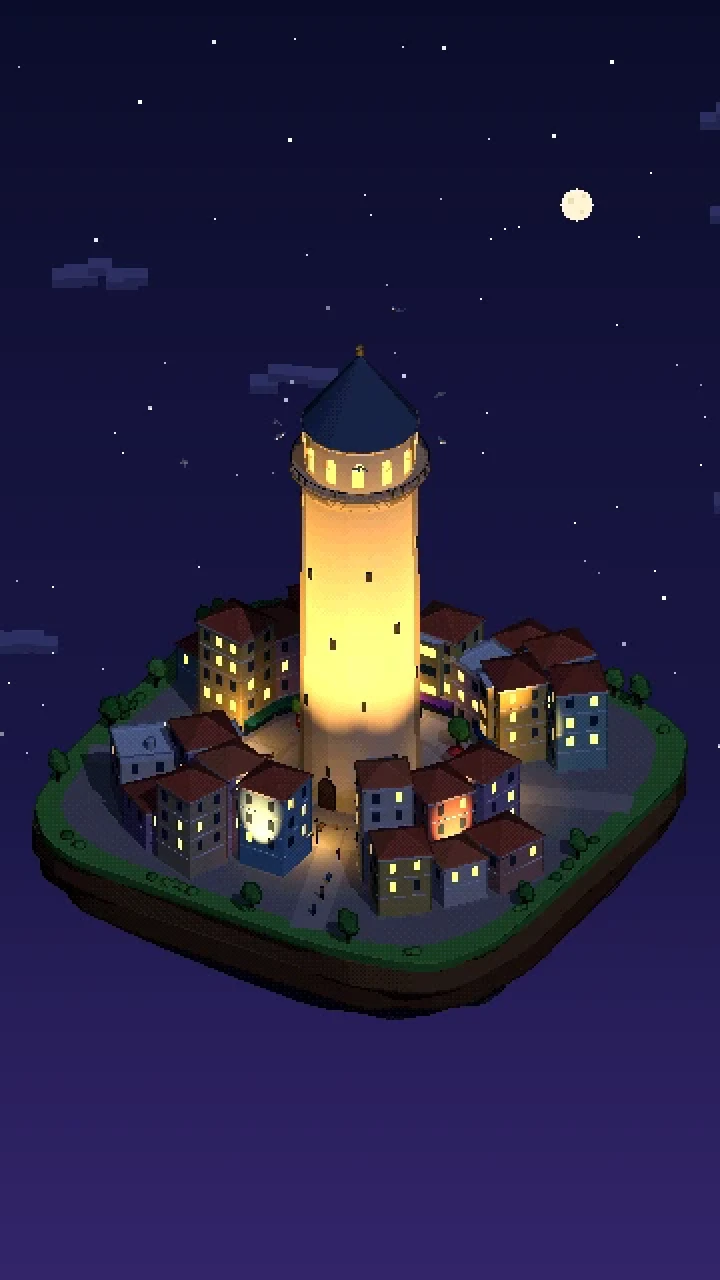
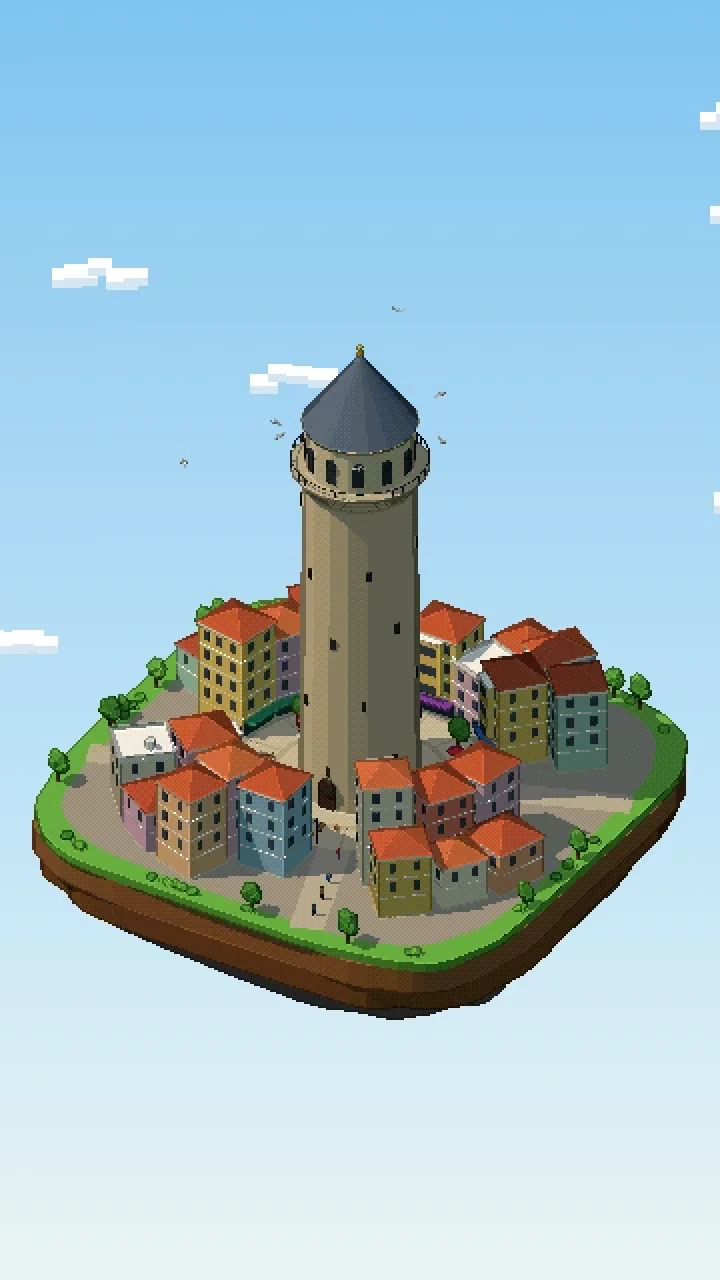
The diorama puts the tower on a floating island of Galata, built in Three.js and rendered as pixel art: the scene is drawn at a low resolution, every edge gets a dark outline, the colours are reduced to a small palette, and the result is scaled up without smoothing. The tower is modelled close to its real proportions: an 18-sided stone shaft that narrows slightly as it rises, a spiral of slit windows, a corbelled ring under the balcony, the arched gallery and the lead cone with its golden finial.
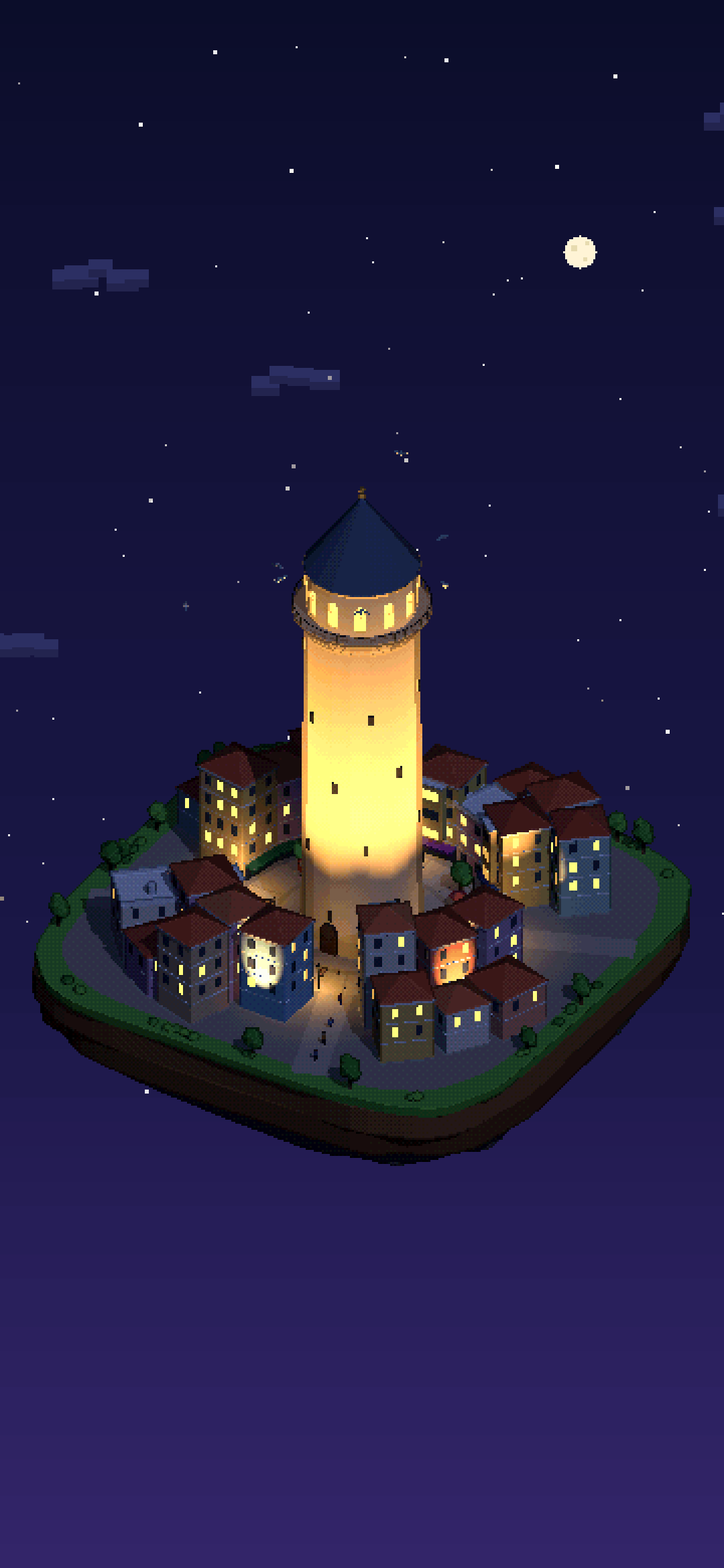
Around it, the cobbled Galata square opens in a circle, with streets leading off between rows of Beyoğlu houses in pastel ochre, pink and mint, many with bay windows (cumba) and tiled hip roofs. When the light changes from day to golden hour to night, the windows come on one by one, the street lamps light up and floodlights turn the tower warm against the sky.
Things to spot
- A red simit cart on the square
- Five cats, two of them on patrol
- Seagulls circling the cap
- Café parasols and benches under plane trees
- The lit gallery under the cone at night
What we simplified
- The houses are generic Beyoğlu row houses, not the actual buildings around the square.
- The street layout is idealised into a ring with four streets; the real square is smaller and steeper.
Questions
How tall is the Galata Tower?
The Galata Tower is 66.9 metres tall including the finial, or 62.6 metres without it. Its stone shaft is 16.45 metres across on the outside, with walls 3.75 metres thick.
When was the Galata Tower built?
The Galata Tower was built in 1348 by the Genoese colony of Galata, as the tallest point of the walls around their trading colony, and was called the Tower of Christ. Its pointed cap was rebuilt during the restoration of 1965–67.
Can you go to the top of the Galata Tower?
Yes. The Galata Tower is a museum today, and its observation balcony right below the cap looks over the Golden Horn, the Bosphorus and the domes of the old city.
Who flew from the Galata Tower?
According to the 17th-century traveller Evliya Çelebi, Hezârfen Ahmed Çelebi strapped on wings, jumped from the Galata Tower and glided across the Bosphorus to Üsküdar. Whether it really happened or not, it is Istanbul’s favourite legend.
How was this pixel-art diorama of the Galata Tower made?
It is a real-time Three.js scene running on this page, drawn at 360 × 640 pixels with dark outlines and a small palette, then scaled up without smoothing. The tower is modelled close to its real proportions, with an 18-sided stone shaft, a spiral of slit windows and the lead cone. Press “Explore in 3D” to drag it round and switch between day, dusk and night.
Isometric maps of Istanbul
Istanbul also has 2 isometric pixel-art maps made by the community: the whole city drawn tile by tile in the same SimCity-like style. See the maps of Istanbul →