About Balat
Balat is a neighbourhood in Istanbul’s Fatih district, on the western shore of the Golden Horn between Fener and Ayvansaray. Its name probably comes from the Greek palation, “palace”, after the Byzantine Palace of Blachernae nearby. The old Byzantine sea walls once cut it off from the water, and a plaque marks the place where Mehmed II’s troops entered the city on 23 April 1453.
For centuries it was one of the most mixed corners of the city. A large Jewish community settled here in the late 15th century, after Sultan Bayezid II welcomed Jews expelled from Spain, and at its peak Balat had 18 synagogues. Ahrida, founded in the 15th century by Jews from Ohrid, is one of three still in use. Greek Orthodox and Armenian families lived alongside them, and the Bulgarian St Stephen Church, built from prefabricated iron parts shipped from Vienna, still stands on the shore. Over the 20th century most of these communities left, and Balat became a poorer, working-class neighbourhood of small shops and workshops.
The houses are what people come for now. The back streets climb steeply from the shore, lined with narrow terraced houses of brick, stone and timber, many with a cumba, the Ottoman bay window that juts out over the street. From 2003 a rehabilitation programme funded by the European Union and run with UNESCO and Fatih Municipality repaired houses in Fener and Balat, and in the 2020s, as the neighbourhood became one of Istanbul’s most popular places to visit, many were repainted in bright colours and turned into cafés, galleries and guesthouses.
Kiremit Caddesi, with its row of red, yellow, blue and green houses, is the most photographed street; Merdivenli Yokuş, a stepped lane nearby, is usually quieter. Up the hill in neighbouring Fener stands the Phanar Greek Orthodox College, a huge red-brick building of 1881–83 by the architect Konstantinos Dimadis that locals call the Red Castle. Today the T5 tram and the Golden Horn ferries stop in Balat, and Vodina Caddesi below the hill is full of cafés, antique shops and cats.
The diorama
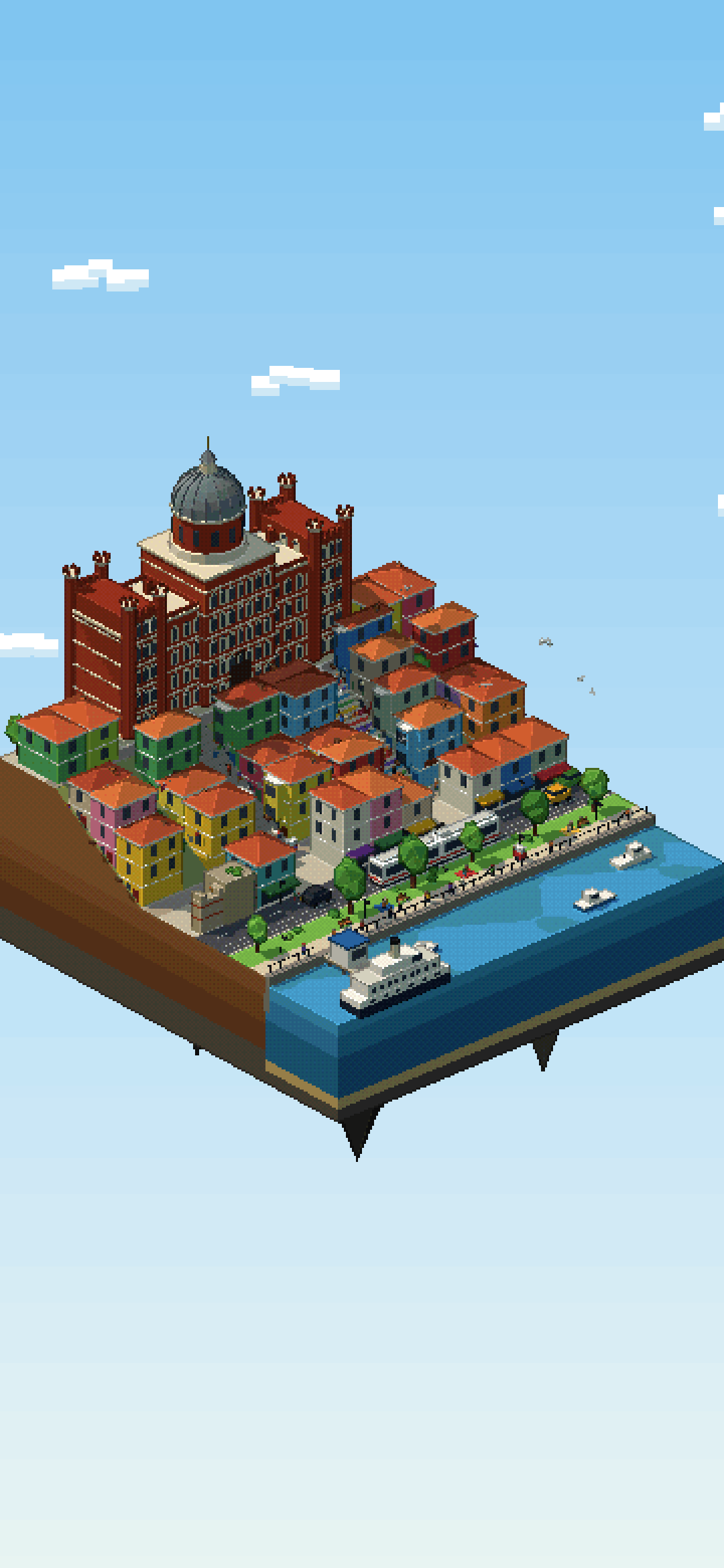
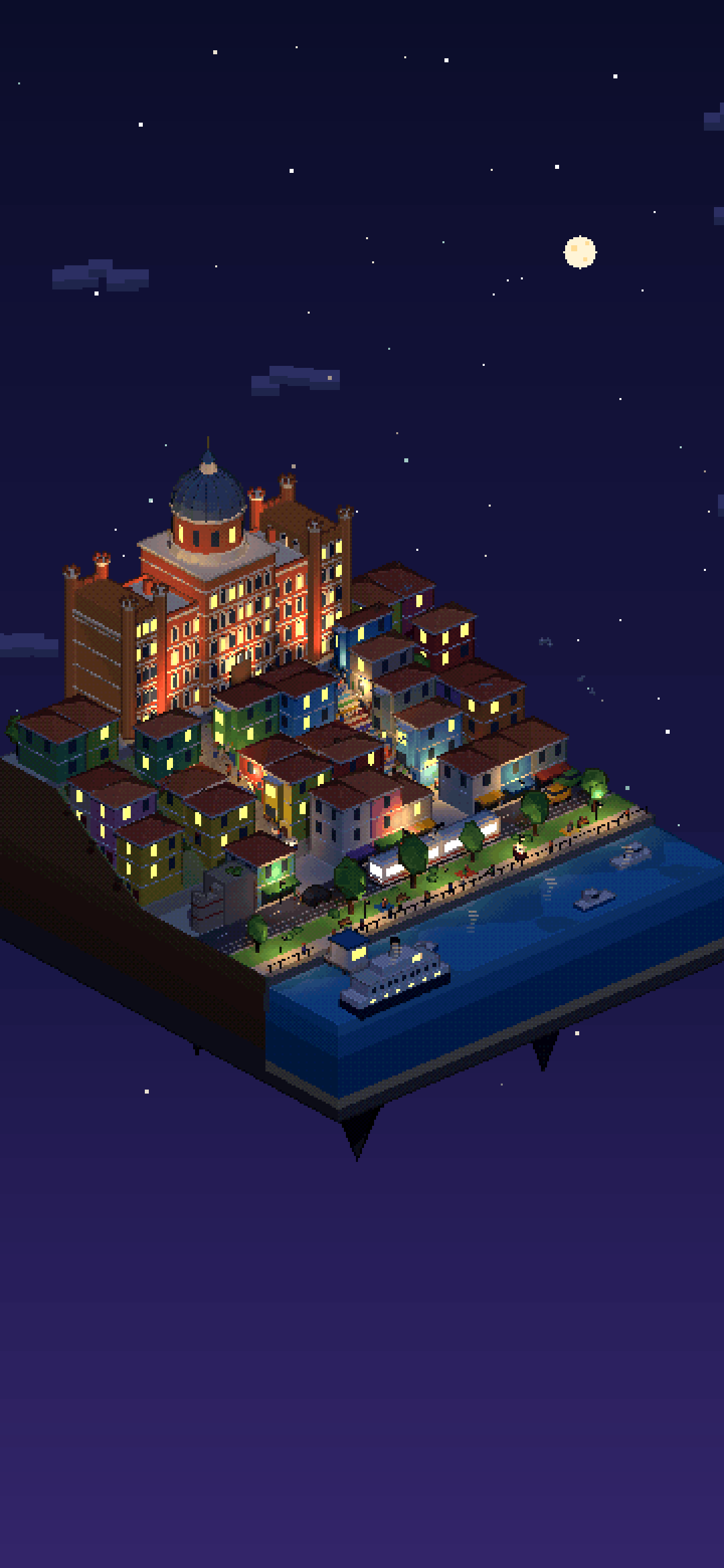
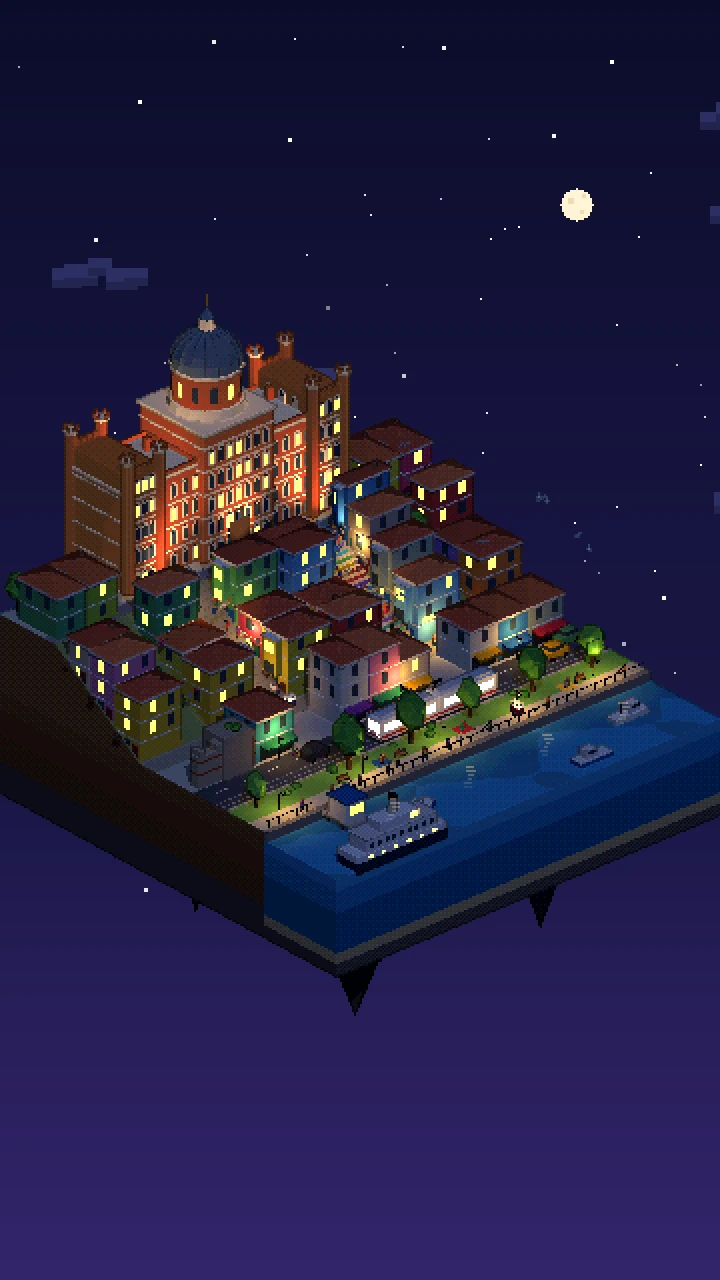
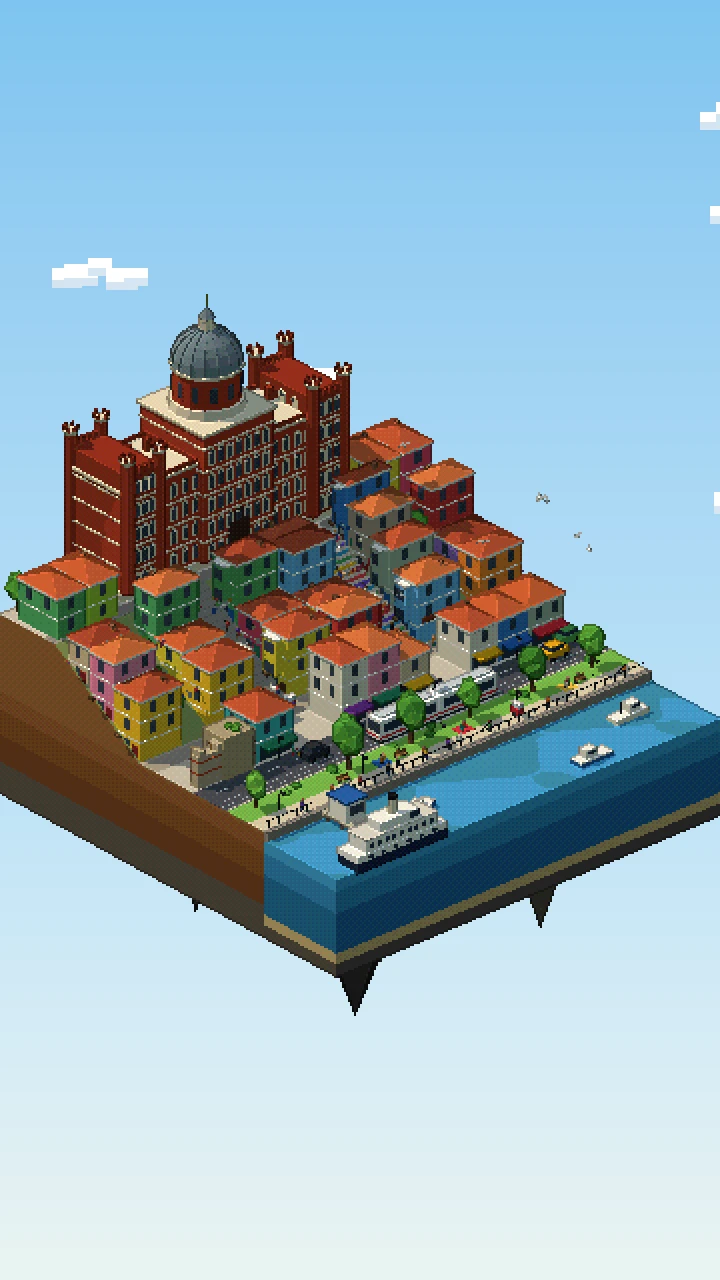
The diorama cuts a block of Balat out of the hill as a floating island, built in Three.js and rendered as pixel art: the scene is drawn at a low resolution, every edge gets a dark outline, the colours are reduced to a small palette, and the result is scaled up without smoothing. It reads from the water up the slope: the Golden Horn with the Balat ferry pier, a moored Haliç ferry and fishing boats; a seaside park with plane trees, benches and men fishing over the rail; the coast road with the white-and-red T5 tram and a stump of the Byzantine sea walls; a row of shops, then flat Vodina Caddesi with low stools, tea glasses and a simit cart.
From Vodina two lanes climb straight up the hill: cobbled Kiremit Caddesi with a car parked on the slope, and stepped Merdivenli Yokuş with its risers painted in rainbow colours. Both are lined with two- and three-storey row houses in red, yellow, blue, green and pink, most with cumbas, shutters and flower boxes, stepping up the slope under tiled hip roofs, with washing strung across the lanes. On the crest above them stands the Red Castle, a long red-brick building with stone bands, end pavilions with corner turrets and a domed central tower. At night the café signs glow, wall lanterns light the lanes, the college is floodlit and the shore lamps shimmer on the water.
Things to spot
- Friends posing against the coloured houses on Kiremit Caddesi while someone takes the photo
- A cat asleep on the roof of the car parked on the slope
- The T5 tram sliding along the coast road and pausing at the Balat stop
- Two simit carts, one on Vodina and one in the park
- Men fishing off the rail, rods out over the Golden Horn
- Laundry strung across the lanes
What we simplified
- Kiremit Caddesi and Merdivenli Yokuş are not really side by side: they are placed as two parallel lanes climbing straight up from the shore so both fit on the island.
- The hill is compressed and the Red Castle is drawn larger than life; the real college stands further up the hill, in neighbouring Fener, not right above these lanes.
- The rainbow-painted steps are a nod to Balat’s colourful stairs; the stairs famous for that are a separate spot in the neighbourhood.
- The houses are generic Balat row houses, not the actual buildings on either street.
Questions
Why are Balat’s houses colourful?
Balat’s old terraced houses were repaired in the 2000s under a rehabilitation programme funded by the European Union and run with UNESCO, and in the 2020s, as the neighbourhood became popular with visitors, many were repainted in bright colours and turned into cafés, galleries and guesthouses.
Where are the colourful houses in Balat?
The best-known row is on Kiremit Caddesi, which climbs the hill from Vodina Caddesi. Merdivenli Yokuş, a stepped lane nearby, has more colourful houses and is usually quieter.
What is the red building above Balat?
It is the Phanar Greek Orthodox College, built in red brick in 1881–83 to a design by the architect Konstantinos Dimadis. Locals call it the Red Castle. It stands on the hill in neighbouring Fener and is still a school, so visitors cannot go inside.
How do you get to Balat?
The T5 tram stops in Balat, and Golden Horn ferries call at the Balat pier. You can also walk along the shore of the Golden Horn from Fener.
How was this pixel-art diorama of Balat made?
It is a real-time Three.js scene running on this page, drawn at 360 × 640 pixels with dark outlines and a small palette, then scaled up without smoothing. Every house is built from code with its own colour, cumba and roof, stepping up the slope. Press “Explore in 3D” to drag it round and switch between day, dusk and night.
Isometric maps of Istanbul
Istanbul also has 2 isometric pixel-art maps made by the community: the whole city drawn tile by tile in the same SimCity-like style. See the maps of Istanbul →