About Belém Tower
Belém Tower guarded the mouth of the Tagus at the height of Portugal’s Age of Discovery. King Manuel I ordered the fortress, the military architect Francisco de Arruda designed it, and it was finished in 1519, two years before the king died. Officially it is the Tower of Saint Vincent, after Lisbon’s patron saint. It was built on a small island close to the shore at Restelo, the beach from which many voyages set out; land reclaimed over the centuries has since brought the bank right up to it.
The fortress has two parts: a low bastion shaped like an irregular hexagon, with cannon openings along its walls, and a square tower about 30 metres tall rising behind it. Inside the tower are a governor’s hall, the King’s Hall with its loggia of seven arches looking over the river, an audience hall and a rib-vaulted chapel, with a roof terrace on top.
It is one of the finest buildings of the Manueline style, the exuberant Portuguese late Gothic named after the king. Look for stone carved as twisted rope, armillary spheres (Manuel’s emblem), the Cross of the Order of Christ on the shield-shaped battlements, watch turrets topped with ribbed domes, and a small rhinoceros below one of them, probably the animal Manuel sent to Pope Leo X in 1515.
Over time the tower also served as a prison, a customs post and a signal station. It became a national monument in 1907 and, together with the nearby Jerónimos Monastery, a UNESCO World Heritage Site in 1983. Belém is also home to the custard tarts sold since 1837 as pastéis de Belém, while Lisbon’s famous tram 28 rattles through the old hill districts across town.
The diorama
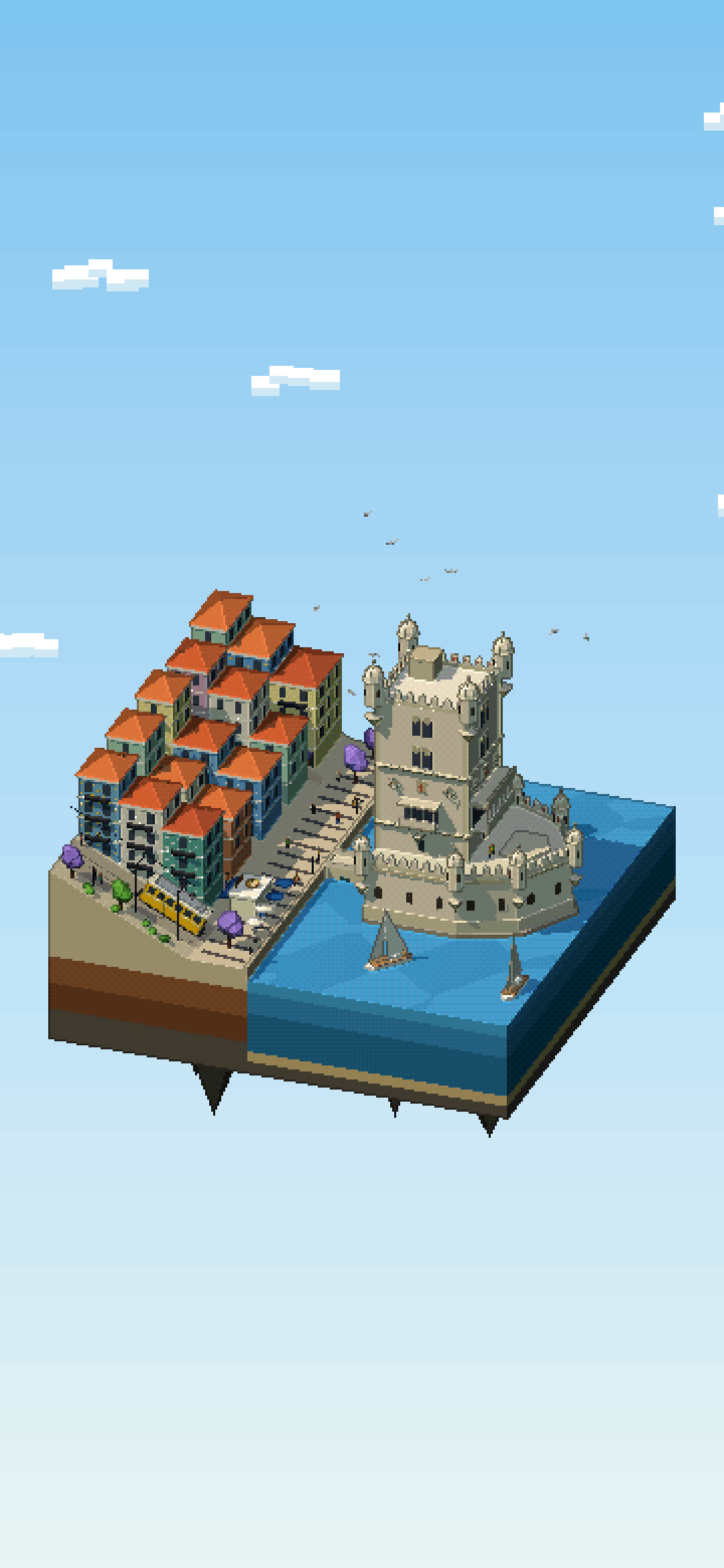
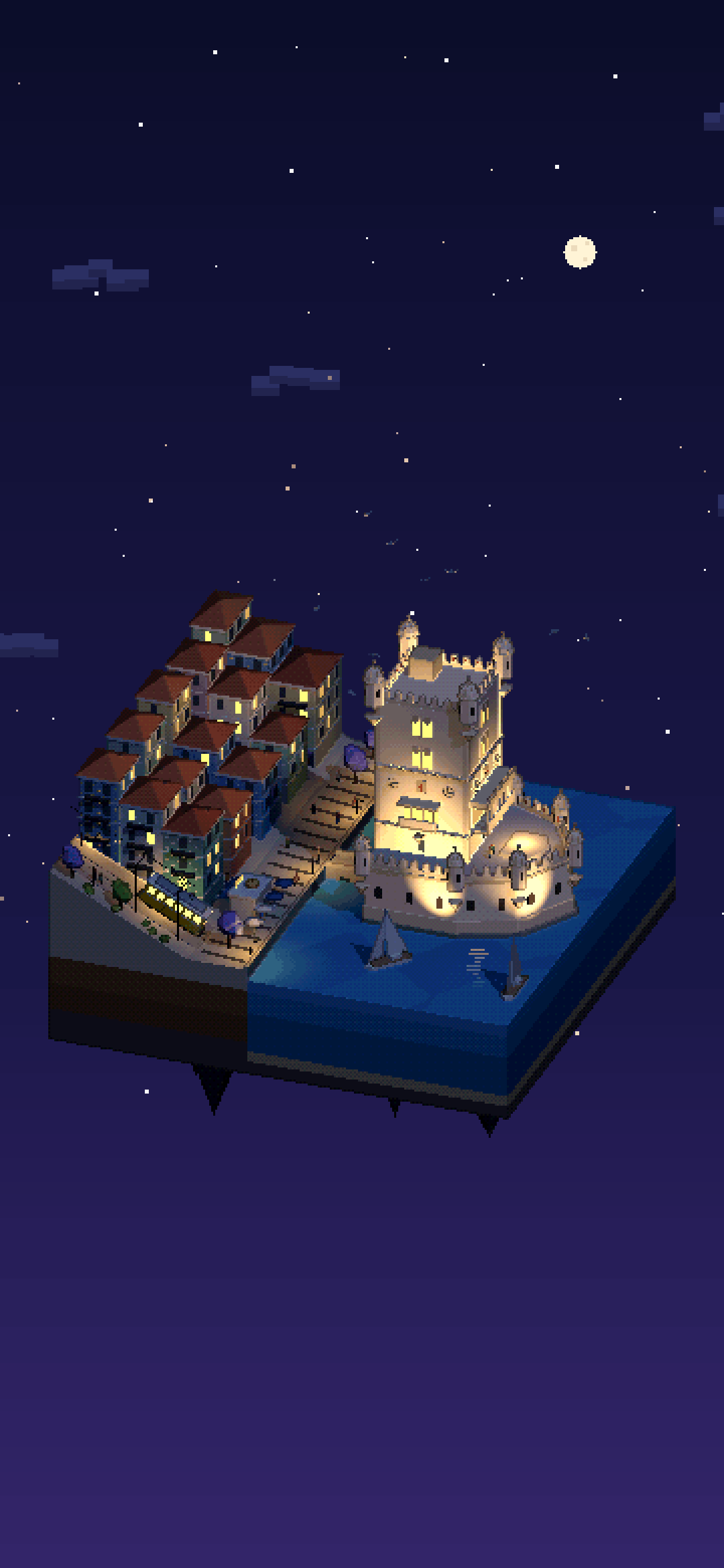
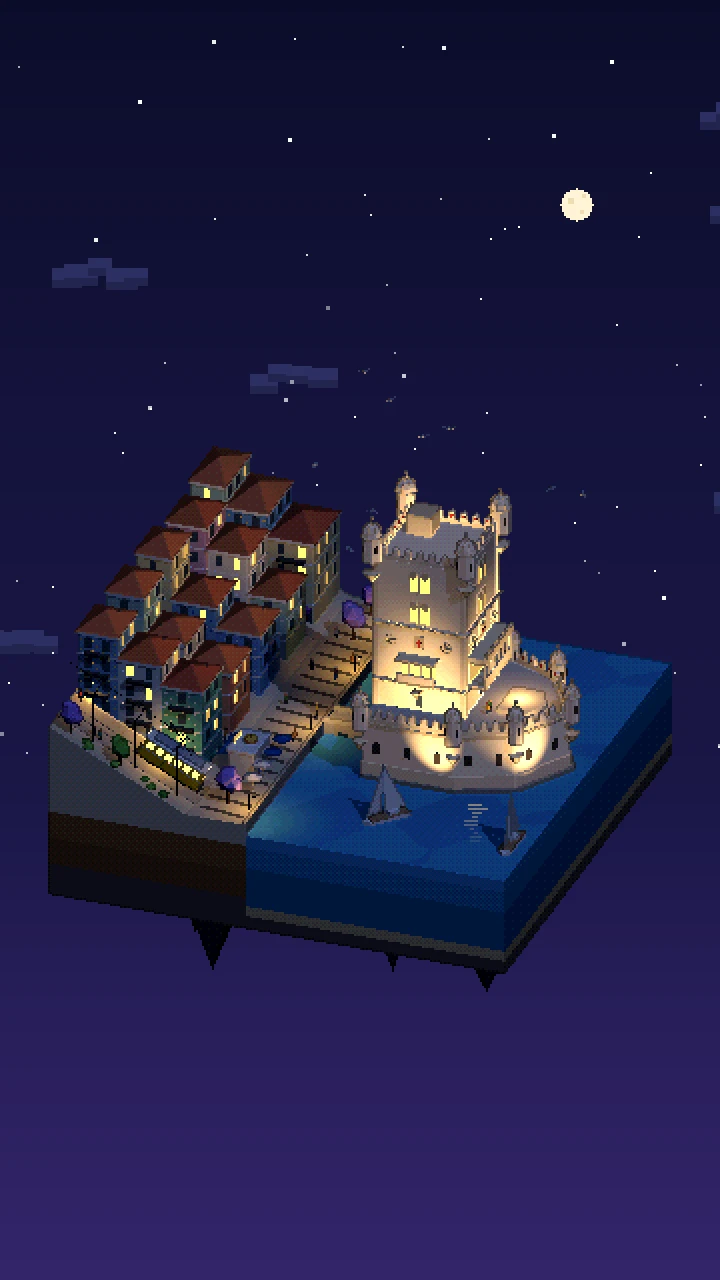
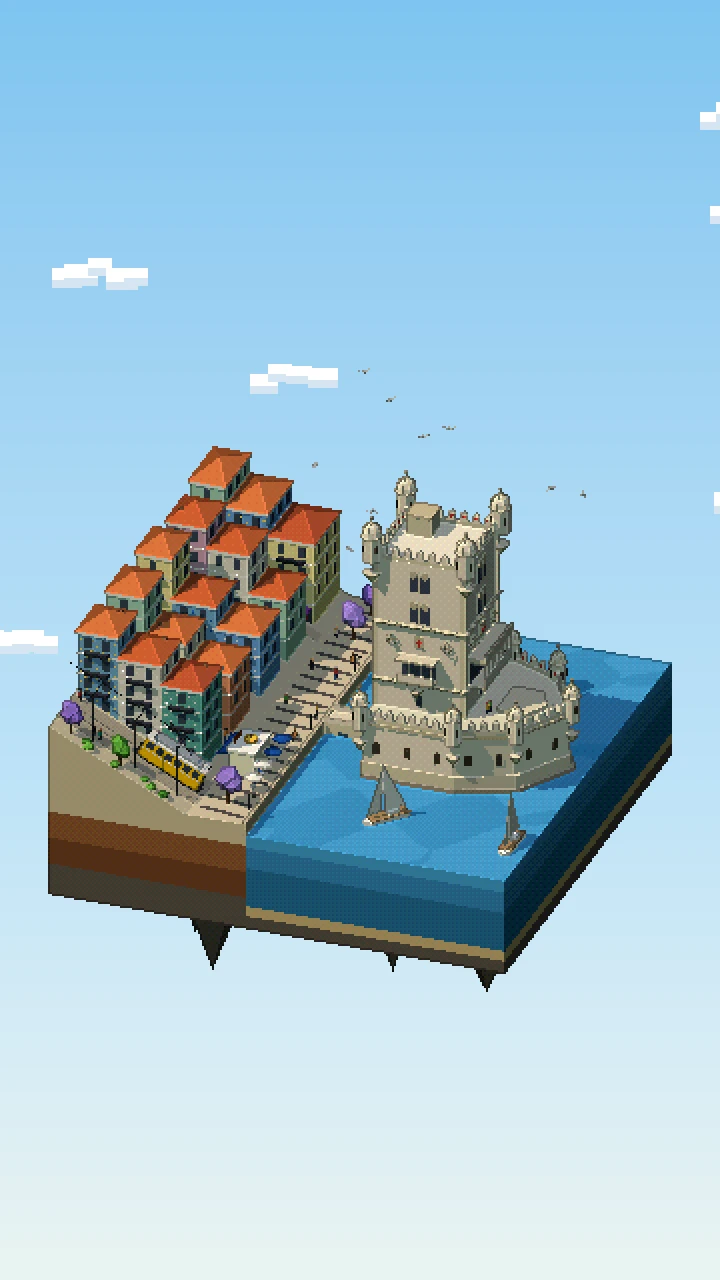
The diorama is a cut-out block of Lisbon, half river and half hillside, built in Three.js and rendered as pixel art: drawn at a low resolution, outlined in dark pixels, reduced to a small palette and scaled up without smoothing. The tower stands in the Tagus at roughly its real proportions, joined to the shore by a short stone walkway: the hexagonal bastion with its embrasures, a cloister well and shield-shaped merlons with red crosses, the square tower with paired arched windows, rope mouldings, armillary spheres, side balconies, the arched loggia over the river and eleven watch turrets with ribbed domes.
On the shore, a steep cobbled street climbs between pastel houses, some covered in blue, green and white azulejo tiles, with iron balconies and terracotta roofs, while a yellow Remodelado tram 28 grinds up the hill under its overhead wire and rolls back down. On the riverside promenade there is a pastel de nata café under jacaranda trees, and sailing boats circle the tower while gulls wheel overhead. At night the windows light up, floodlights turn the tower gold and the tram glows from inside.
Things to spot
- The yellow tram 28 climbing the hill
- A giant pastel de nata on the café roof
- Red crosses on the battlements
- Azulejo-tiled houses among the pastel ones
- Visitors walking the bastion terrace
- Three sailing boats on the Tagus
What we simplified
- Tram 28 does not actually run to Belém (it climbs through Graça, Alfama and Estrela); the street and houses are a generic slice of old Lisbon placed next to the tower.
- The bastion is simplified, the riverbank is much closer than in reality, and the Padrão dos Descobrimentos and the Jerónimos Monastery nearby are left out.
Questions
How tall is Belém Tower?
Belém Tower is about 30 metres tall. Its square tower is roughly 12 metres wide and stands at the back of a lower, hexagonal bastion that juts out into the Tagus.
When was Belém Tower built and by whom?
Belém Tower was built between about 1514 and 1519 on the orders of King Manuel I, to a design by the military architect Francisco de Arruda. It is officially called the Tower of Saint Vincent, after Lisbon’s patron saint.
Was Belém Tower built in the middle of the river?
No. It was built on a small island close to the shore. The often-repeated story that the river moved after the 1755 earthquake is not right: land reclaimed over the centuries brought the bank right up to the tower.
Does tram 28 go to Belém Tower?
No. Tram 28 runs between Martim Moniz and Prazeres through Graça, Estrela and Campo de Ourique. To reach Belém by tram, take line 15. The diorama puts a tram 28 next to the tower simply to show two Lisbon icons in one scene.
How was this pixel-art diorama of Belém Tower made?
It is a real-time Three.js scene running on this page, drawn at 360 × 640 pixels with dark outlines and a small palette, then scaled up without smoothing. The tower is modelled close to its real proportions, with the hexagonal bastion, rope mouldings and ribbed-dome turrets, next to a hillside street with a working tram. Press “Explore in 3D” to drag it round and switch between day, dusk and night.
Isometric maps of Lisbon
Lisbon also has an isometric pixel-art map made by the community: the whole city drawn tile by tile in the same SimCity-like style. See the map of Lisbon →