About Sagrada Família
The Sagrada Família is a church that has been under construction for more than 140 years. Work began in 1882 on a fairly ordinary Gothic Revival design, and a year later the young Antoni Gaudí took over. He redrew it completely and spent the rest of his life on it, moving into his workshop on the site in his final months. When he died in 1926, after being hit by a tram, the Nativity facade was nearly complete but only one of its towers was finished.
Gaudí planned three facades, each telling part of the life of Christ. The Nativity facade on the east, the one he built himself, is dense with carved figures, plants and animals and looks almost organic. The Passion facade on the west, made decades later by the sculptor Josep Maria Subirachs, is stark and angular on purpose. The Glory facade, the main entrance, is still being built.
Inside, the columns branch like trees to hold up the vaults, and the stained glass fills the nave with cool colours on the east side and warm ones on the west. The building is paid for by donations and visitors’ tickets, rather than public money, which is one reason it has taken so long. It was consecrated as a basilica in 2010.
The skyline is defined by its towers: eight bell towers over the two side facades, four for the evangelists around the centre, one for the Virgin Mary topped with a glass star, and the central Tower of Jesus Christ, topped out at 172.5 metres in 2026, which made the Sagrada Família the tallest church in the world.
The diorama
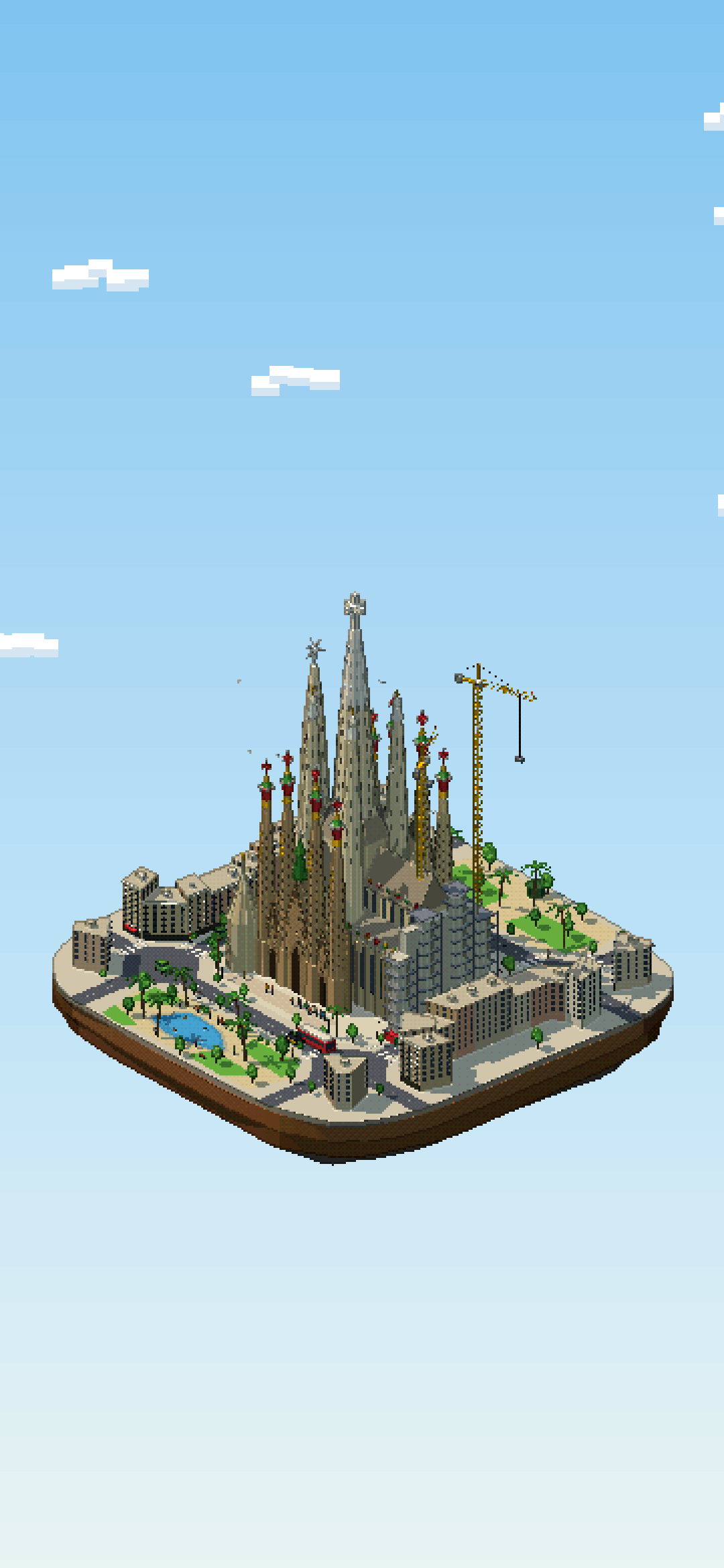
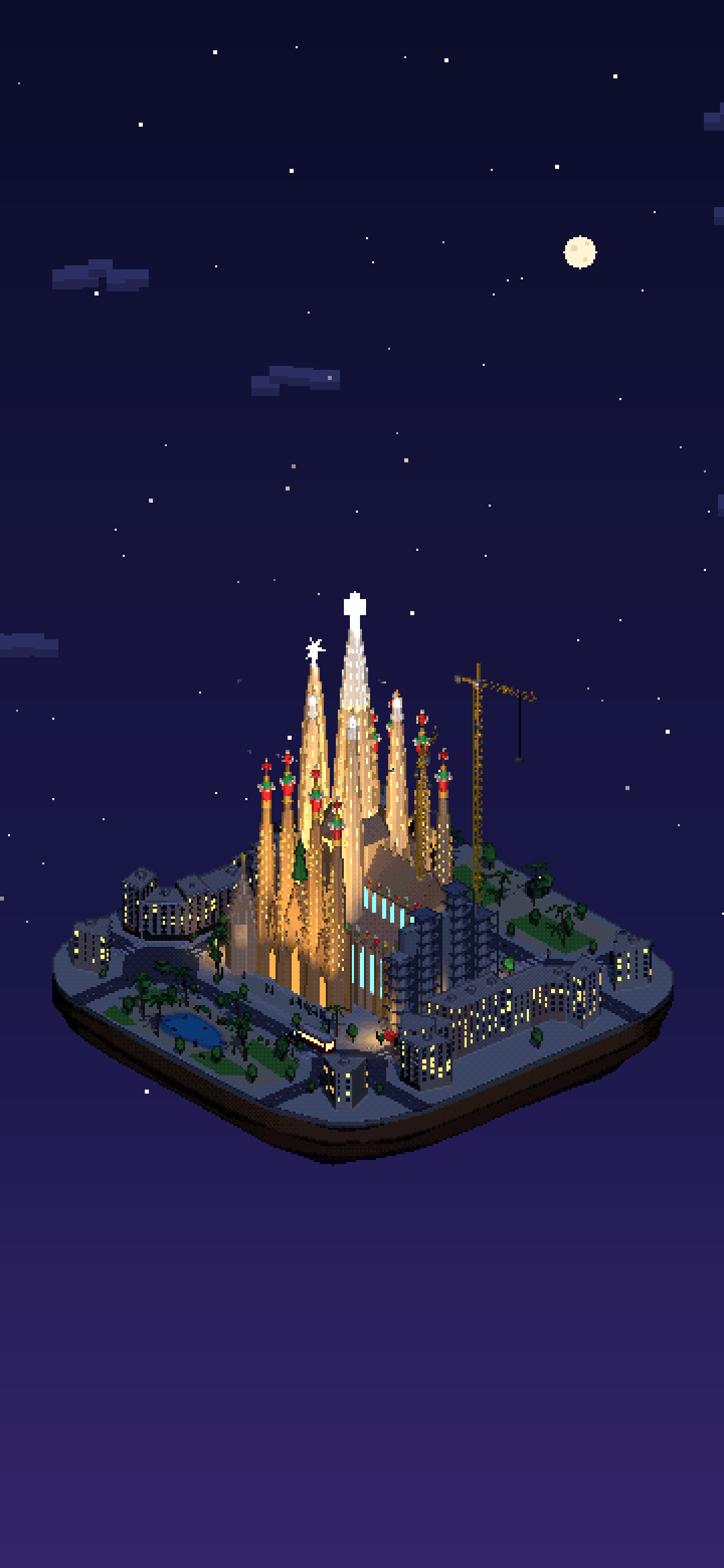
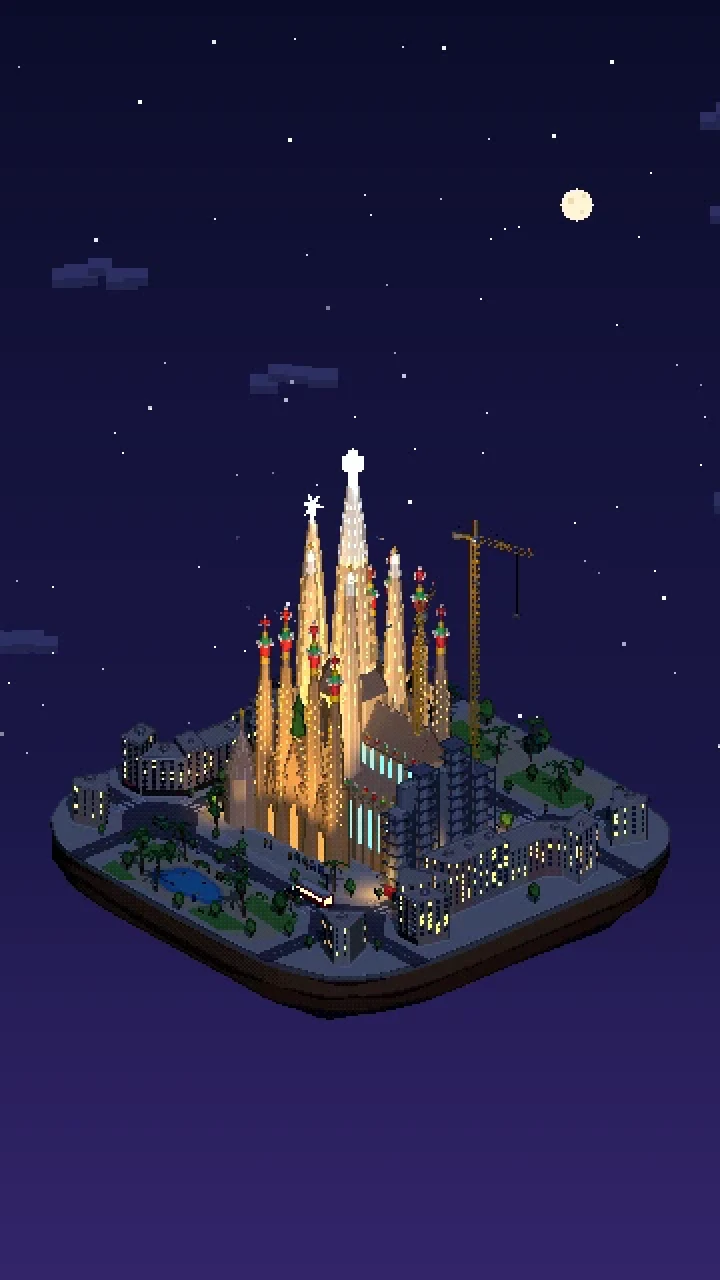
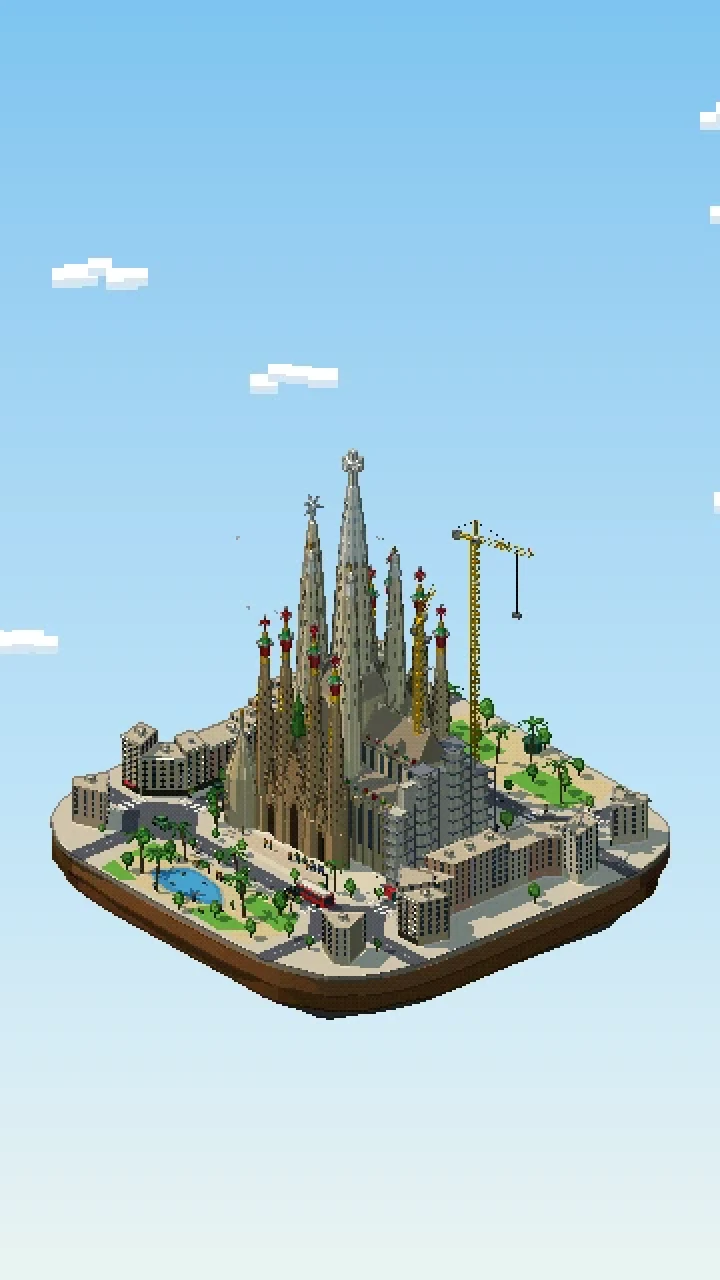
The diorama shows the basilica with the Tower of Jesus Christ at its full height, filling its whole Eixample block with the chamfered corners typical of Barcelona’s grid. The Latin-cross plan, the nave, the apse with its ring of spiky chapels and the sacristy domes are all modelled, along with the eight bell towers with their spiralling openings, the four ribbed Evangelist towers, the Virgin Mary’s tower with its twelve-pointed star and the central tower with its four-armed cross. The Nativity facade is dark and lumpy, with the cypress of the Tree of Life and white doves; the Passion facade is pale and angular, with leaning columns like bones.
On the south-east side the Glory facade is still a building site: concrete stubs in scaffolding, a fence and containers, and two tower cranes that slowly swing their loads. Around the block are Eixample corner buildings, the pond and palms of Plaça de Gaudí, and streets full of traffic. At night the stone is floodlit warm, the tower openings glow, and the star and the cross shine.
Things to spot
- Two tower cranes lifting loads over the Glory facade
- Barcelona taxis in black and yellow, and a red bus
- Ducks on the pond in Plaça de Gaudí
- Photographers by the pond and a queue at the Nativity facade
- “Hosanna” and “Sanctus” lettering on the bell towers
- The glowing cross and star at night
What we simplified
- The basilica is stretched a little upwards, and the cross, the star and the pinnacles are slightly oversized so they read at pixel scale.
- The neighbouring buildings are generic Eixample blocks, not the actual houses around the church.
- The sculpture on the facades is suggested by texture rather than carved figure by figure.
Questions
How tall is the Sagrada Família?
The Sagrada Família’s central Tower of Jesus Christ is 172.5 metres tall. It was topped out in 2026, which made the Sagrada Família the tallest church in the world.
Who designed the Sagrada Família?
Antoni Gaudí designed the Sagrada Família: he took over in 1883, a year after work began, redrew it completely and worked on it until his death in 1926. The Passion facade was made decades later by the sculptor Josep Maria Subirachs.
Is the Sagrada Família finished?
Not yet. The Glory facade, the main entrance, is still under construction, more than 140 years after work began in 1882.
Why is the Sagrada Família taking so long to build?
One reason is money: the Sagrada Família is paid for by donations and visitors’ tickets rather than public money. Work began in 1882 and has gone on for more than 140 years.
How was this pixel-art diorama of the Sagrada Família made?
It is a real-time Three.js scene on this page, drawn at 360 × 640 pixels with outlines and a small palette and scaled up without smoothing. It shows the basilica with the Tower of Jesus Christ at full height and the Glory facade still a building site. Press “Explore in 3D”, drag to turn it, and switch between day, dusk and night.
Isometric maps of Barcelona
Barcelona also has 2 isometric pixel-art maps made by the community: the whole city drawn tile by tile in the same SimCity-like style. See the maps of Barcelona →