About Royal Palace of Madrid
The Royal Palace stands on the spot where Madrid’s old Moorish fortress, later the royal Alcázar, stood for centuries. On Christmas Eve 1734 a fire burned for four days and destroyed the Alcázar completely. King Philip V, the first Bourbon king of Spain, decided to build a new palace on the same site.
The Italian architect Filippo Juvarra drew the first plans but died soon after, and his pupil Giovanni Battista Sacchetti adapted them to the site. Building ran from 1738 to 1755. Charles III was the first king to live in the palace, from 1764, and his architect Francesco Sabatini enlarged it. The facades mix grey granite with white limestone, and the statues of kings that once lined the roof were moved elsewhere to give the building a more classical look.
With about 135,000 square metres of floor space and 3,418 rooms, it is often called the largest royal palace in Western Europe. It is still the official residence of the King of Spain, but the royal family lives elsewhere and uses it for state ceremonies, banquets and receptions. The state owns it and Patrimonio Nacional runs it, and many of its rooms are open to visitors.
The main front looks south onto the Plaza de la Armería, a vast paved forecourt. Across the square stands the Almudena Cathedral, begun in 1883 and consecrated by Pope John Paul II in 1993. To the east, the Plaza de Oriente has a bronze of Philip IV on a rearing horse by Pietro Tacca, and to the north lie the formal Sabatini Gardens, opened to the public in 1978.
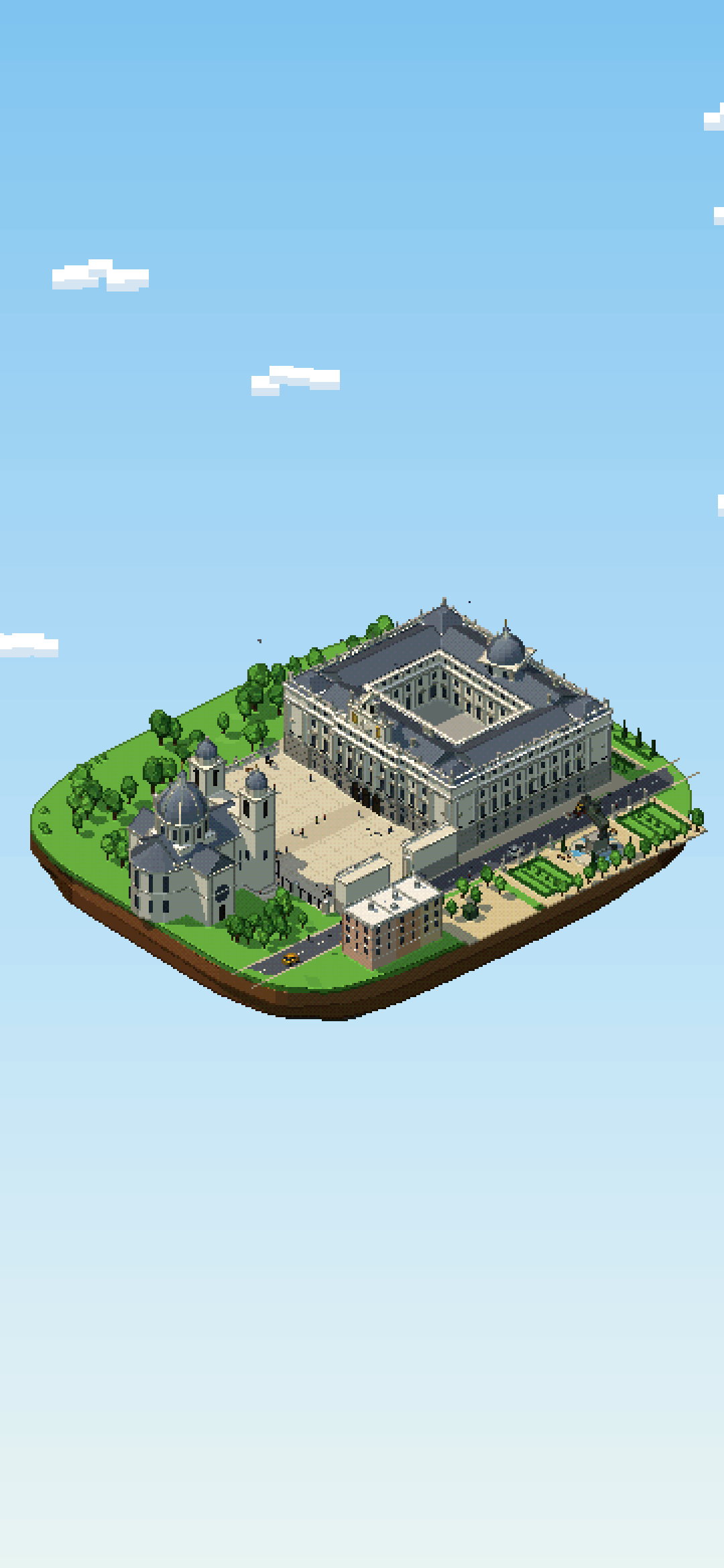
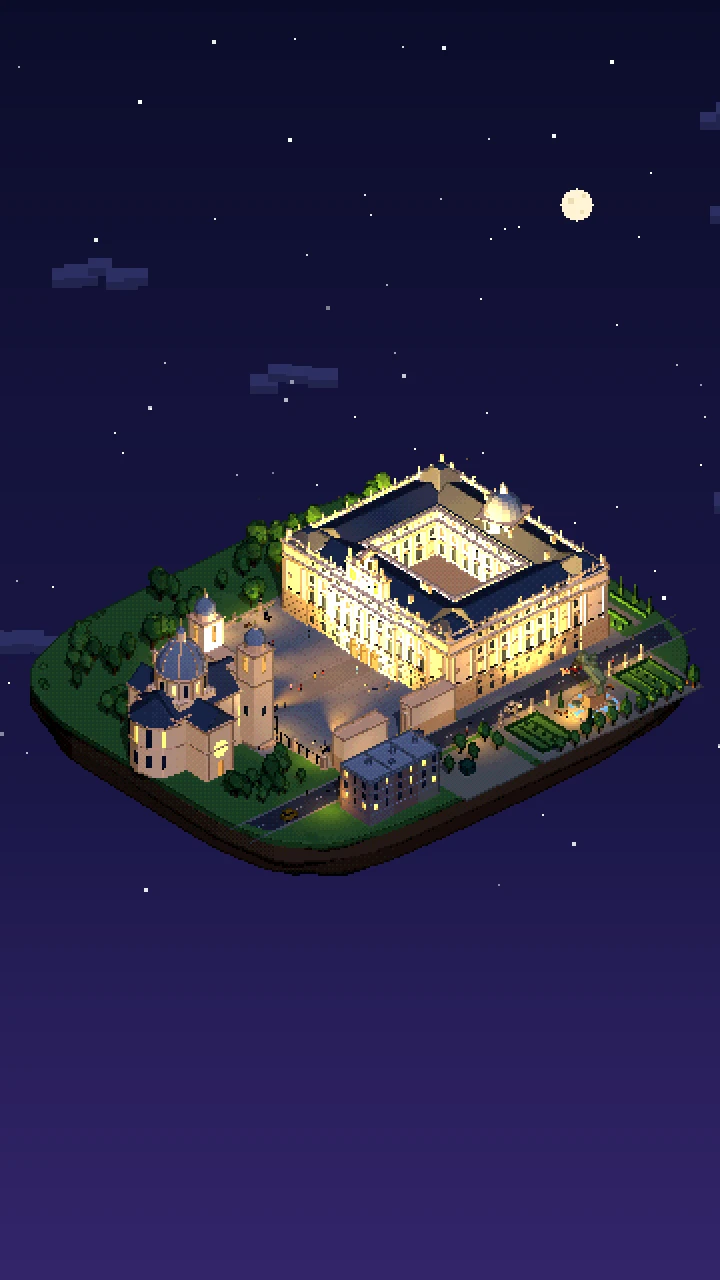
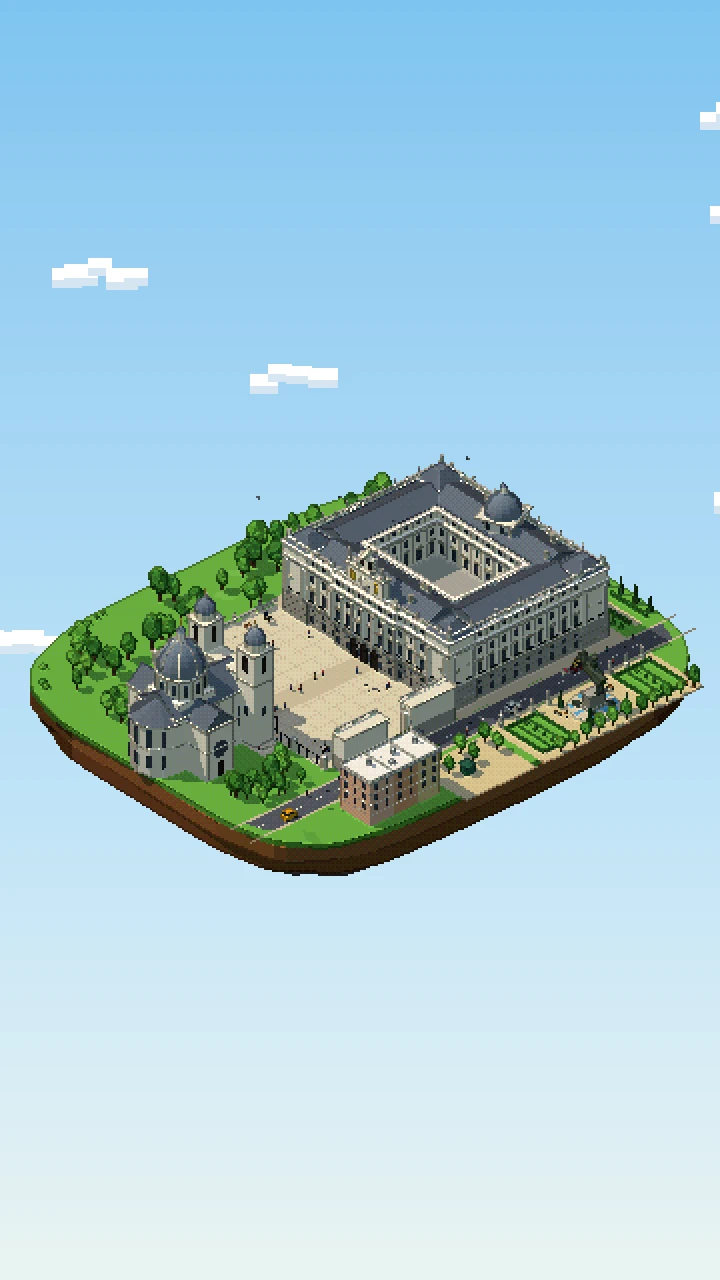
The diorama
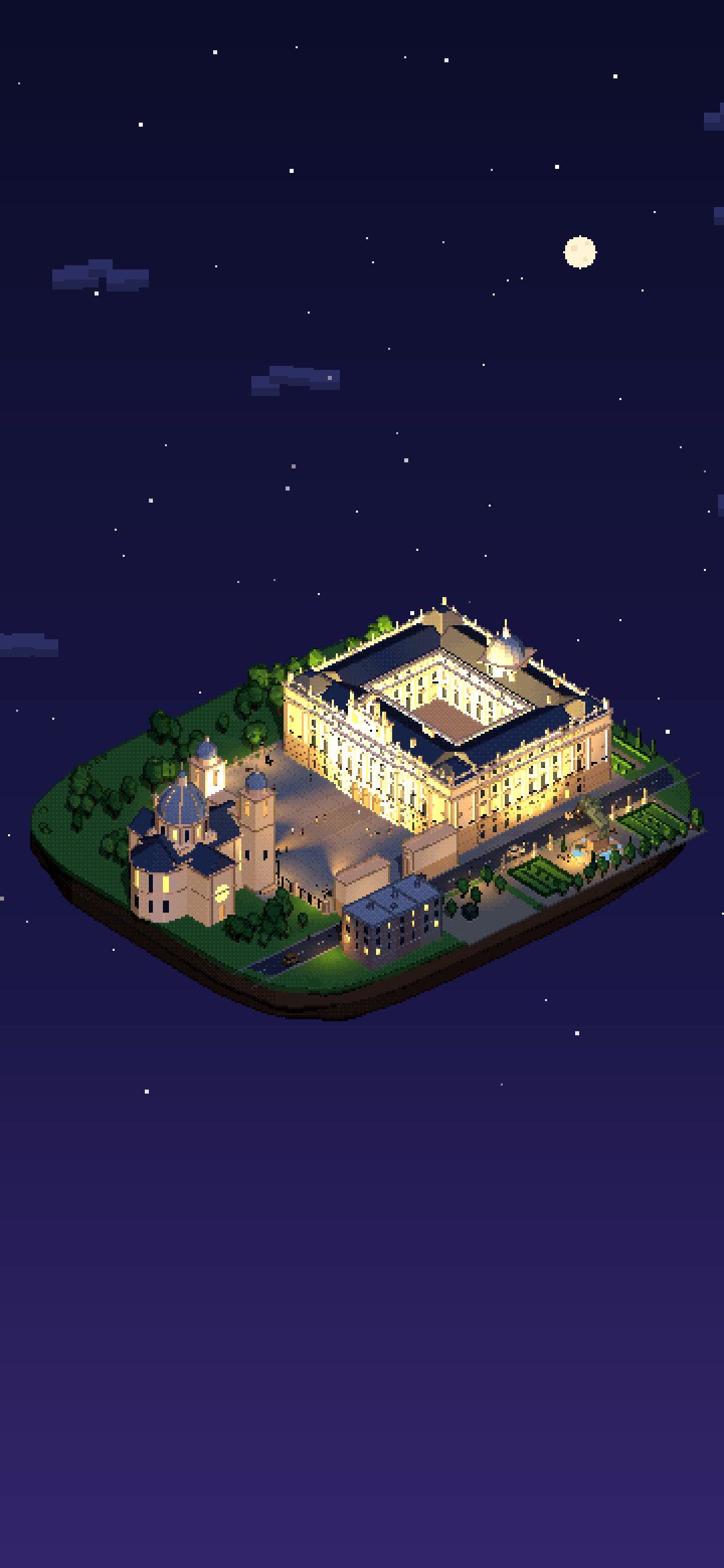
The palace is a square block around its courtyard, with a grey granite base, giant white pilasters, rows of framed windows with balconies and alternating pediments, an attic storey and a balustrade topped with statues and vases. On the south front, engaged columns frame the three doors, with Sabatini’s clock, the royal arms and the bell frame above, and the dome of the Royal Chapel rises over the north wing. Heights are drawn about a quarter taller so the facade reads at pixel size.
In front, the Plaza de la Armería has its arcaded east gallery, the Puerta del Príncipe with two mounted guards, and a detachment of the Royal Guard marching round the square, closed to the south by the Almudena Cathedral with its twin towers and grey ribbed dome. Across the Calle de Bailén, Philip IV rears over a fountain in the Plaza de Oriente among clipped parterres and stone kings, and the Sabatini Gardens line up their hedges and long pool to the north. At night the palace and the cathedral are floodlit gold.
Things to spot
- The guard detachment marching round the Armería, with red plumes
- Two mounted guards on patrol and two more at the Puerta del Príncipe
- A horse-drawn carriage on the Calle de Bailén
- Sabatini’s clock and the bell frame over the main front
- Philip IV’s rearing horse in the Plaza de Oriente
- Pigeons pecking on the forecourt
What we simplified
- The palace, the Armería and the cathedral are pulled much closer together than in reality, and the Plaza de Oriente and the Sabatini Gardens are squeezed into narrow strips.
- The facades repeat one bay design; the real fronts vary from side to side, and the courtyard arcades and roofs are simplified.
- The marching guard is a loose nod to the Royal Guard’s changing ceremonies, not a faithful copy of the uniforms or drill.
Questions
When was the Royal Palace of Madrid built?
It was built between 1738 and 1755, after the old Alcázar burned down on Christmas Eve 1734. Filippo Juvarra drew the first design and Giovanni Battista Sacchetti carried it out. Charles III was the first king to live there, from 1764.
How big is the Royal Palace of Madrid?
It has about 135,000 square metres of floor space and 3,418 rooms, and is often called the largest royal palace in Western Europe.
Does the Spanish royal family live in the Royal Palace?
No. The palace is the official residence of the King of Spain, but the royal family lives elsewhere and uses it for state ceremonies, banquets and receptions. It is run by Patrimonio Nacional, and much of it is open to visitors.
When is the Changing of the Guard at the Royal Palace?
The guard is changed at the Puerta del Príncipe on Wednesdays and Saturdays in the late morning. On the first Wednesday of most months there is a much larger Solemn Changing of the Guard in the Plaza de la Armería, with hundreds of soldiers and horses. Check Patrimonio Nacional’s website for current dates.
How was this pixel-art diorama of the Royal Palace of Madrid made?
It is a real-time Three.js scene running on this page, drawn at 360 × 640 pixels with outlines and a small palette, then scaled up without smoothing. Press “Explore in 3D”, drag to turn it, and switch between day, dusk and night.
Isometric maps of Madrid
Madrid also has an isometric pixel-art map made by the community: the whole city drawn tile by tile in the same SimCity-like style. See the map of Madrid →