About Eiffel Tower
The Eiffel Tower was built in just over two years as the entrance arch to the 1889 World’s Fair, which marked the centenary of the French Revolution. Engineers Maurice Koechlin and Émile Nouguier of Gustave Eiffel’s company drew the first sketch; architect Stephen Sauvestre added the decorative arches at the base and the glazed hall on the first floor. At 300 metres it was the tallest structure in the world until 1930.
It was meant to stand for only twenty years. Many Parisian artists signed a protest against the “useless and monstrous” tower before it was even finished. It survived because it was useful: Eiffel ran experiments in meteorology and aerodynamics from the top, and the tower became a radio antenna. Antennas still crown it today, which is why it now measures 330 metres.
The shape is a direct answer to the wind. Four lattice legs curve inward and meet above the second platform, and the openwork lets the wind pass through. The whole iron structure weighs about 7,300 tonnes and is repainted roughly every seven years in its own shade of bronze, known as Eiffel Tower brown.
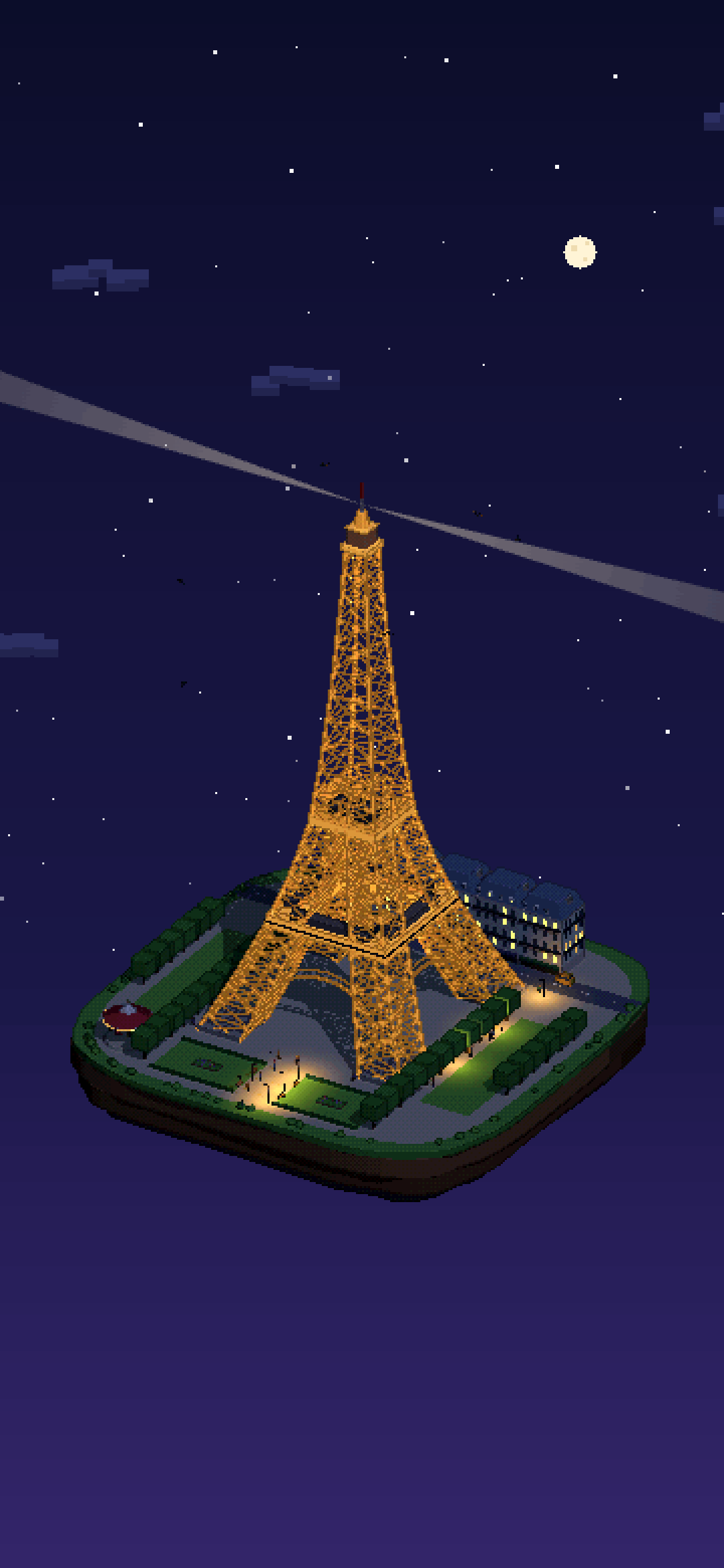
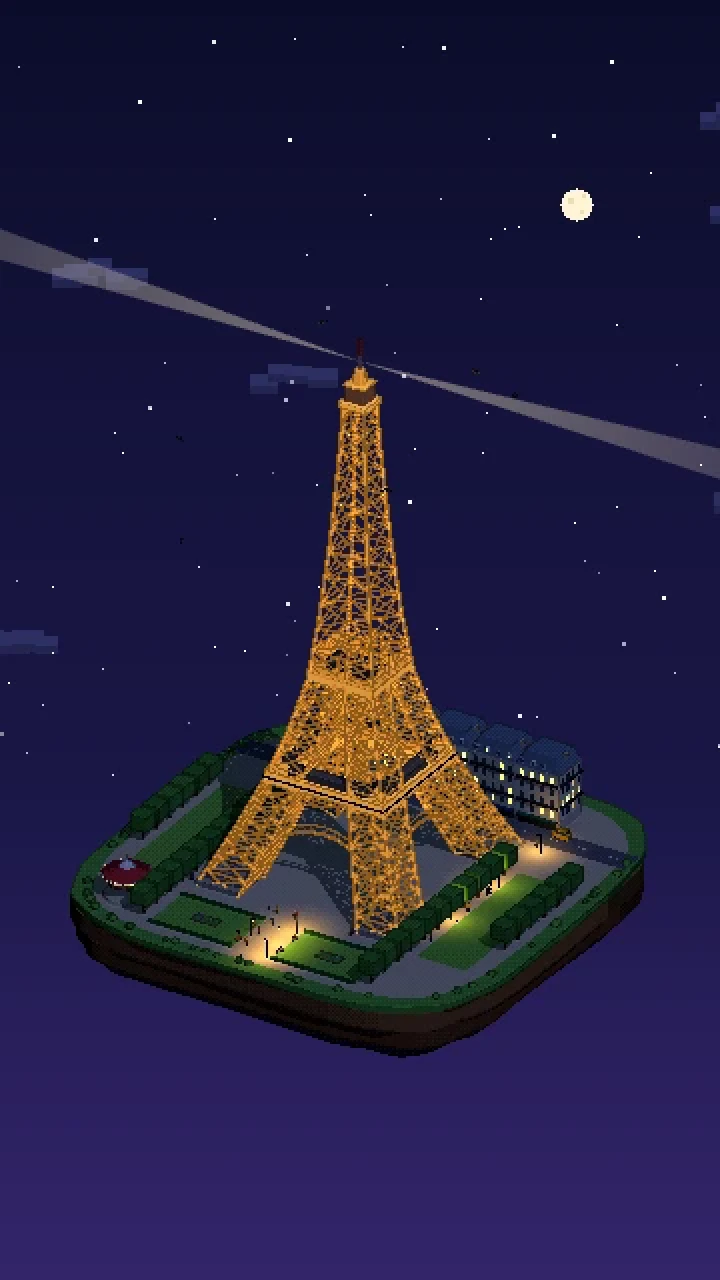
At night the tower is lit gold from inside, a rotating beacon sweeps the sky from the top, and for five minutes at the start of every hour thousands of flashing lights make it sparkle.
The diorama
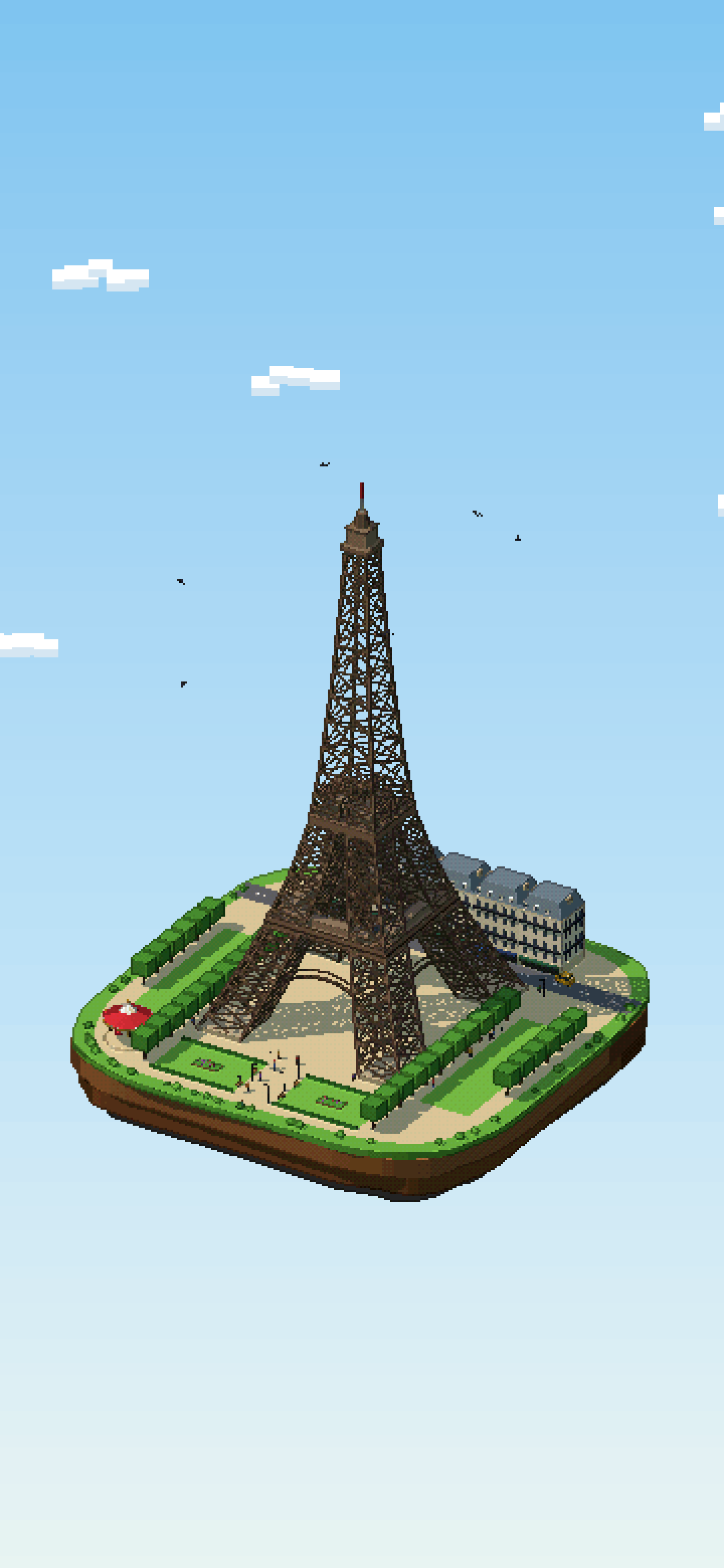
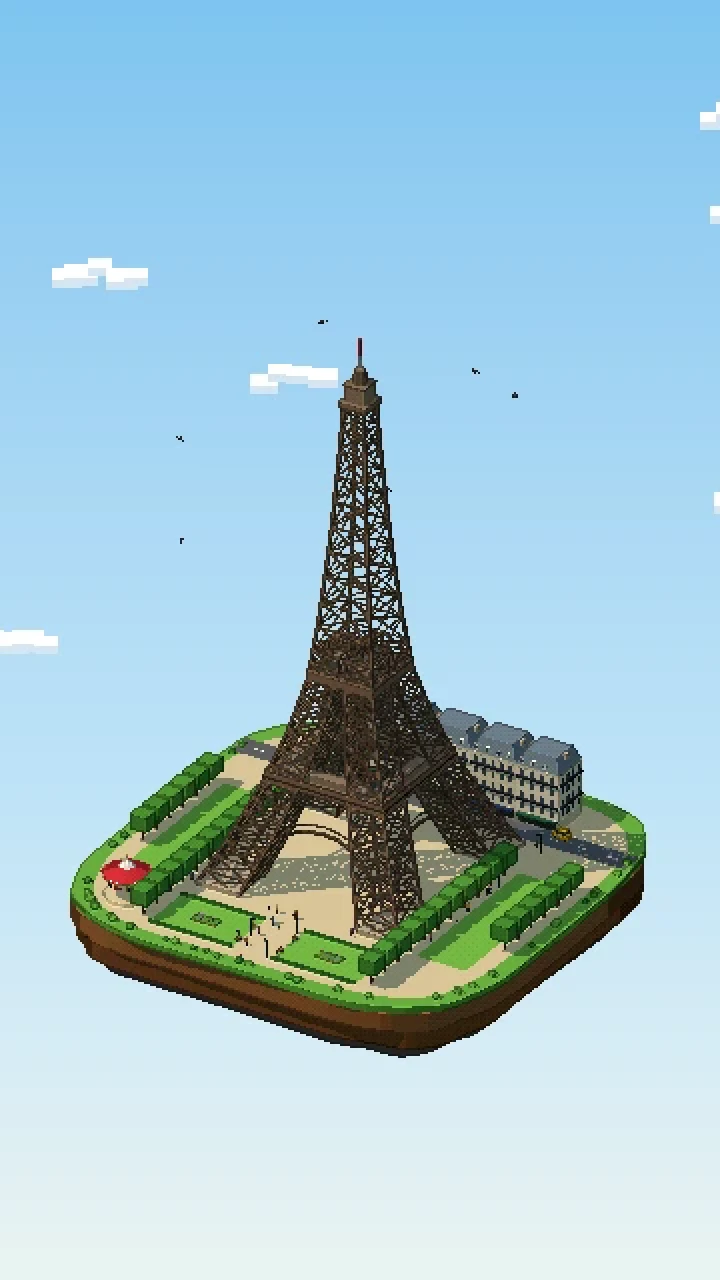
The tower in the diorama is built from its real profile: the half-width of the legs at each height comes from the actual tower, scaled to one unit for three metres. Each leg is a lattice of corner columns, horizontal ties and cross braces, the four legs merge into a single shaft above the second platform, and the decorative arches sit between the legs under the first platform. More than a thousand beams in all, drawn as pixel art with dark outlines so the lattice stays readable at a low resolution.
The rest of the island is toy-scale on purpose: the lawns of the Champ de Mars with clipped box-shaped trees, flower beds, benches and lamps, a carousel that keeps turning, and a row of cream Haussmann buildings with iron balconies and grey mansard roofs along a boulevard with traffic. At night the iron turns gold, the beacon starts to turn, and the tower sparkles.
Things to spot
- The carousel with its bobbing horses
- Cars on the boulevard and walkers on the avenue
- Birds circling the second platform
- The rotating beacon on top at night
- The sparkle once night has fallen
What we simplified
- The surroundings are compressed: the Champ de Mars, the boulevard and the Haussmann buildings sit much closer to the tower than they do in Paris.
- People, trees and buildings are larger than scale so they still read next to a 330 m tower.
Questions
How tall is the Eiffel Tower?
The Eiffel Tower is 330 metres tall with its antennas; as built it measured 300 metres. Its platforms are at 57, 115 and 276 metres.
When was the Eiffel Tower built?
It was built from 1887 to 1889, in just over two years, as the entrance arch to the 1889 World’s Fair. It was the tallest structure in the world until 1930.
Who designed the Eiffel Tower?
Engineers Maurice Koechlin and Émile Nouguier of Gustave Eiffel’s company drew the first sketch, and architect Stephen Sauvestre added the decorative arches at the base and the glazed hall on the first floor.
When does the Eiffel Tower sparkle?
For five minutes at the start of every hour after dark, thousands of flashing lights make the tower sparkle. At night it is also lit gold from inside, and a rotating beacon sweeps the sky from the top.
How was this pixel-art diorama of the Eiffel Tower made?
It is a real-time Three.js scene running on this page, drawn at 360 × 640 pixels with outlines and a small palette, then scaled up without smoothing. Press “Explore in 3D”, drag to turn it, and switch between day, dusk and night.
Isometric maps of Paris
Paris also has 3 isometric pixel-art maps made by the community: the whole city drawn tile by tile in the same SimCity-like style. See the maps of Paris →