About City of Arts and Sciences
The City of Arts and Sciences is a complex of museums, theatres and gardens at the south-eastern end of the old Turia riverbed in Valencia. After a disastrous flood in 1957 the river was diverted around the city, and its dry bed became a long green park. In the 1990s the regional government chose its far end for a showpiece of culture and science, and the Valencia-born architect Santiago Calatrava designed most of the buildings, strung along one long axis and set in shallow pools of water.
The first to open, on 16 April 1998, was L'Hemisfèric, an IMAX cinema and planetarium about 110 metres long. It is shaped like an eye: the dome of the cinema is the pupil, and long shells on its sides open upwards like an eyelid. Seen together with its reflection in the pool around it, the building looks like a whole eye. Next came the Museu de les Ciències in 2000, a science museum 220 metres long whose white concrete ribs make it look like the skeleton of a huge animal.
L'Umbracle followed in 2001: a walkway and garden about 320 metres long under 55 fixed and 54 floating white arches, planted with palms, bitter orange trees and climbing plants. L'Oceanogràfic, designed by the Mexican-Spanish architect Félix Candela, opened soon after, and the Palau de les Arts Reina Sofia, an opera house about 75 metres high wrapped in two steel shells under a long curved roof, was inaugurated on 8 October 2005. L'Àgora completed the complex in 2009.
The project was famously expensive: the final cost was several times the original budget, and the white broken-tile mosaic (trencadís) on the opera house came loose in storms and had to be replaced. But it has become the symbol of modern Valencia and one of the most visited places in Spain. Its futuristic look has also made it a favourite filming location, from Tomorrowland and Doctor Who to Westworld and Andor.
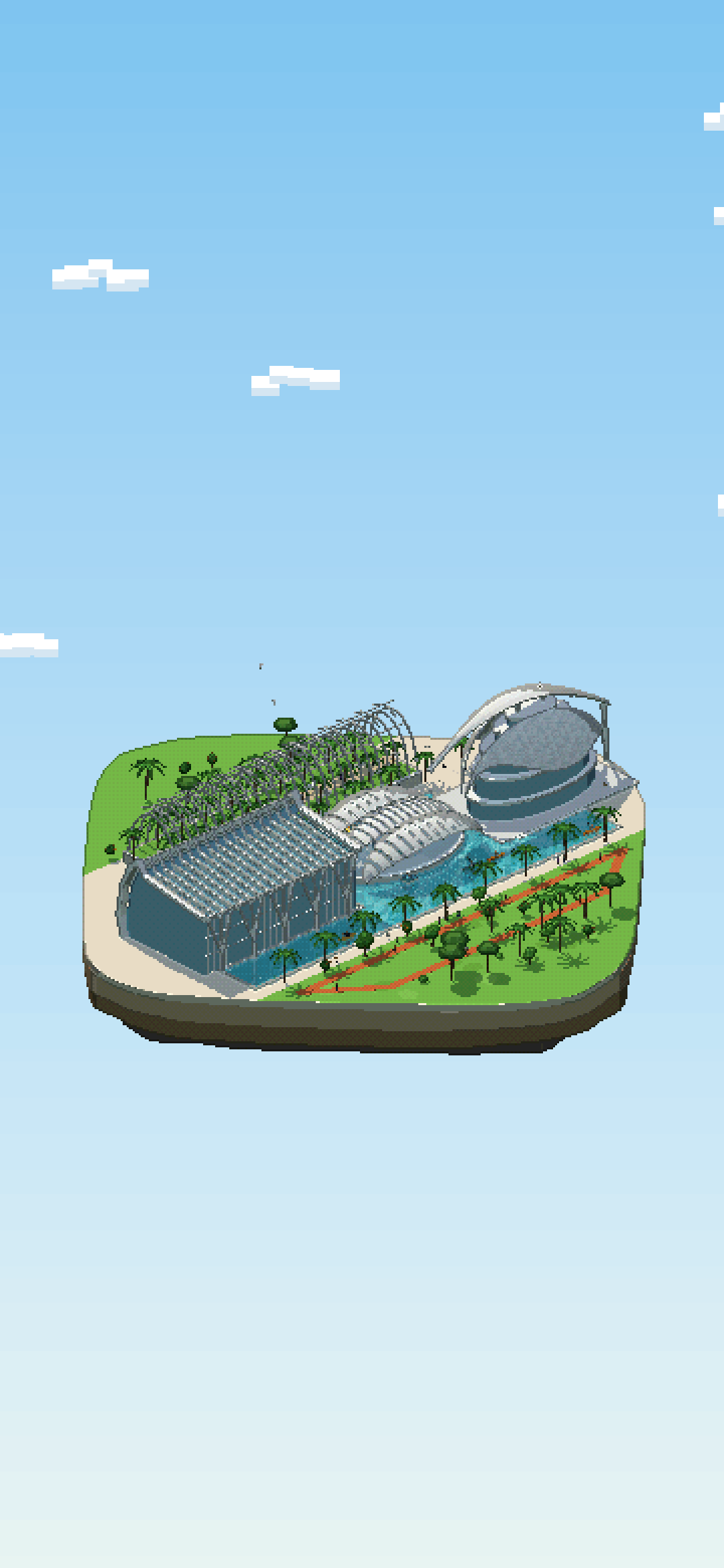
The diorama
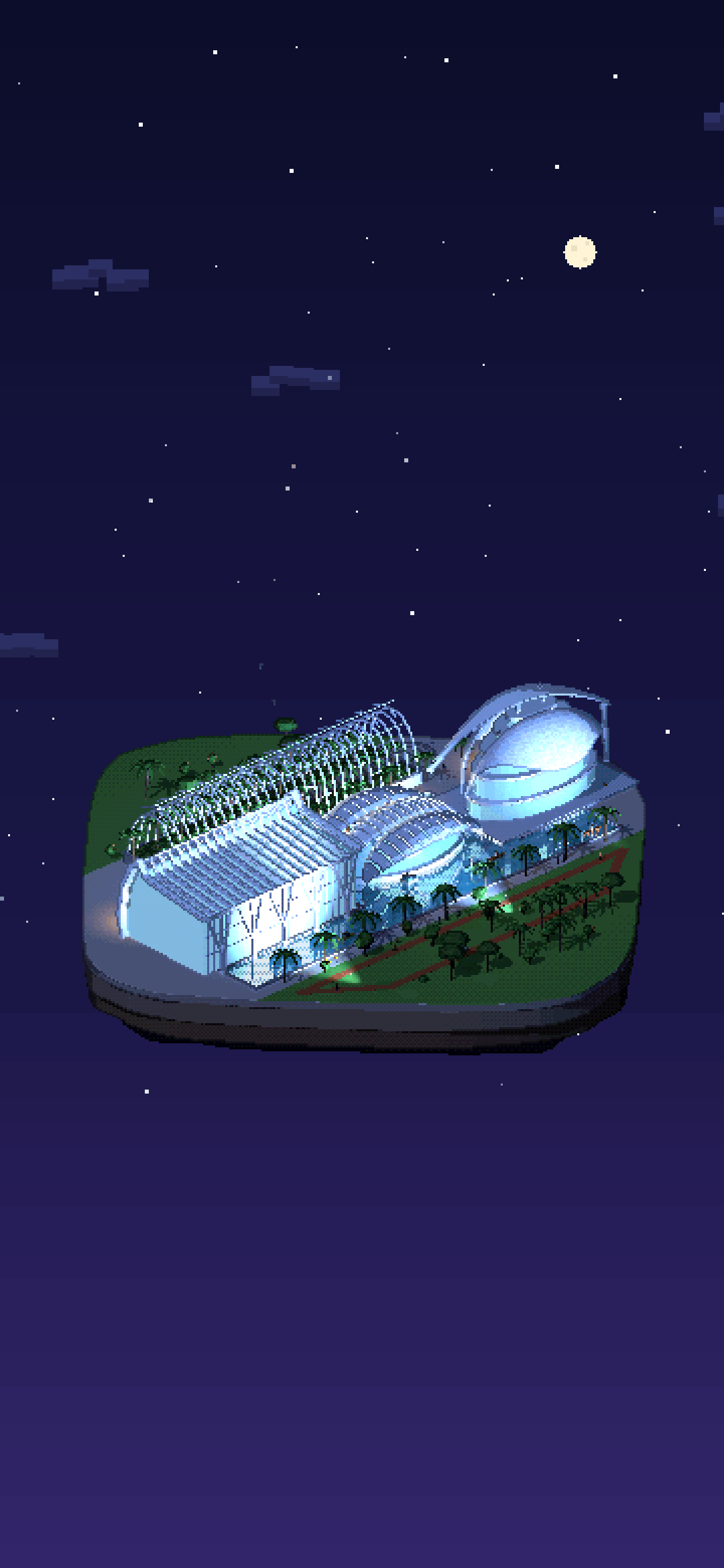
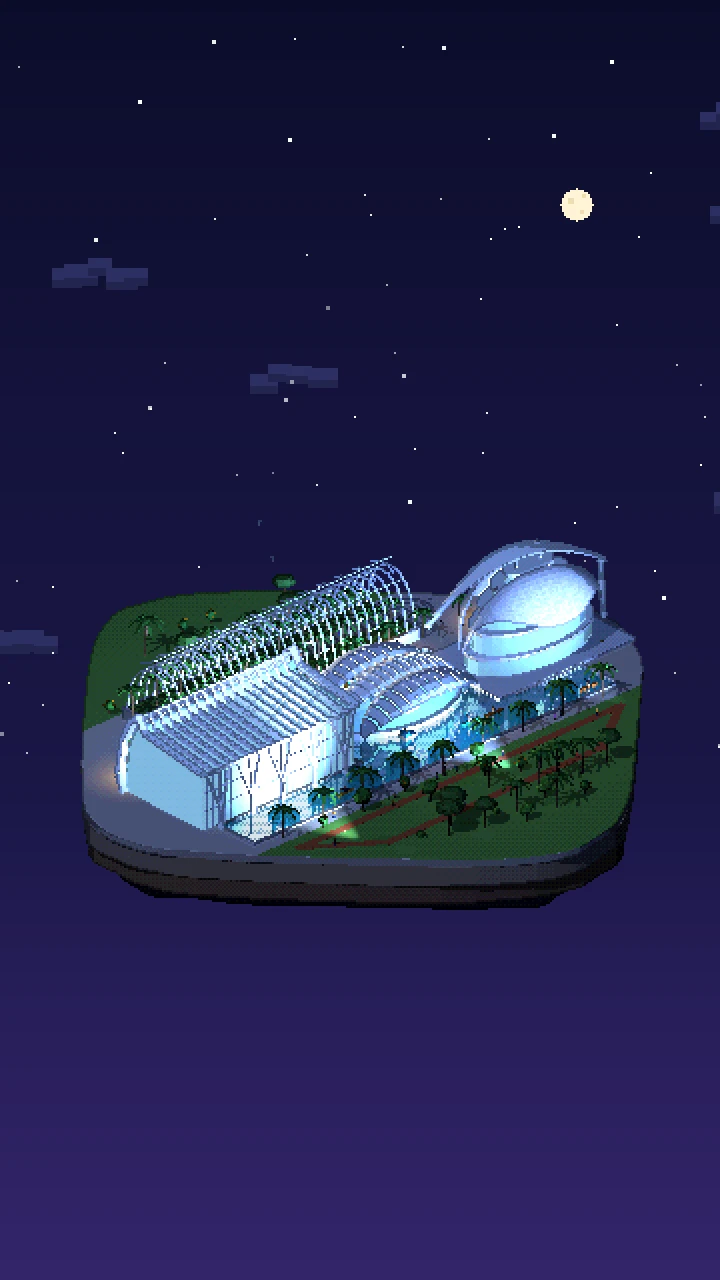
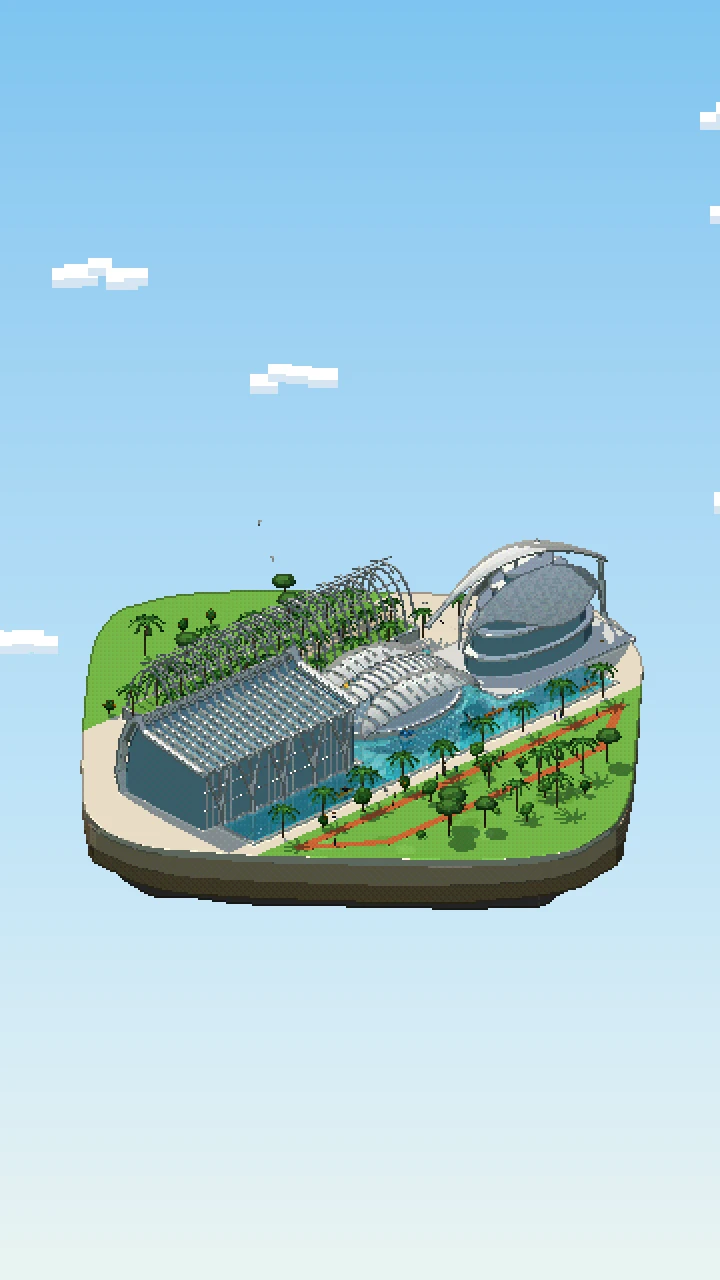
The diorama puts the complex on a floating island, with the river axis running diagonally across it, built in Three.js and drawn as pixel art. In the middle, L'Hemisfèric sits in a turquoise pool: a glass vault over the white dome of the cinema, with a ribbed white spine and two louvred eyelids that slowly open and close. Beside it stands the Museu de les Ciències, its glass hall framed by a row of white ribs with pointed tops and white branching columns along the pool side, and at the other end the Palau de les Arts, with terraces of glass under two trencadís shells and the curved feather of its roof sweeping over the top.
Behind them runs L'Umbracle, a raised walk under white arches with palms and white mosaic benches, and in front lie the gardens of the old riverbed with palms, stone pines and orange trees, and a red jogging track with runners going round. Kayaks and pedal boats glide on the pools, people stroll the promenade, and gulls circle overhead. At night the buildings glow blue and white under floodlights, the glass lights up, and everything is mirrored in the rippling water of the pools.
Things to spot
- L'Hemisfèric opening and closing its eyelids
- The reflections of the buildings shimmering in the pools
- Kayaks and pedal boats on the water
- Joggers on the red track in the Turia gardens
- Orange trees among the palms
- The feather roof of the Palau de les Arts
What we simplified
- The real complex stretches for almost two kilometres along the riverbed; here the buildings are pushed close together, and the museum and Umbracle are shortened.
- L'Oceanogràfic, L'Àgora and the Assut de l'Or bridge are left out, and the eyelids of the Hemisfèric open on both sides at once in a simpler movement than the real ones.
Questions
Who designed the City of Arts and Sciences?
Most of the complex was designed by Santiago Calatrava, who was born in Valencia. L'Oceanogràfic, the aquarium, was designed by Félix Candela.
When was the City of Arts and Sciences built?
Construction started in the mid-1990s. The first building, L'Hemisfèric, opened on 16 April 1998, and the last, L'Àgora, was completed in 2009.
Why is L'Hemisfèric shaped like an eye?
The building is designed as a giant eye: the dome of the IMAX cinema is the pupil, and shells on its sides open like an eyelid. Its reflection in the surrounding pool completes the shape of the eye.
Why is the City of Arts and Sciences in a dry riverbed?
After a devastating flood in 1957, the Turia river was diverted around Valencia. Its old bed was turned into a long park, and the City of Arts and Sciences was built at its south-eastern end.
How was this pixel-art diorama of the City of Arts and Sciences made?
It is a real-time Three.js scene on this page, drawn at 360 × 640 pixels with outlines and a small palette and scaled up without smoothing. The Hemisfèric's eyelids open and close, and the pools mirror the buildings. Press “Explore in 3D”, drag to turn it, and switch between day, dusk and night.
Isometric maps of Valencia
Valencia also has an isometric pixel-art map made by the community: the whole city drawn tile by tile in the same SimCity-like style. See the map of Valencia →