About Brandenburg Gate
The Brandenburg Gate was built between 1788 and 1791 by Carl Gotthard Langhans as a grand entrance to Unter den Linden, the boulevard leading to the royal palace. It replaced a plain gate in Berlin’s old customs wall. Langhans modelled it on the Propylaea, the gateway to the Acropolis in Athens, and it became one of the first major buildings of Greek Revival in Germany.
On top stands the Quadriga by Johann Gottfried Schadow: the goddess of victory driving a chariot pulled by four horses. In 1806 Napoleon took it to Paris as a trophy. When it came back after his defeat, Karl Friedrich Schinkel gave Victoria a new staff crowned with an iron cross and a Prussian eagle, and the square in front was named Pariser Platz.
The gate was badly damaged in the Second World War and restored in the 1950s. When the Berlin Wall went up in 1961, it ended up just inside East Berlin, in the restricted zone, and for 28 years nobody could walk through it. It reopened on 22 December 1989, a few weeks after the Wall fell, and became the symbol of a reunited Germany.
Today Pariser Platz is again lined with embassies, the Academy of Arts and the Hotel Adlon, rebuilt after reunification. A double row of cobblestones in the road marks where the Wall once ran, and the square is the setting for New Year’s Eve parties, concerts and demonstrations.
The diorama
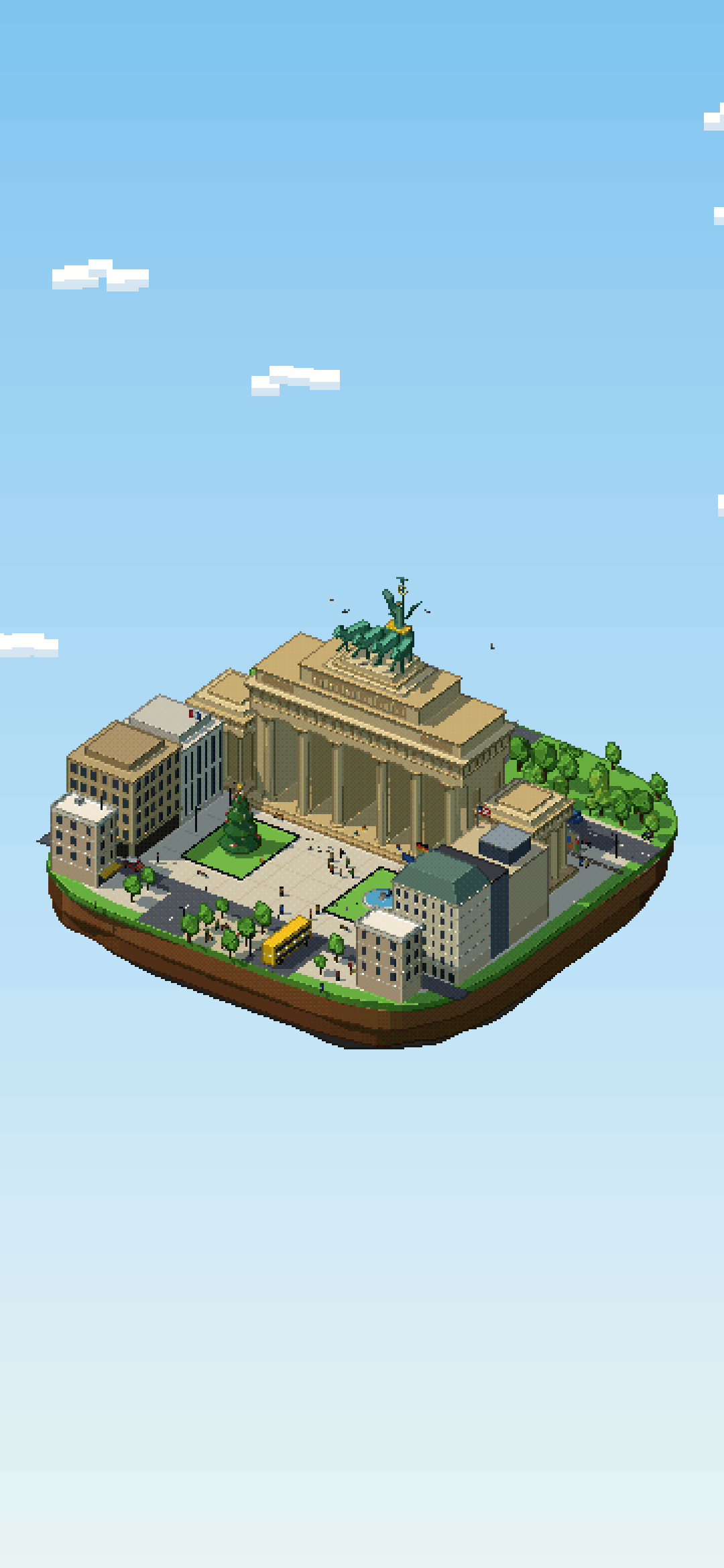
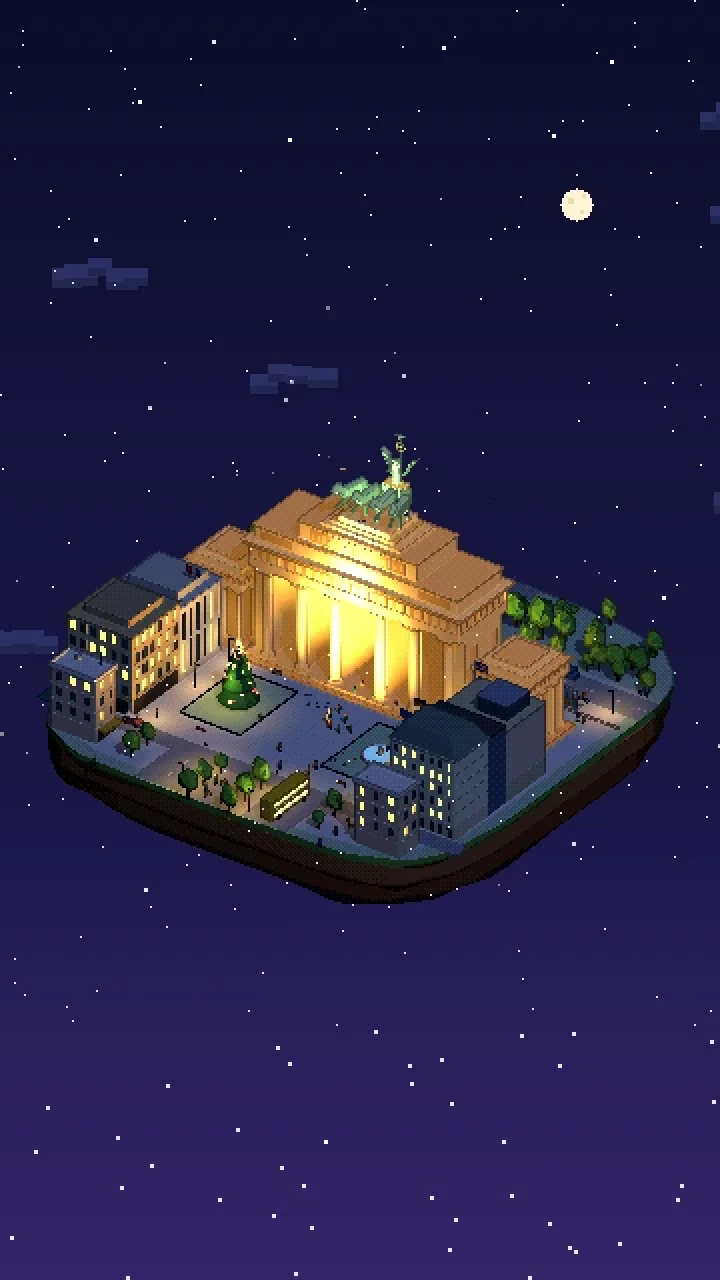
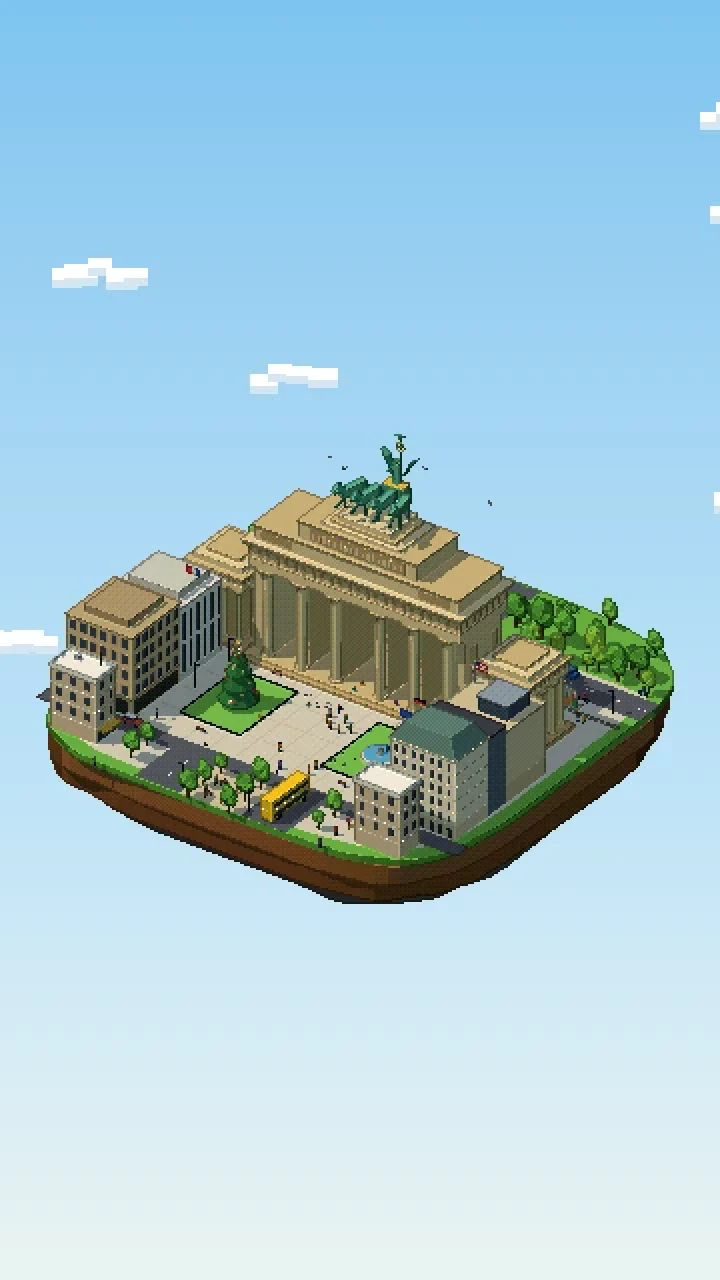
The gate is modelled close to its real measurements: twelve fluted Doric columns, the five passages with the wide one in the middle, the entablature with its triglyph frieze, the stepped attic with a relief of a procession, and the two small temple-like gatehouses at the ends. The copper Quadriga on top, horses, chariot and Victoria with her staff, is drawn about a third larger so it still reads at pixel size.
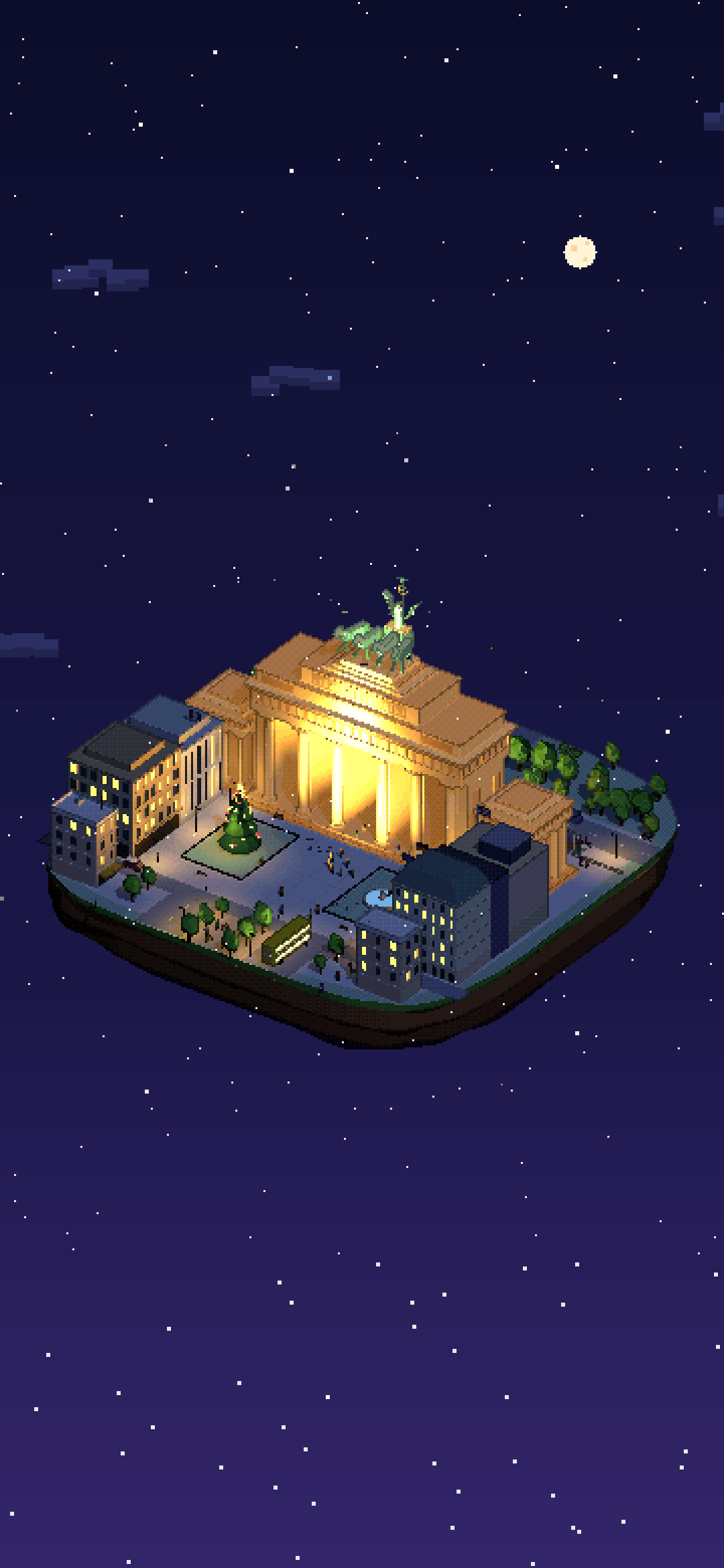
East of the gate, Pariser Platz has its two lawns, a fountain and a Christmas tree, framed by the Hotel Adlon, the glass front of the Academy of Arts, the US and French embassies and a bank. Unter den Linden runs off between lime trees, and on the west side the trees of the Tiergarten line the Straße des 17. Juni. As night falls, the gate is floodlit gold, the Christmas tree lights up and snow starts to fall.
Things to spot
- Trabants and a yellow double-decker bus
- A street juggler with his audience in front of the gate
- Cyclists riding through the outer passages
- Pigeons pecking on the square
- The double cobble line of the Wall and a few painted Wall segments
- The lit Christmas tree and falling snow at night
What we simplified
- The gate is drawn a little larger than the buildings around it, and Pariser Platz is compressed to fit the island.
- The embassies, the Academy and the Hotel Adlon are simplified blocks that suggest the real facades.
- Trabants are a nod to 1989; you will see few of them in Berlin traffic today.
Questions
When was the Brandenburg Gate built?
The Brandenburg Gate was built between 1788 and 1791 for King Frederick William II of Prussia. It was designed by Carl Gotthard Langhans as a grand entrance to Unter den Linden.
How tall is the Brandenburg Gate?
The gate is 26 metres high, 65.5 metres wide with its side wings and 11 metres deep. Twelve Doric sandstone columns form its five passages.
What is the statue on top of the Brandenburg Gate?
It is the Quadriga by Johann Gottfried Schadow, from 1793: Victoria, the goddess of victory, in a chariot drawn by four horses. Napoleon took it to Paris in 1806, and when it came back Schinkel gave Victoria a new staff with an iron cross and a Prussian eagle.
Why is the Brandenburg Gate a symbol of reunification?
When the Berlin Wall went up in 1961, the gate ended up in the restricted zone of East Berlin, and for 28 years nobody could walk through it. It reopened on 22 December 1989, a few weeks after the Wall fell, and became the symbol of a reunited Germany.
How was this pixel-art diorama of the Brandenburg Gate made?
It is a real-time Three.js scene running on this page, drawn at 360 × 640 pixels with outlines and a small palette, then scaled up without smoothing. Press “Explore in 3D”, drag to turn it, and switch between day, dusk and night.
Isometric maps of Berlin
Berlin also has an isometric pixel-art map made by the community: the whole city drawn tile by tile in the same SimCity-like style. See the map of Berlin →