About Nyhavn
Nyhavn, the “New Harbour”, was dug in the early 1670s for King Christian V by Danish soldiers and Swedish prisoners of war from the Dano-Swedish War of 1658–60. Sources differ a little on the exact years, but 1671–73 is the usual date. The straight canal, about 450 metres long, was a gateway from the sea right into the old city at Kongens Nytorv, the King’s New Square: ships unloaded their cargo along the quays and fishermen landed their catch.
The two sides grew up very differently. The north side is lined with narrow, brightly painted townhouses of brick, plaster and timber; the oldest, Nyhavn 9, dates from 1681. The south side has larger, more stately houses, starting with Charlottenborg Palace on the corner of Kongens Nytorv. For a long time the quay was a rough sailors’ district, known for its beer, sailors and prostitution. Hans Christian Andersen lived here too, at No. 20, at No. 67 and, from 1871, at No. 18.
As ocean-going ships grew bigger, Nyhavn was left to small coastal freighters, and after the Second World War, when goods moved to the roads, it emptied of ships. In 1951 the Memorial Anchor was placed at the head of the canal in memory of the more than 1,700 Danish seafarers who died in the war. The bascule bridge Nyhavnsbroen, which crosses the canal towards the harbour, dates from 1912.
The canal came back to life as a harbour for old ships. It was opened as a veteran ship and museum harbour in 1977, and wooden sailing ships and the red lightship Gedser Rev, built in 1895, are moored along the quays. In 1980 the quay was turned into a pedestrian area. Today the sunny north side is one long row of bars and restaurants, and canal tour boats leave from the quay all day.
The diorama
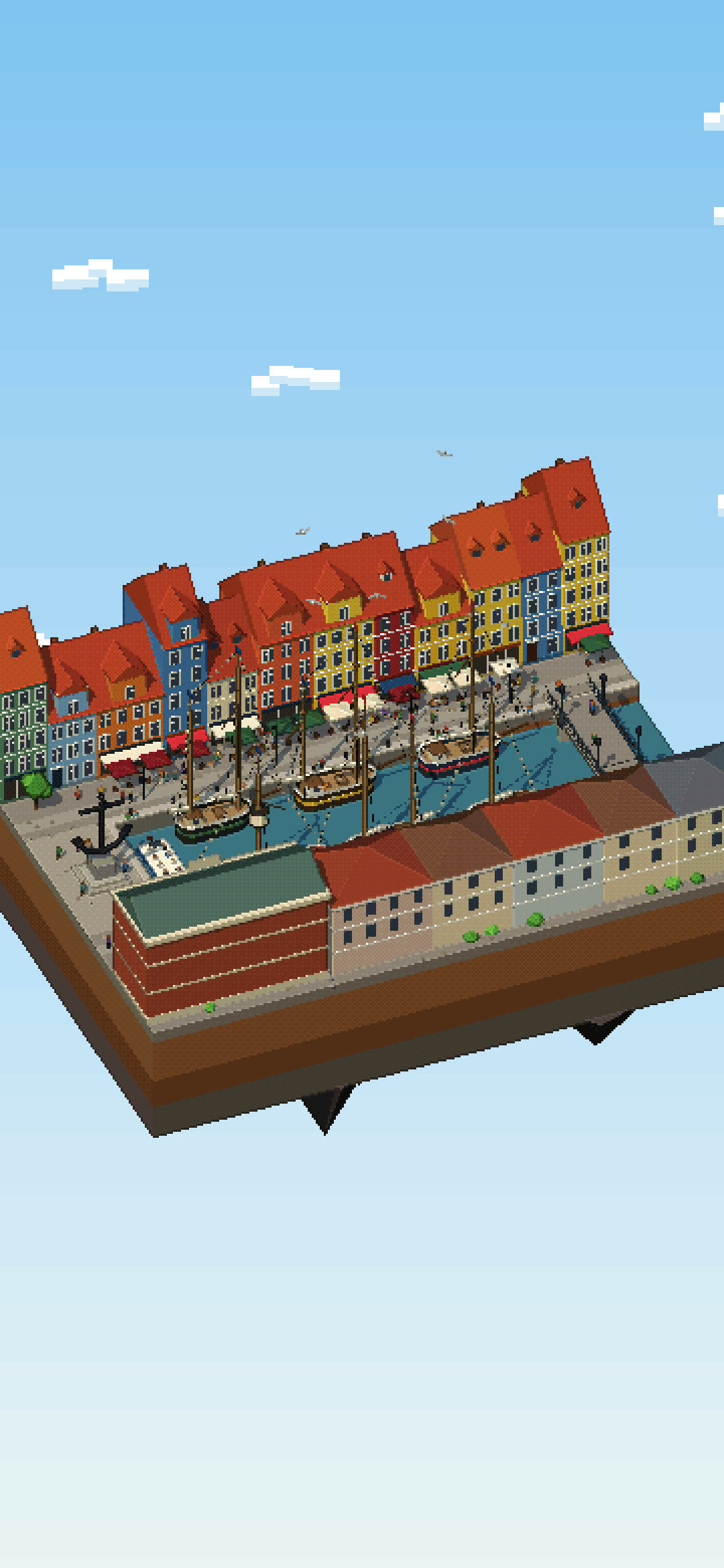
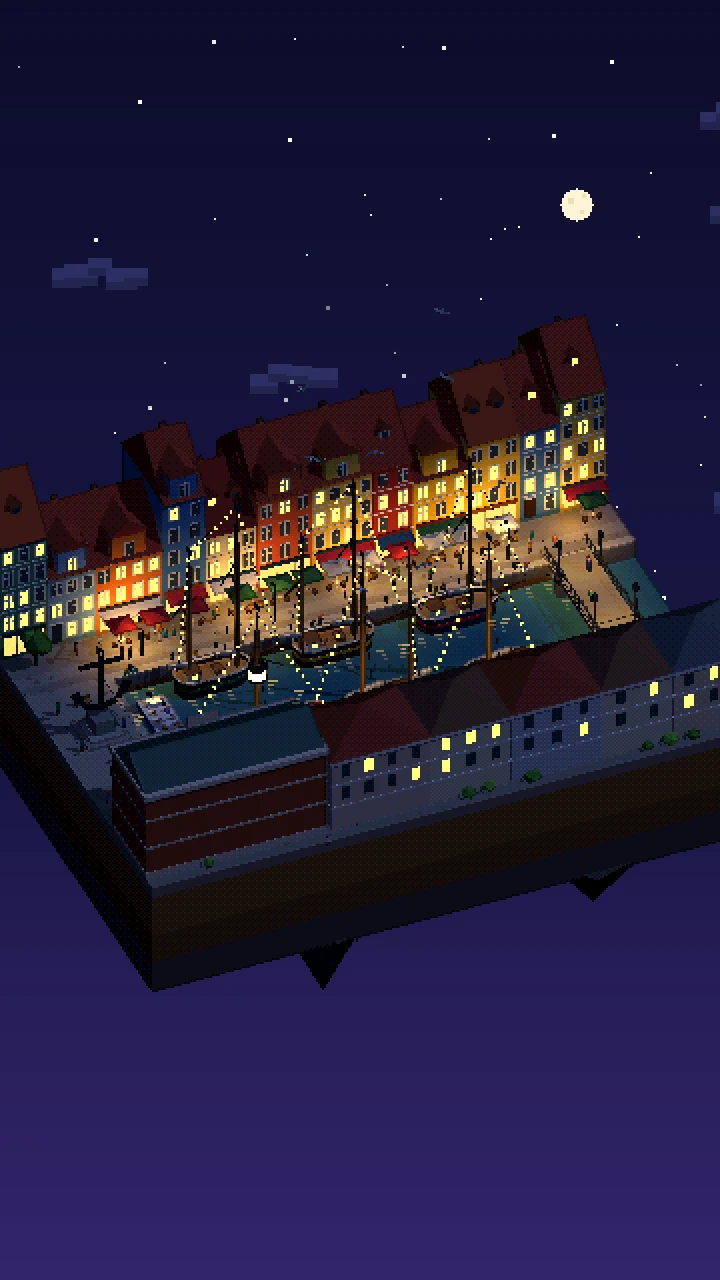
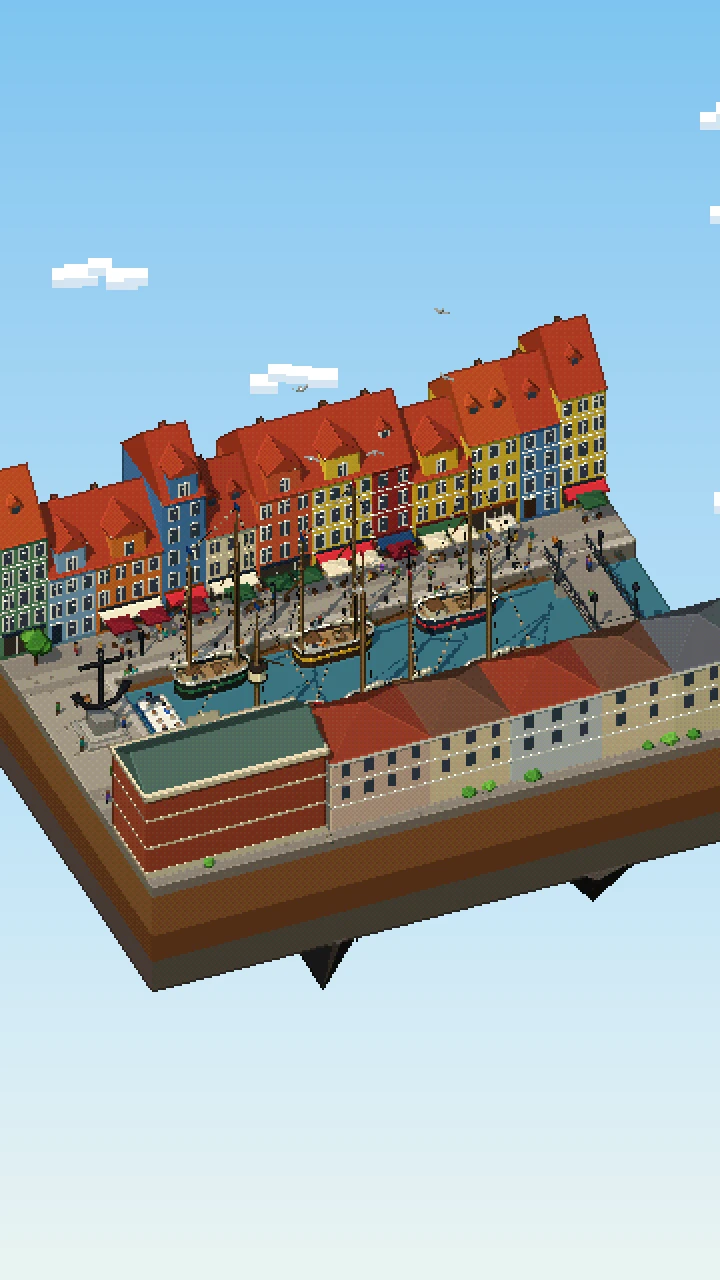
The diorama shows the inner basin of Nyhavn on a floating island, built in Three.js and rendered as pixel art: the scene is drawn at a low resolution, every edge gets a dark outline, the colours are reduced to a small palette, and the result is scaled up without smoothing. The canal runs between granite quay walls and is cut open at the harbour end, so you see the water in section. At the head stands the Memorial Anchor on its granite plinth, with a wreath at its foot; at the other end the low Nyhavnsbroen crosses, with stone piers, small arches, iron railings and old-style lamps.
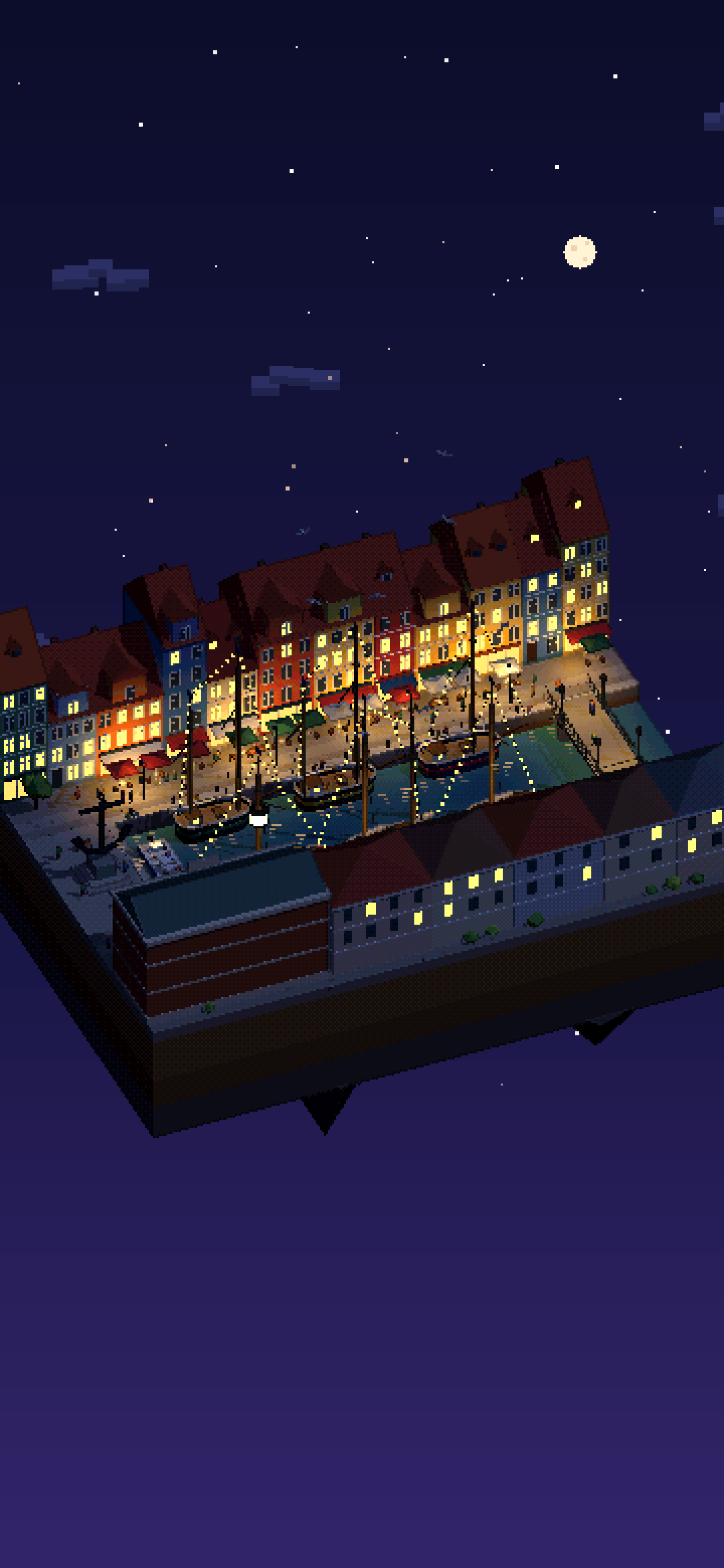
Along the north quay runs the postcard row: narrow three- to five-storey townhouses in ochre, red, orange, blue, yellow and green, each with its own roof, from dormers to street gables and central front gables, cafés on the ground floors and parasols and patio heaters on the cobbles. The south side is plainer and grander, beginning with Charlottenborg’s red-brick exhibition wing. Wooden sailing ships with furled sails are moored along both quays, among them the red lightship. At night the café fronts glow, strings of bulbs light up the rigging and everything is mirrored on the water.
Things to spot
- People sitting on the quay edge with their drinks, feet over the water
- Canal tour boats coming in under the bridge and turning at the head of the canal
- The red lightship with its lantern on the mast
- A ship’s cat on deck
- The wreath at the foot of the Memorial Anchor
- Light bulbs strung through the ships’ rigging at night
What we simplified
- The canal is narrower and much shorter than the real Nyhavn, so both quays, the anchor and the bridge fit on one island.
- The townhouses are generic Nyhavn houses, not the actual numbered buildings, and the south side is reduced to Charlottenborg’s exhibition wing and a row of plainer houses.
- The ships are lookalikes of the kind of vessels moored here, not exact models of particular ships, and they carry their rigging lights all year round.
Questions
When was Nyhavn built?
Nyhavn was dug in the early 1670s for King Christian V, usually dated 1671–73, by Danish soldiers and Swedish prisoners of war. It was built as a gateway from the sea to Kongens Nytorv, where ships could unload their cargo.
What is the oldest house in Nyhavn?
The oldest house is Nyhavn 9, built in 1681. It stands on the north side, among the brightly painted townhouses of brick, plaster and timber.
Did Hans Christian Andersen live in Nyhavn?
Yes. Hans Christian Andersen lived in Nyhavn at three different addresses: No. 20, No. 67, where a memorial plaque hangs, and from 1871 No. 18.
What is the big anchor at the end of Nyhavn?
It is the Memorial Anchor, placed at the head of the canal at Kongens Nytorv in 1951 in memory of the more than 1,700 Danish seafarers who died in the Second World War.
How was this pixel-art diorama of Nyhavn made?
It is a real-time Three.js scene running on this page, drawn at 360 × 640 pixels with dark outlines and a small palette, then scaled up without smoothing. Each townhouse is built from code with its own colour and roof, and at night the lit windows and rigging lights are reflected on the canal. Press “Explore in 3D” to drag it round and switch between day, dusk and night.