About Palace of Culture and Science
The Palace of Culture and Science stands on Parade Square (Plac Defilad) in the centre of Warsaw, beside Marszałkowska Street. At 237 metres to the tip of its spire it was the tallest building in Poland from 1955 until 2021, when the Varso Tower overtook it, and it is still one of the most recognisable shapes on the city’s skyline. Warsaw residents have plenty of nicknames for it; the best known are Pekin, from its Polish initials PKiN, and patyk, “the stick”.
The building goes back to an agreement signed on 5 April 1952 between the Polish People’s Republic and the Soviet Union, under which it was offered as a gift to the people of Poland; on completion it was dedicated to Joseph Stalin. Construction began on 2 May 1952 and the palace opened on 22 July 1955. The Soviet architect Lev Rudnev led the design, and an estimated 3,500 to 5,000 Soviet workers and about 4,000 Polish workers built it. Sixteen of them died in accidents on the site.
Its style is socialist realism, drawing on Polish historical architecture and on American Art Deco high-rises. The tower rises in setbacks, each crowned with a decorative parapet modelled on Renaissance houses and palaces in Kraków and Zamość, to a main structure of about 120 metres, a 40-metre turret and a 77-metre spire. The palace has 3,288 rooms. Four clock faces, each 6.3 metres across, were added on the turret for the millennium and started running on 31 December 2000. In 2007 the building was entered in Poland’s register of cultural heritage.
Today the palace is a busy public building. It holds the 3,000-seat Congress Hall, where the Rolling Stones played in 1967, four theatres, the Museum of Evolution, the Museum of Technology, a multiplex cinema, university floors and the offices of the Warsaw City Council. The viewing terrace on the 30th floor looks out 114 metres above the city. Since its LED lighting was modernised in 2010, the tower is often lit in changing colours at night, and in 2024 the white new building of the Museum of Modern Art opened on Parade Square in front of it.
The diorama
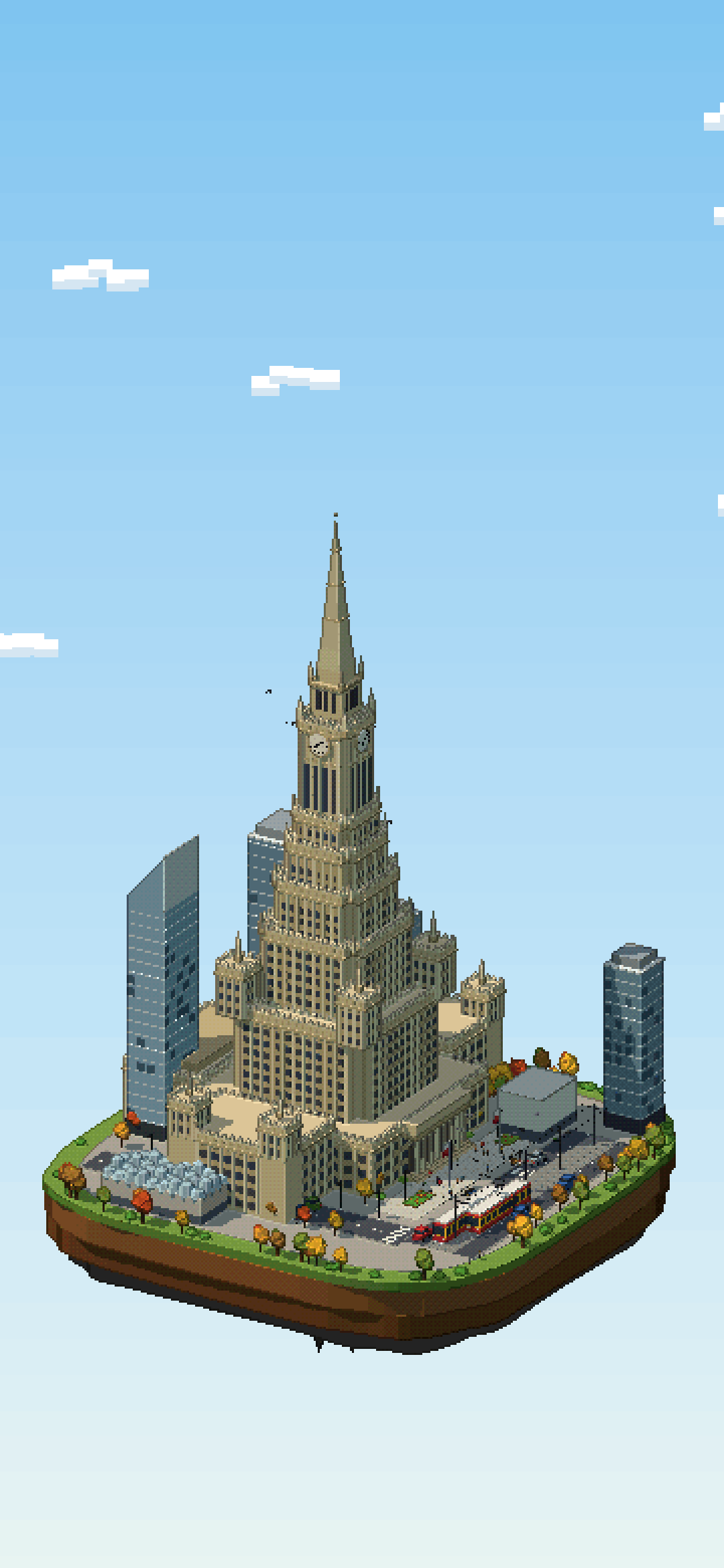
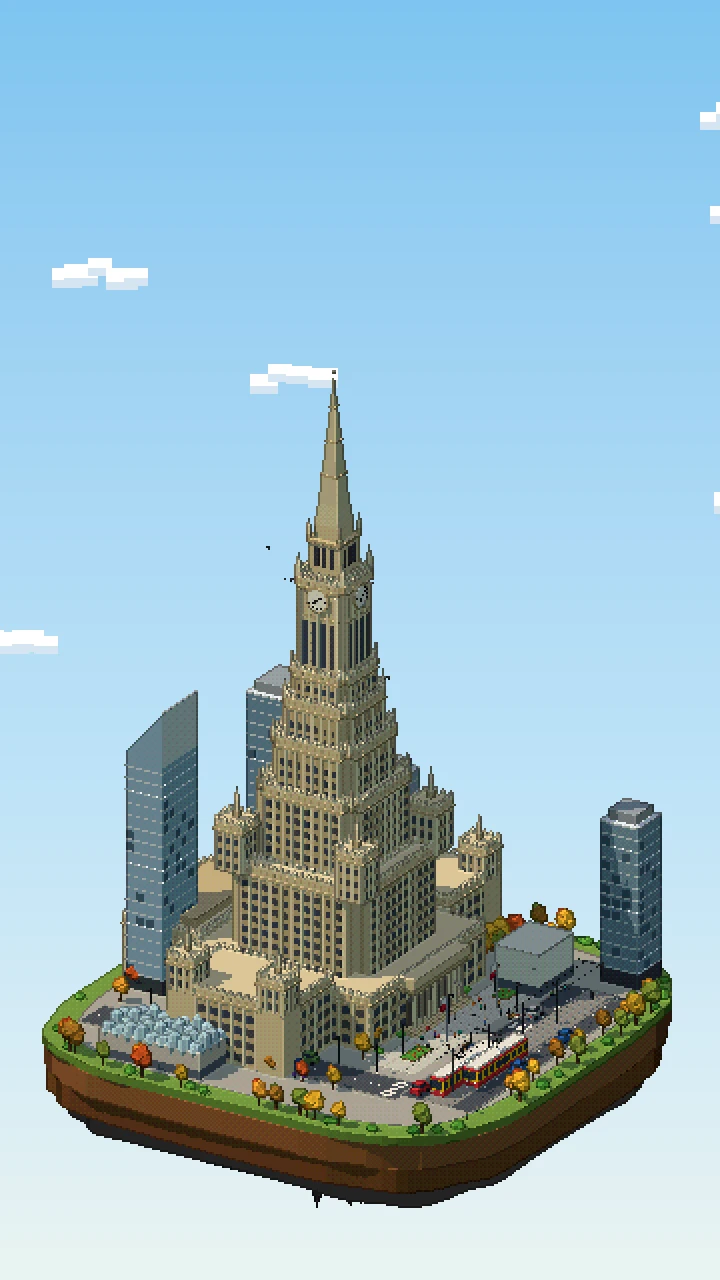
The diorama puts the palace on a floating island with autumn trees. The tower climbs in sandstone-coloured setbacks, each with vertical pilasters and a crenellated Renaissance-style attic with small pinnacles on the corners, past four corner towers on the lower body to the tall clock section with a clock face on every side, a lantern and the ribbed spire. Lower wings with their own corner towers spread to the north and south, the Congress Hall sits at the back, and a colonnaded portico with steps and two Polish flags faces Parade Square.
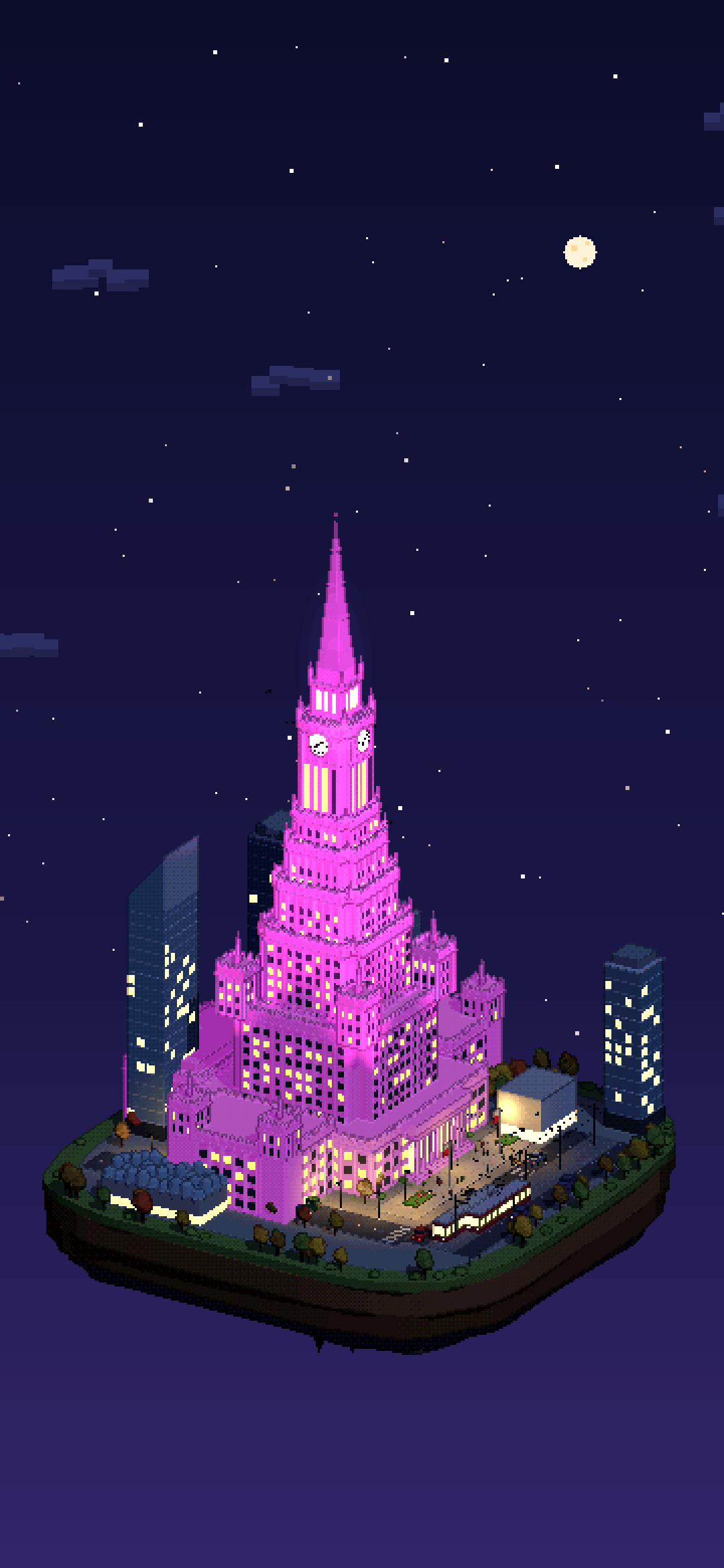
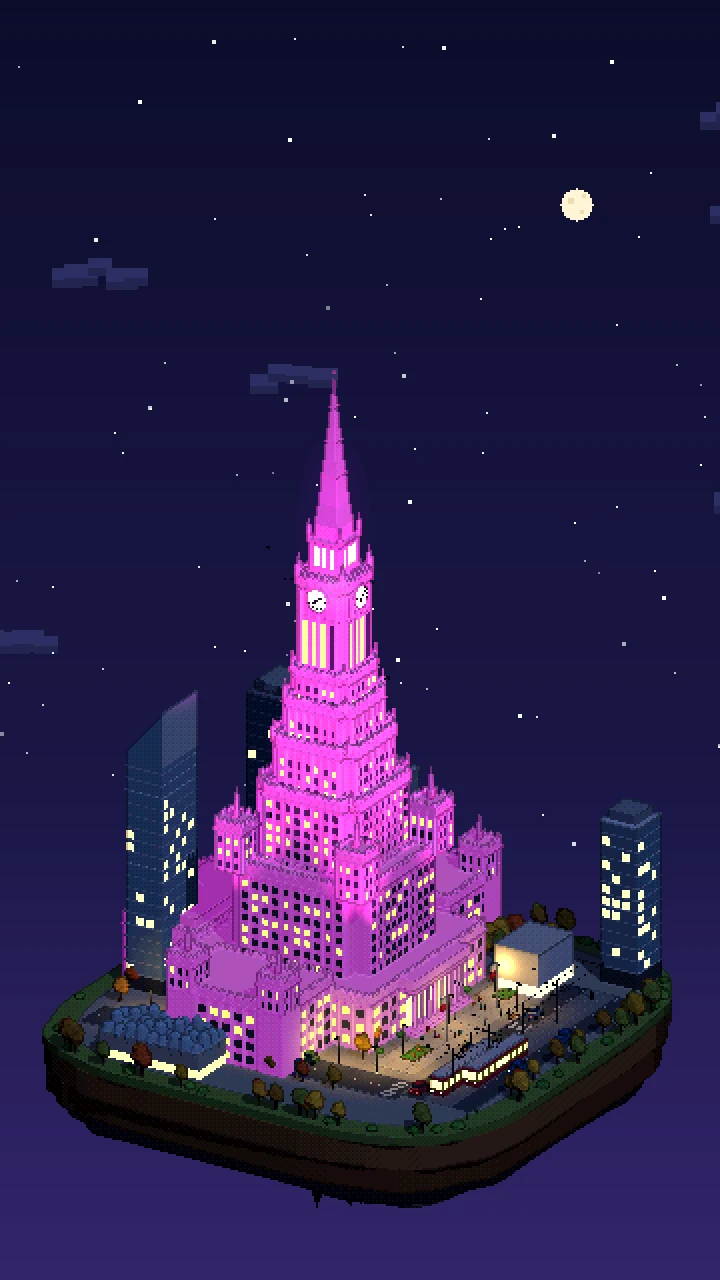
On the square there are planters, benches, lamps, pigeons and plenty of people, with a white block standing in for the Museum of Modern Art. Yellow-and-red trams run under their overhead wires on Marszałkowska next to the cars, more traffic passes on a side street, and simplified glass towers, one with a sloping sail-like top, and the bubbly glass roof of Złote Tarasy fill the corners. At night the windows light up, the clock faces glow white and the whole palace is washed in slowly changing colours, from purple to pink to blue.
Things to spot
- The four clock faces high on the turret
- The crenellated attics and pinnacles on every setback
- Yellow-and-red trams on Marszałkowska
- The Polish flags by the portico on Parade Square
- The wavy glass roof of Złote Tarasy
- The tower changing colour at night
What we simplified
- The plan of the complex is squeezed: the wings, the Congress Hall and Parade Square are much smaller and closer to the tower than in reality, while the clocks, attics and pinnacles are drawn bolder so they read at pixel size.
- The surrounding glass towers, Złote Tarasy and the Museum of Modern Art are simplified stand-ins, placed to suggest the neighbourhood rather than map it exactly.
- The real tower’s night colours change for occasions and events; here they cycle every few seconds.
Questions
How tall is the Palace of Culture and Science?
It is 237 metres tall to the tip of the spire, with 42 floors. It was the tallest building in Poland from 1955 until 2021, when the Varso Tower in Warsaw overtook it.
Who built the Palace of Culture and Science?
It was designed by the Soviet architect Lev Rudnev and built from 1952 to 1955 under an agreement between Poland and the Soviet Union, which presented it as a gift to the people of Poland. Thousands of Soviet and Polish workers worked on the site.
When was the clock added?
The four clock faces, each 6.3 metres across, were added for the millennium and started running on 31 December 2000.
Can you go up the Palace of Culture and Science?
Yes. The viewing terrace on the 30th floor is 114 metres above the street and looks out over the whole of central Warsaw.
How was this pixel-art diorama of the Palace of Culture and Science made?
It is a real-time Three.js scene on this page, drawn at 360 × 640 pixels with outlines and a small palette and scaled up without smoothing. The plan of the complex is compressed and the details are drawn bolder so they read at pixel size. Press “Explore in 3D”, drag to turn it, and switch between day, dusk and night.
Isometric maps of Warsaw
Warsaw also has 2 isometric pixel-art maps made by the community: the whole city drawn tile by tile in the same SimCity-like style. See the maps of Warsaw →