About Colosseum
The Colosseum was begun by the emperor Vespasian around AD 70, on the site of the lake in the gardens of Nero’s Golden House, and opened by his son Titus in AD 80 with a hundred days of games. Its real name is the Flavian Amphitheatre, after the family of emperors who built it; the name Colosseum came later, probably from a colossal statue of Nero that stood nearby.
It is the largest amphitheatre ever built: an ellipse of 189 by 156 metres, its outer wall about 48 metres high in four storeys. The three arcaded storeys carry half-columns in the Tuscan, Ionic and Corinthian orders, and the solid attic on top once held the masts of the awning that shaded the crowd. Tens of thousands of spectators came in through numbered arches and found their places by rank.
Under Domitian, the arena floor was built over the hypogeum, a maze of tunnels, cages and lifts that sent animals and scenery up into the arena. Gladiator fights and animal hunts went on for centuries. After that, earthquakes brought down part of the outer wall, and for hundreds of years the fallen stone was carted away to build palaces and churches across Rome.
That is why the full four-storey facade survives only on the north side, and the inner ring shows elsewhere. A small cross on the edge of the arena recalls the Christian martyrs traditionally said to have died here, and today the Colosseum is one of the most visited monuments in the world.
The diorama
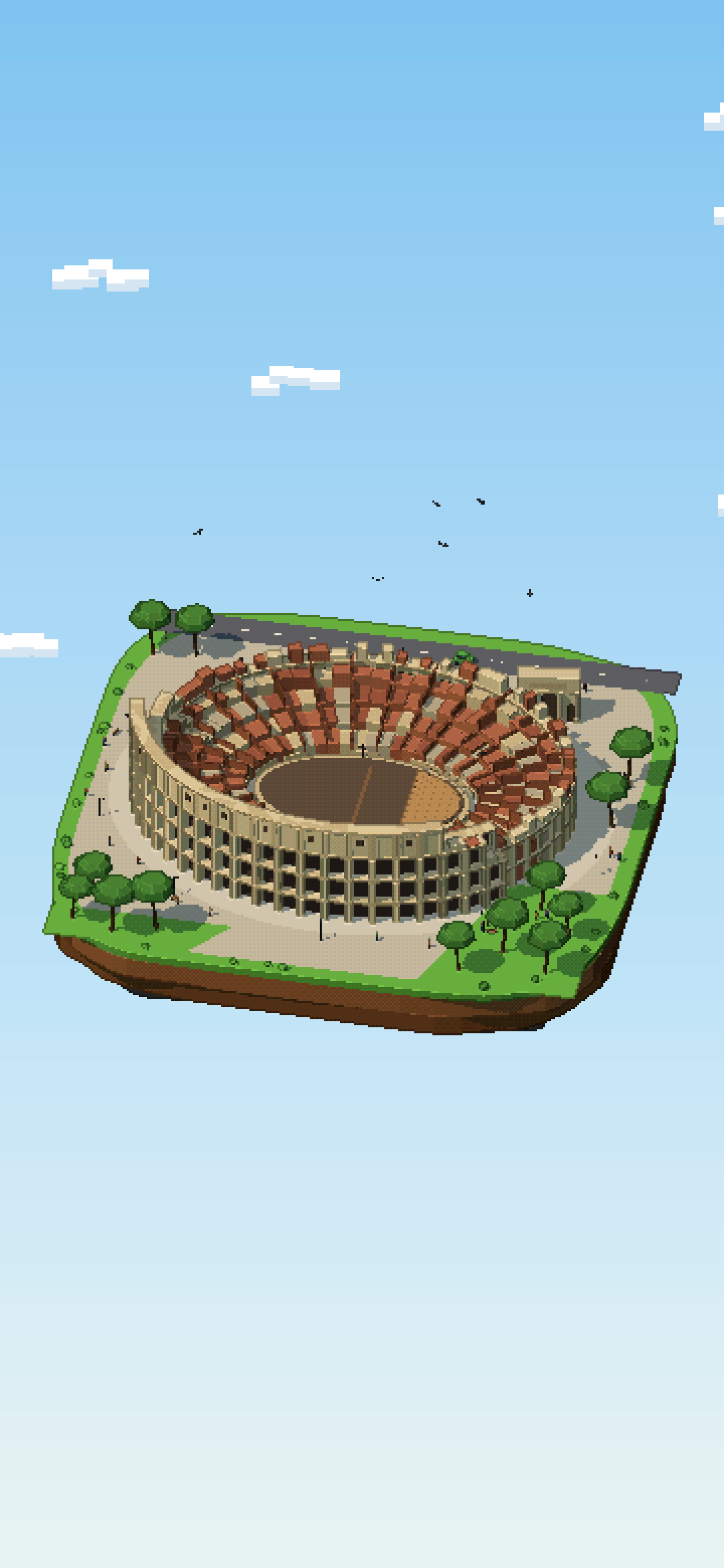
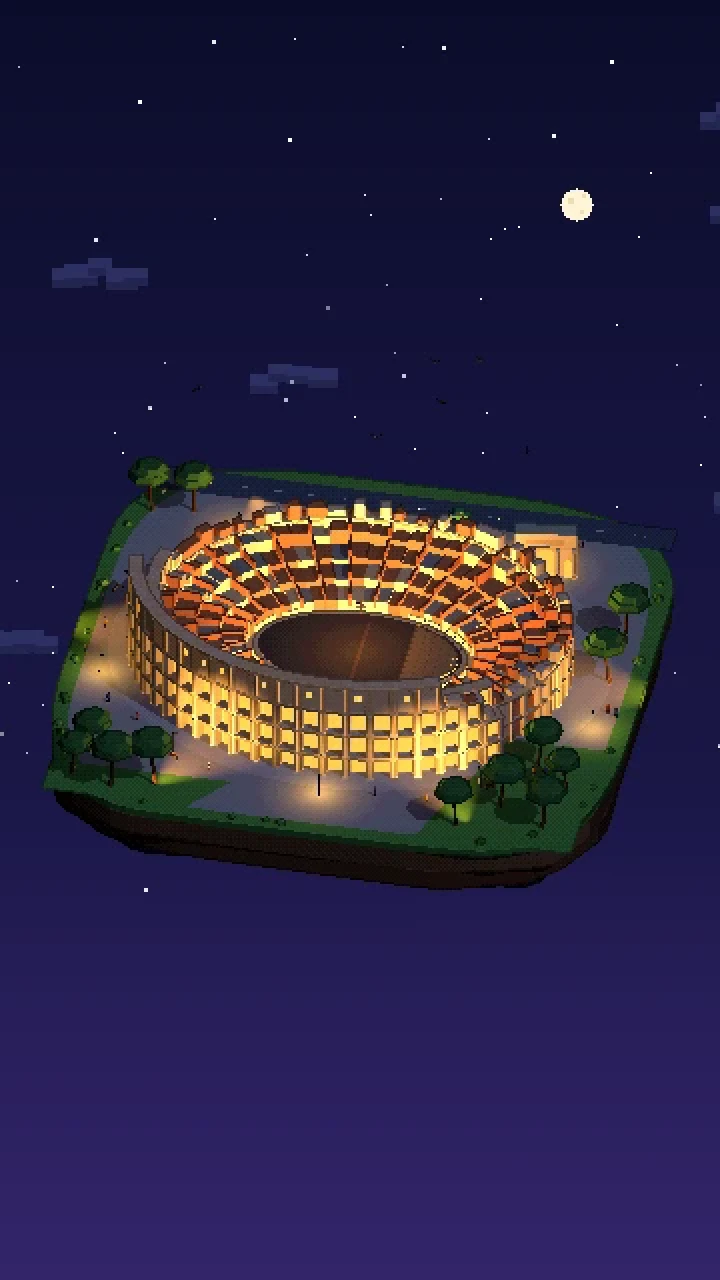
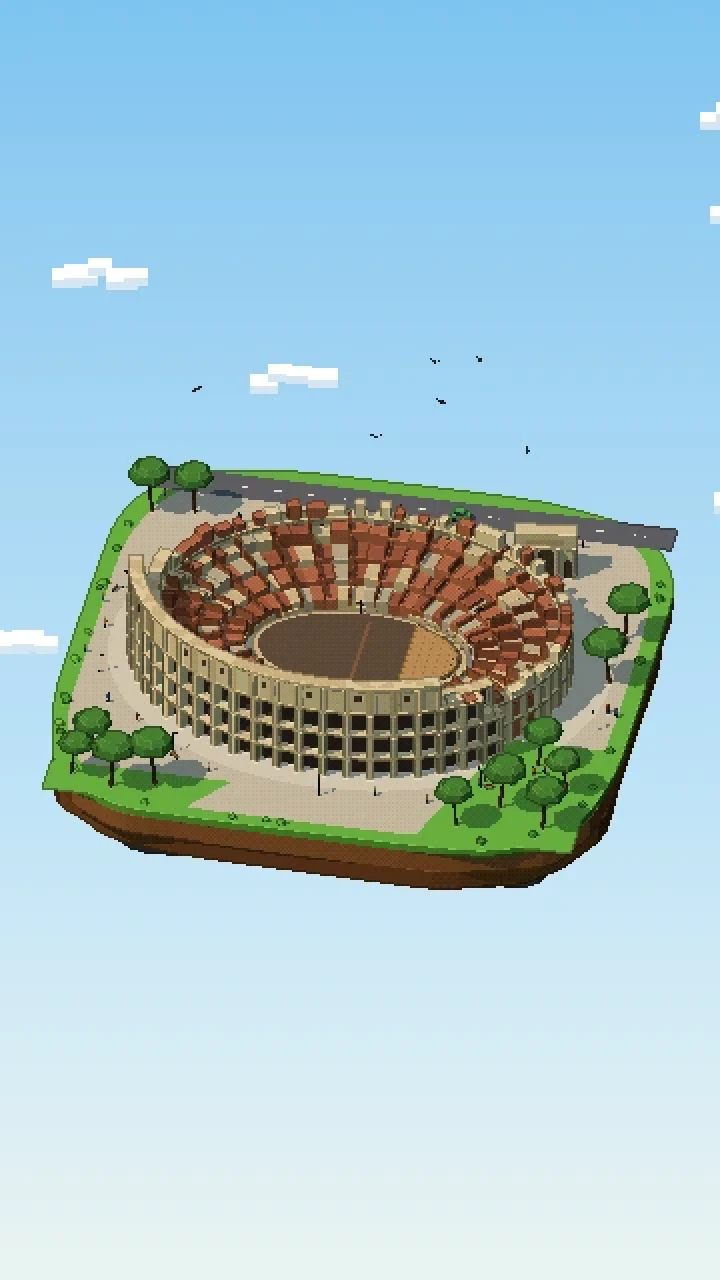
The amphitheatre is built bay by bay on its real elliptical plan at one unit for two and a half metres, with 60 bays round instead of 80. Along one side the outer wall stands to its full four storeys, three of arches and one solid attic, and it breaks off in stepped, jagged ends. Elsewhere the lower inner ring shows, with its arcades open to the sky. Inside, ruined seating rings of brick and travertine step down to the arena.
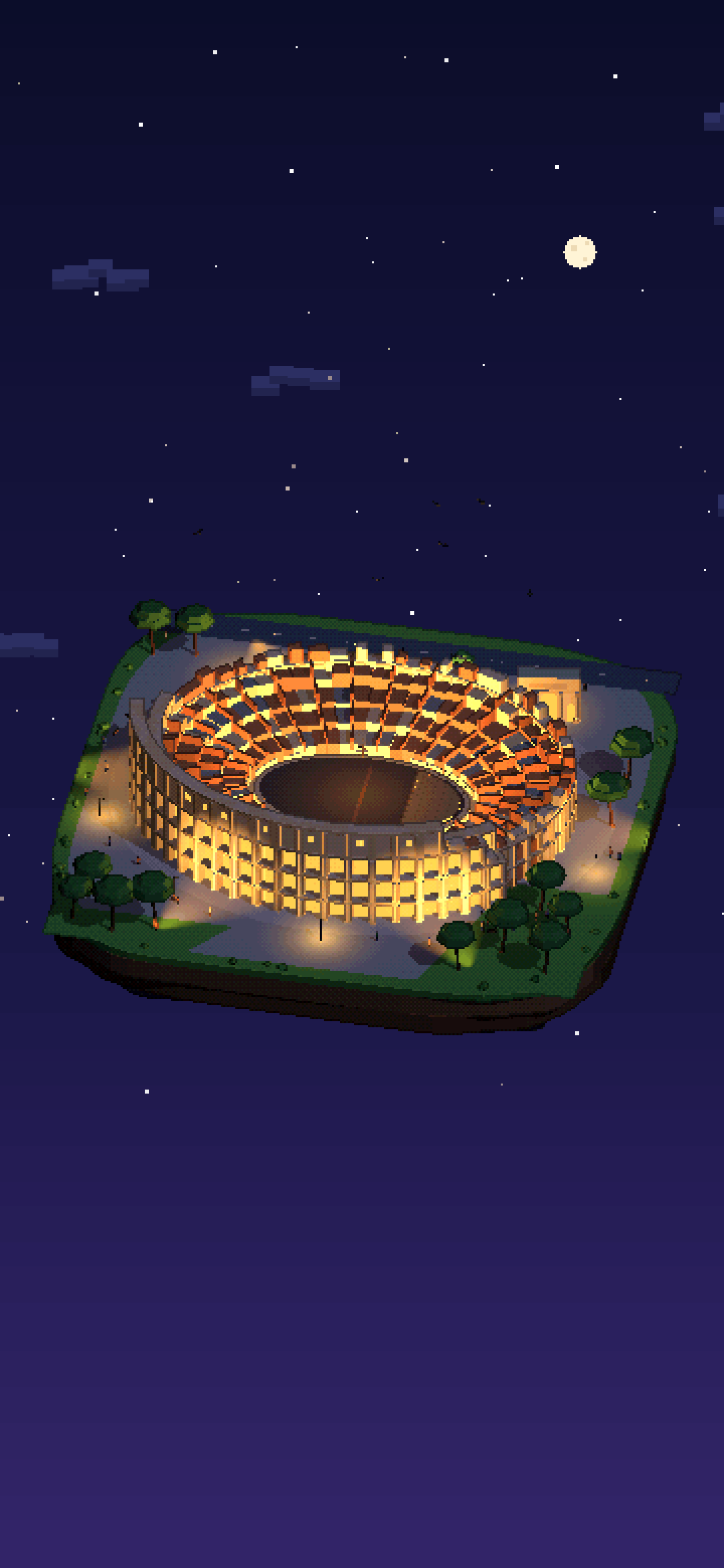
Most of the arena is open, showing the brick walls of the hypogeum, with a section of the modern wooden floor at one end and the cross on the edge. Outside, the piazza is ringed with lamps and benches, the Arch of Constantine stands to one side, and umbrella pines grow on the lawns beside the road. At night, floodlights turn the travertine gold and light glows through the arches.
Things to spot
- A tour guide with a red flag leading a group around the piazza
- A centurion in a red tunic and gold helmet, posing for photos
- Cars on the road, among them a little cream city car
- The Arch of Constantine
- The cross on the edge of the arena
What we simplified
- The Colosseum has 60 bays instead of 80, and the seating rings are ruined at random rather than as they really are.
- The Arch of Constantine and the road are moved closer, and the Roman Forum and the Palatine are left out.
Questions
When was the Colosseum built?
The Colosseum was built around AD 70–80: begun by the emperor Vespasian and opened by his son Titus in AD 80 with a hundred days of games.
How big is the Colosseum?
The Colosseum is an ellipse of 189 by 156 metres, with an outer wall about 48 metres high in four storeys. It is the largest amphitheatre ever built and held an estimated 50,000 spectators or more.
Why is the Colosseum called the Colosseum?
Its real name is the Flavian Amphitheatre, after the family of emperors who built it. The name Colosseum came later, probably from a colossal statue of Nero that stood nearby.
Why is part of the Colosseum missing?
Earthquakes brought down part of the outer wall, and for hundreds of years the fallen stone was carted away to build palaces and churches across Rome. That is why the full four-storey facade survives only on the north side.
How was this pixel-art diorama of the Colosseum made?
It is a real-time Three.js scene running on this page, drawn at 360 × 640 pixels with outlines and a small palette, then scaled up without smoothing. Press “Explore in 3D”, drag to turn it, and switch between day, dusk and night.
Isometric maps of Rome
Rome also has 2 isometric pixel-art maps made by the community: the whole city drawn tile by tile in the same SimCity-like style. See the maps of Rome →