About Cappadocia
Cappadocia is a region in the middle of Anatolia, and Göreme is the village at the centre of its most famous valleys. Millions of years ago, volcanoes including Erciyes and Hasan buried the land in thick layers of ash, which hardened into a soft rock called tuff. Wind, rain and frost have been wearing it away ever since, leaving ridges, gorges and the tall cones known as fairy chimneys.
Many chimneys wear a darker cap of harder rock that erodes more slowly than the tuff beneath it, which is why they end up shaped like mushrooms. Valleys such as Paşabağ and Love Valley near Göreme are full of them, in bands of cream, pink and ochre that change colour with the light.
Because the rock is so easy to carve, people have dug into it for thousands of years: houses, dovecotes, storerooms, whole underground cities, and hundreds of churches and monasteries. The rock-cut churches of the Göreme Open-Air Museum are painted with frescoes, mostly from the 10th to the 12th centuries. Above the village rises Uçhisar castle, a great rock honeycombed with rooms, and today many of the old cave houses are hotels.
Cappadocia is best known now for its balloons. Most mornings, when the weather allows, dozens of hot-air balloons take off at sunrise and drift over the valleys, and guests watch them from the rooftop terraces of the cave hotels.
The diorama
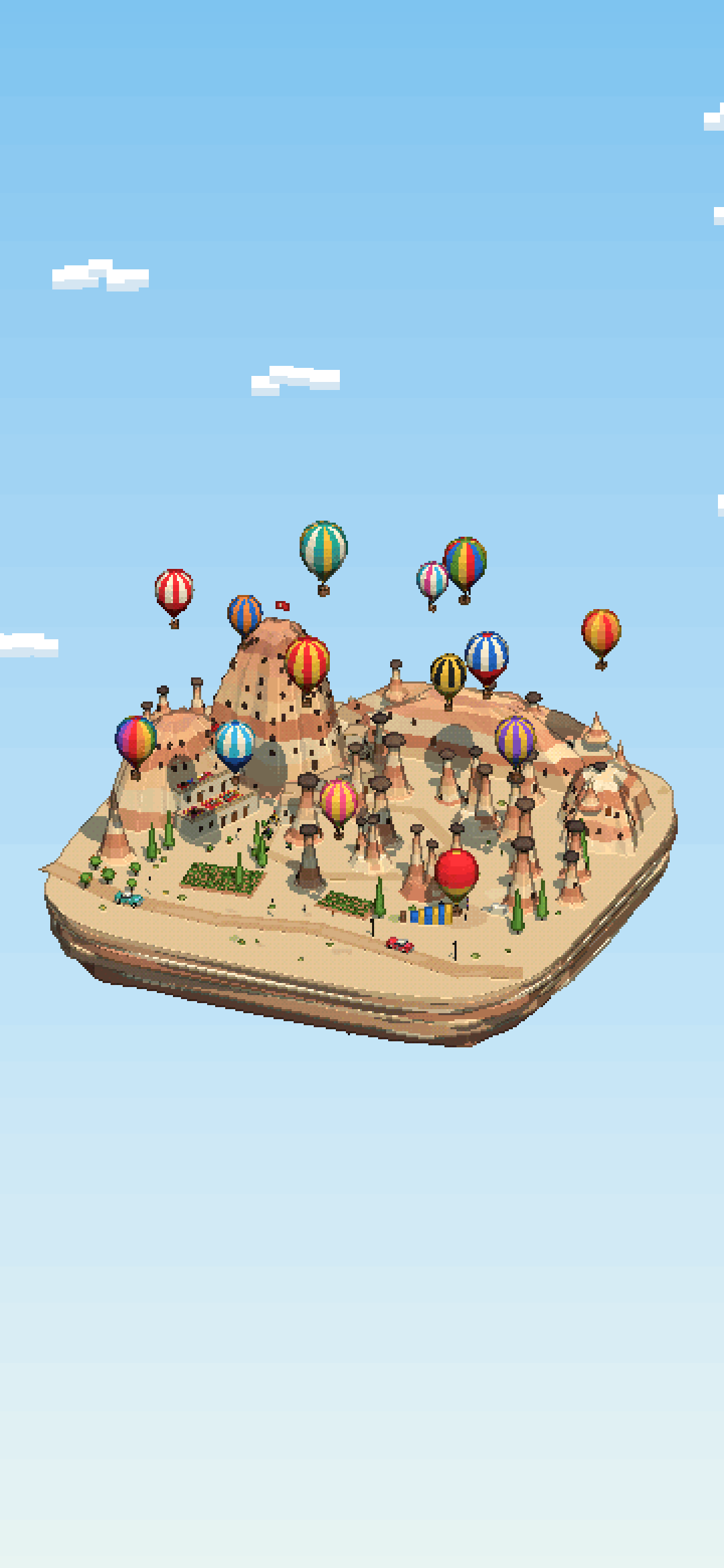
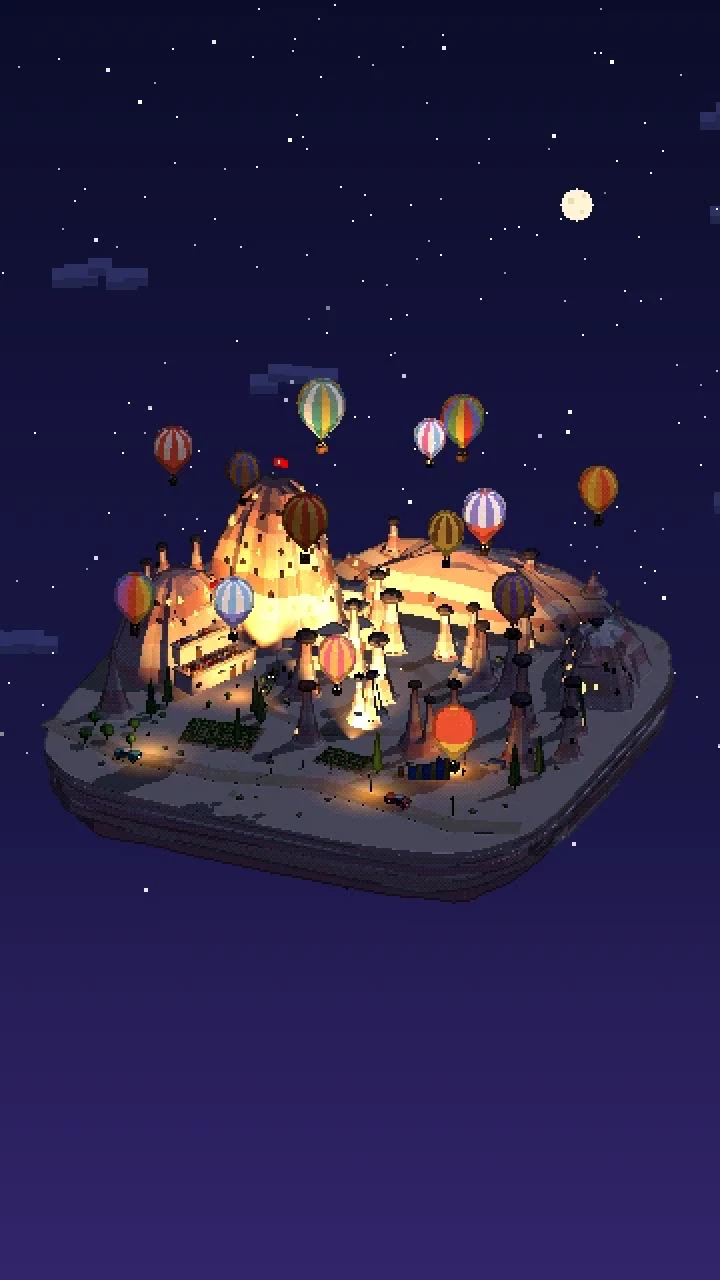
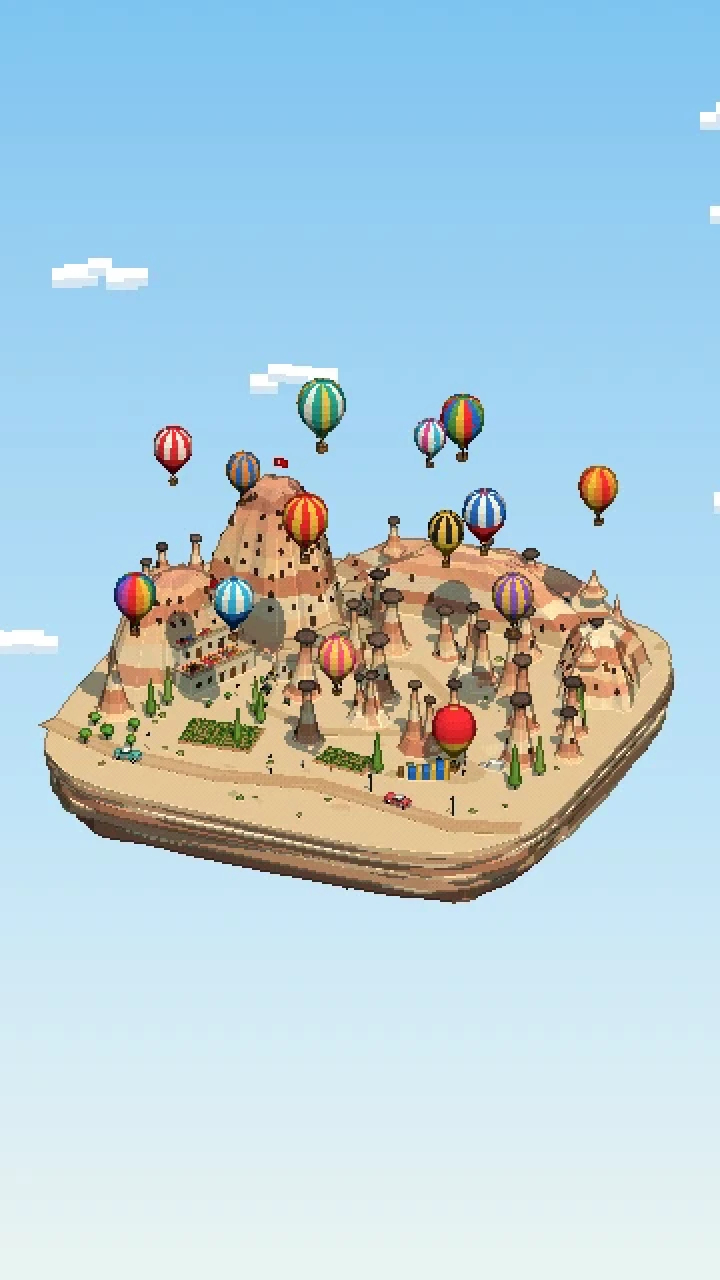
The diorama compresses the Göreme landscape onto one floating island of tuff, its edges cut in undulating bands of pink and cream rock. Uçhisar castle rock rises on one side, stepped and fluted, dotted with cave openings and wooden doors, with a Turkish flag on top and a cluster of stone houses at its foot. Ridges close the back and side of the valley, topped with smaller chimneys, and in the middle stands a field of fairy chimneys, some single, some in twin and triple groups, most with dark basalt caps.
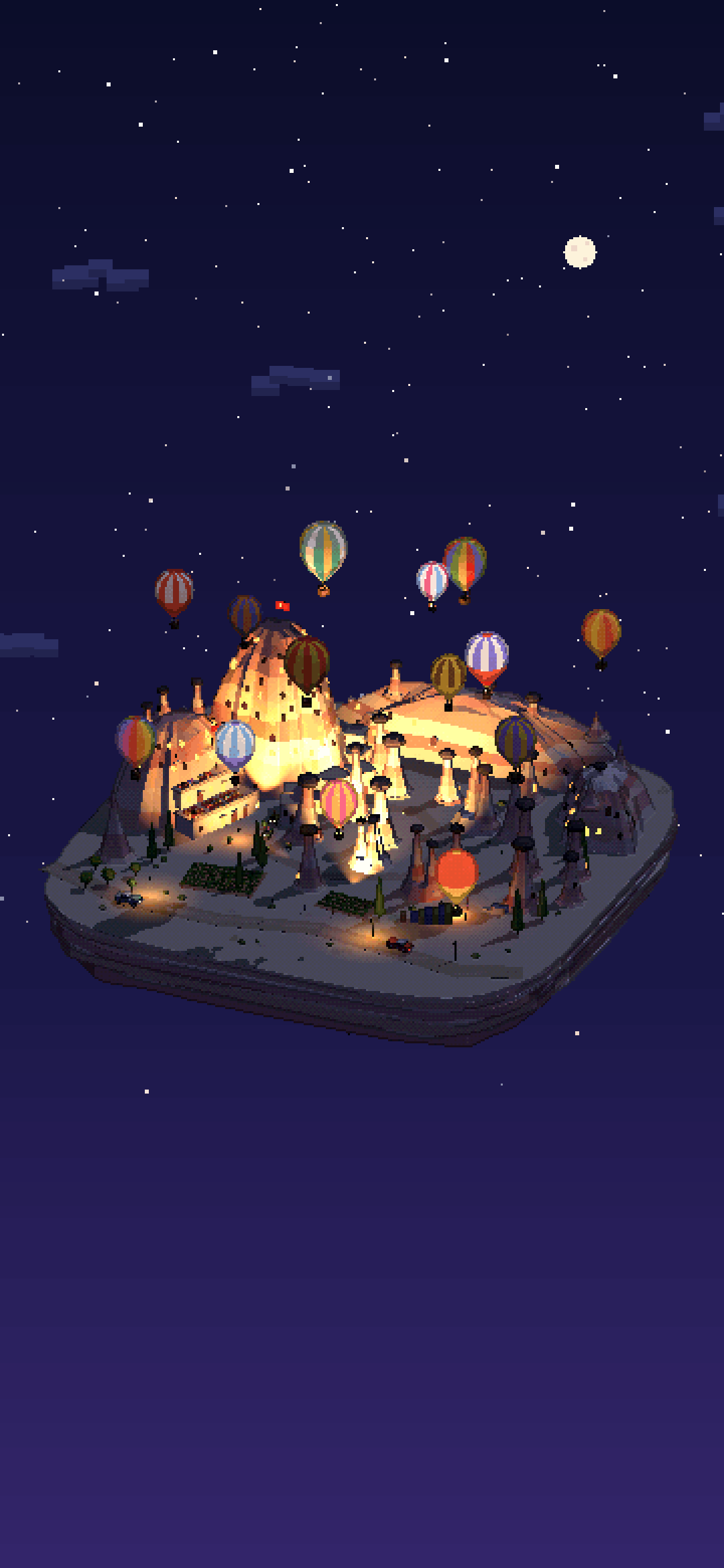
In front, a cave hotel steps down in three cream stone levels, with rugs, cushions and low breakfast tables on every terrace and guests looking at the sky. Vineyards, scrub, a dusty road and an ATV track fill the valley floor. Thirteen balloons drift and climb over it while a fourteenth takes off from the launch field. After dark the cave windows and lanterns light up, Uçhisar is floodlit, and the burners make the balloon envelopes flicker and glow.
Things to spot
- The balloon launching from the field, with its crew and a second envelope still on the ground
- Four ATVs on a safari loop, kicking up dust
- Two vintage cars, one turquoise and one red, on the dirt road
- Breakfast tables and cushions on the hotel terraces
- The flag on top of Uçhisar castle rock
What we simplified
- Uçhisar, the valley chimneys and a cave hotel are squeezed into one view; in reality they are a few kilometres apart.
- The balloons are drawn smaller than the real 20–30 m envelopes so that more of them fit in the frame, and there are far fewer than on a busy morning.
Questions
How were the fairy chimneys of Cappadocia formed?
Volcanoes including Erciyes and Hasan buried the land in ash, which hardened into a soft rock called tuff, and wind, rain and frost have been wearing it away ever since. Many chimneys keep a cap of harder rock that erodes more slowly than the tuff beneath, which gives them their mushroom shape.
Where is Cappadocia?
Cappadocia is a region in Central Anatolia, Turkey, mostly in Nevşehir Province. Göreme is the village at the centre of its most famous valleys.
Why are there hot-air balloons in Cappadocia?
Cappadocia is best known now for its balloons: most mornings, when the weather allows, dozens of hot-air balloons take off at sunrise and drift over the valleys. Guests watch them from the rooftop terraces of the cave hotels.
Is Cappadocia a UNESCO World Heritage Site?
Yes. Göreme National Park and the Rock Sites of Cappadocia have been World Heritage since 1985, including the rock-cut churches of the Göreme Open-Air Museum with frescoes mostly from the 10th to 12th centuries.
How was this pixel-art diorama of Cappadocia made?
It is a real-time Three.js scene running on this page, drawn at 360 × 640 pixels with outlines and a small palette, then scaled up without smoothing. Press “Explore in 3D”, drag to turn it, and switch between day, dusk and night.