About Petra
Petra was the capital of the Nabataeans, Arab traders who grew rich on the caravan routes of the ancient Near East. Their city lies in a basin of sandstone mountains in southern Jordan, and instead of building their grandest monuments they carved them straight into the cliffs. The name Petra is Greek for “rock”. The city later passed to Rome, slowly emptied, and was introduced to European readers again by the Swiss traveller Johann Ludwig Burckhardt in 1812.
The usual way in is the Siq, a narrow gorge about 1.2 km long that was split open by tectonic forces and then smoothed by water. In places it is only about 3 m wide, and its walls rise far above the path. The Nabataeans cut water channels along its sides, and stretches of its old paving survive. At the end of the gorge the walls part, and the first thing a visitor sees is the facade of Al-Khazneh, the Treasury.
Al-Khazneh is about 39 m high and 25 m wide, carved into the rock face from the top down. The lower storey is a portico of six Corinthian columns under a pediment. Above it a round tholos with a conical roof and an urn stands between two half-pavilions with a broken pediment. It was most likely a royal tomb from the time of Aretas IV in the early 1st century AD. The name “Treasury” comes from a Bedouin legend that treasure was hidden in the urn, which still carries bullet marks from people trying to break it open.
Petra was listed by UNESCO in 1985 and voted one of the New 7 Wonders of the World in 2007. The Treasury became famous worldwide as the hiding place of the Holy Grail in the 1989 film Indiana Jones and the Last Crusade. Today visitors walk, ride horse carriages or camels through the site, and on some evenings of the week the Siq and the square in front of the Treasury are lit by candles in paper bags for Petra by Night.
The diorama
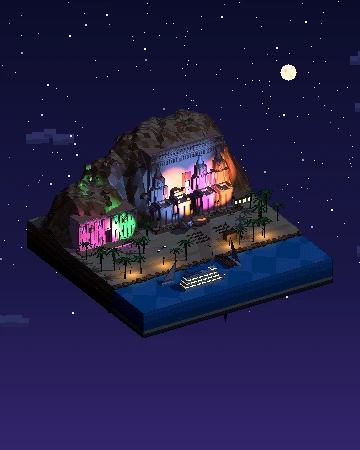
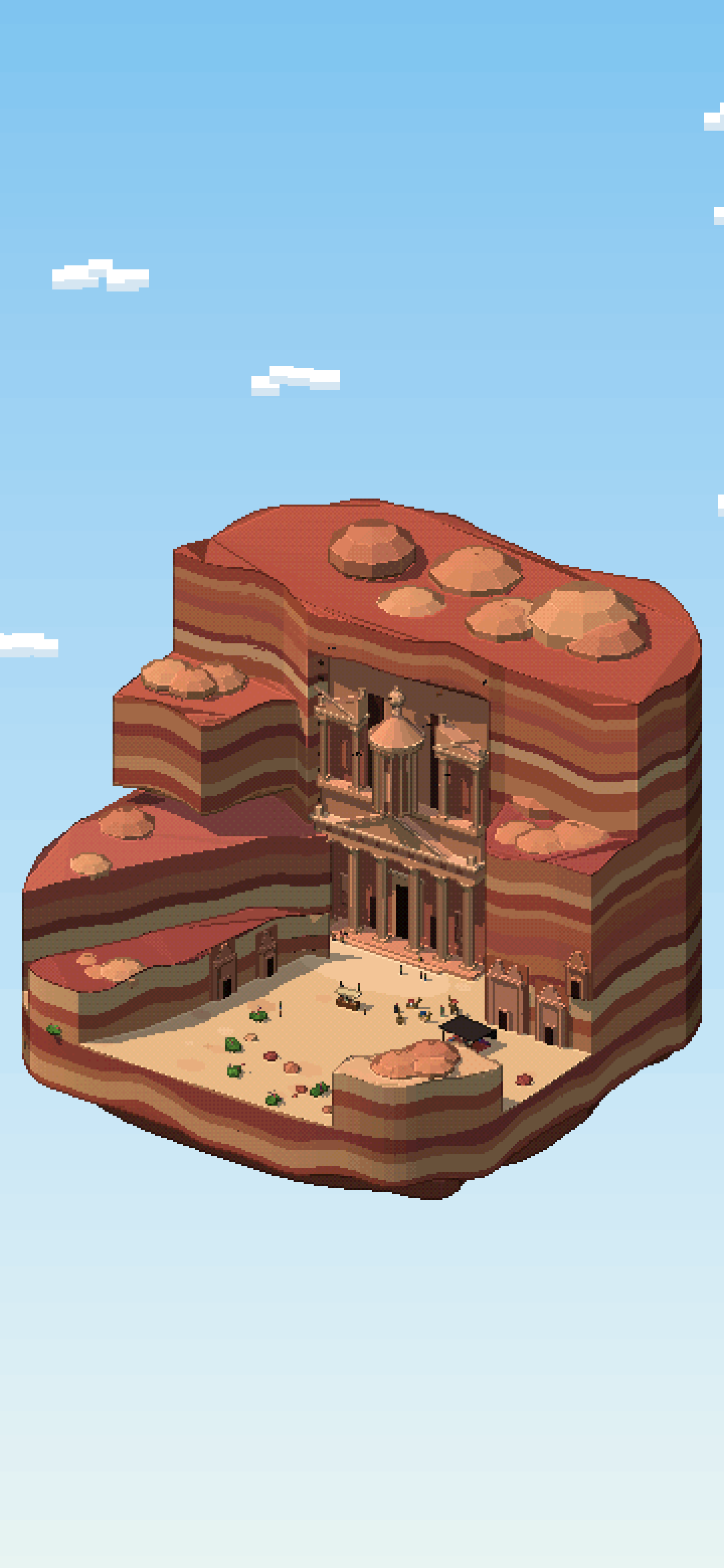
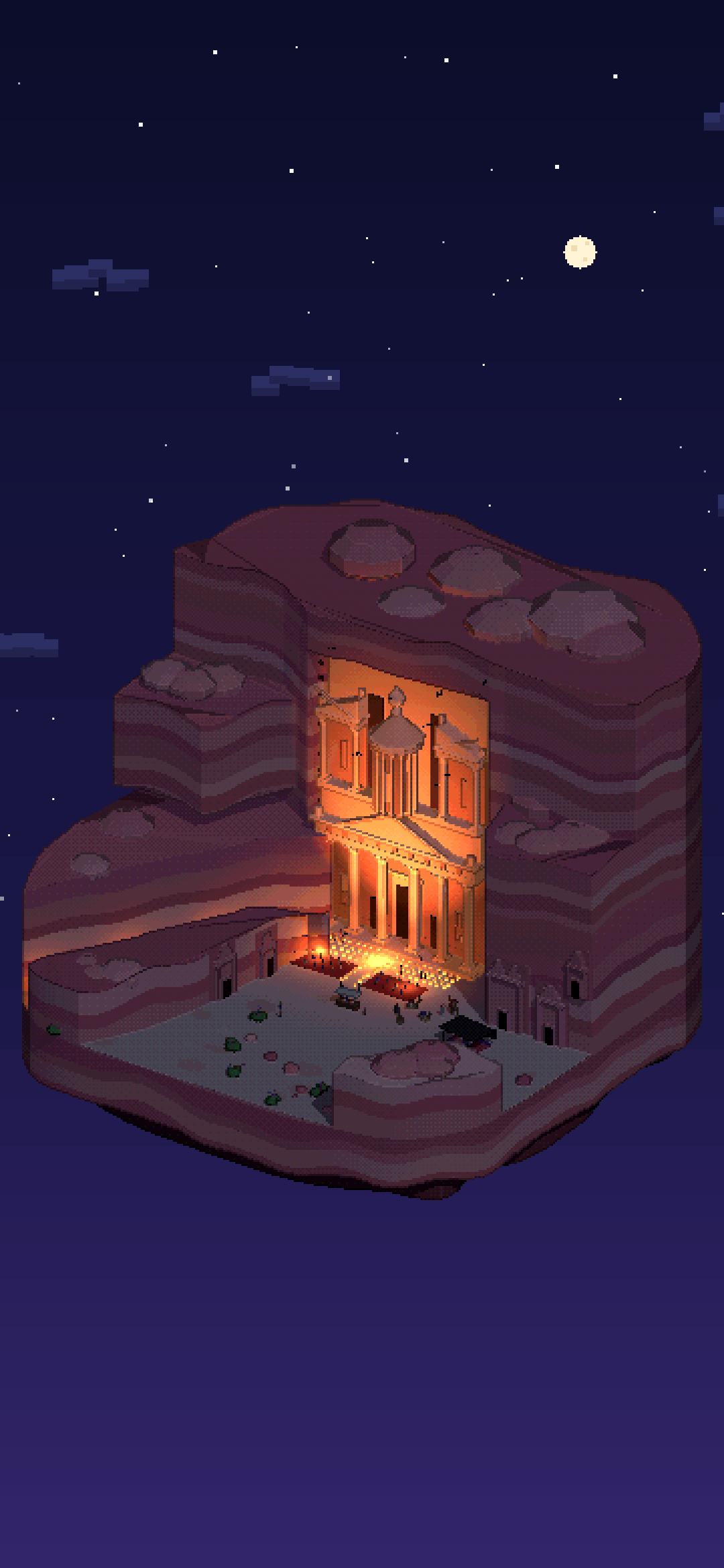
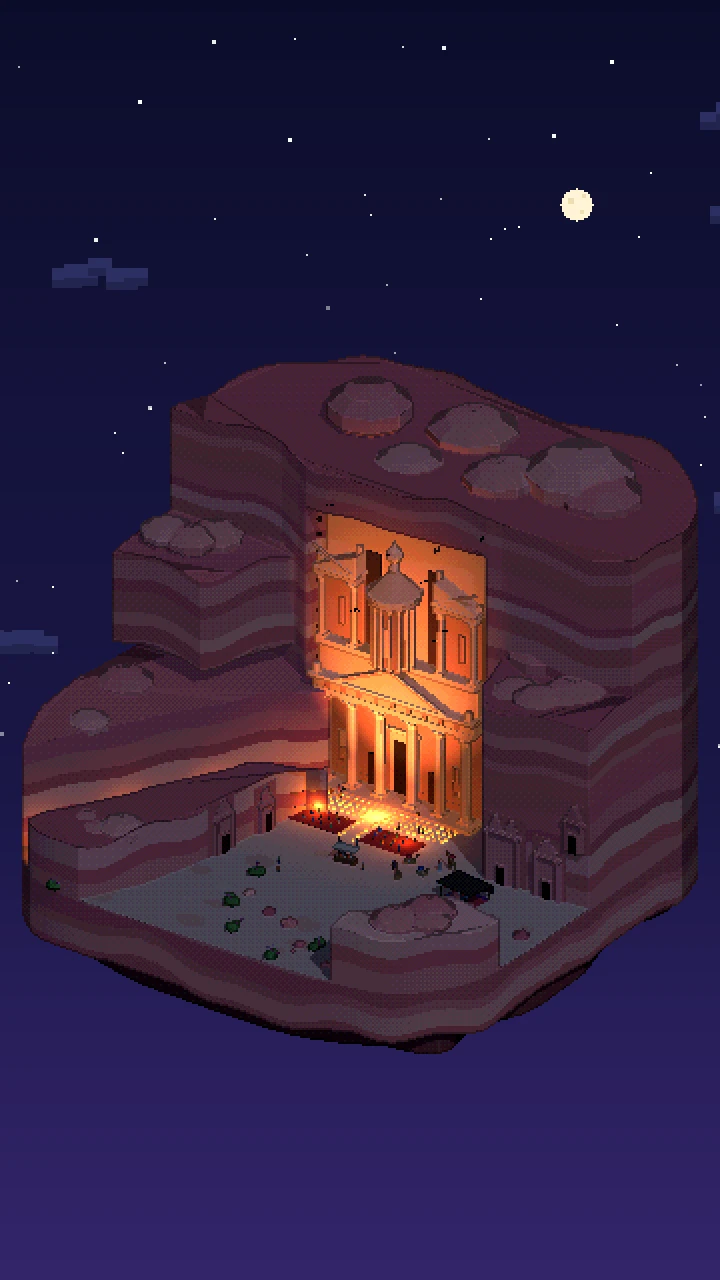
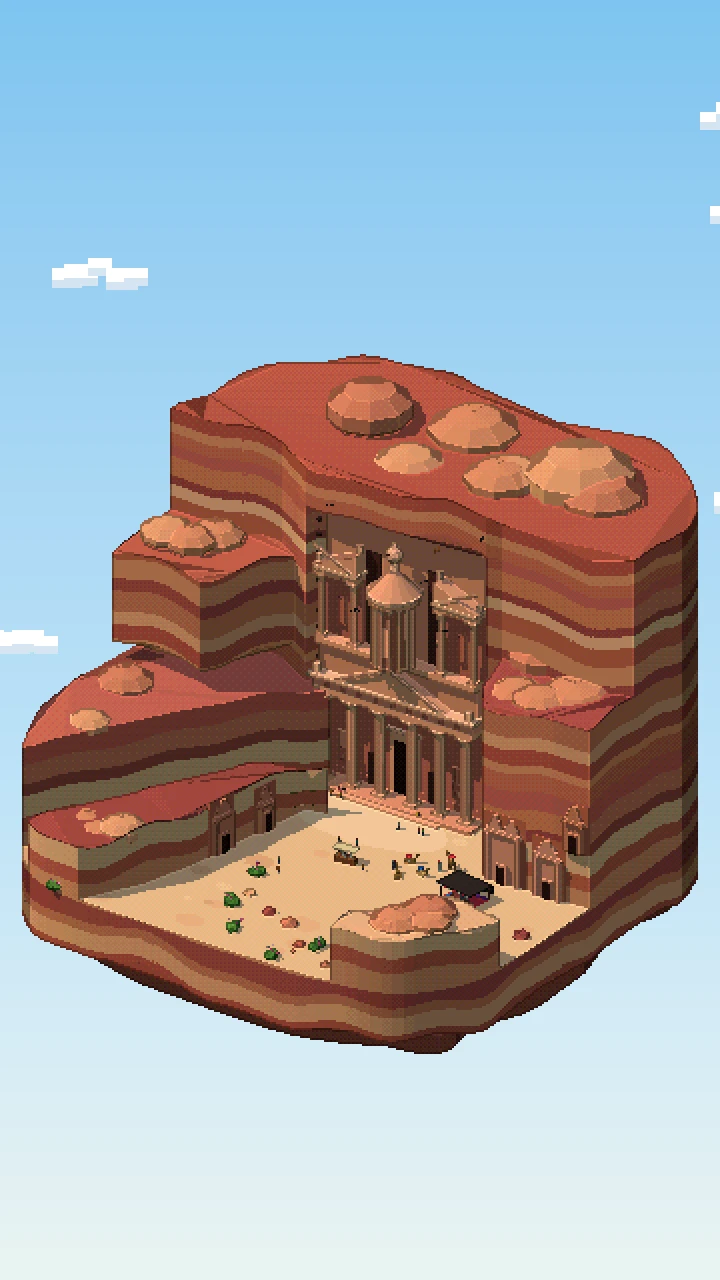
The diorama sets the Treasury on a floating block of sandstone, built in Three.js and rendered as pixel art with dark outlines and a small palette. The rock is drawn in wavy pink, red, ochre and salmon layers that run through every cliff and down the sides of the island, with rounded, eroded domes on top. The facade is carved into a niche in the tallest cliff at its real size: the six-column portico with its pediment and riders in relief, and above it the tholos with its urn between the two half-pavilions with their broken pediment.
A winding Siq cuts through the rock from the front corner of the island to the plaza in front of the Treasury, with a water channel along its wall. Crow-step tomb facades are cut into the side cliffs. In the open sand there are camels resting with their Bedouin handlers, a donkey ride, a horse carriage driving in and out of the Siq, tourists and a Bedouin tea tent beside a souvenir stall. At night the Siq and the plaza fill with flickering candles, an audience sits on mats, and the facade glows in the candlelight.
Things to spot
- A horse carriage driving in and out of the Siq
- Kneeling camels with their Bedouin handlers
- The urn on top of the tholos, with its bullet marks
- Crow-step tomb facades on the side cliffs
- A donkey ride with a guide on foot
- Candles lining the Siq and filling the plaza at night
What we simplified
- The Siq is much shorter, wider and lower than the real gorge, which runs about 1.2 km between far higher walls; here it is a short S-bend so you can see into it.
- The other tomb facades stand in for Petra’s Street of Facades and the wider city, which really lie further along the valley beyond the Treasury.
- The facade is drawn at its real size but with heavier columns and cornices, and its carved figures are only hinted at.
Questions
How tall is the Treasury at Petra?
Al-Khazneh, the Treasury, is about 39 m high and 25 m wide. It was carved into the sandstone cliff face rather than built from blocks.
Why is it called the Treasury?
The name comes from a Bedouin legend that treasure was hidden in the stone urn at the top of the facade. The urn is solid rock, and it still shows bullet marks from people who tried to break it open. The building was most likely a royal tomb.
How long is the Siq at Petra?
The Siq is a winding gorge about 1.2 km long that leads to the Treasury. In places it is only about 3 m wide, and its walls rise far above the path.
What is Petra by Night?
Petra by Night is an evening visit held on several nights a week, when the path through the Siq and the square in front of the Treasury are lit by over a thousand candles in paper bags. Visitors sit in front of the facade for music and storytelling.
How was this pixel-art diorama of Petra made?
It is a real-time Three.js scene on this page, drawn at 360 × 640 pixels with outlines and a small palette and scaled up without smoothing. The Treasury is modelled at its real size, but the Siq is much shorter and wider than the real gorge so you can see into it. Press “Explore in 3D”, drag to turn it, and switch between day, dusk and night.