About Jet d’Eau
The Jet d’Eau began as plumbing. In 1886 the hydraulic plant on the Rhône that supplied water under pressure to Geneva’s workshops needed a way to let off excess pressure. Engineers fitted an open-air outlet, and the plume of water, about 30 metres high, turned out to be so popular that the city decided to keep a fountain for its own sake.
In 1891 a new Jet d’Eau was built at its present place in the harbour, at the end of the Eaux-Vives jetty, in time for the Federal Gymnastics Festival and the 600th anniversary of the Swiss Confederation. It reached about 90 metres. In 1951 it got its own pumping station that draws water straight from the lake, and the jet rose to the 140 metres it still reaches today.
The numbers are what make it remarkable: 500 litres of water every second, thrown up at 200 km/h, with roughly seven tonnes of water in the air at any moment. The column looks white because the nozzle mixes millions of air bubbles into the water. The wind decides where it comes down, and visitors who walk out along the jetty regularly get soaked when it shifts.
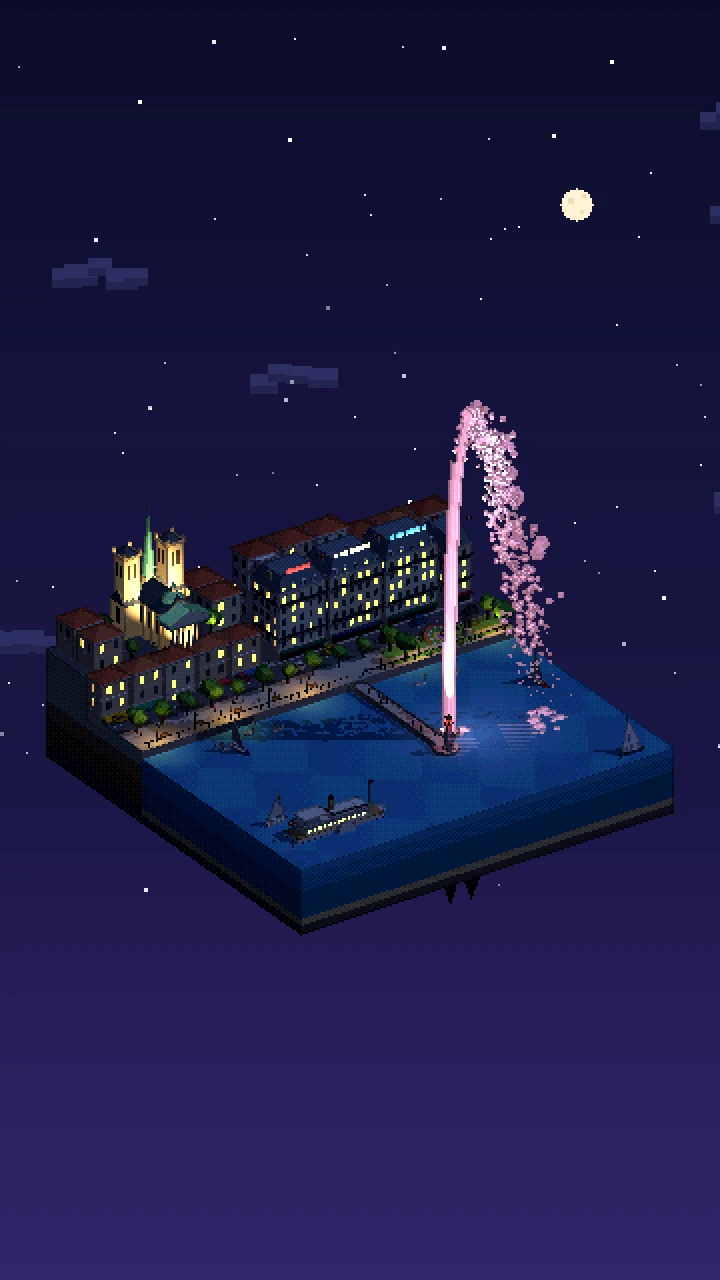
The jet is run by SIG, Geneva’s utility company. Retired staff keep watch and switch it off when it freezes or the wind is too strong, and it rests for a few weeks each year for maintenance. On evenings when it runs it is floodlit, usually white, and for international days and causes it is lit in colours, such as pink for breast-cancer awareness in October.
The diorama
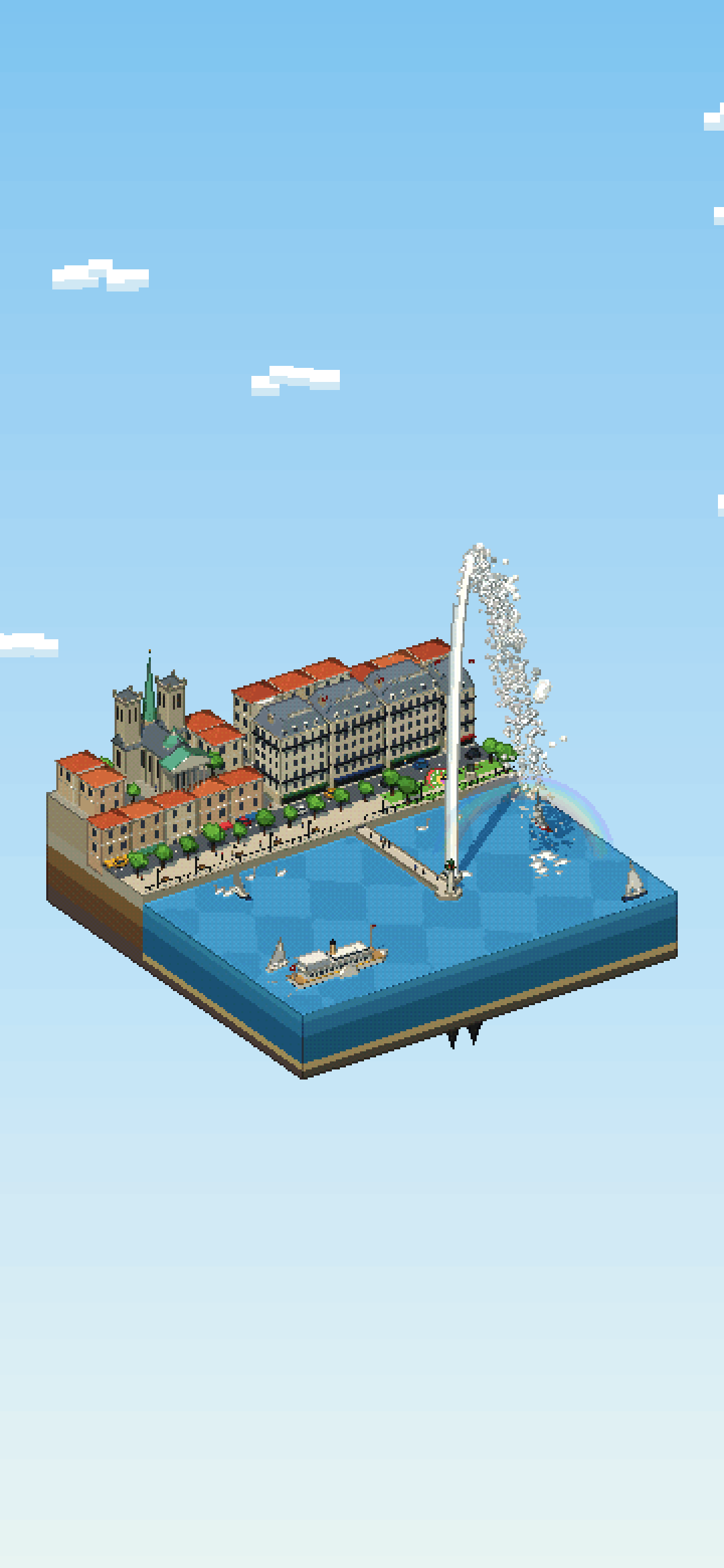
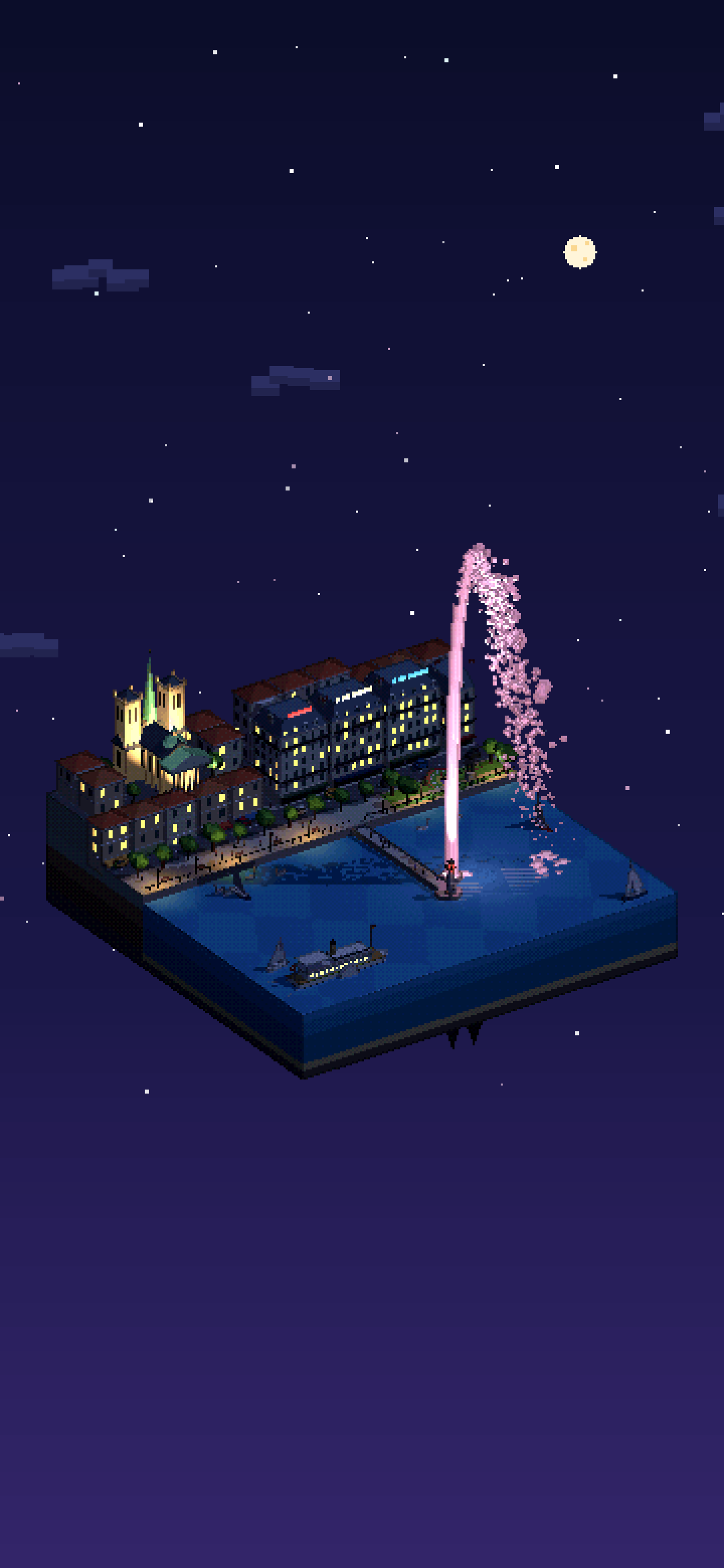
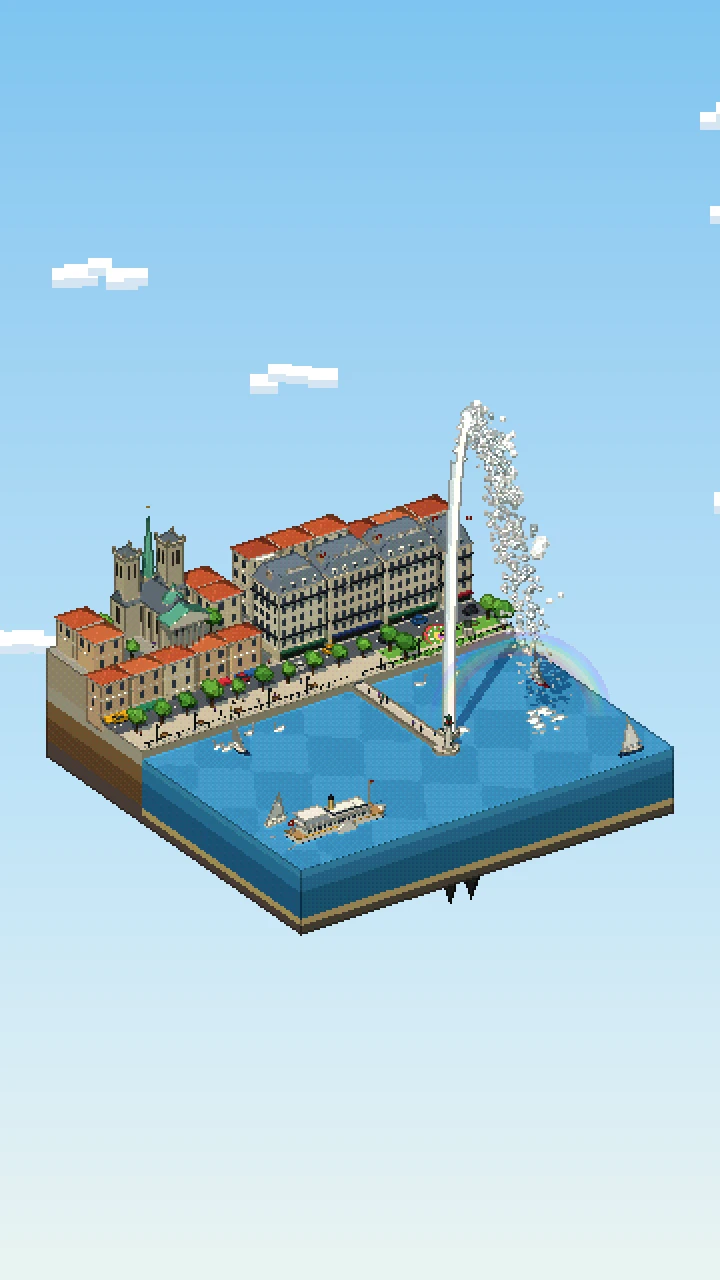
The diorama puts the Jet d’Eau on a floating block of Geneva, built in Three.js and rendered as pixel art: the scene is drawn at a low resolution, every edge gets a dark outline, the colours are reduced to a small palette, and the result is scaled up without smoothing. The jet is a white column that rises from a stone rotunda beside the jetty and falls back as hundreds of animated droplets and puffs of mist, blown downwind across the lake. The stone jetty runs out to the little cast-iron lighthouse with its red lantern.
Behind the quay are the lakeside promenade with trees, benches and lamps, the Jardin Anglais with the flower clock, a busy quay road, grand hotels with rooftop signs, and the Old Town hill crowned by St Pierre Cathedral, with its two towers, green copper spire and columned portico. A Belle Époque paddle steamer, sailing boats and swans move on the water. At golden hour a rainbow stands in the spray; at night the jet glows white, then pink, over the lit city.
Things to spot
- A rainbow in the spray at golden hour
- The flower clock in the Jardin Anglais, with a red second hand that really turns
- Swans paddling along the quay wall
- The paddle steamer flying the Swiss flag at the stern
- People walking out along the jetty towards the spray
- The lighthouse’s red lantern blinking at night
What we simplified
- The jet is drawn a little taller than its true scale, and the lighthouse much larger, so both read at pixel size.
- The waterfront is condensed: the hotels, the Jardin Anglais and the Old Town are pulled together on one quay, and the buildings are generic rather than the real façades.
- St Pierre Cathedral is simplified and turned so that its portico faces the lake.
Questions
How tall is the Jet d’Eau?
The Jet d’Eau in Geneva is 140 metres tall. It pumps 500 litres of lake water a second out of its nozzle at 200 km/h, and about seven tonnes of water are in the air at any moment.
Why was the Jet d’Eau built?
It started in 1886 as a pressure outlet for a hydraulic plant on the Rhône that supplied Geneva’s workshops. The plume was so popular that in 1891 a fountain was built at its present place in the harbour, and in 1951 a dedicated pumping station raised it to 140 metres.
Can you walk to the Jet d’Eau?
Yes. The Jet d’Eau stands at the end of the Eaux-Vives jetty, which you reach from Quai Gustave-Ador on the left bank of the lake. It is free, but if the wind turns you may get drenched by the spray.
Is the Jet d’Eau lit at night?
On evenings when it runs, the Jet d’Eau is floodlit, usually in white. For international days and causes it is lit in colours, such as pink in October for breast-cancer awareness. It is switched off in frost or strong wind.
How was this pixel-art diorama of the Jet d’Eau made?
It is a real-time Three.js scene running on this page, drawn at 360 × 640 pixels with dark outlines and a small palette, then scaled up without smoothing. The jet is an animated column of droplets and mist that drifts downwind, with the jetty, its lighthouse and the Geneva waterfront behind. Press “Explore in 3D” to drag it round and switch between day, dusk and night.
Isometric maps of Geneva
Geneva also has an isometric pixel-art map made by the community: the whole city drawn tile by tile in the same SimCity-like style. See the map of Geneva →