About Abu Simbel
Abu Simbel is a pair of temples cut straight into a sandstone cliff above the Nile in Nubia, in the far south of Egypt, for Pharaoh Ramesses II in the 13th century BC. The larger one, the Great Temple, honours the gods Ra-Horakhty, Amun-Ra and Ptah together with the deified king himself. Four seated colossi of Ramesses, each about 20 metres tall, guard its entrance, and a row of 22 baboons greets the rising sun along the top of the façade.
Next to it stands the Small Temple, dedicated to the goddess Hathor and to Nefertari, Ramesses’ chief queen. Its façade has six standing statues about ten metres high, four of the king and two of the queen, and unusually for Egyptian art the queen’s statues are the same size as the king’s. Above the Great Temple’s door, the falcon-headed sun god Ra-Horakhty stands in a niche.
The Great Temple is aligned so that, twice a year around 22 February and 22 October, the rising sun shines along its whole length and lights three of the four seated statues in the inner sanctuary. Ptah, a god linked with the underworld, stays in the dark. The dates are often said to be the king’s birthday and coronation day, but there is no direct evidence for that.
When the Aswan High Dam was built, the rising waters of Lake Nasser would have drowned the temples. In an international rescue led by UNESCO between 1964 and 1968, they were cut into 1,036 blocks and rebuilt about 65 metres higher and 200 metres further inland, against an artificial hill raised over concrete domes and set to keep the sunrise alignment. The temples were rediscovered by Johann Ludwig Burckhardt in 1813.
The diorama
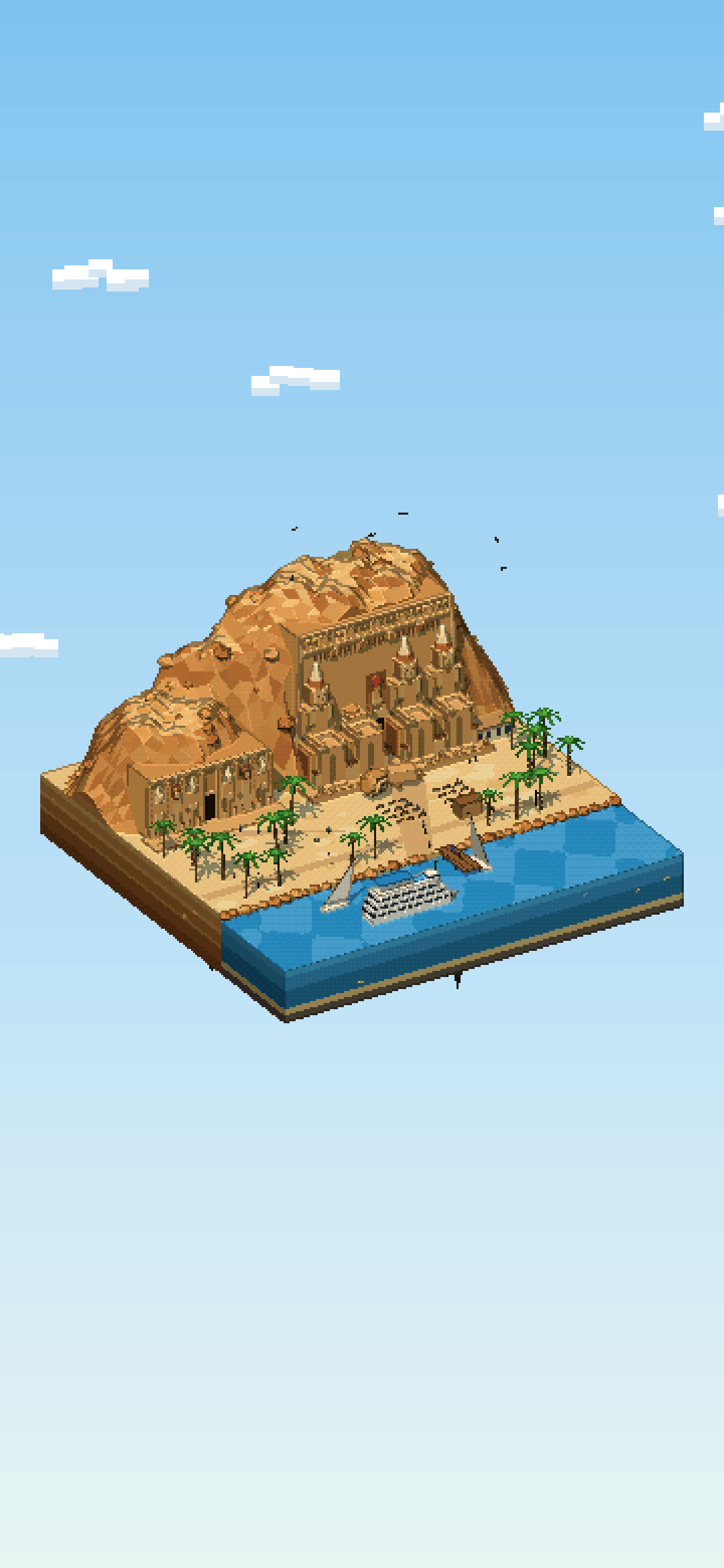
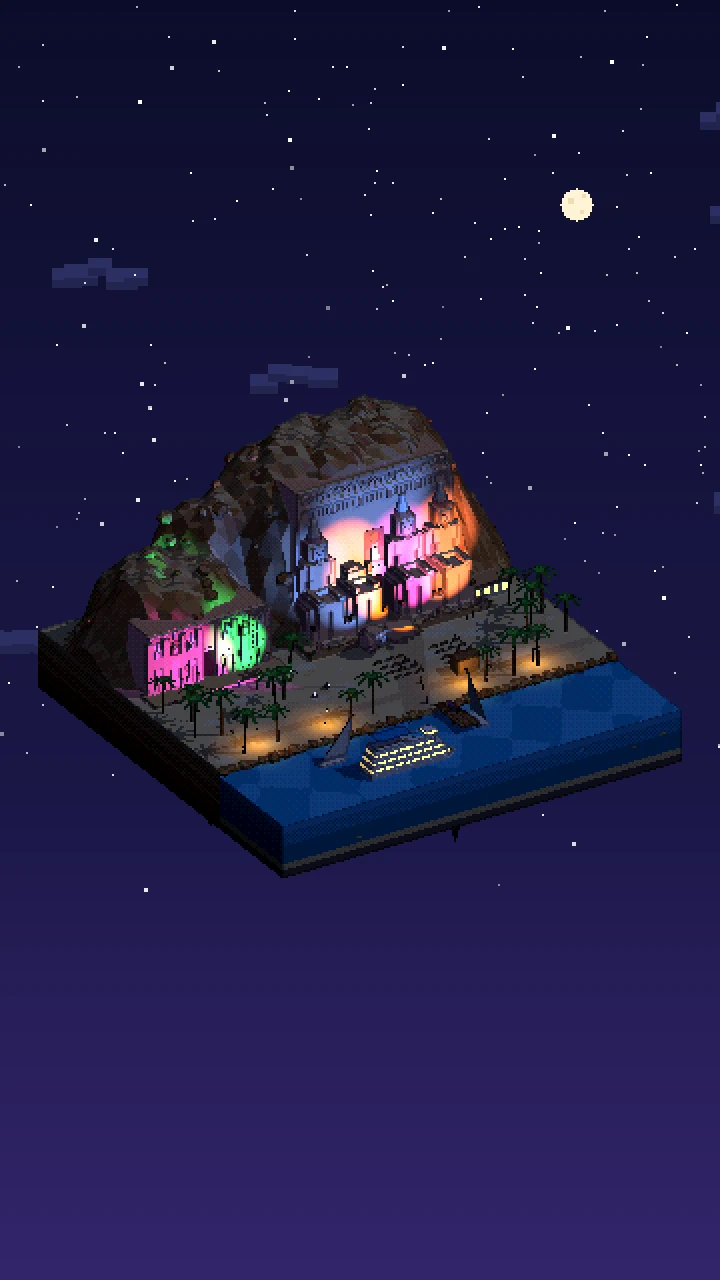
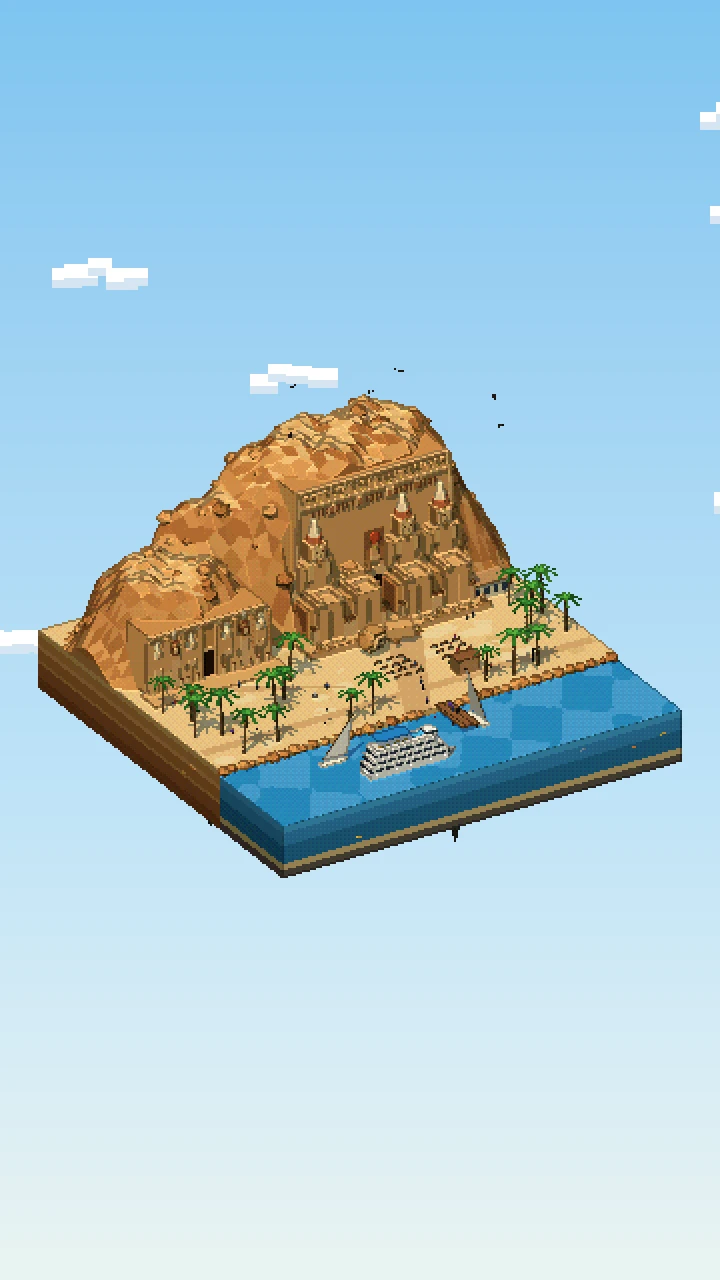
The diorama sets both temples into a faceted sandstone hill on a floating island, built in Three.js and rendered as pixel art with dark outlines and a small palette. The Great Temple’s pylon-shaped façade carries its four seated colossi with striped headdresses and double crowns, small family figures at their feet, the doorway with Ra-Horakhty and his sun disc in the niche above, an inscription band, a frieze of cobras and the row of 22 baboons. The second colossus from the left is broken, its head and chest lying in front of it.
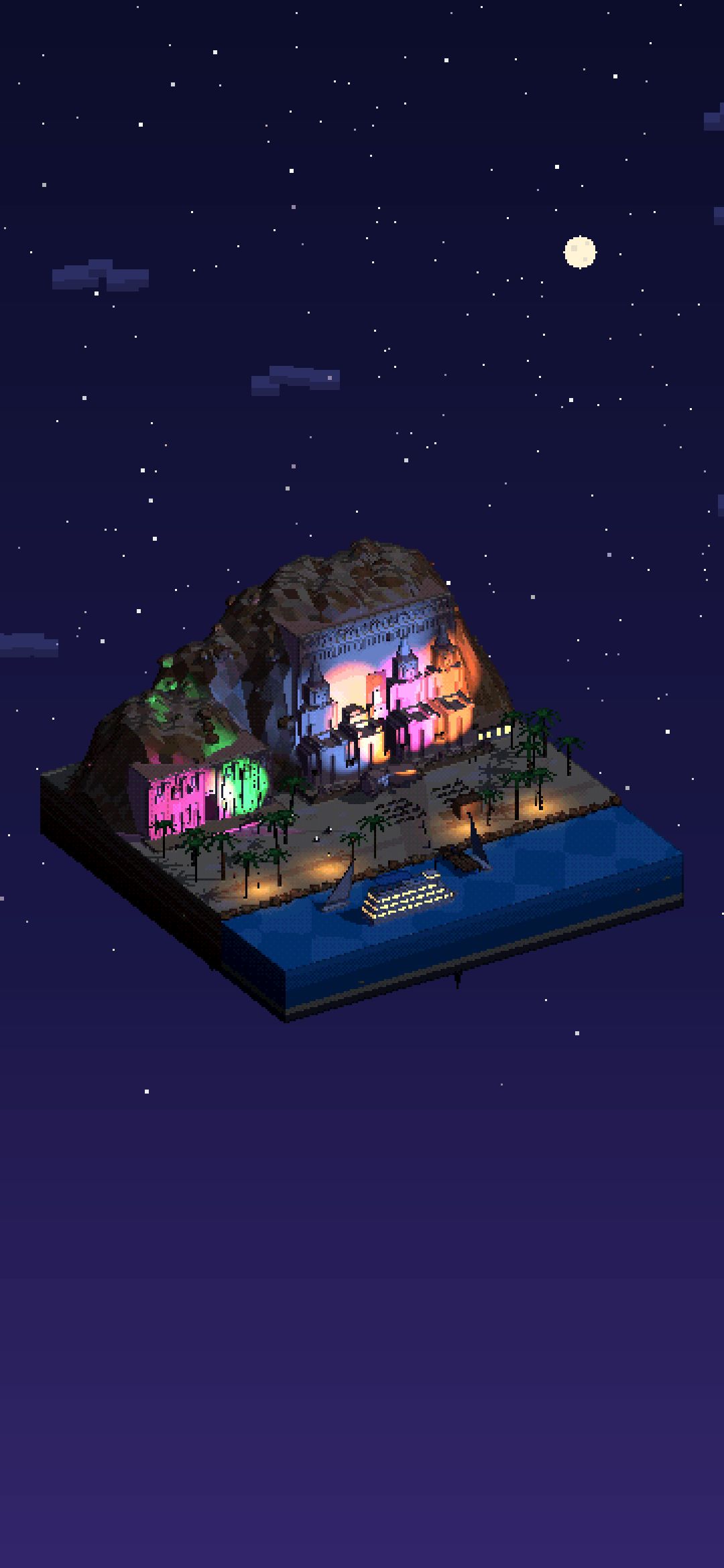
Beside it, Nefertari’s temple shows its six standing statues between sloping buttresses. In front are a sandy plaza with palms, tourists, a projection booth and benches for the show, a wooden jetty, and Lake Nasser cut open at the island’s edge, with a three-deck cruise boat and a felucca. At golden hour a beam of sunrise light runs into the Great Temple’s doorway and the sanctuary glows; at night projectors wash the colossi and the queen’s temple in cycling colours for the sound-and-light show.
Things to spot
- The fallen head of the broken colossus lying on its side
- Twenty-two baboons along the top of the façade
- Ra-Horakhty with his red sun disc above the door
- A Nile cruise boat with a pool on its sun deck
- A felucca with its tall white sail
- Visitors waiting on the benches for the sound-and-light show
What we simplified
- The two temples stand much closer together than they really do, and the hill behind them is a simple rocky dome.
- The colossi, buttresses and reliefs are simplified into blocks, and the sunrise beam is drawn as a 2D light shaft from the lake side.
- The plaza, benches, jetty and boats stand in for the busier real waterfront and visitor area.
Questions
How tall are the statues at Abu Simbel?
The four seated colossi of Ramesses II at the Great Temple are each about 20 metres tall, on a façade about 33 metres high and 38 metres wide. The six standing statues of the Small Temple are about ten metres high.
When does the sun shine into Abu Simbel?
Around 22 February and 22 October, the rising sun shines along the whole Great Temple and lights the statues in its sanctuary, except Ptah, a god linked with the underworld, who stays in the dark.
Why was Abu Simbel moved?
The Aswan High Dam would have flooded the temples under Lake Nasser. Between 1964 and 1968 they were cut into 1,036 blocks and rebuilt about 65 metres higher and 200 metres inland, in an international rescue led by UNESCO.
Why is one of the colossi broken?
The second colossus from the left is thought to have lost its head and upper body in an earthquake soon after the temple was finished. The pieces were left lying at its feet and were not put back when the temple was moved.
How was this pixel-art diorama of Abu Simbel made?
It is a real-time Three.js scene on this page, drawn at 360 × 640 pixels with outlines and a small palette and scaled up without smoothing. The temples keep their real proportions, but stand much closer together than at the real site. Press “Explore in 3D”, drag to turn it, and switch between day, dusk and night.