About Pyramids of Giza
The three pyramids on the Giza plateau were built as tombs for three kings of Egypt’s Fourth Dynasty: Khufu, his son Khafre and Menkaure. The Great Pyramid of Khufu came first and is the largest. For thousands of years it was the tallest structure made by people, and it is the only one of the Seven Wonders of the Ancient World still standing.
The pyramids were built mainly from limestone blocks, over two million in Khufu’s alone, and were once covered in smooth white casing stones that made their faces flat and bright. Almost all of that casing was later stripped for building stone. Khafre’s pyramid still keeps a cap of it near the top, which is why it looks pointed and paler at the tip, and Menkaure’s was partly cased in red granite at its foot.
The pyramids were not built alone. Each had a mortuary temple against its east face, a causeway down to a valley temple near the edge of the Nile flood plain, smaller pyramids for queens, and fields of mastaba tombs for officials and family. The Great Sphinx, a lion with a king’s head, was carved from a ridge of bedrock left standing in a quarry next to Khafre’s causeway, and is usually linked to him.
Today the plateau sits right at the edge of Giza’s suburbs, a short drive from central Cairo. Visitors arrive by bus and car, ride camels round the pyramids, and in the evening sit in front of the Sphinx for the sound-and-light show, when coloured lights play across the stones.
The diorama
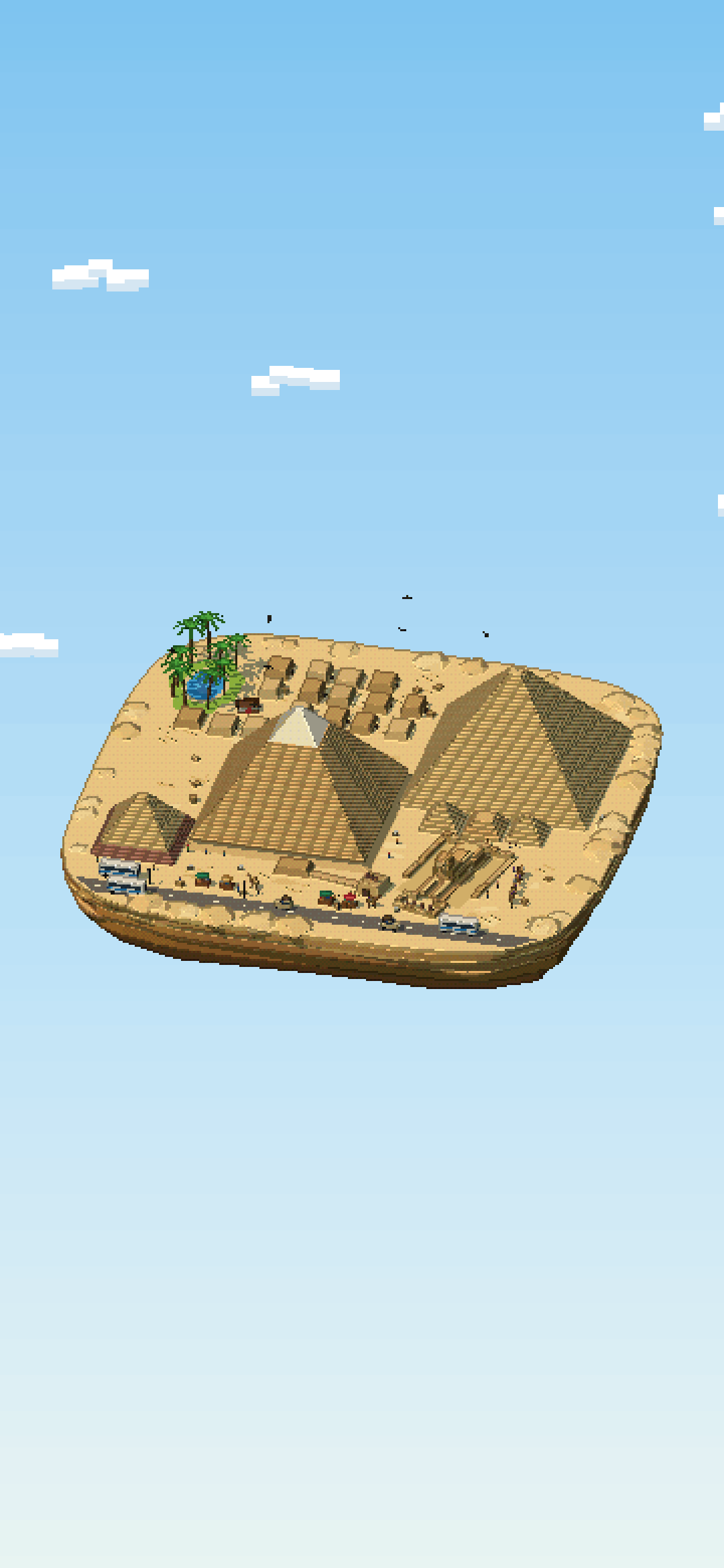
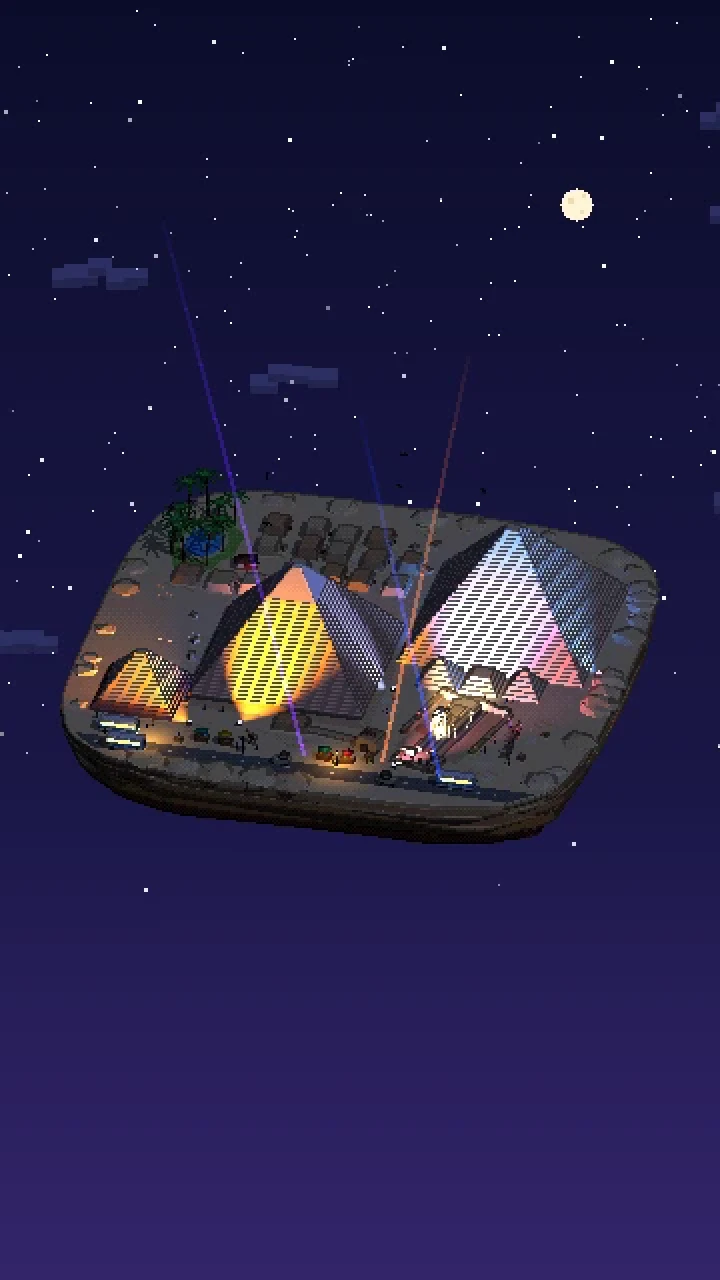
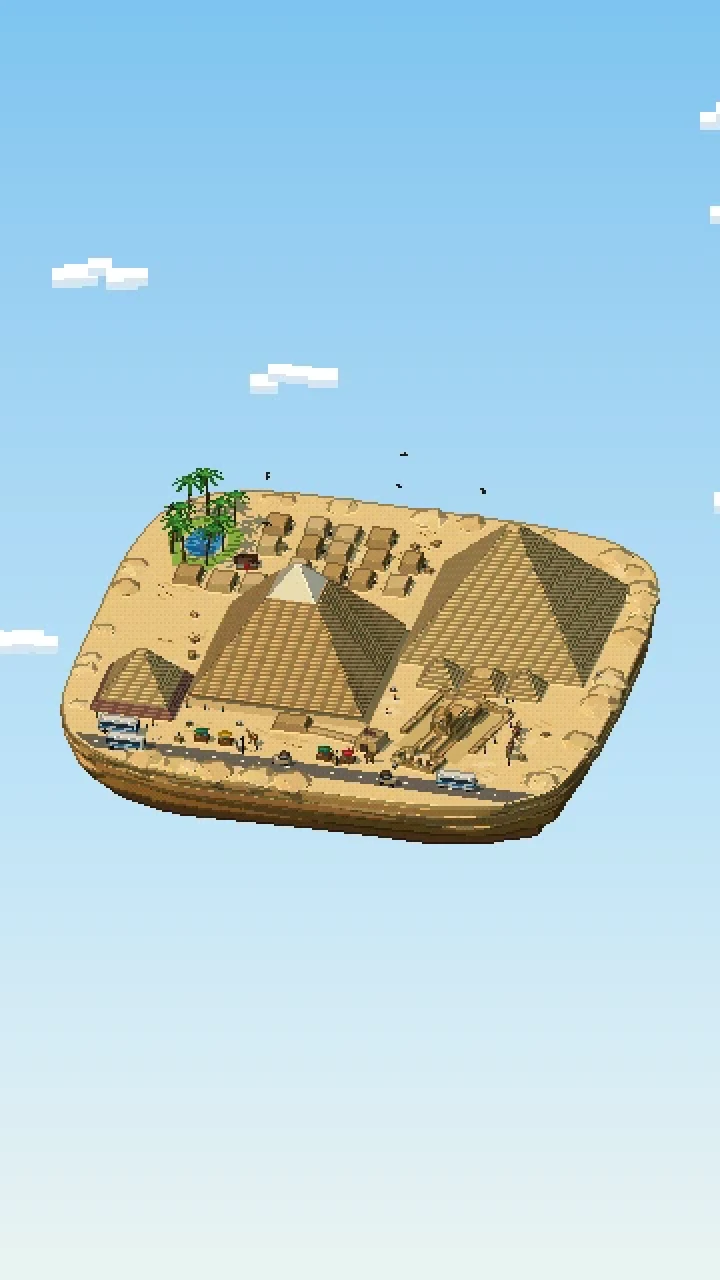
The diorama sets the plateau on a floating island of sand with sandstone layers in its sides, built in Three.js and rendered as pixel art with dark outlines and a small palette. The three pyramids keep their real sizes relative to each other: they are stacked from thin stone courses, Khufu with its flat top and three queens’ pyramids beside it, Khafre on its raised bedrock terrace with the smooth casing cap, and Menkaure with red granite courses at its foot. The spacing between them is compressed so they fit on one island.
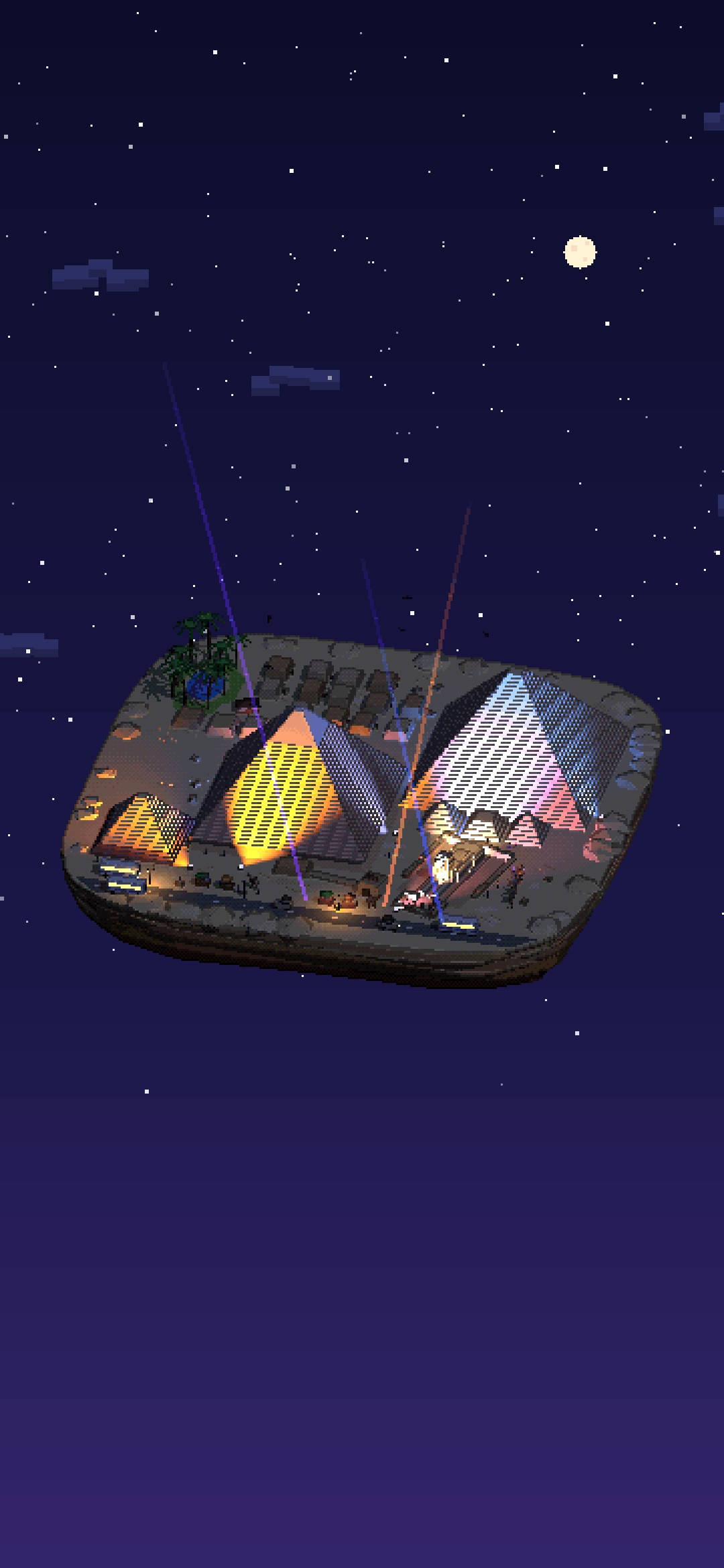
In front, the Sphinx lies in its quarried enclosure with the Sphinx temple and Khafre’s valley temple beside it, drawn a little larger than scale so it reads. Behind are rows of ruined mastabas, and along the front edge a desert road with souvenir stalls and a palm oasis. When night falls, projectors on the ground light the pyramids in shifting blue, amber and purple, and beams sweep up into a starry sky.
Things to spot
- A camel caravan with a guide on foot and a pack camel at the back
- Tour buses and jeeps on the desert road
- Black kites circling high over the plateau
- A Bedouin tent by the palm oasis
- The survey mast on Khufu’s flat top
- Light beams sweeping the sky in the sound-and-light show
What we simplified
- The pyramids sit much closer together than they do on the real plateau, and the Sphinx is drawn about 1.4 times its size.
- The oasis, the road and the souvenir stalls stand in for the busy edge of Giza; the real plateau has no palm grove beside the pyramids.
Questions
How tall is the Great Pyramid of Giza?
The Great Pyramid of Khufu was 146.6 m tall as built and is about 139 m today, on a 230 m base. For thousands of years it was the tallest structure made by people.
When were the Pyramids of Giza built?
The Pyramids of Giza were built about 2600–2500 BC, in Egypt’s Fourth Dynasty. They are the tombs of three kings: Khufu, his son Khafre and Menkaure.
Why does Khafre’s pyramid have a pointed top?
Khafre’s pyramid still keeps a cap of its original smooth casing stones near the top, which is why it looks pointed and paler at the tip. Almost all of the casing on the pyramids was later stripped for building stone.
How big is the Great Sphinx of Giza?
The Great Sphinx is 73 m long and 20 m high. It was carved from a ridge of bedrock left standing in a quarry next to Khafre’s causeway, and is usually linked to him.
How was this pixel-art diorama of the Pyramids of Giza made?
It is a real-time Three.js scene on this page, drawn at 360 × 640 pixels with outlines and a small palette and scaled up without smoothing. The three pyramids keep their real sizes relative to each other, but they stand much closer together than on the real plateau. Press “Explore in 3D”, drag to turn it, and switch between day, dusk and night.