About San Siro
San Siro opened on 19 September 1926 in the San Siro district of western Milan, built for AC Milan to a design by Ulisse Stacchini and Alberto Cugini, with room for about 35,000. It was first called the Nuovo Stadio Calcistico San Siro. The city of Milan bought it in 1935 and it was enlarged that year, and Inter moved in as a tenant in 1947 and has shared it with Milan ever since.
The 1950s expansion by the engineers Armando Ronca and Ferruccio Calzolari added the spiral ramps that became its trademark. In 1980 the stadium was named after Giuseppe Meazza, the two-time World Cup winner who played for Inter. For the 1990 World Cup, architects Giancarlo Ragazzi and Enrico Hoffer and engineer Leo Finzi added a third ring of seating supported by eleven towers with spiral ramps, and a roof held up by the four corner towers with projecting red girders. The work cost about $60 million and raised capacity to roughly 85,000; today the listed capacity is 75,817.
San Siro has hosted European Cup finals in 1965 and 1970, Champions League finals in 2001 and 2016, matches at the 1934 and 1990 World Cups, and the 1980 European Championship. On 30 September 2025 Milan’s city council approved the sale of the stadium and the land around it to the two clubs, and the deed was signed on 5 November 2025 at a value of €197 million. Milan’s prosecutors have opened an investigation into possible irregularities in the sale.
The clubs plan to replace it. On 29 October 2026 they presented the Generali Stadium, designed by Foster + Partners and Manica: a two-tier bowl for 71,500 with a pre-cast concrete facade and a fixed roof, to be built alongside the old stadium. The clubs aim to finish it in time for Euro 2032, with a first match targeted for 2031–32, and the old San Siro is to be demolished after that. Construction had not started in November 2026, and reports differ on when it will.
The diorama
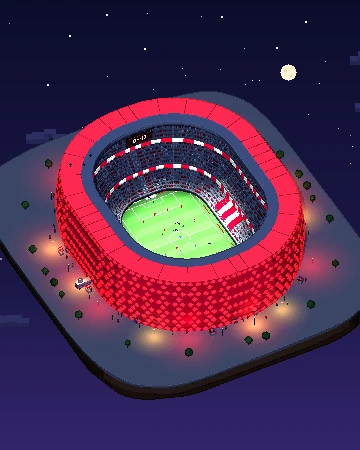
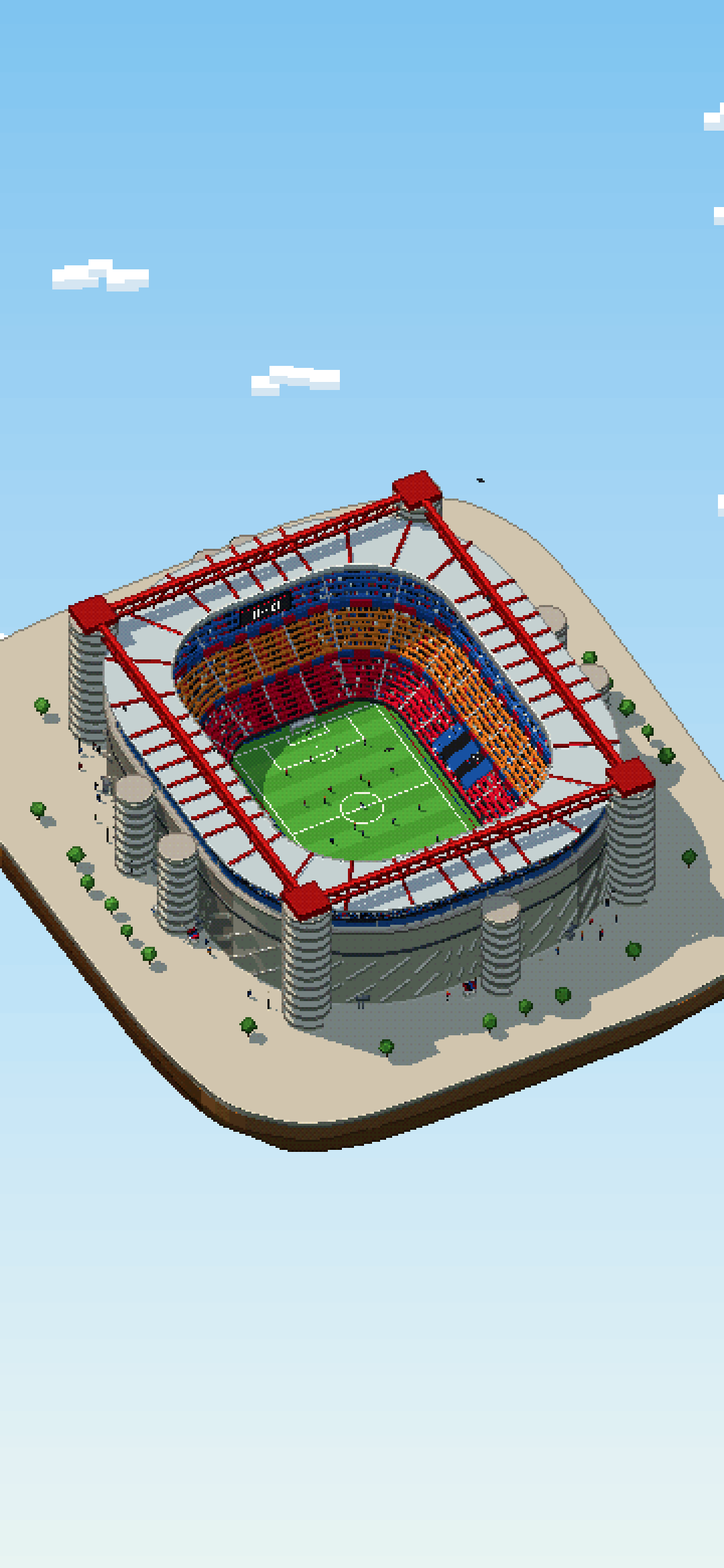
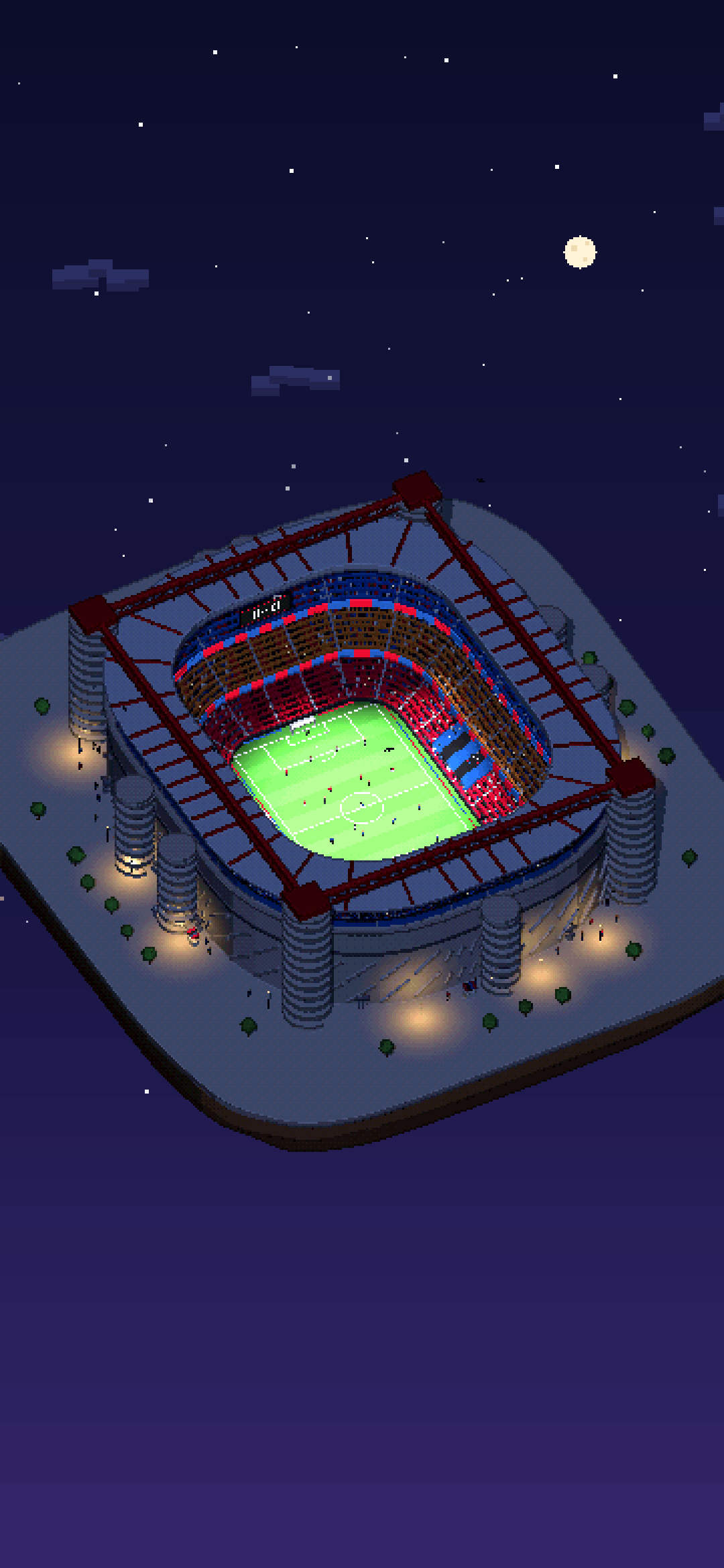
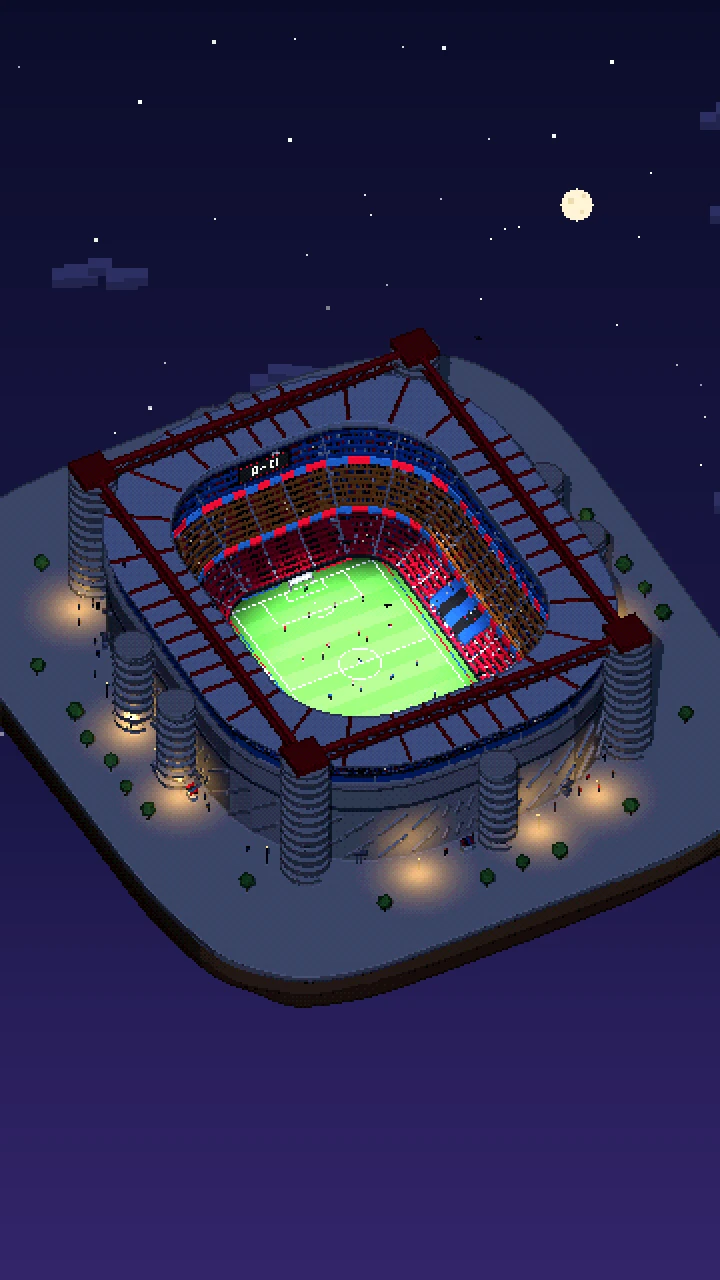
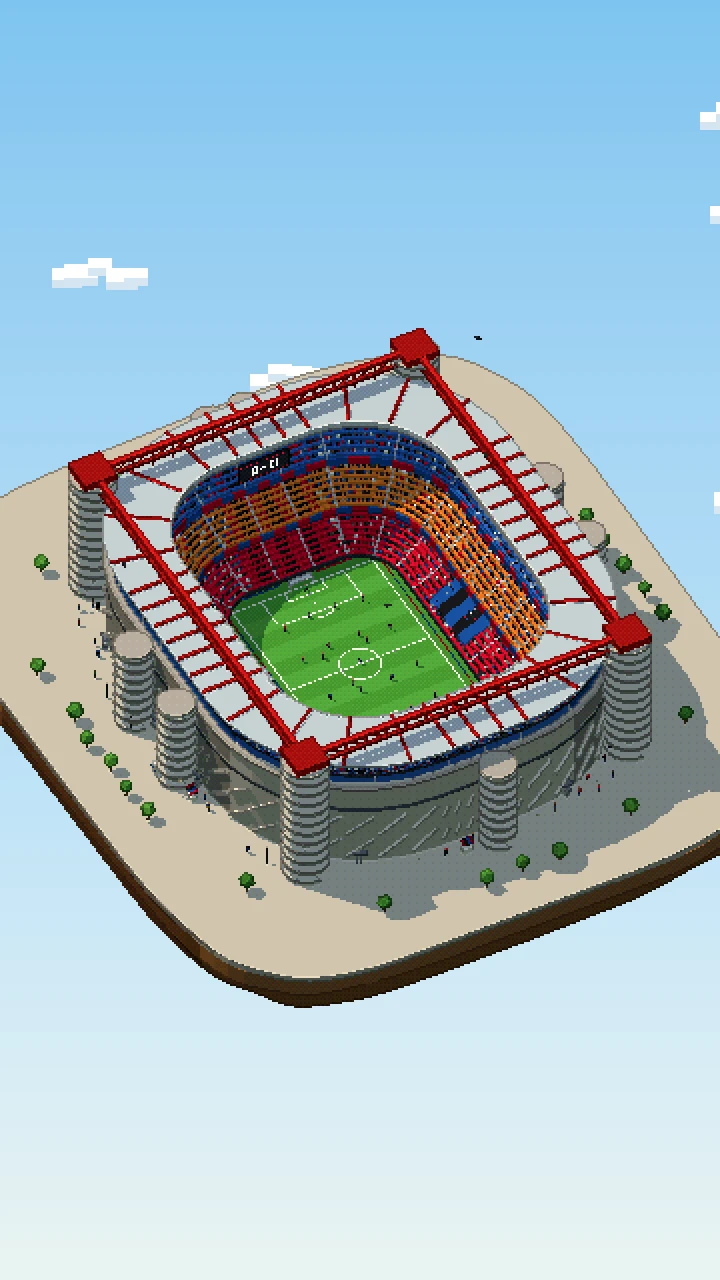
The diorama puts San Siro on a floating island, built in Three.js and rendered as pixel art: a low-resolution picture with dark outlines and a small palette, scaled up without smoothing. The scene uses 1 unit for every 2.5 metres and a full-size 105 × 68 m pitch. Three rings of stands sit in a rounded rectangle. Outside, concrete towers wound with spiral ramps stand round the bowl: four taller ones at the corners carry the roof, and seven lower ones stand along the sides. Four red box girders run from tower to tower over a translucent roof with red ribs, and diagonal ramp bands run round the walls of the second ring.
A match plays on a loop of 15 seconds. Light changes from day to dusk to a floodlit night, and a goal is scored every cycle: the ball crosses the line, the scoreboards change from 0-0 to GOL! and then 1-0, the crowd jumps, and confetti rises from the stands. The home side wears red and black stripes against blue and black stripes. The stadium is shared, so one end holds a red and black striped tifo while a blue and black flag is passed over the far stand. Outside, fans in red, black and blue walk the forecourt among street stalls, with birds overhead. Only colours are used: no crests or sponsor names.
Things to spot
- Eleven concrete towers wound with spiral ramps
- The four taller corner towers and the red girders between them
- Red ribs across the translucent roof
- The red-and-black striped tifo and the blue-and-black flag
- Confetti and the whole crowd jumping after the goal
What we simplified
- The real roof is held by the four corner towers with red steel girders. The diorama draws four box girders with posts and red ribs, a simplified version of the real structure.
- The diorama has three rings all the way round. The real third ring of 1990 may not run unbroken round the stadium, so the layout of the rings is approximate.
- The towers are drawn as drums with a ramp winding round them. The real towers are bigger, and their ramps and proportions are approximated.
- The diorama shows the stadium as it stands today. The planned Generali Stadium is not shown, and it will replace San Siro in the early 2030s.
- The crowd, the players, the tifo and the flag are invented for the animation, and the seats are colour-coded for look, not copied from the real seating.
Questions
Why does San Siro have two names?
Its original name was Nuovo Stadio Calcistico San Siro, after the district. In 1980 it was named Stadio Giuseppe Meazza after the Inter player who won two World Cups. Inter fans tend to say Meazza, and Milan fans prefer San Siro.
Who owns San Siro?
AC Milan and Inter have owned the stadium and the land round it since a deed signed on 5 November 2025, at a value of €197 million. Before that it belonged to the city of Milan, which had bought it in 1935.
Will San Siro be demolished?
That is the plan. The clubs presented a new 71,500-seat Generali Stadium on 29 October 2026, to be built next to San Siro, with a first match targeted for 2031–32. The old stadium is to be demolished once the new one opens, though a prosecutors’ investigation into the sale is still open.
What are the towers at San Siro?
Eleven towers with spiral ramps support the third ring added for the 1990 World Cup and give access to it. Four of them, at the corners, also carry the red girders that hold the roof.
How was this pixel-art diorama of San Siro made?
It is a real-time Three.js scene running on this page, drawn at a low resolution with dark outlines and a small palette, then scaled up without smoothing. A scripted match loops every 15 seconds with a goal each time. Press “Explore in 3D” to drag it round and switch between day, dusk and night.