About Tower Bridge
By the 1870s the East End needed a crossing below London Bridge, but any new bridge had to let tall ships reach the wharves of the Pool of London. A public competition drew more than fifty designs. In 1884 the City’s architect Horace Jones and the engineer John Wolfe Barry put forward a bascule bridge, Parliament approved it, and work began in 1886. Jones died a year into construction, and Barry saw the bridge through.
The bridge was opened on 30 June 1894 by the Prince and Princess of Wales. Its two towers are about 65 metres tall and are really steel frames, clad in Cornish granite and Portland stone so that the Gothic design would sit comfortably next to the Tower of London. Two high-level walkways join the tops of the towers, and the side spans hang from curved chains anchored on each bank.
The central span of about 61 metres is made of two bascules that pivot like see-saws, with heavy counterweights hidden inside the piers. They were first worked by steam-driven hydraulics; since the 1970s the machinery has run on oil and electricity, and the old engines are now on show. River traffic still has priority, and the bridge lifts around a thousand times a year, free of charge for passing vessels.
The walkways closed in 1910 and reopened in 1982 as part of the Tower Bridge Exhibition; glass floors were added in 2014. The bridge was first painted a chocolate brown and was repainted red, white and blue for the Queen’s Silver Jubilee in 1977. Since its restoration in 2008–2010 it has been blue and white. It is a Grade I listed building.
The diorama
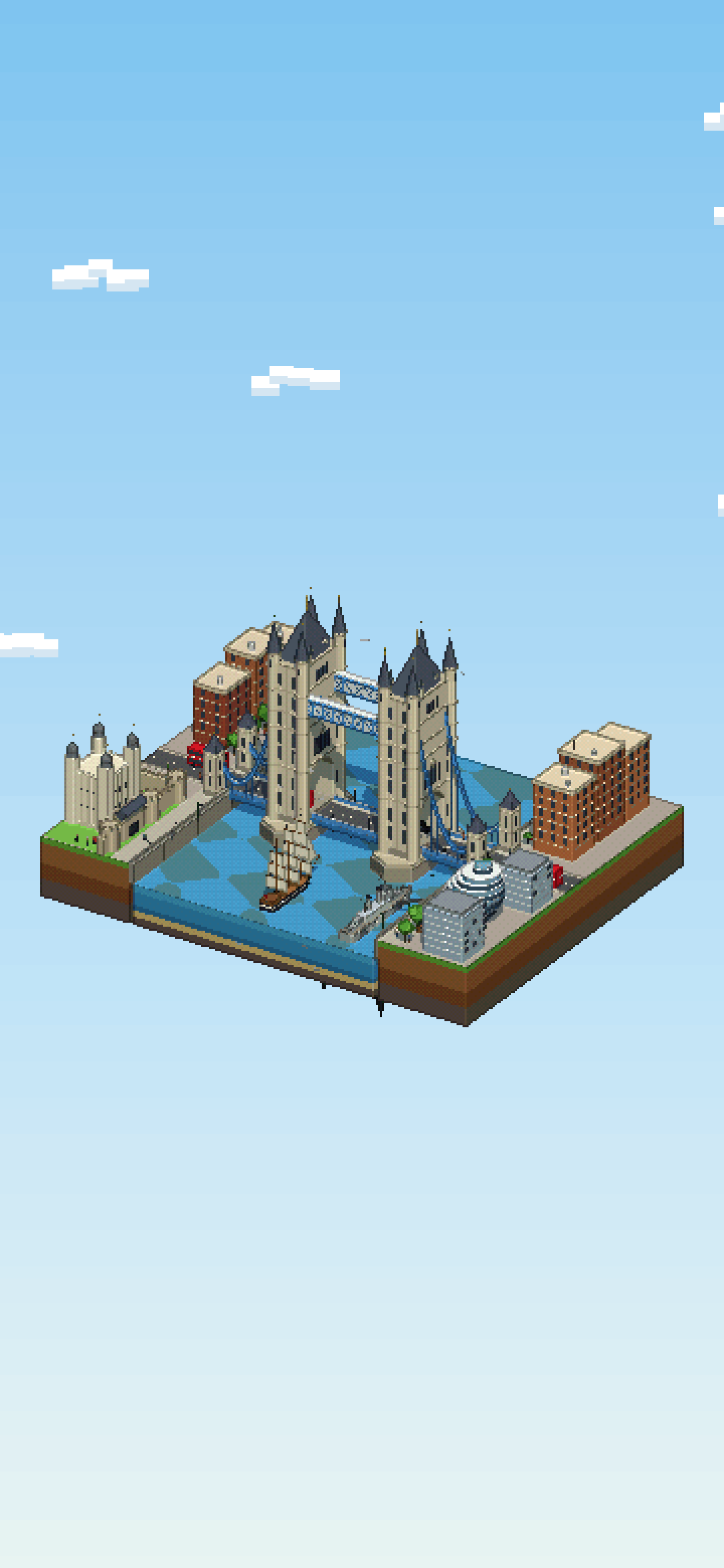
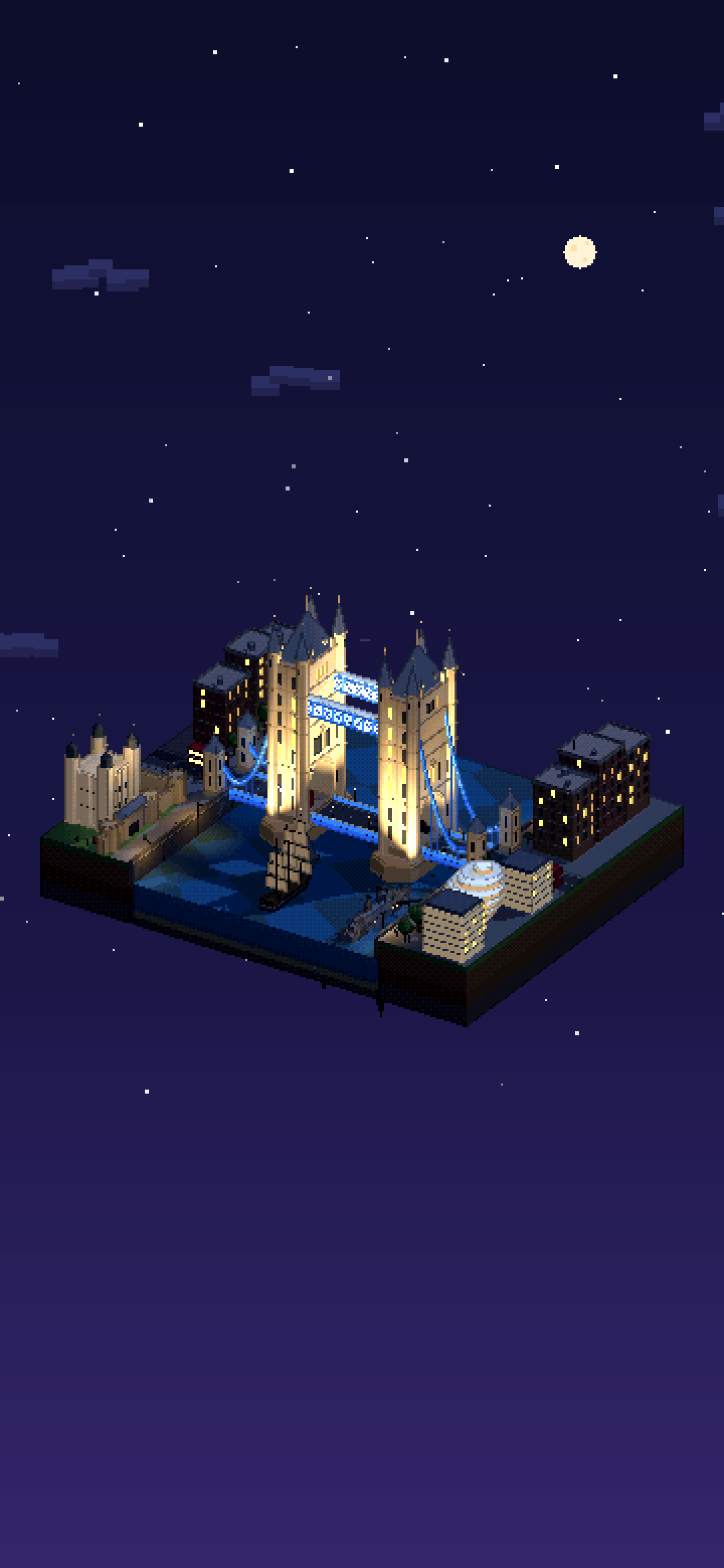
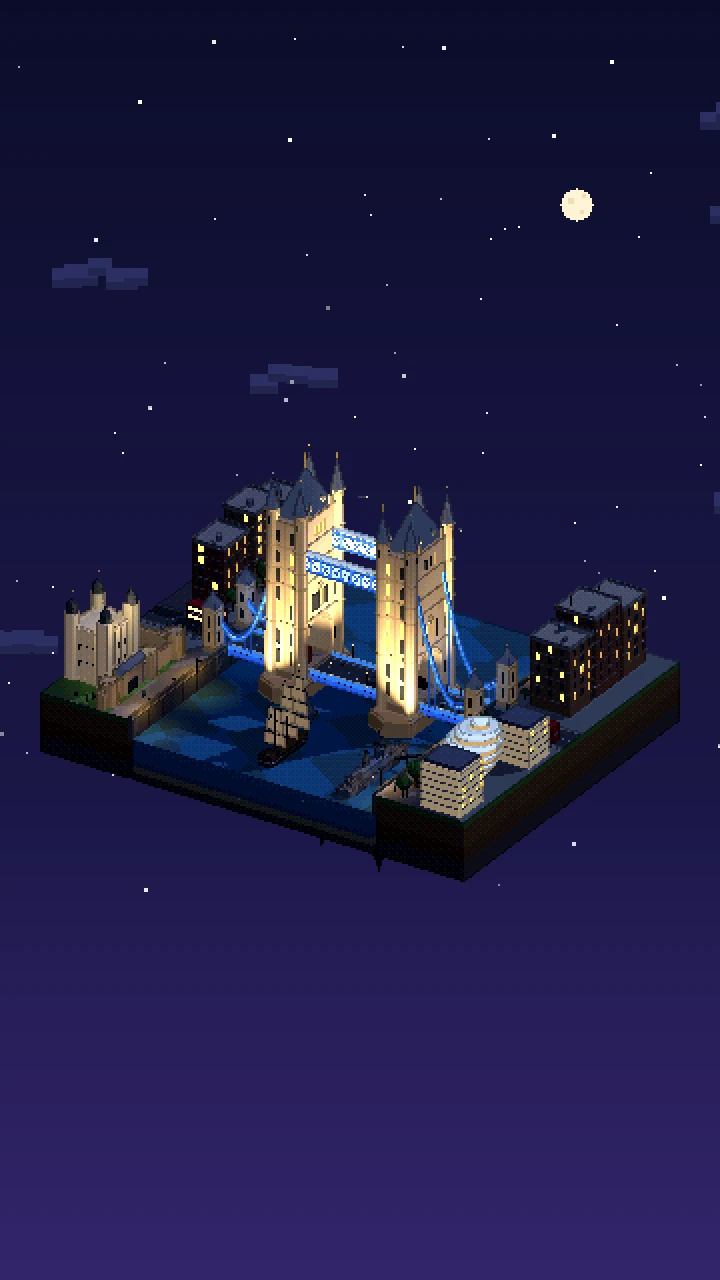
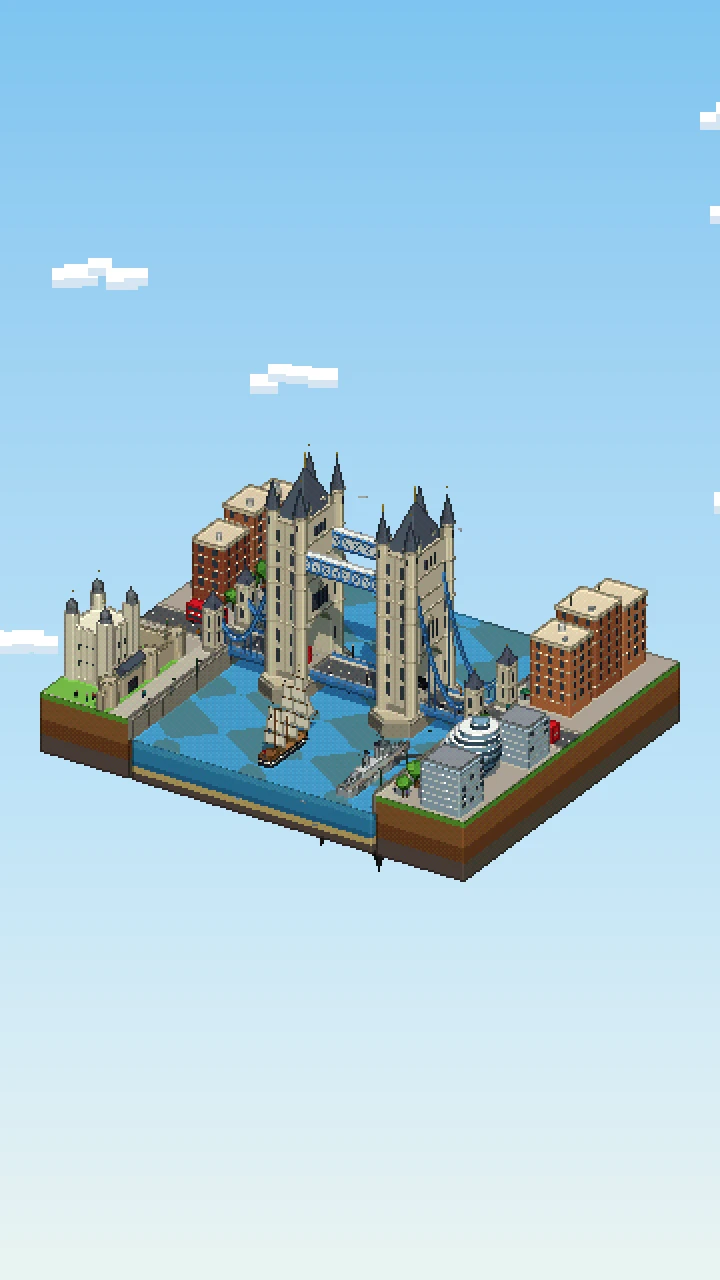
The bridge crosses a cut-away stretch of the Thames, with the spans shortened and the towers kept tall so that the silhouette reads at pixel size. Each tower stands on a granite pier with cutwaters and has four corner turrets with slate spires and gilded finials, a pyramid roof and a pointed portal arch over the road. Between the towers run the two blue-and-white lattice walkways with their glass floors, and blue chains swing down to small towers on each bank.
Early in the reel the barriers drop, red buses and black cabs queue on both approaches, and the bascules lift for a three-masted tall ship that has been waiting upstream; once it is through they come down again and the traffic moves on. On the north bank stands a corner of the Tower of London, with its curtain wall, Traitors’ Gate, the White Tower and ravens on the lawn. Across the river are the glass dome of the former City Hall, offices, brick warehouses and HMS Belfast moored by the bank. At night the stone is floodlit and the steelwork glows blue and white.
Things to spot
- The bascules lifting while the traffic queues
- The tall ship sailing through the open bridge
- A Thames Clipper passing under the bridge
- Ravens hopping on the Tower of London lawn
- HMS Belfast moored upstream
- Gulls circling the walkways
What we simplified
- The spans are much shorter than the real ones, so the towers look taller and the river narrower than they really are.
- Only a corner of the Tower of London is shown, squeezed in close to the bridge, and HMS Belfast, City Hall and the warehouses are moved nearer than they stand.
- The tower stonework, the walkway lattice and the chain girders are simplified, and the bascules lift much faster than the real ones.
Questions
When was Tower Bridge built?
Construction began in 1886, and the bridge was opened on 30 June 1894 by the Prince and Princess of Wales. It took eight years to build.
How tall is Tower Bridge?
Its two towers are about 65 metres tall. The central span between them is about 61 metres long, and the high-level walkways run more than 40 metres above the river.
How often does Tower Bridge open?
The bascules lift around a thousand times a year, about three times a day on average. By law river traffic has priority, and vessels pass free of charge.
Is Tower Bridge the same as London Bridge?
No. London Bridge is the next bridge upstream; the current one opened to traffic in 1973. Tower Bridge takes its name from the Tower of London beside it, and its Gothic style was chosen to suit the Tower.
How was this pixel-art diorama of Tower Bridge made?
It is a real-time Three.js scene running on this page, drawn at 360 × 640 pixels with outlines and a small palette, then scaled up without smoothing. Press “Explore in 3D”, drag to turn it, and switch between day, dusk and night.
Isometric maps of London
London also has 3 isometric pixel-art maps made by the community: the whole city drawn tile by tile in the same SimCity-like style. See the maps of London →