About Westfalenstadion
Westfalenstadion was built because another city dropped out. When Cologne withdrew as a host of the 1974 World Cup in 1971, Dortmund got the funds for a new ground next to its old Stadion Rote Erde. It cost about 32.7 million Deutsche Mark and opened on 2 April 1974 with a friendly against Schalke 04, which Dortmund lost 3–0. It then held about 54,000 people, most of them standing, and staged four group matches at the World Cup that summer. The name refers to Westphalia, the historic region around Dortmund.
The stadium has grown with the club. In 1992 UEFA rules cut the capacity to 42,800 and turned the standing areas into seats; after the 1995 league title the east and west stands were given a second tier. Between 1999 and 2003 the north and south ends were enlarged, and the corners were filled in before the 2006 World Cup. To keep the new corner seats free of obstructions, the old roof supports inside the stadium were replaced by eight yellow steel pylons standing outside the stands. They are now the stadium’s trademark. The 2006 work cost about €200 million, and the record attendance, 83,000, dates from 2004.
The south end is the Südtribüne, known as Die Gelbe Wand, the Yellow Wall. It is a single steep terrace for 24,454 people, described by the club as the largest standing terrace in European football, and on match days it is a block of yellow shirts, flags and scarves. Elsewhere the stadium has two tiers. Since 1 December 2005 it has officially carried a sponsor’s name, Signal Iduna Park, a deal extended in 2022 to 2031. Many supporters and many football writers still say Westfalenstadion.
Besides Dortmund’s league and European nights, the ground has hosted the 2006 World Cup, including Germany’s 2–0 semi-final defeat by Italy, and six matches of UEFA Euro 2024, among them a round-of-16 match and the Netherlands–England semi-final.
The diorama
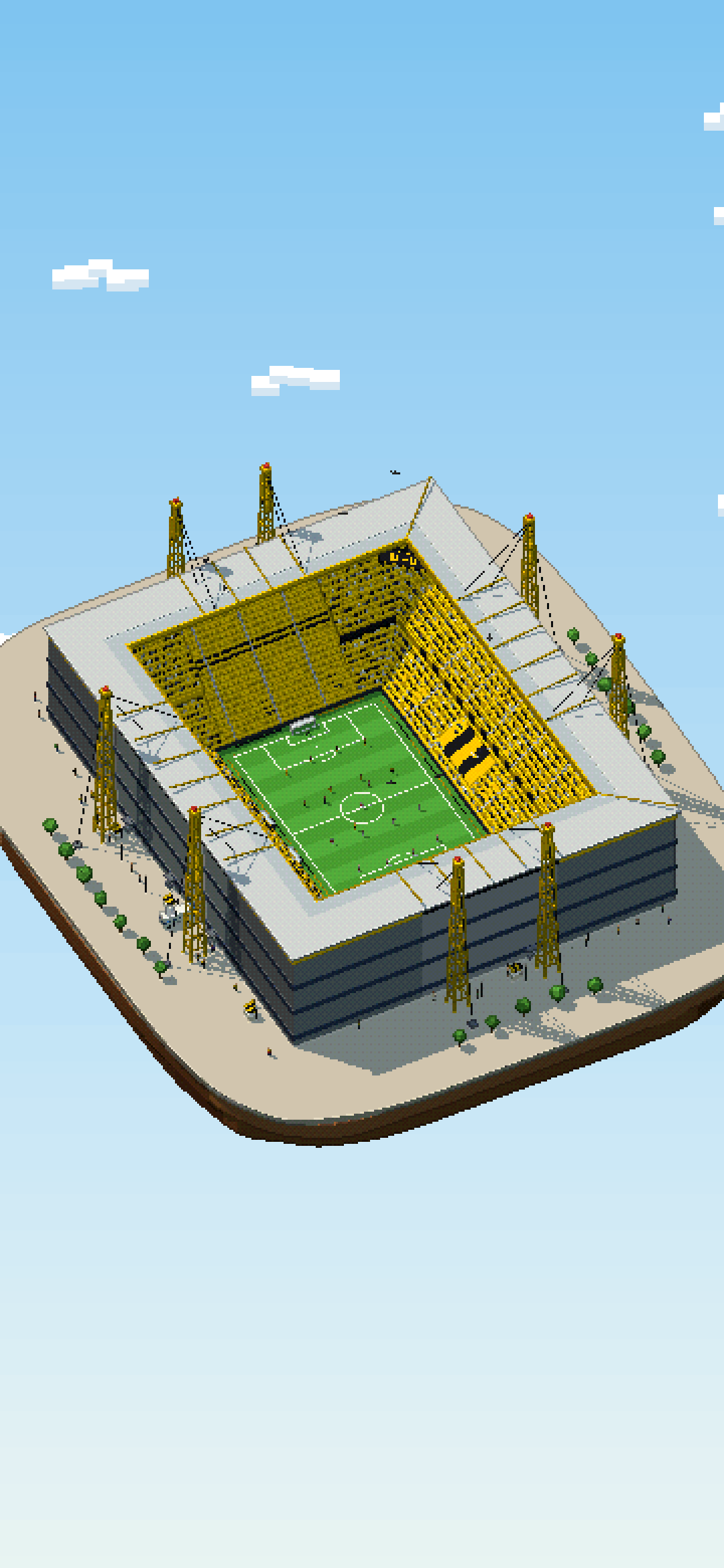
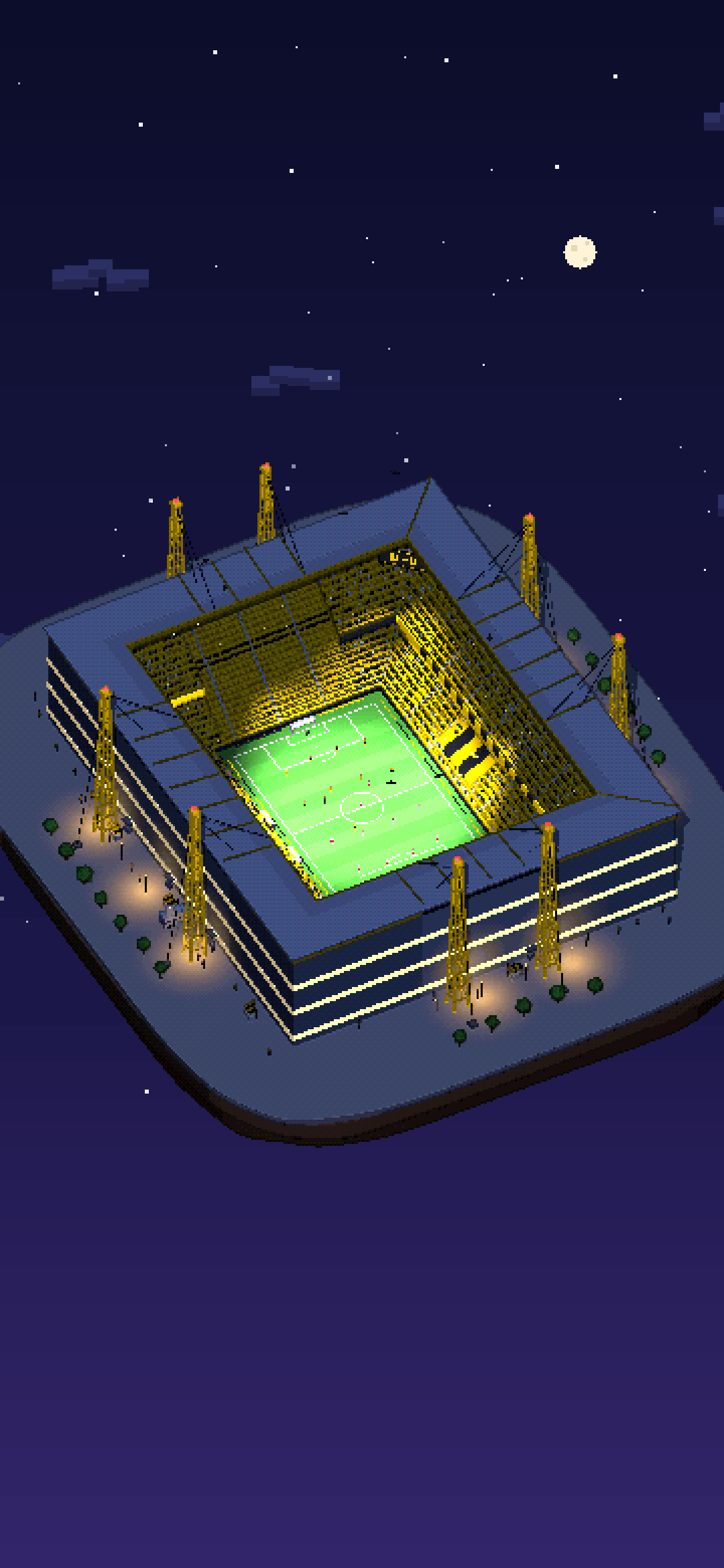
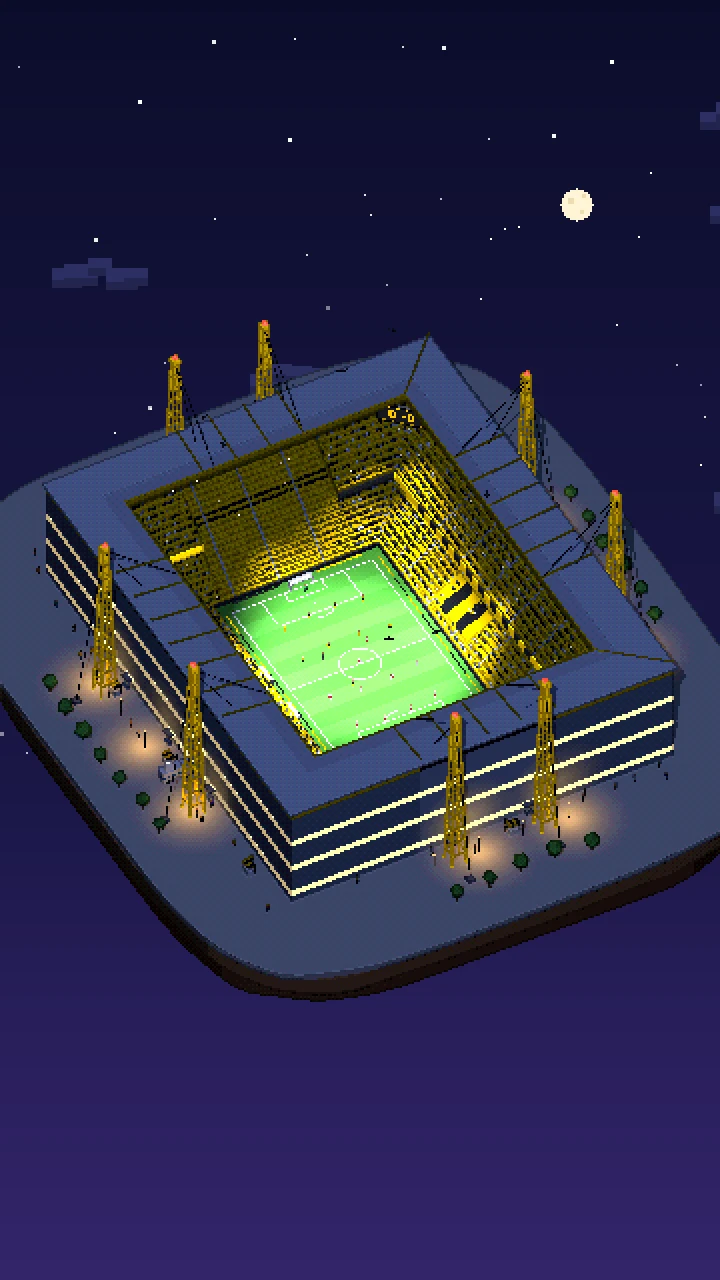
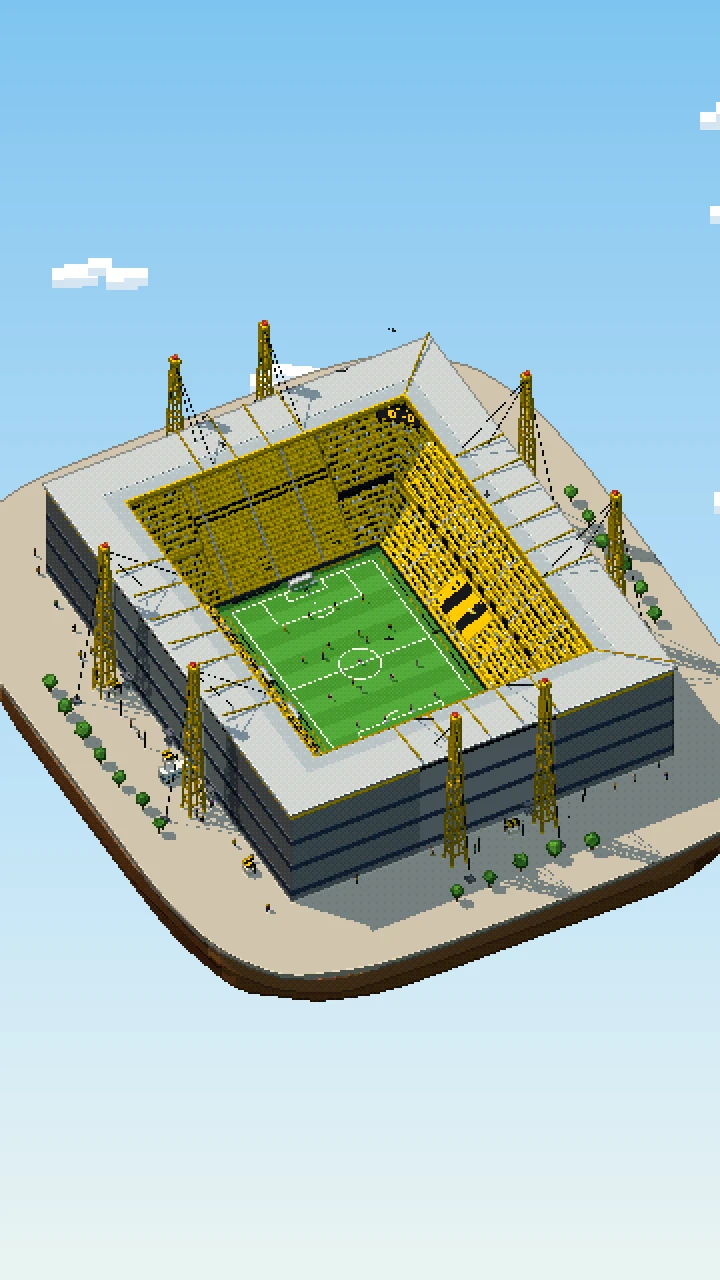
The diorama puts the stadium on a floating island, built in Three.js and rendered as pixel art: a low-resolution picture with dark outlines, a small palette and no smoothing when scaled up. The bowl is a rectangle with filled-in corners, two tiers on three sides and one huge steep single tier on the Yellow Wall side. The roof sits over every seat, and eight yellow lattice pylons stand outside the stands, two at each corner, each with a red aircraft light on top and cables running down to the roof and the ground. Grey cladding, glazed concourse bands and two big screens under the roof complete the shell.
A match plays on the pitch, 22 players and a referee in yellow and black against white and red, and it repeats every 15 seconds: the ball is moved up the field, Dortmund score, the scoreboards flip from 0–0 to a flashing goal message and then 1–0, the players pile on the scorer, the crowd jumps and confetti flies out of the stands. The Yellow Wall is all yellow with a black band across the middle, its fans bounce for the whole match, and a giant flag drifts along the stand, passed from hand to hand. The light runs from day to dusk to night; floodlights and the windows come on, and fans’ phone lights twinkle in the stands. Outside, stalls, turnstiles, a TV van, lamps and walking fans fill the forecourt.
Things to spot
- Eight yellow pylons, two at each corner
- The Yellow Wall with its black band, bouncing all match
- The giant flag drifting along the stand
- The goal at 10 seconds: scoreboards flip to 1–0 and the confetti goes up
- Phone lights in the stands at night
What we simplified
- The pylons are drawn as tapering four-legged lattice masts with simple cables; the real structures and their cable layout are more complex, and the model does not copy their exact height.
- The Yellow Wall is placed on the west side of the model and the pitch is a generic 105 × 68 m; the real Südtribüne is at the south end, and the real stadium’s compass orientation is not kept.
- The facade, the interior and the tier proportions are generic. The real stadium has four separate stands and different tier heights on each side, and the real seating colours are not copied.
- The two teams are plain shirts: no club badges, sponsor names or real kits are shown, only black and yellow. The scoreboard goal message is a generic “GOL!”.
- The forecourt, stalls, TV van and surroundings are invented, not the real streets around Strobelallee.
Questions
When did Westfalenstadion open?
It opened on 2 April 1974 with a friendly between Borussia Dortmund and Schalke 04, which Schalke won 3–0. It was built for the 1974 World Cup after Cologne withdrew as a host city.
Is Westfalenstadion the same as Signal Iduna Park?
Yes. Westfalenstadion is the original name. Since 1 December 2005 it has officially been called Signal Iduna Park after a sponsor, with the deal extended to 2031. UEFA calls it BVB Stadion Dortmund.
How many people does Westfalenstadion hold?
The capacity is 81,365 for Bundesliga matches, which includes standing places. For international matches, when it is all-seated, it holds about 66,000. The record attendance is 83,000, from 2004.
What is the Yellow Wall?
The Yellow Wall (Die Gelbe Wand) is the Südtribüne, the south stand: a single steep terrace for 24,454 people. The club describes it as the largest standing terrace in European football.
Why does the stadium have yellow pylons?
Eight yellow steel pylons stand outside the stands and carry the roof. They replaced older supports inside the corners, which blocked the view from the new corner seats built before the 2006 World Cup.
What does the pixel-art diorama of Westfalenstadion show?
It is a real-time Three.js scene running on this page: a looping match with a goal every 15 seconds, a jumping crowd, confetti, a scoreboard that goes from 0–0 to 1–0, and a day-to-night cycle. Press “Explore in 3D” to drag it round.