About Ali Sami Yen Stadium
Galatasaray’s home since 2011 is the Ali Sami Yen Spor Kompleksi at Seyrantepe, in the north of European Istanbul. It is named after Ali Sami Yen, the founder of the club. The name was first used for the club’s older ground at Mecidiyeköy, which opened in December 1964 and was in use until the new complex replaced it, and it carried over to the new stadium.
Work on the new stadium began on 13 December 2007, after a German firm, asp Architekten of Stuttgart, won an international design competition. It opened on 15 January 2011, with a match between Galatasaray and Ajax. For the first ten years it carried the name of its telecom sponsor, as Türk Telekom Arena and later Türk Telekom Stadium. It was Nef Stadium from 2021 to 2023, and it has been branded Rams Park since. The official name of the complex has stayed Ali Sami Yen Spor Kompleksi throughout.
The stadium was the first in Turkey to meet the requirements for Euro 2016, rates among UEFA’s top-category venues, and hosted matches at the 2013 FIFA U-20 World Cup, including the final. Its best-known feature today is the roof. In 2022 about 10,400 solar panels were added to it, and Guinness World Records recognised the plant, operated with the energy company Enerjisa, as the most powerful solar-powered stadium, at 4.2 MW on 22 March 2022. Some outlets quote 4.3 MW. Reports say it covers about two-thirds of the stadium’s electricity use.
Capacity figures vary: StadiumDB lists 52,280 and Wikipedia 53,387. Sources also disagree on the cost and on whether the roof was ever meant to retract, so this page leaves those out.
The diorama
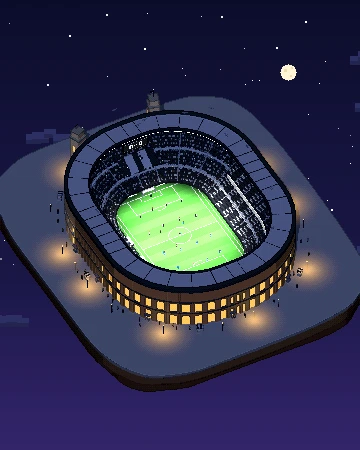
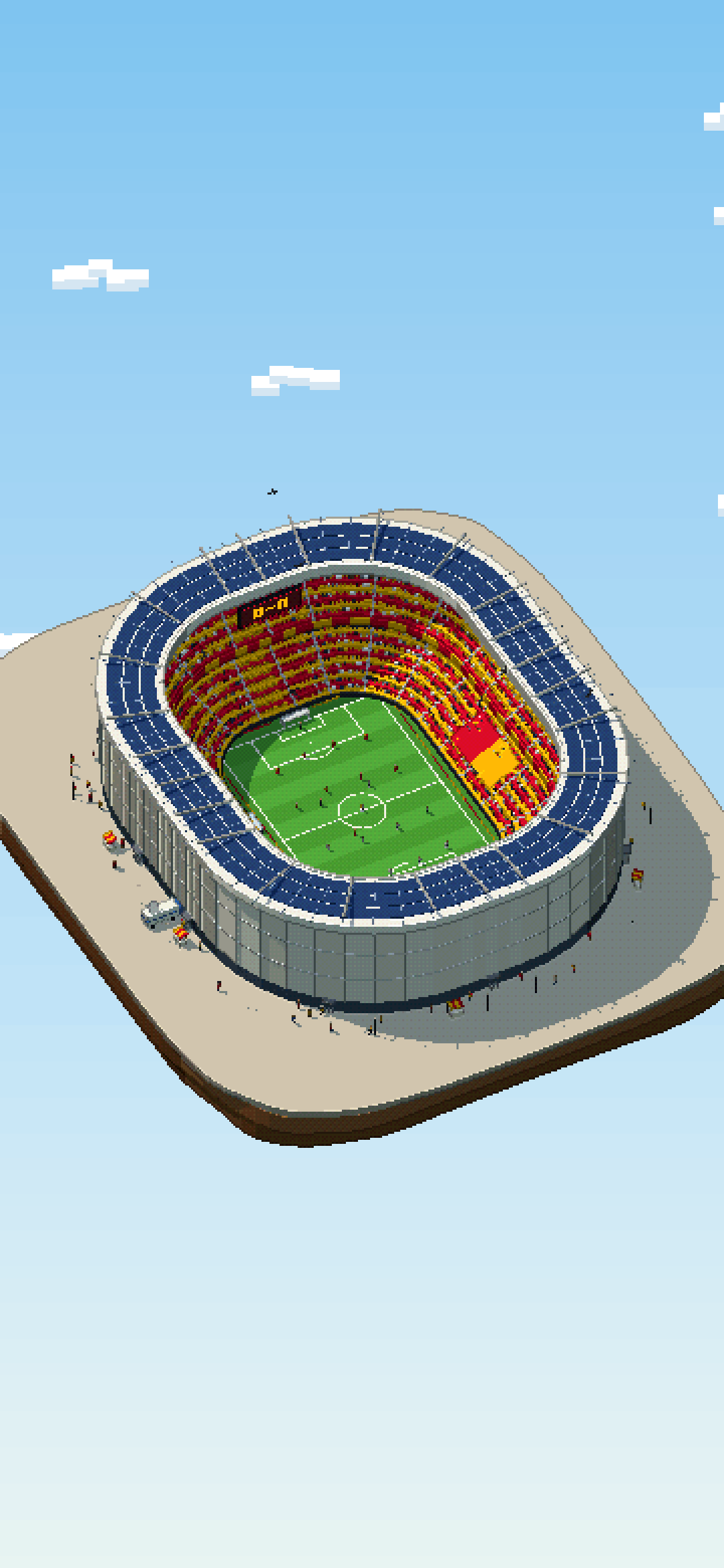
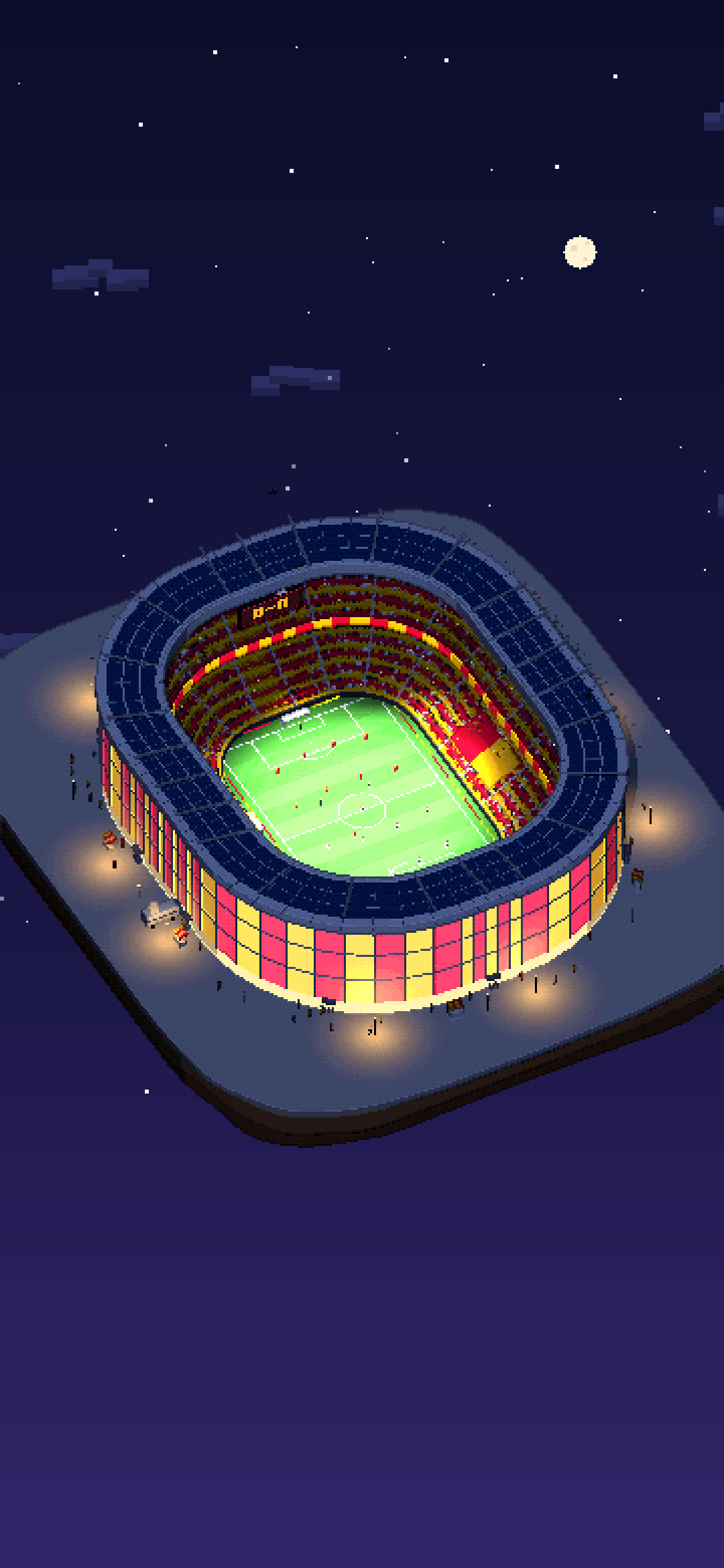
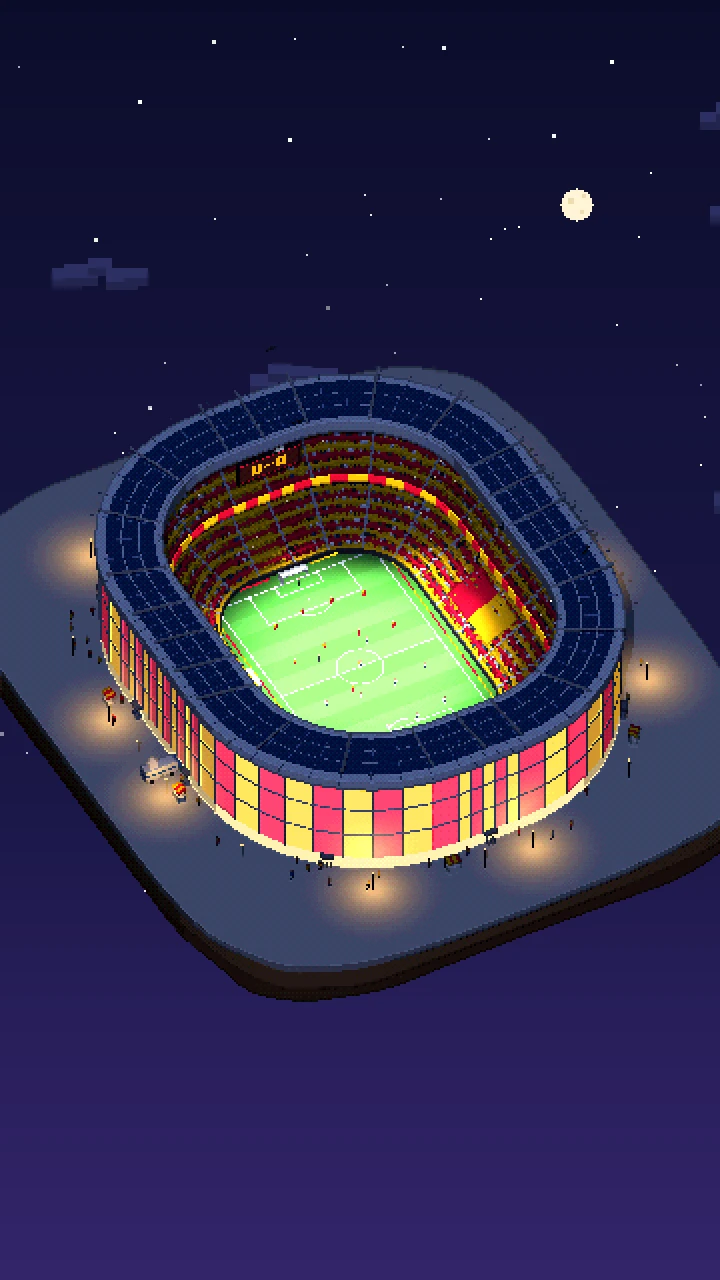
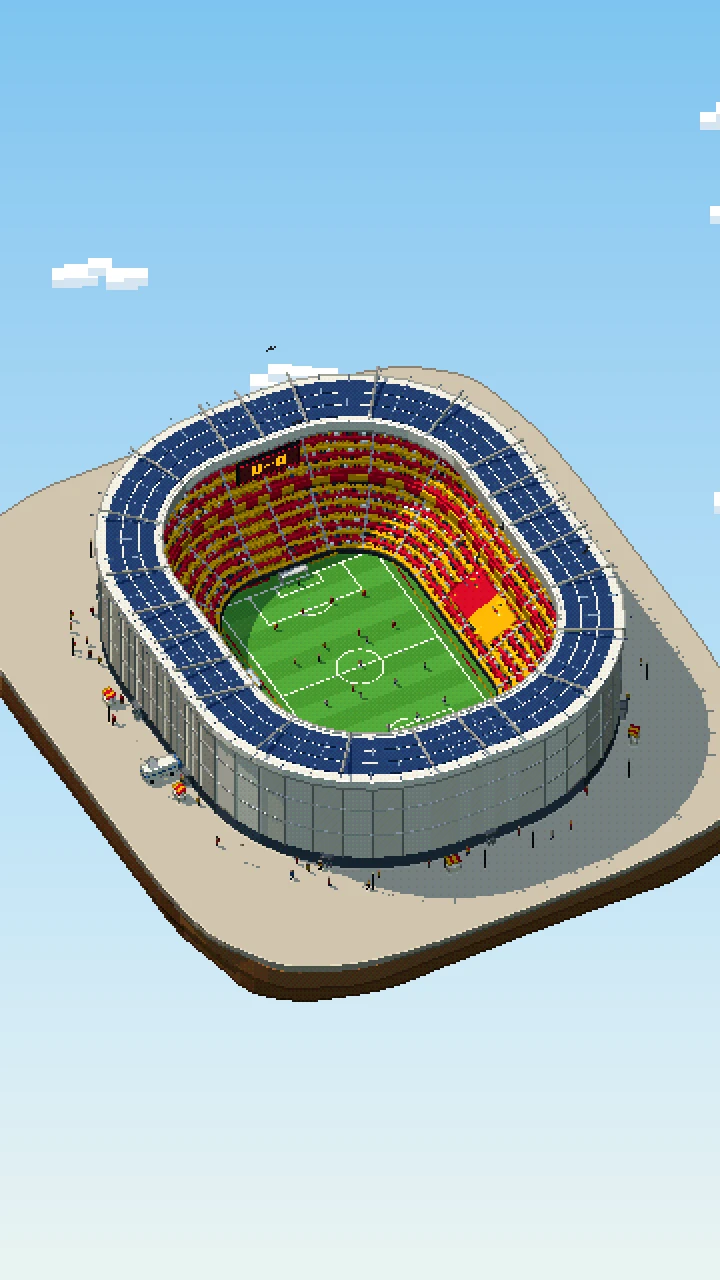
The diorama builds the stadium on a floating island of Seyrantepe in Three.js and renders it as pixel art. It is a rounded bowl with two tiers and a ring of glazed boxes between them, under a big white roof whose top is covered in rows of solar panels, as on the real stadium. The outside is wrapped in a light skin of tall panels between mullions, tilted out a little at the top, which glow yellow and red at night, over a glass entrance plinth. Screens hang under the roof over both ends. Only club colours are used: there are no crests or sponsor names anywhere in the scene.
Then it plays a match. The day turns to a floodlit night while two teams, home in yellow and red, run a scripted move that ends in a goal every 15 seconds. The crowd jumps, the tifo behind one goal splits into yellow and red halves like the shirt, a giant yellow-and-red flag passes along the far stand, and confetti goes up after the goal. The screens show 0–0 and then 1–0, and phone lights glow in the stands. Outside, fans, stalls and a TV van fill the forecourt and a few birds fly overhead.
Things to spot
- Rows of blue solar panels on top of the white roof
- The yellow and red skin glowing at night
- The tifo split into a yellow half and a red half
- Screens hung over both ends
- The TV van and the stalls on the forecourt
What we simplified
- The skin, mullions and roof ribs are stylised; the real facade and roof structure are more complex.
- The solar field is drawn as a few bands of panels, not 10,400 of them.
- Seat counts and capacity are scaled to the model, not the real figures.
- The surrounding hillside is not shown, only a plain forecourt.
- The match is a looping scripted move, and the players are plain figures in club colours with no names, numbers or crests.
Questions
Is the Ali Sami Yen Stadium the same as Rams Park?
Yes. Its official name is Ali Sami Yen Spor Kompleksi. Rams Park is a sponsor-style name used since 2023, and before that it was Türk Telekom Arena/Stadium (2011–2021) and Nef Stadium (2021–2023).
Who was Ali Sami Yen?
Ali Sami Yen was the founder of Galatasaray. The name was first given to the club’s older stadium at Mecidiyeköy, which opened in 1964, and then to the new complex.
When did it open and how many does it hold?
It opened on 15 January 2011. Capacity is about 52,300–53,400 depending on the source: StadiumDB lists 52,280 and Wikipedia 53,387.
What is special about its roof?
About 10,400 solar panels cover the roof. Guinness World Records lists it as the most powerful solar-powered stadium, at 4.2 MW (March 2022). Some outlets report 4.3 MW.
How was this pixel-art diorama of the stadium made?
It is a real-time Three.js scene running on this page, drawn at low resolution with dark outlines and a small palette, then scaled up without smoothing. The match, crowd, tifo, confetti and scoreboard are all animated live. Press “Explore in 3D” to drag it round and switch between day, dusk and night.
Isometric maps of Istanbul
Istanbul also has 2 isometric pixel-art maps made by the community: the whole city drawn tile by tile in the same SimCity-like style. See the maps of Istanbul →