About Anfield
Anfield opened in 1884 as the home of Everton. A dispute over rent between the club and the landlord, John Houlding, led Everton to leave for Goodison Park in 1892, and Houlding founded Liverpool FC to fill the ground. Liverpool have played at Anfield ever since.
The Kop is the most famous part. It began as an embankment and was rebuilt in 1928 with a roof and room for tens of thousands standing. It was named after Spion Kop, the hill in South Africa where many British soldiers died in 1900. The Kop was rebuilt as a single-tier all-seater stand in 1994, which kept its steep rake and holds just under 13,000. Outside it stand the Paisley Gateway and, on Anfield Road, the Shankly Gates, which carry the words “You’ll Never Walk Alone”, the song the Kop adopted as the club’s anthem.
In the last decade the ground has grown on two sides. The Main Stand was expanded to three tiers, with a large roof truss, adding about 8,500 seats and taking the ground to around 54,000 in September 2016. The Anfield Road End followed, with a second tier added in works that began in 2021 and were completed in 2024, taking the capacity above 61,000. The Hillsborough memorial, with its eternal flame for the 97 people who died in 1989, stands in front of the Main Stand.
The diorama
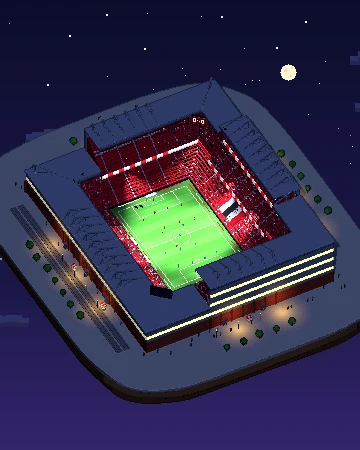
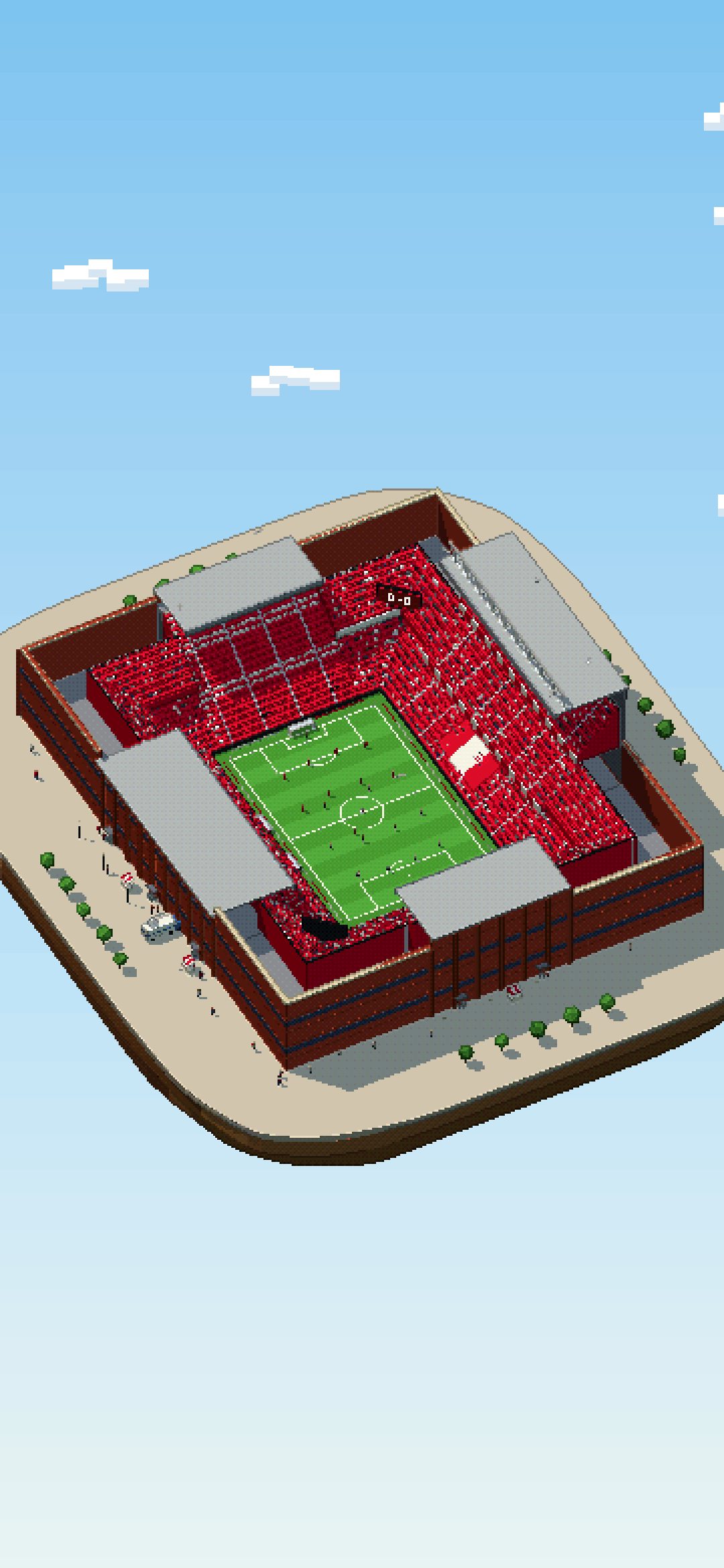
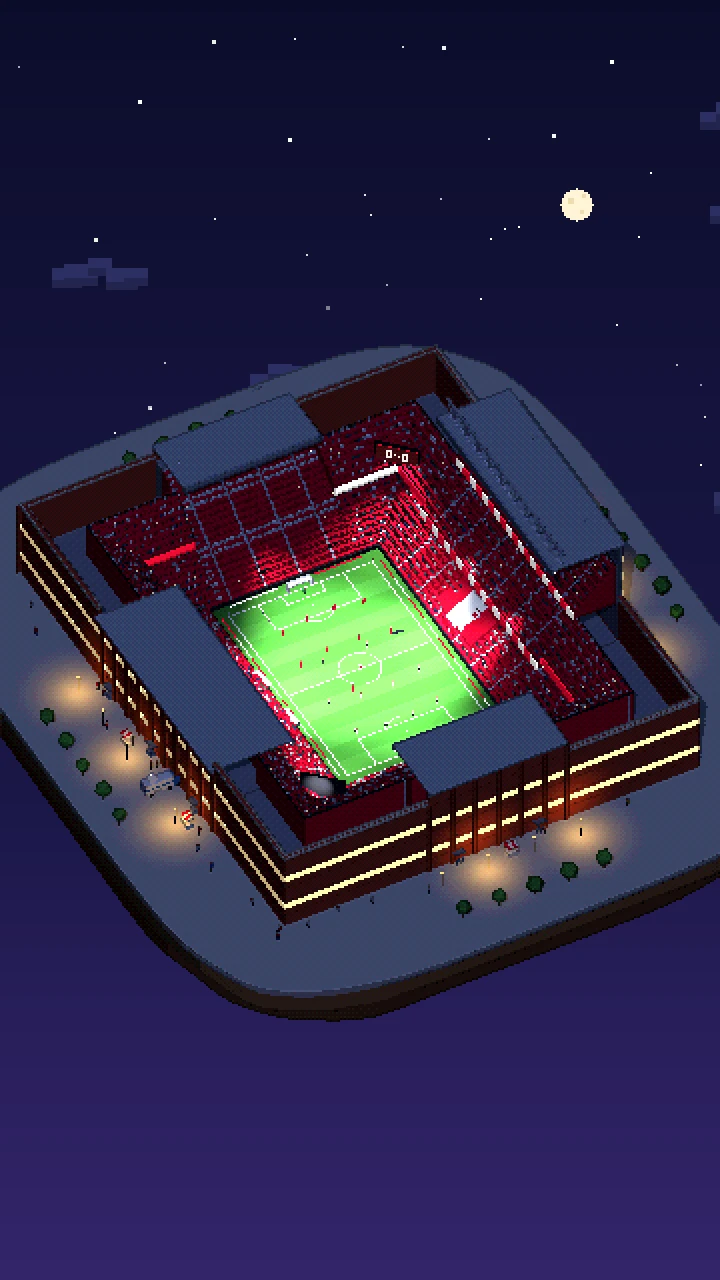
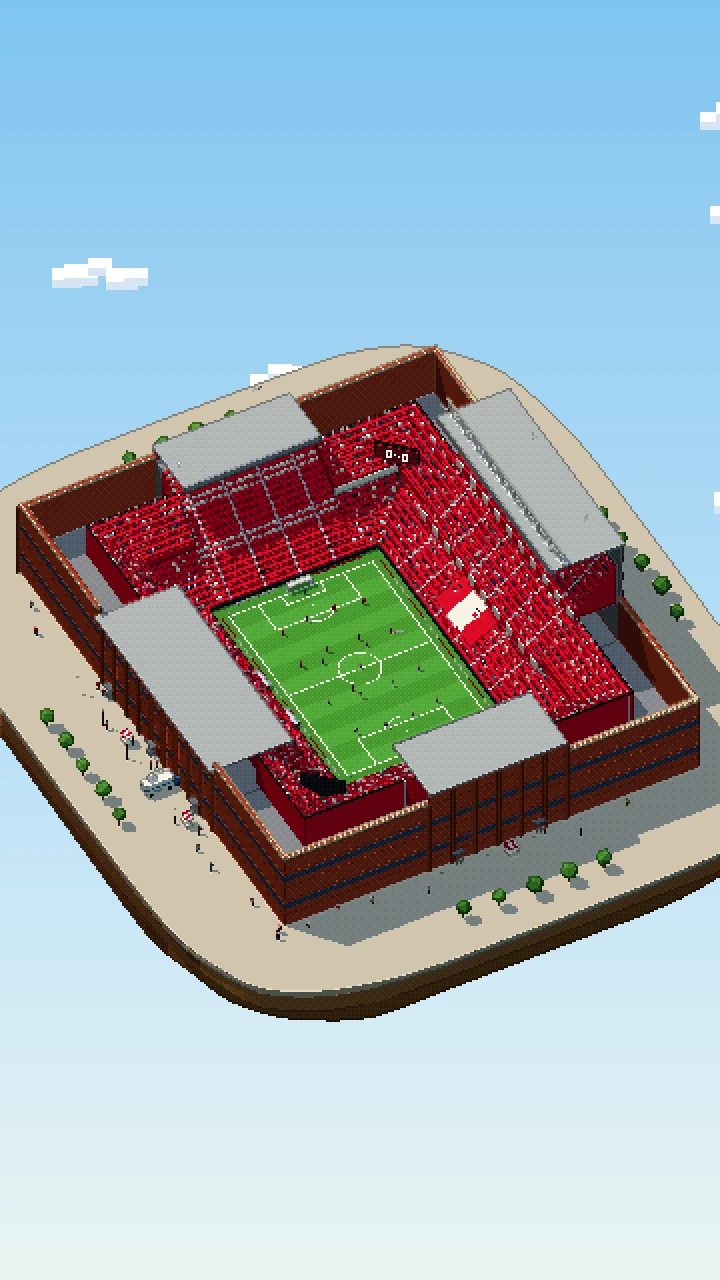
The diorama puts Anfield on a floating island, built in Three.js and rendered as pixel art: the scene is drawn at a low resolution, every edge gets a dark outline, the colours are reduced to a small palette, and the result is scaled up without smoothing. The tall three-tier Main Stand faces the camera with its roof and front truss, and the Kop at the west end is a single enormous steep tier that holds the tifo, a red mosaic with two white bands. The Anfield Road end has two tiers, the Sir Kenny Dalglish Stand on the near side is the lowest, and the corners are open to the sky. Outside is red brick with darker bands and stone copings, and on the forecourt behind the Kop stand black iron gates with a gilded arch.
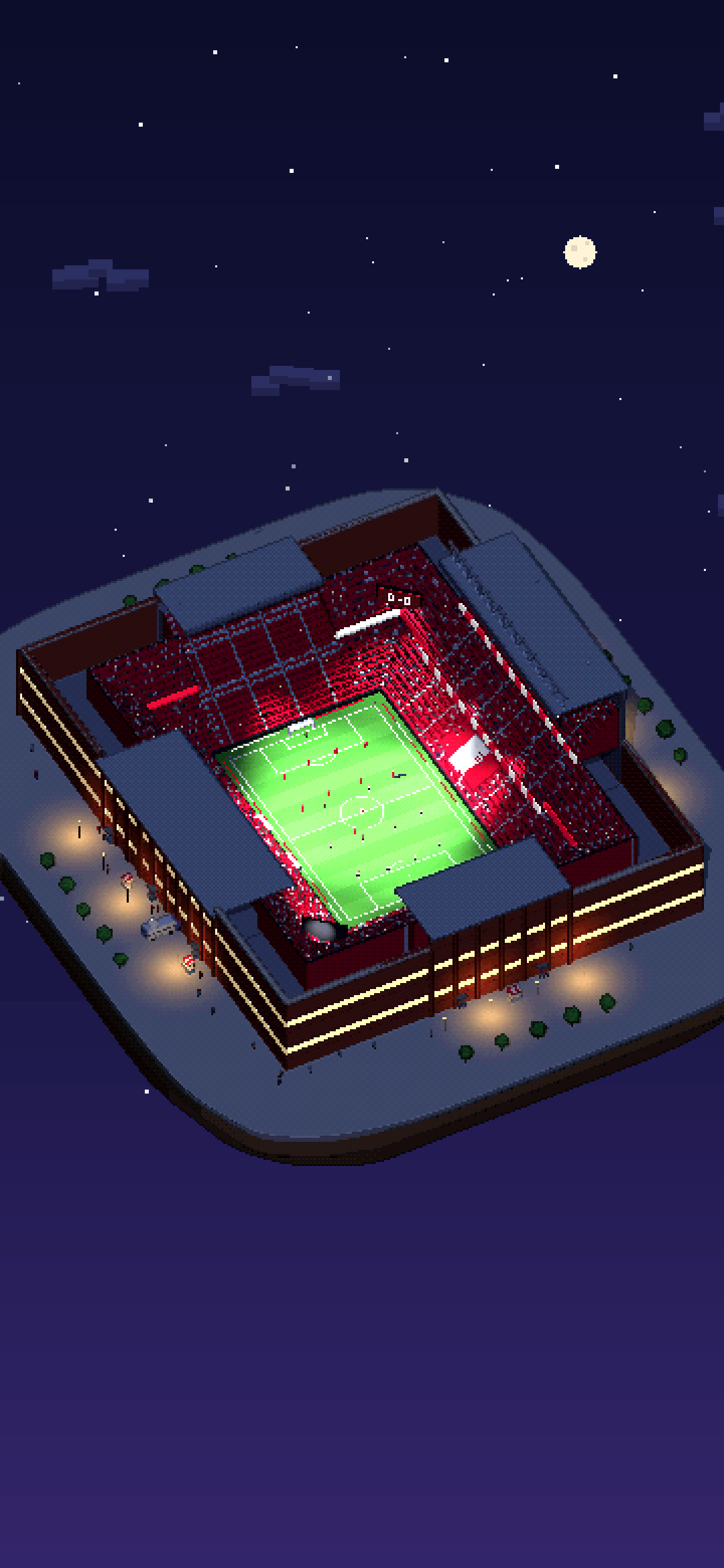
On the pitch a 22-player match plays over and over, and every 15 seconds it ends in a goal. The crowd bounces all game and jumps for the goal, the scoreboards change from 0-0 to 1-0, confetti flies out of the stands and a giant flag is passed along the crowd on the Main Stand side. As the light changes from day to dusk to night, the windows come on, the floodlights light the pitch and the crowd lifts its phones. No crest or lettering appears: the home side wears plain red, the visitors white shirts and black shorts, and seagulls circle overhead.
Things to spot
- The tall Main Stand roof, with its truss along the front
- The steep single-tier Kop with its red and white mosaic
- The black iron gates with the gilded arch behind the Kop
- The corners left open to the sky
- Gulls circling over the floodlit roof at night
What we simplified
- The Kop mosaic, the gates and the tier layout are idealised; the real ground is more irregular and sits in tight terraced streets next to Stanley Park.
- The pitch is drawn at the standard 105 × 68 m, while the real Anfield pitch is shorter, at about 101 × 68 m.
- The iron gates are a generic version of the Shankly Gates and Paisley Gateway, with no lettering, and there are no statues or the Hillsborough memorial.
- The kits are plain colours with no crests or sponsors, and the match is a looping scripted move, not a real fixture.
Questions
When was Anfield built?
Anfield opened in 1884 as the home of Everton. Everton left in 1892 after a dispute with the landlord, John Houlding, who then founded Liverpool FC, who have played there since.
What is the capacity of Anfield?
Anfield holds about 61,000 spectators. The commonly quoted figure is 61,276, reached after the Anfield Road End expansion was completed in 2024.
Why is it called the Kop?
The Kop is named after Spion Kop, a hill in South Africa where many British soldiers died in the Boer War. Today it is a single-tier, all-seater stand rebuilt in 1994.
When was the Main Stand expanded?
The expanded Main Stand opened in September 2016. It has three tiers and added about 8,500 seats, taking the ground to around 54,000 at the time.
What changed at the Anfield Road End?
The stand got a second tier, with work that started in 2021 and was completed in 2024. It added about 7,000 seats and took Anfield above 61,000.
How was this pixel-art diorama of Anfield made?
It is a real-time Three.js scene running on this page, drawn at a low resolution with dark outlines and a small palette, then scaled up without smoothing. Press “Explore in 3D” to drag it round and switch between day, dusk and night.