About Old Trafford
Old Trafford has been Manchester United’s home since 1910. The club moved here from its cramped ground in Bank Street, Clayton, and Archibald Leitch, the engineer behind many of Britain’s early football grounds, designed the new stadium. It opened on 19 February 1910 with a 4–3 defeat of United by Liverpool. The ground was bombed in 1941, and United played at Manchester City’s Maine Road until it reopened in 1949.
The ground you see now is mostly the work of the last 60 years. A cantilever roof, which removed the pillars that once blocked the view, arrived in the 1960s, and the huge three-tier North Stand, today the Sir Alex Ferguson Stand, opened in 1996. Its cantilever roof reaches 58.5 m from the back wall to the front edge and is often described as the largest in Europe. The Stretford End at the west end was rebuilt in the early 1990s and gained its second tier in 2000. The Sir Bobby Charlton Stand along the south side is the odd one out: it has only one tier, because a railway line runs right behind it.
Old Trafford has also been a host for much more than United. It staged matches at Euro 96, the 2012 Olympic football tournament and the opening match of the Women’s Euro 2022, which drew 68,871 and was a record for that tournament. It also hosts the Rugby League Super League Grand Final.
The future of the ground is now in question. In March 2025 the club presented plans, designed by Foster + Partners, for a new stadium of about 100,000 seats on land roughly 350 m from the current ground, and Old Trafford would be demolished afterwards. As of November 2026 a public consultation has closed, but no planning application has been submitted, and reports put the opening in the early 2030s. The design, cost and timetable are all still reported to be changing.
The diorama
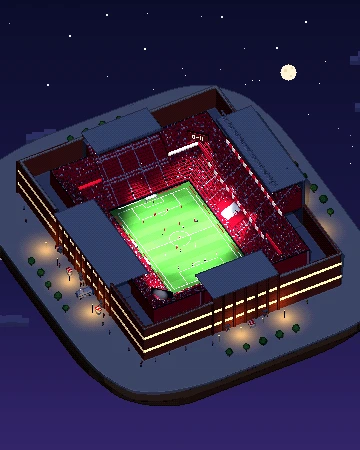
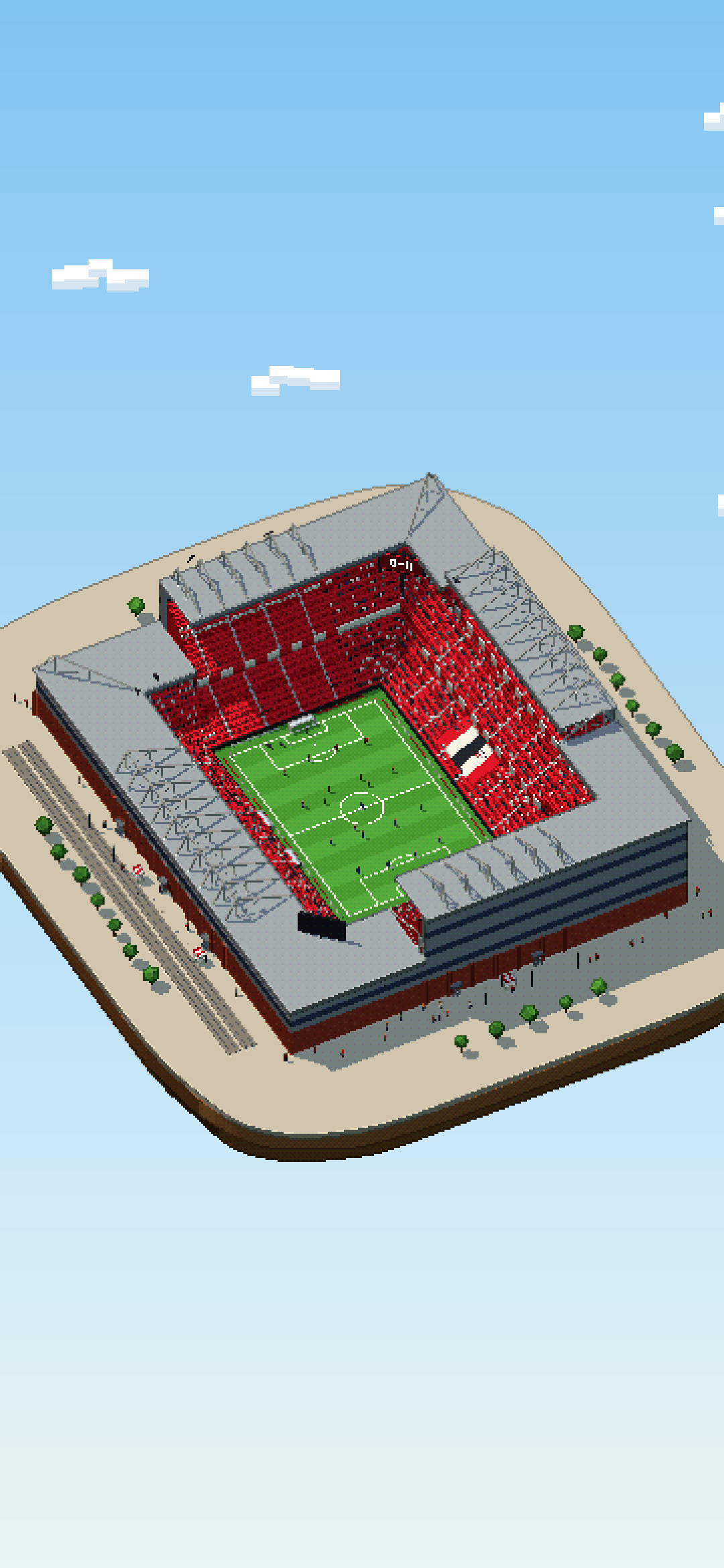
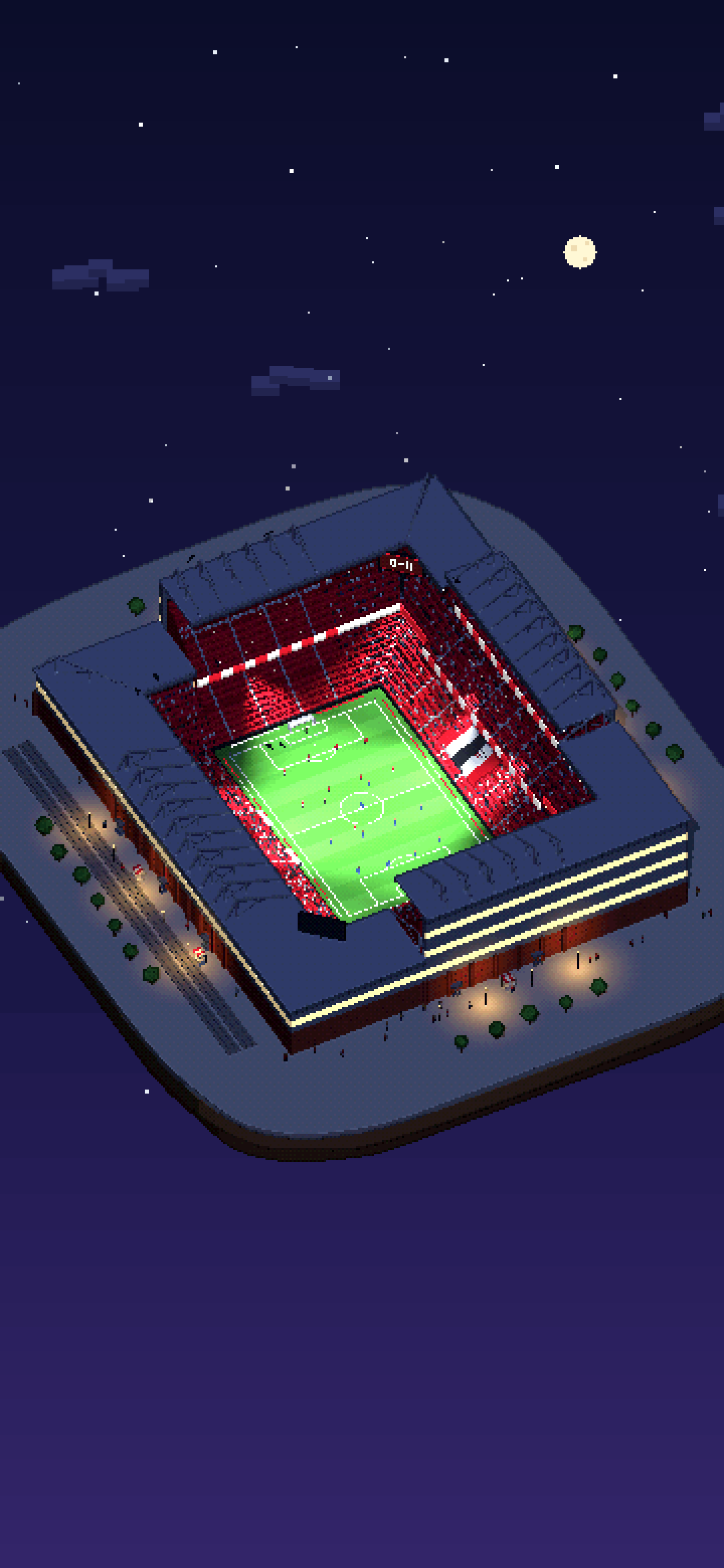
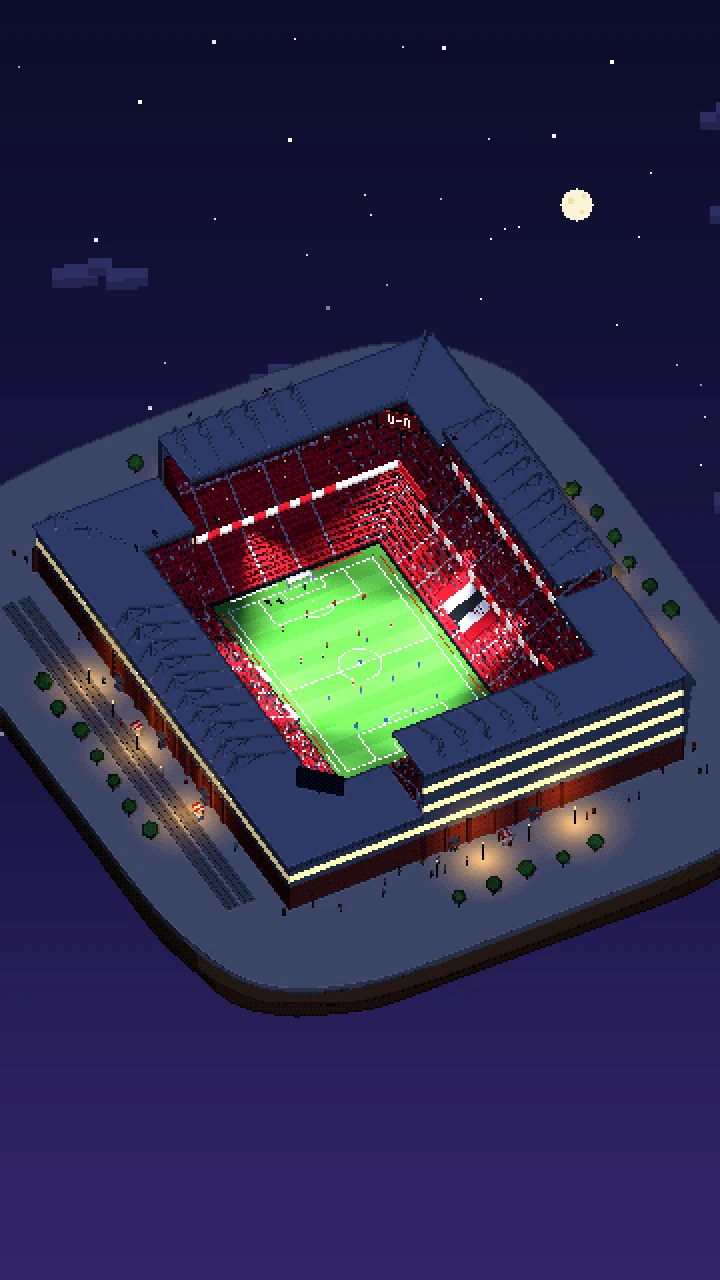
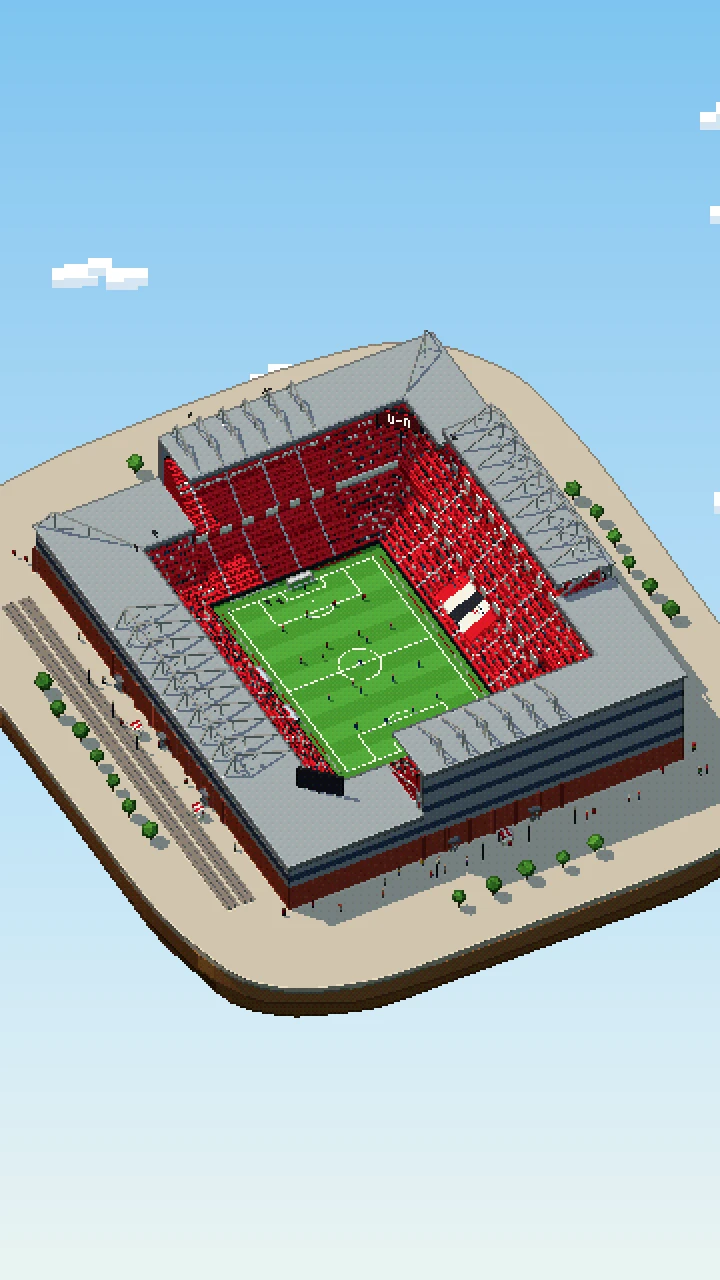
The diorama puts Old Trafford on a floating island, built in Three.js and rendered as pixel art: the scene is drawn at a low resolution, every edge gets a dark outline, the colours are reduced to a small palette, and the result is scaled up without smoothing. The bowl is a rectangle with filled-in corners and red seats everywhere. The tall three-tier stand on the far side stands for the Sir Alex Ferguson Stand, with a cantilever roof topped by white tubular trusses linked along the top. The low single-tier stand on the camera side is the Sir Bobby Charlton Stand, and behind it two railway tracks run past, as in real life. The outside is red brick at the base, then grey cladding and glass bands, with large screens in two corners.
On the pitch a 22-player match plays over and over, and every 15 seconds it ends in a goal. The crowd bounces all game and jumps for the goal, the scoreboards change from 0-0 to 1-0, confetti flies out of the stands and a giant flag is passed along the crowd on the far stand. The Stretford End on the left shows a tifo in red and white. As the light changes from day to dusk to night, the windows come on, the floodlights light the pitch and the crowd lifts its phones. No crest or sponsor appears: the home side wears plain red shirts with white shorts, the visitors blue.
Things to spot
- The railway tracks behind the low south stand
- The white trusses standing on top of the north stand roof
- The red and white tifo on the Stretford End
- The giant flag rippling along the crowd on the far side
- Confetti and phone lights after the goal at night
What we simplified
- The stands are idealised: the real ground has a different tier layout on the east and west sides, executive levels, and a more irregular outline.
- The roof trusses are a simplified guess at the real cantilever structure, and the colours of the cladding are approximate.
- The surroundings are generic: a forecourt with stalls and fans, not the real Sir Matt Busby Way, the statues or the Trafford Park estate.
- The kits are plain colours with no crests or sponsors, and the match is a looping scripted move, not a real fixture.
- Old Trafford is shown as it is today; the planned new stadium is not part of the scene.
Questions
When did Old Trafford open?
Old Trafford opened on 19 February 1910, when Manchester United lost 4–3 to Liverpool. It was designed by Archibald Leitch.
What is the capacity of Old Trafford?
Old Trafford holds about 74,000, which makes it the largest club football ground in the UK. Sources quote slightly different figures between about 74,100 and 74,300 depending on how the seating is counted.
Is Manchester United building a new stadium?
Plans exist but nothing has been built. In March 2025 United presented a Foster + Partners design for a 100,000-seat stadium about 350 m from Old Trafford. As of November 2026 a consultation has closed, the club is working towards a planning application and no opening date has been confirmed.
Why does the south stand have only one tier?
The Sir Bobby Charlton Stand is the only single-tier stand at Old Trafford because a railway line runs directly behind it, which restricts any expansion.
What is the Stretford End?
The Stretford End is the west stand at Old Trafford, traditionally the home of United’s most vocal supporters. It was rebuilt in the early 1990s and has two tiers. In the diorama it is the end that holds the tifo.
How was this pixel-art diorama of Old Trafford made?
It is a real-time Three.js scene running on this page, drawn at a low resolution with dark outlines and a small palette, then scaled up without smoothing. Press “Explore in 3D” to drag it round and switch between day, dusk and night.