About Wembley Stadium
Wembley Stadium is the national football stadium of England and home of the England team and the FA Cup final. It stands on the site of the old Wembley, which opened in 1923 and whose twin towers were a symbol of English football until the stadium closed in 2000. The old stadium was demolished from 2002 and the new one, designed by Foster + Partners and HOK Sport, was officially opened on 19 May 2007. Chelsea beat Manchester United 1–0 in the FA Cup final that day.
The arch is the landmark. It rises 133 m above the north stand and spans 315 m, and the stadium’s own pages call it the longest single-span roof structure in the world. It carries much of the weight of the roof, which covers more than 11 acres, a part of which can slide open, and it lights up at night. The bowl has three tiers and 90,000 seats, all of them under cover, and its capacity makes it the largest stadium in the UK and one of the biggest in Europe.
Wembley is also London’s main stadium for big events. It staged the Euro 2020 final in July 2021, in which Italy beat England on penalties, and the Women’s Euro 2022 final, which England won 2–1 against Germany in front of 87,192, a record for the competition. It hosts NFL games, rugby, boxing and some of the biggest concerts in the UK.
The diorama
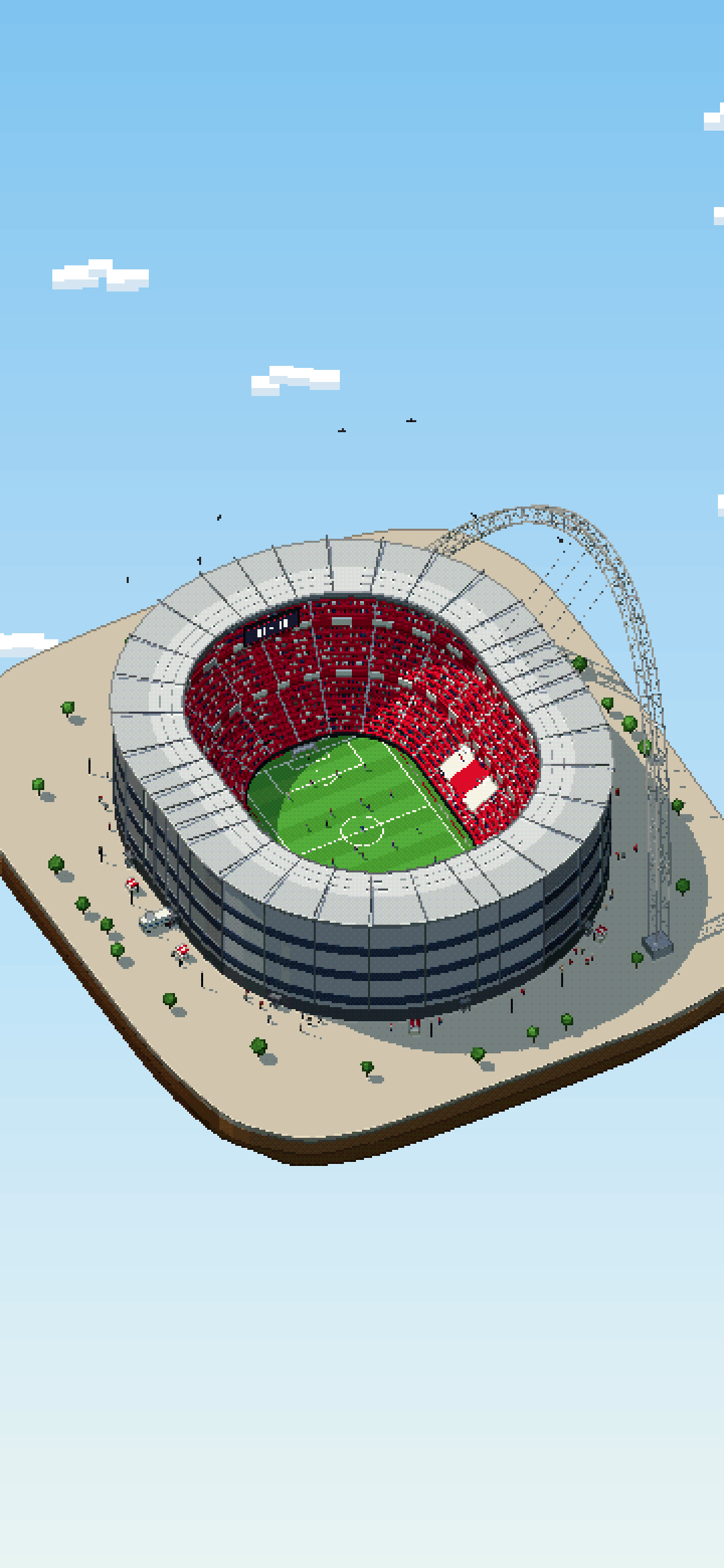
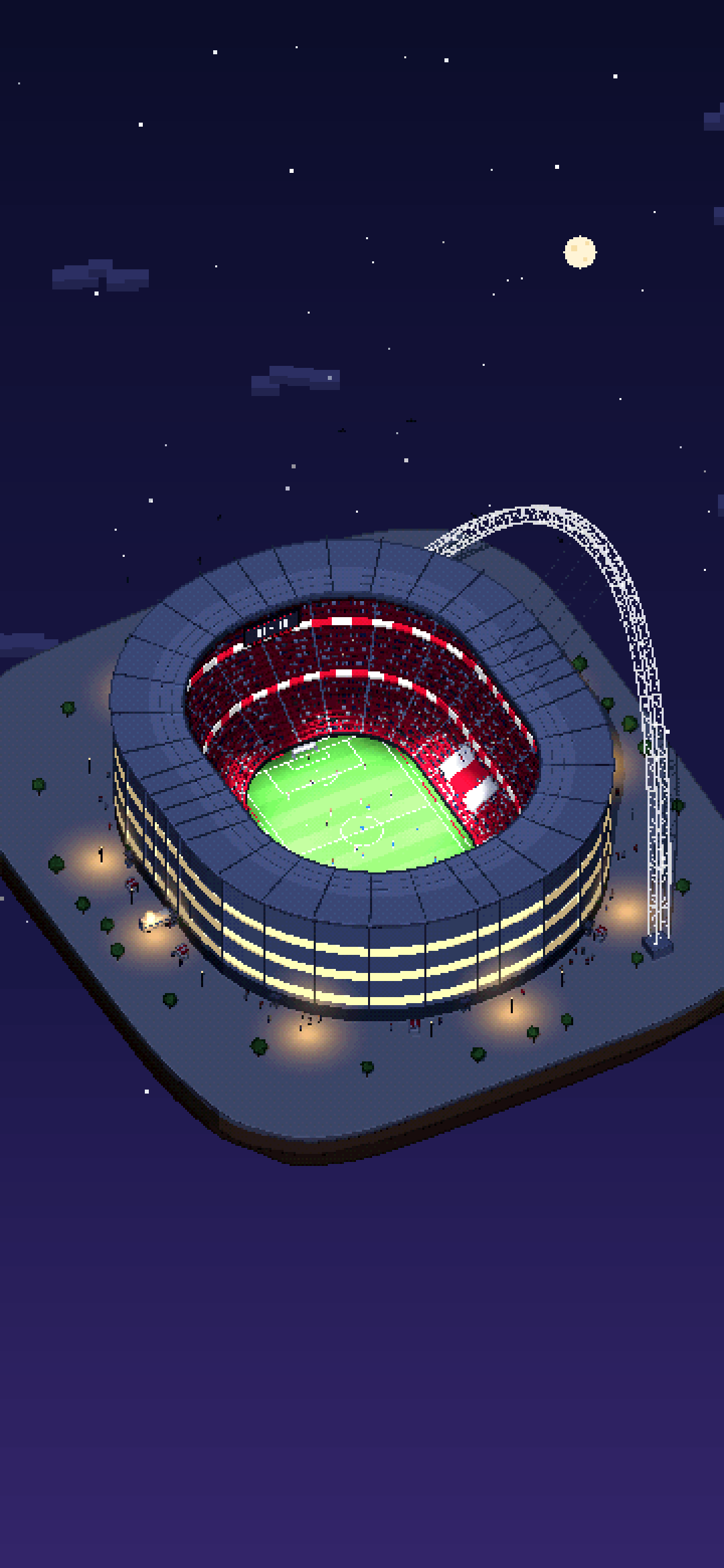
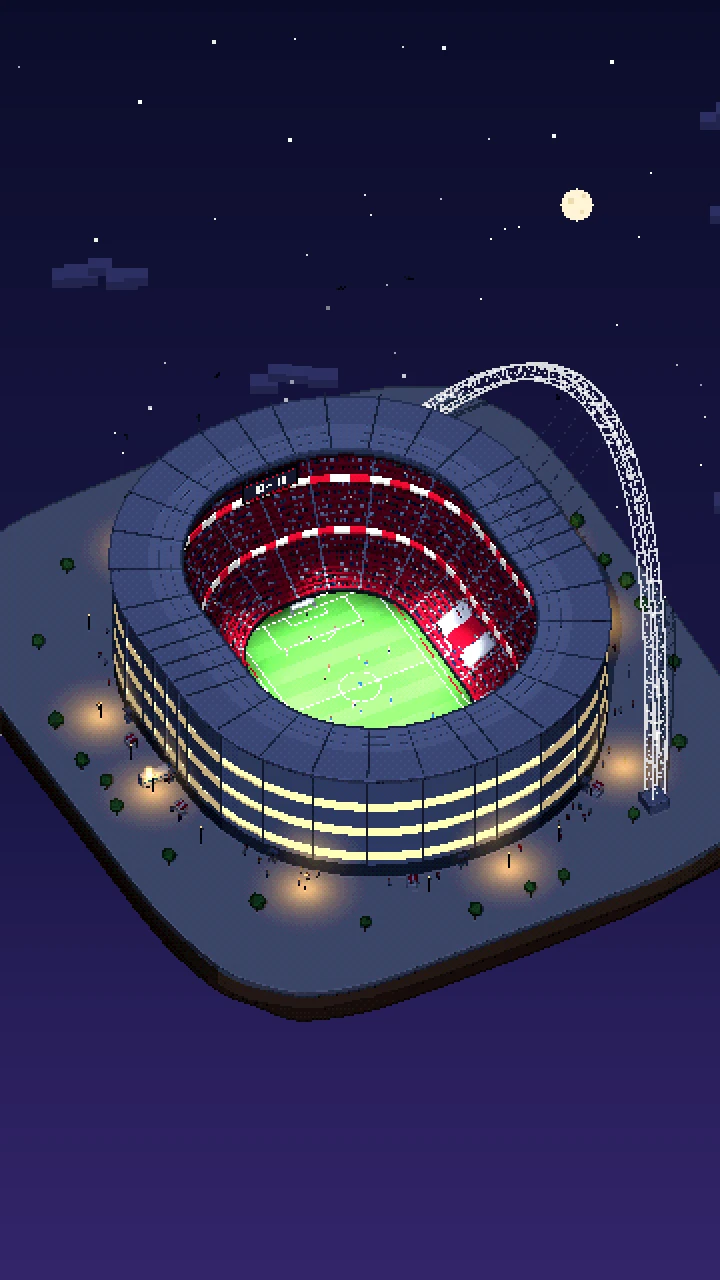
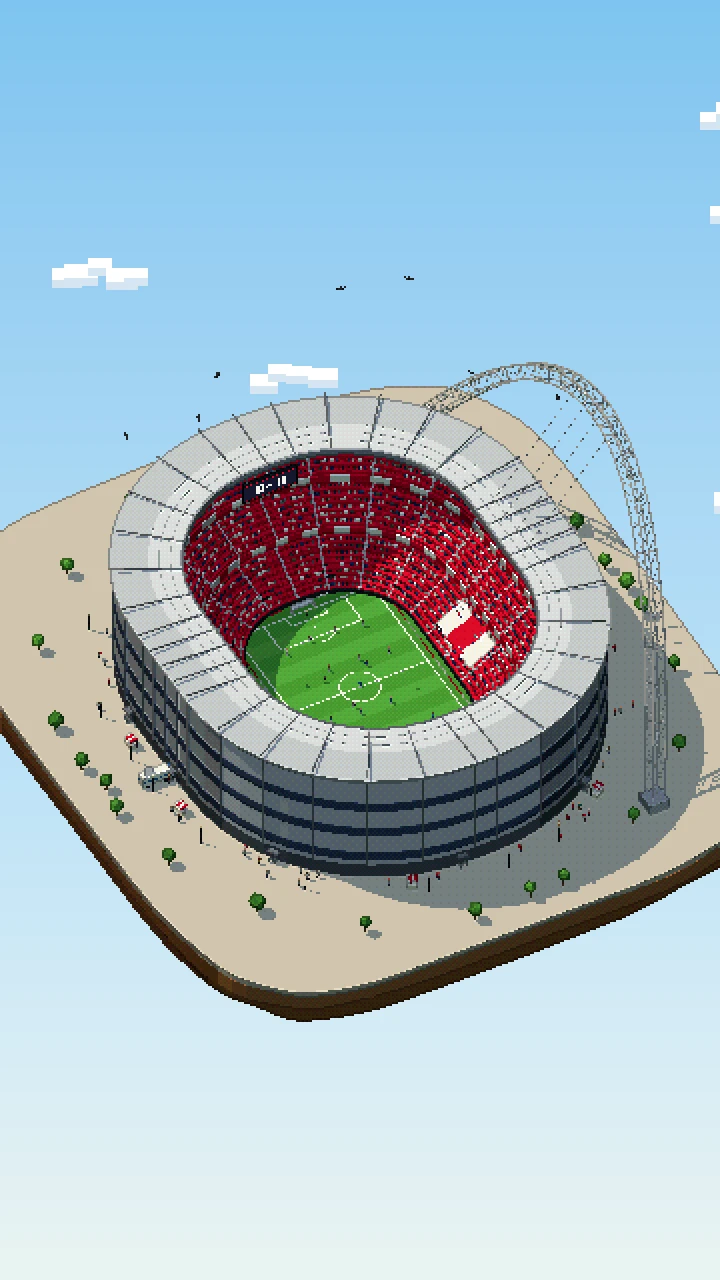
The diorama puts Wembley on a floating island, built in Three.js and rendered as pixel art: the scene is drawn at a low resolution, every edge gets a dark outline, the colours are reduced to a small palette, and the result is scaled up without smoothing. It shows a large rounded bowl with three tiers of red seats and a roof over every seat, with the sliding panels drawn as lighter strips around its inner edge. The outside is a dark plinth, silver cladding and deep glass bands. The white lattice arch, built from four chords with hoops and diagonals, leans out over the stand on the far side and holds the roof up on a row of thin cables.
On the pitch a 22-player match plays over and over, and every 15 seconds it ends in a goal. The crowd bounces all game and jumps for the goal, the scoreboards, hung under the roof at both ends, change from 0-0 to 1-0, confetti flies out of the stands and a giant flag is passed along the crowd on the far side. The west end holds a tifo of a red cross on white. As the light changes from day to dusk to night, the windows come on, the floodlights light the pitch and the arch glows white. No crest or sponsor appears: the home side wears white shirts with navy shorts, the visitors blue.
Things to spot
- The white lattice arch and its cables to the roof
- The lighter sliding roof panels at the inner edge
- The red cross tifo on the west end
- The big screens hanging under the roof at each end
- The arch glowing white at night
What we simplified
- The arch is shortened and its proportions are approximate: it is drawn at roughly 250 m across and about 120 m high, against the real 315 m span and 133 m height, and it leans out over the far stand rather than standing exactly as the real one does.
- The sliding roof panels are drawn as a ring around the whole bowl; the real roof has only some sections that move.
- The tiers are idealised; the real stadium has many more levels of boxes and concourses, and a different seat count in each tier.
- The surroundings are generic, with no Wembley Way, the Olympic Steps or the old twin towers.
- The kits are plain colours with no crests or sponsors, and the match is a looping scripted move, not a real fixture.
Questions
When did the new Wembley Stadium open?
The new Wembley Stadium was officially opened on 19 May 2007 with the FA Cup final, which Chelsea won 1–0 against Manchester United. The old stadium had closed in 2000.
How big is the Wembley arch?
The arch is 133 m high and spans 315 m, and Wembley’s own pages call it the longest single-span roof structure in the world. It sits above the north stand.
What is the capacity of Wembley Stadium?
Wembley has 90,000 seats, all of them under cover. Its three tiers hold 34,303 in the lower, 16,532 in the middle and 39,165 in the upper tier. For UEFA matches the capacity is a little lower, about 86,000 to 87,000.
Who designed the new Wembley?
Wembley was designed by Foster + Partners and HOK Sport, which is now Populous.
Who owns Wembley Stadium?
Wembley is owned by The Football Association, and it is the home of the England national team and the FA Cup final.
How was this pixel-art diorama of Wembley made?
It is a real-time Three.js scene running on this page, drawn at a low resolution with dark outlines and a small palette, then scaled up without smoothing. Press “Explore in 3D” to drag it round and switch between day, dusk and night.
Isometric maps of London
London also has 3 isometric pixel-art maps made by the community: the whole city drawn tile by tile in the same SimCity-like style. See the maps of London →