About Angkor Wat
Angkor Wat stands a few kilometres north of Siem Reap in Cambodia, at the heart of the old Khmer capital region of Angkor. It was built in the first half of the 12th century for King Suryavarman II as a temple to the Hindu god Vishnu, and probably also as his funerary temple. Over the following centuries it became a Buddhist temple, and it has never been fully abandoned. Its name means roughly "temple city".
The temple is a model of Mount Meru, the home of the gods in Hindu cosmology. Its five towers, arranged in a quincunx with the tallest in the middle, stand for Meru’s peaks, the walls for the mountains at the edge of the world and the wide moat for the ocean. The central tower rises about 65 m above the ground, on top of three rising rectangular galleries, each one smaller and higher than the last.
Unusually for an Angkorian temple, Angkor Wat faces west. Visitors cross the moat on a causeway lined with balustrades in the shape of nagas, many-headed serpents, pass through the long western entrance gallery and walk a raised causeway past two "libraries" and two ponds to the temple. The inner walls of the outer gallery carry huge bas-reliefs, including the Churning of the Ocean of Milk.
The temple has appeared on Cambodia’s national flag since the 19th century, and it is the country’s best known sight. Guinness World Records lists it as the largest religious structure in the world. Most visitors come at dawn, when the towers stand in silhouette against the sky and are mirrored in the pond in front of the northern library.
The diorama
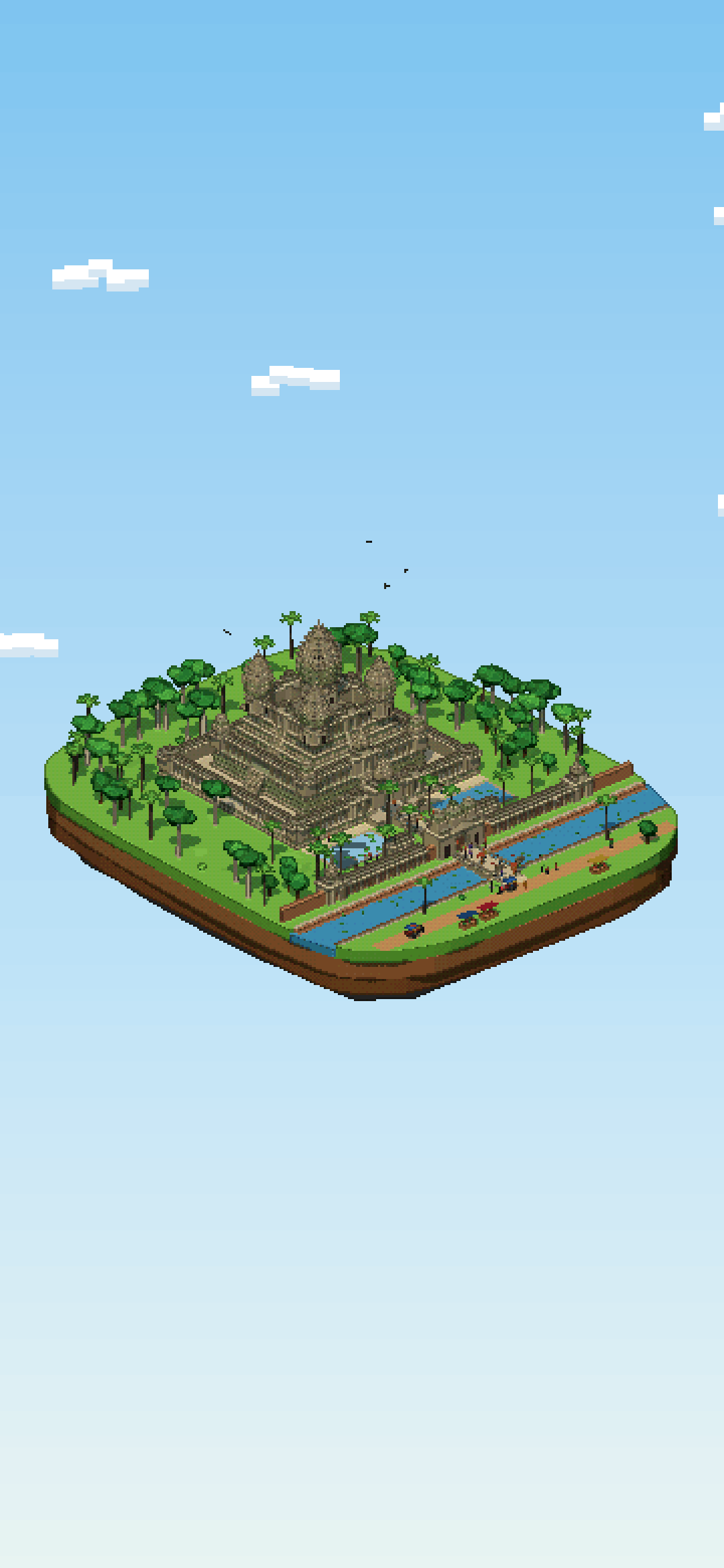
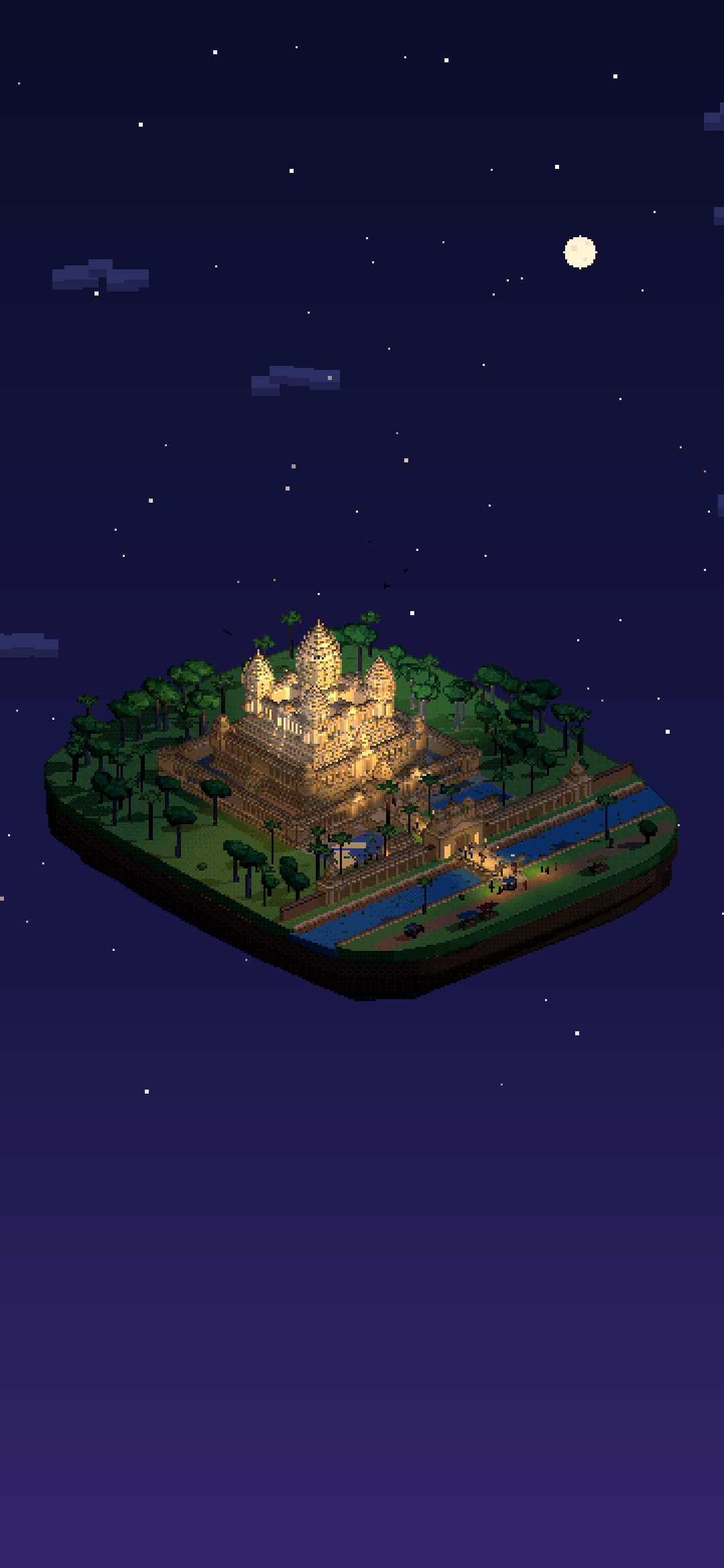
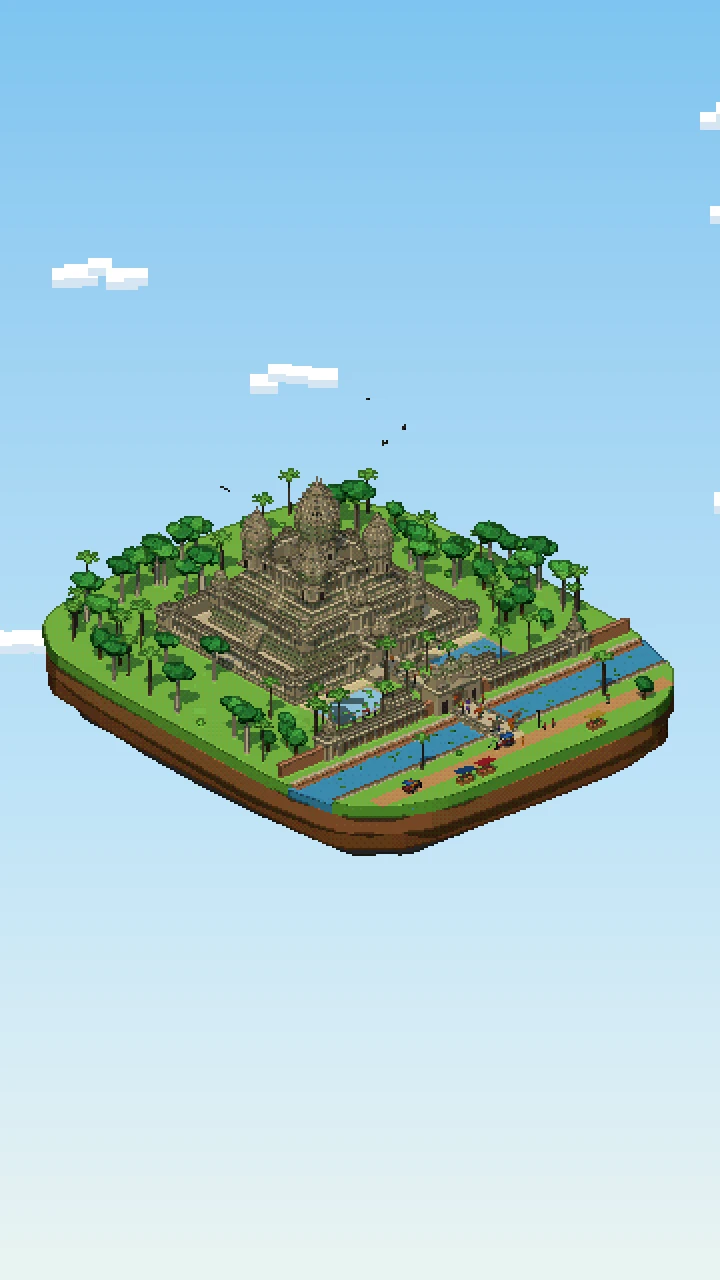
The diorama puts the temple on a floating island cut by its moat, built in Three.js and drawn as pixel art. The three galleries rise in steps, each with colonnades, stepped roofs and entrance pavilions, up to the steep Bakan with stairs on all four sides and the five lotus-bud towers, made of redented tiers with small pinnacles on every ledge. The sandstone is grey-brown with mossy green bands, and the towers are stretched upwards so the quincunx reads at pixel size.
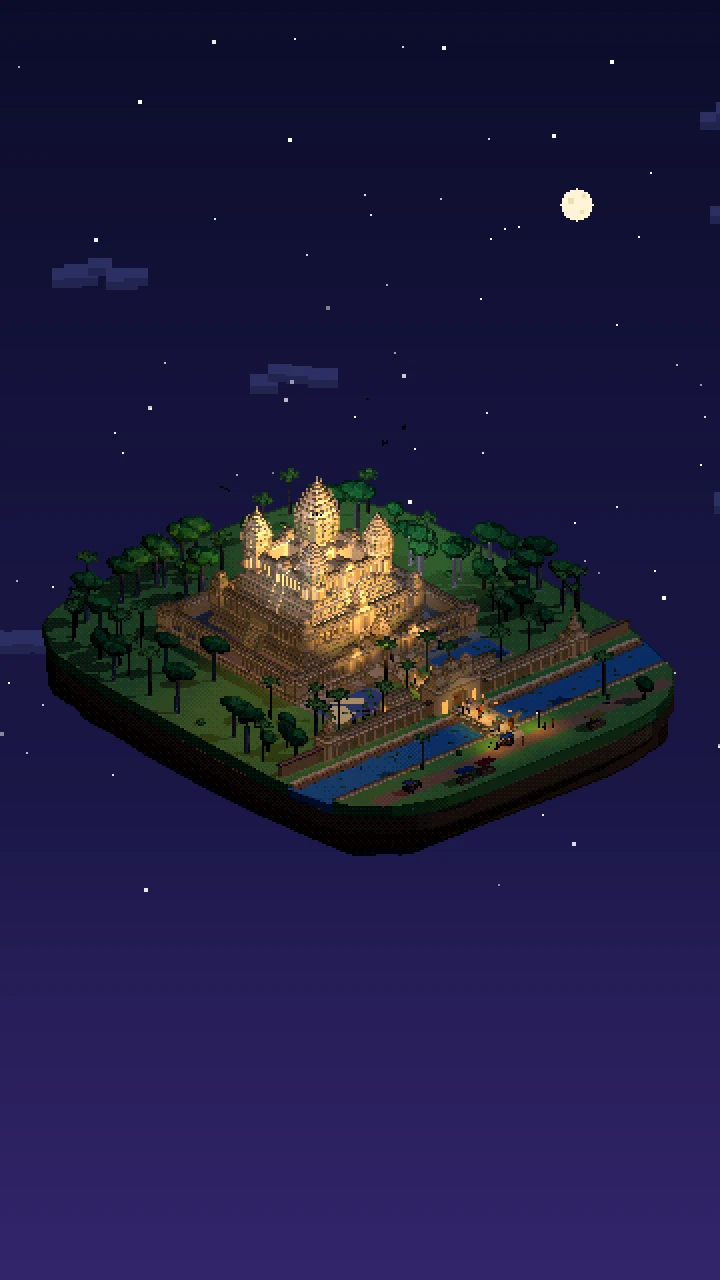
In front, the causeway with naga balustrades and lanterns crosses the moat to the western entrance gallery with its three cut-down towers, and a raised inner causeway leads past the libraries, the lotus pond and a cross-shaped terrace to the temple. Around it grow tall jungle trees and sugar palms, and a road with stalls and tuk-tuks runs along the outer bank. At golden hour a low sun lights the stone; at night the towers are floodlit.
Things to spot
- The five towers mirrored in the lotus pond, with photographers waiting at its edge
- Saffron-robed monks, some with orange parasols, crossing the causeway
- Macaques hopping along the naga balustrades
- Tuk-tuks on the road outside the moat
- The rearing seven-headed nagas at the end of each causeway
- Egrets flying low over the moat
What we simplified
- The plan is heavily compressed: the real moat, enclosure and causeways are far longer, and the towers are taller than they would be at this scale.
- Only the western entrance and a short stretch of the outer wall are shown, and the corner gopuras and many smaller buildings are left out.
- The bas-reliefs, carved devatas and window balusters are reduced to simple columns and bands.
Questions
Who built Angkor Wat?
Angkor Wat was built in the first half of the 12th century for the Khmer king Suryavarman II, as a Hindu temple dedicated to Vishnu. It later became a Buddhist temple.
Why does Angkor Wat face west?
Most Angkorian temples face east, but Angkor Wat faces west. Scholars still debate why; one common explanation links the west to Vishnu, and another to its probable role as Suryavarman II’s funerary temple.
How tall is Angkor Wat?
The central tower of Angkor Wat rises about 65 m above the ground.
Where is the best place to watch sunrise at Angkor Wat?
Most people watch from the edge of the pond in front of the northern library, to the left of the causeway as you walk in, where the towers are reflected in the water.
How was this pixel-art diorama of Angkor Wat made?
It is a real-time Three.js scene on this page, drawn at 360 × 640 pixels with outlines and a small palette and scaled up without smoothing. The temple keeps its layout of galleries and towers, while the moat and causeways are compressed. Press “Explore in 3D”, drag to turn it, and switch between day, dusk and night.