About Taj Mahal
The Taj Mahal is a mausoleum on the south bank of the Yamuna river in Agra. The Mughal emperor Shah Jahan ordered it around 1632 for his favourite wife, Mumtaz Mahal, who had died the year before giving birth to their fourteenth child. The tomb itself took around a decade, and the whole complex, with its garden, gateway and outbuildings, was finished around 1653. Shah Jahan was later buried beside her.
The tomb is built of white marble from Makrana in Rajasthan, which changes colour with the light, from pinkish at dawn to bright white at noon and soft gold at sunset. It is a block with chamfered corners standing on a square plinth, with a tall arched portal called an iwan on each face. Above it rises the great onion dome on its drum, crowned by a gilded finial and surrounded by four smaller domed kiosks, the chhatris.
Up close, the marble is covered in detail: Quranic verses in black inlaid calligraphy round the arches, carved flowers, and patterns of semi-precious stones set into the stone. The four minarets at the corners of the plinth lean very slightly outwards, said to be so that in an earthquake they would fall away from the tomb.
The complex is laid out with strict symmetry. To one side of the tomb is a red sandstone mosque, and on the other a matching building, the jawab, which exists mainly to balance it. In front lies a charbagh, a Persian-style garden divided into four by water channels, with a long reflecting pool leading the eye up to the tomb.
The diorama
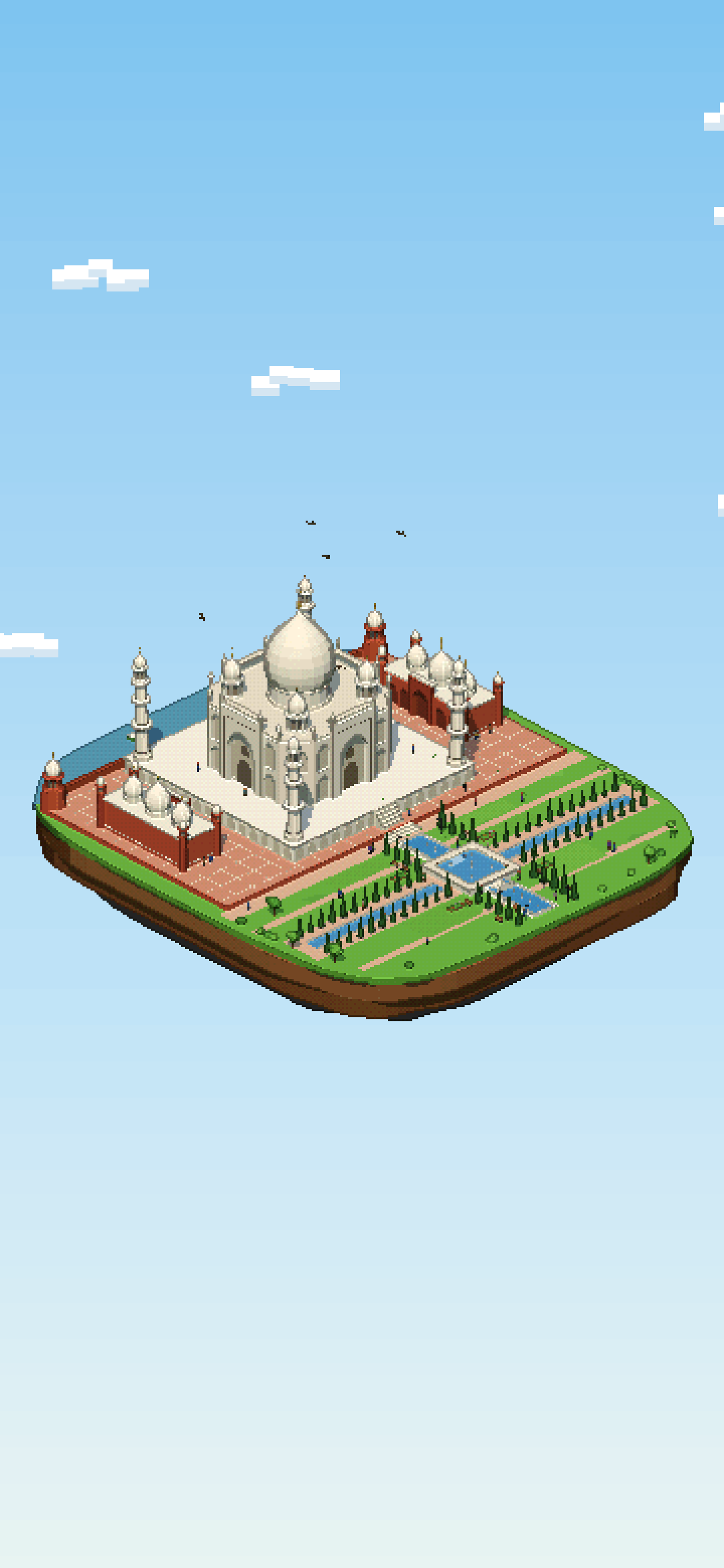
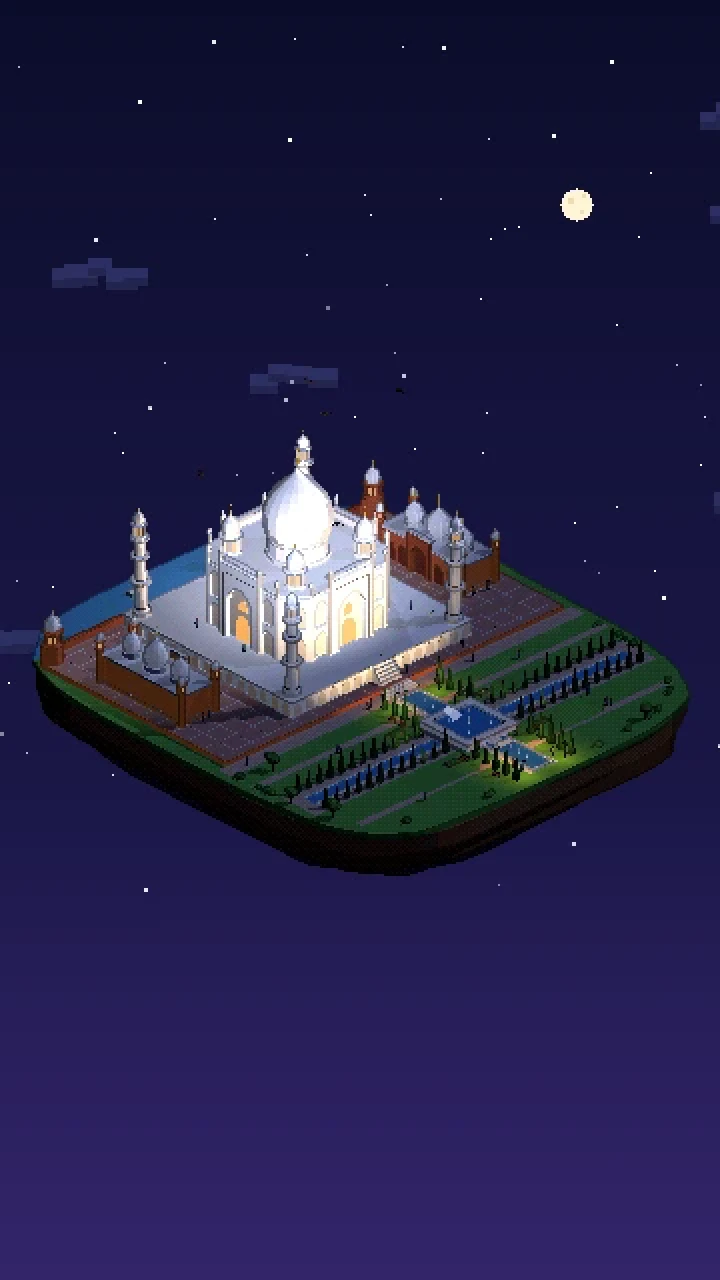
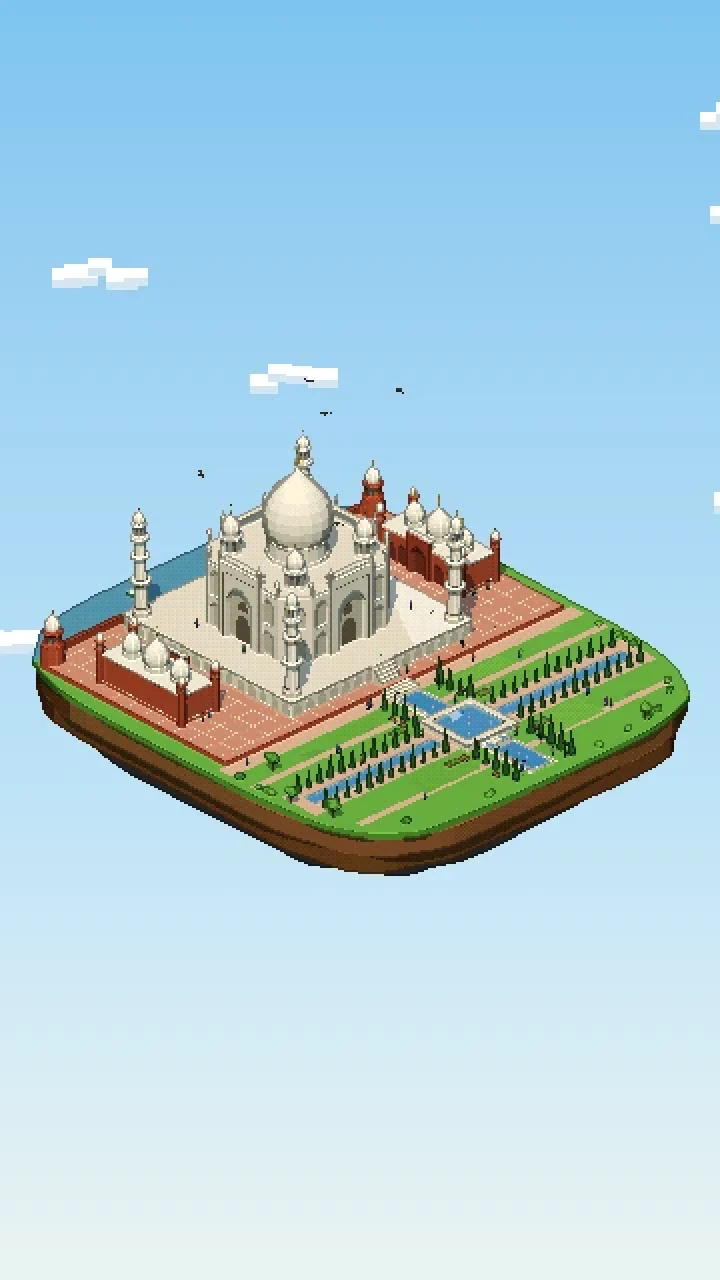
The diorama puts the complex on a floating island with the Yamuna behind it, built in Three.js and drawn as pixel art. The tomb is close to its real proportions: the chamfered marble body with a deep pointed iwan on each face and stacked arched bays beside it, the onion dome on its drum with a ring of lotus petals and a gold finial, the four chhatris and the four minarets with their balconies and dark inlay rings, tilted slightly outwards. It sits on a marble plinth with a blind arcade, on a red sandstone terrace with octagonal corner towers along the river.
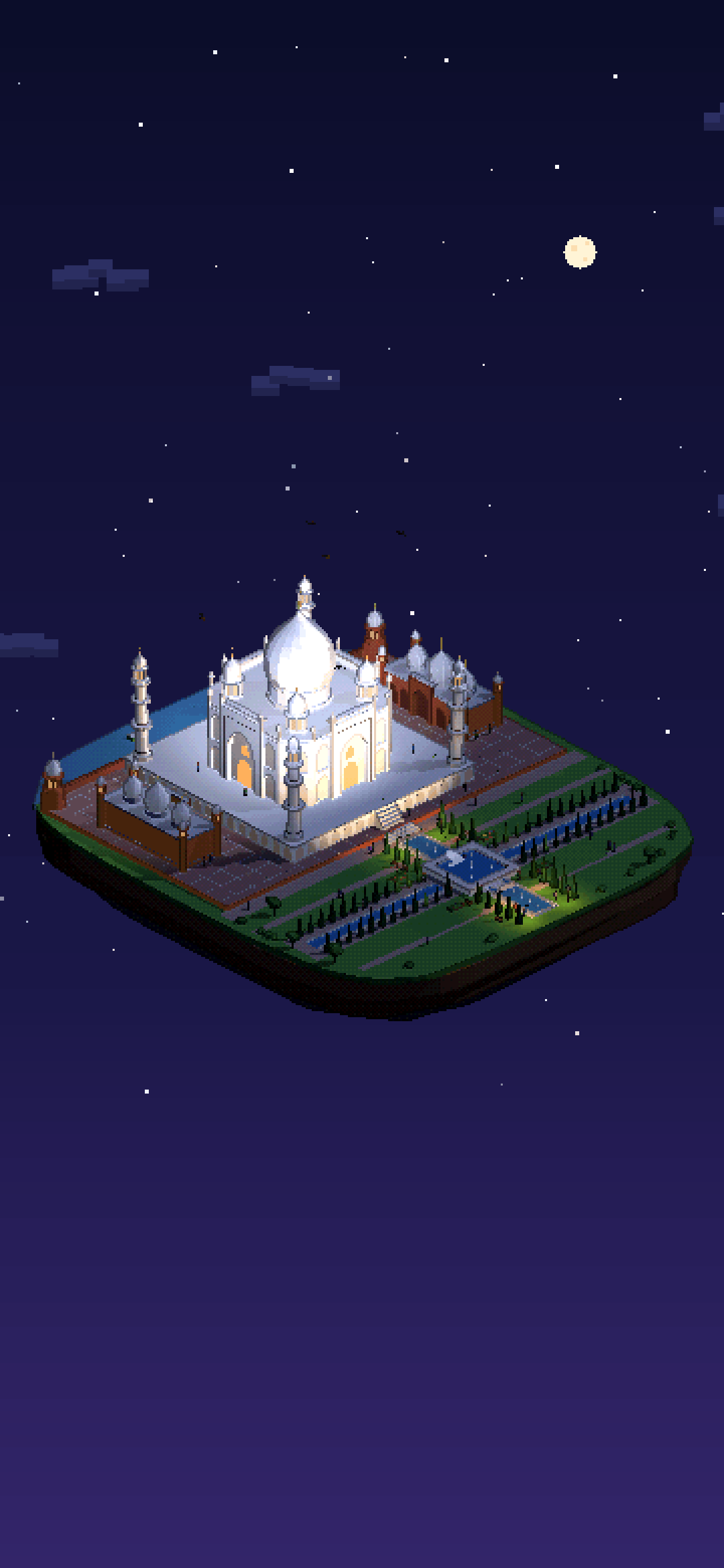
On either side stand the red sandstone mosque and jawab, each with three white domes. In front, the charbagh is laid out with cross paths, cypress rows, flower beds and lawns, and the long pool with its fountains runs to the raised marble tank in the middle. The dome is mirrored in the pool, and as the light changes the marble goes from noon white to golden, then pale under a moonlit wash with the garden lamps glowing warm.
Things to spot
- The reflection of the dome in the long pool
- The marble bench in front of the central tank, everyone’s photo spot
- Visitors walking round the tomb on the plinth
- Green parakeets flitting over the garden and kites circling high above
- A small boat on the Yamuna
What we simplified
- The charbagh is compressed and the great gateway at the far end of the garden is left out.
- The diorama adds a flight of stairs up the front of the plinth for the visitors; on the real plinth the stairs are hidden from view.
- The calligraphy, carvings and stone inlay are reduced to simple dark lines.
Questions
Who built the Taj Mahal and why?
The Mughal emperor Shah Jahan built the Taj Mahal as a mausoleum for his favourite wife, Mumtaz Mahal, who died giving birth to their fourteenth child. Shah Jahan was later buried beside her.
How long did it take to build the Taj Mahal?
The tomb itself took around a decade from about 1632, and the whole complex, with its garden, gateway and outbuildings, was finished around 1653.
How tall is the Taj Mahal?
The Taj Mahal is about 73 m tall to the top of the gilded finial on its dome.
Why do the Taj Mahal’s minarets lean?
The four minarets lean very slightly outwards, said to be so that in an earthquake they would fall away from the tomb.
How was this pixel-art diorama of the Taj Mahal made?
It is a real-time Three.js scene on this page, drawn at 360 × 640 pixels with outlines and a small palette and scaled up without smoothing. The tomb is close to its real proportions, while the charbagh garden is compressed. Press “Explore in 3D”, drag to turn it, and switch between day, dusk and night.