About Great Wall of China
The Great Wall is not one wall but a long series of fortifications built across northern China over some two thousand years. The first walls went up in the 7th century BC, and after the state of Qin unified China in 221 BC its ruler had the older northern walls linked together. Later dynasties repaired, extended and abandoned their own lines, many of them made of rammed earth, stone and wood.
The wall most people picture today belongs to the Ming dynasty, which ruled from 1368 to 1644. Ming builders used fired brick and cut stone, laid the wall along the crests of the mountains north of Beijing, and added watchtowers, barracks and beacon towers on the hilltops, from which smoke or fire signals could pass warnings along the line. A national survey published in 2012 counted about 21,196 kilometres of walls and trenches in all, about 8,850 of them from the Ming.
Near Beijing, two restored sections draw most visitors. Badaling, about 80 kilometres north-west of the city and built around 1505, guarded the approach to Juyong Pass; in 1957 it became the first section opened to tourists, and Richard Nixon walked it in 1972. Mutianyu, about 70 kilometres north-east, was first built in the 6th century and rebuilt by the Ming in 1569.
Mutianyu’s 2,250 metres of restored wall carry 22 watchtowers, and unusually both of its parapets are crenellated. A gondola and a chairlift run up from the valley, and a toboggan track winds back down. The idea that the wall is visible from the Moon is a myth; it is far too narrow. UNESCO listed the Great Wall as a World Heritage Site in 1987.
The diorama
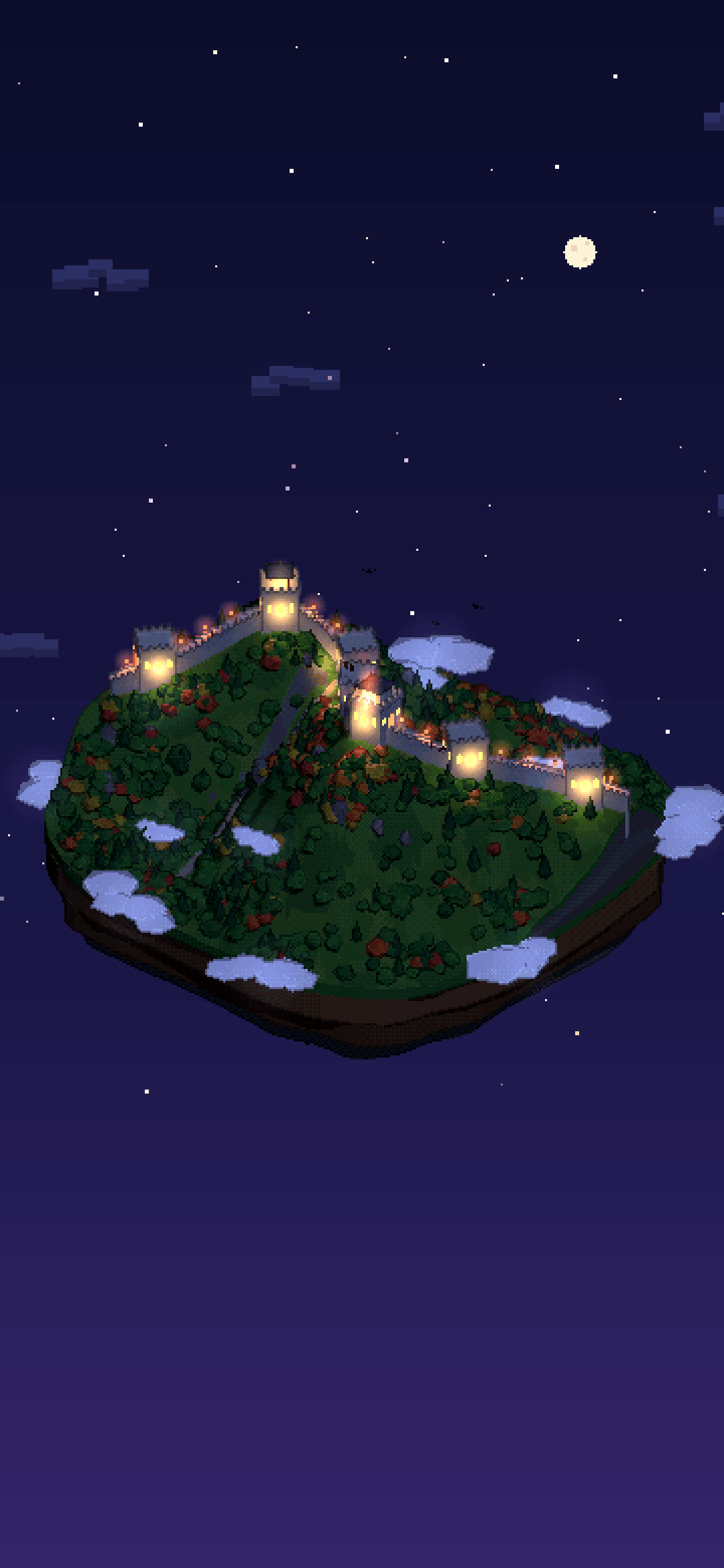
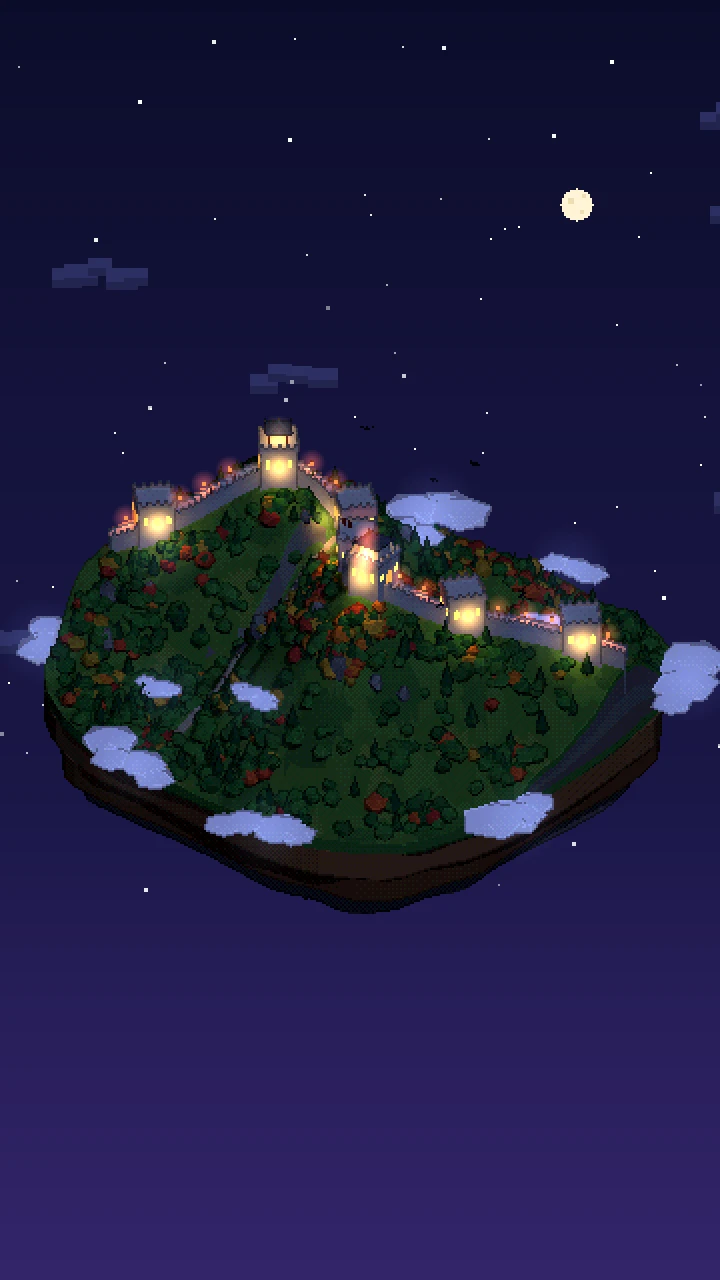
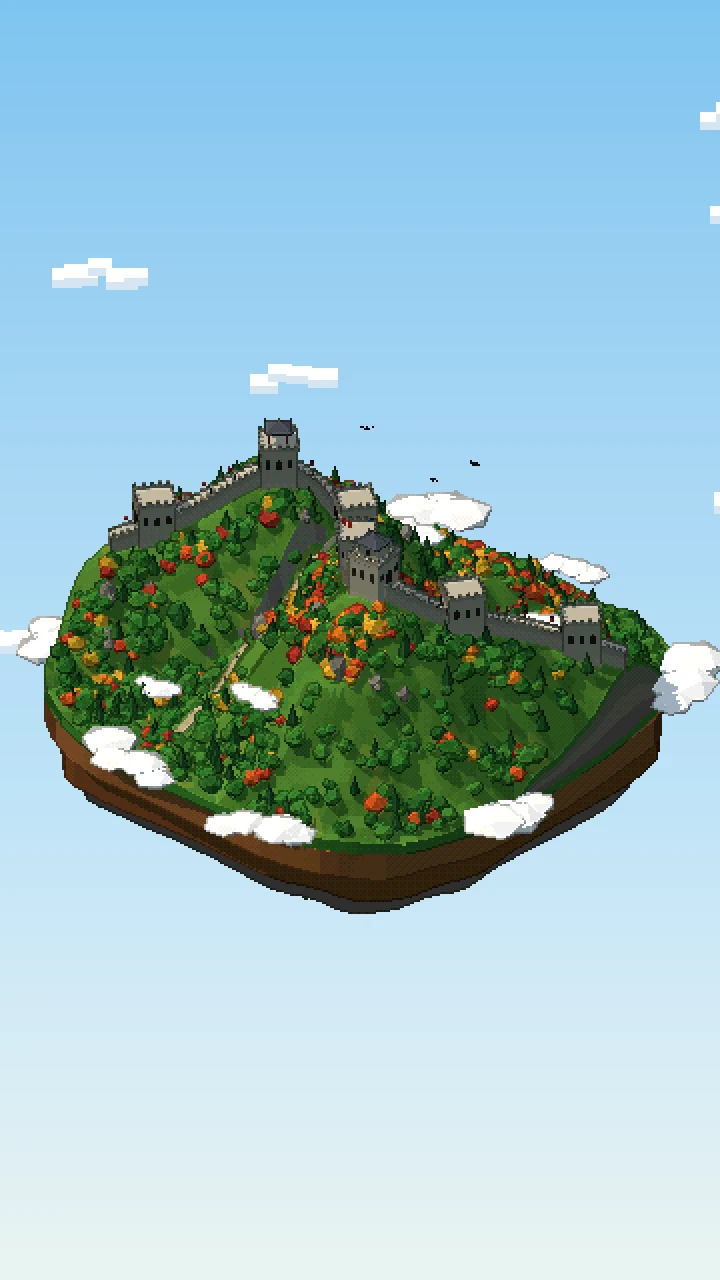
The diorama turns a stretch of Ming wall into a floating mountain ridge, built in Three.js and drawn as pixel art. The grey brick wall climbs and dips over three summits in steep steps, with crenellated battlements on its outer side, a low parapet on the inner side and a footing of pale dressed stone. Seven square watchtowers sit astride it, each with rows of arched windows and a crenellated roof; one carries an open pavilion on red columns, the highest a small guardroom under a grey tiled roof, and another flies a red flag. At both ends the wall runs straight off the island, its cut section showing in the cliff.
The slopes are covered in forest in autumn colours, green with patches of red, orange and yellow, plus dark pines and grey granite crags. A stone trail climbs a spur from the valley to the wall, hikers walk the walkway between the towers, crows circle overhead and banks of mist drift round the foot of the mountain. At night the tower windows glow, a line of red lanterns lights up along the parapet and the stone turns pale under the moon.
Things to spot
- Hikers climbing the steepest steps between the towers
- The red flag waving on one of the towers
- The pavilion with red columns and the tiled guardroom on the summits
- Where the wall runs off the edge of the island
- Hikers on the stone trail up from the valley
- The line of red lanterns along the wall at night
What we simplified
- The wall and its towers are drawn much bigger than the mountains around them, and the towers stand closer together than they do on the real wall.
- The ridge is an invented composite of the Mutianyu and Badaling landscapes rather than a copy of one section, and only the outer parapet has merlons, although Mutianyu has them on both sides.
- The gondola, chairlift and toboggan track, the visitor centres and the car parks are left out.
Questions
How long is the Great Wall of China?
A national survey published in 2012 counted about 21,196 kilometres of walls and trenches built over many dynasties. The Ming dynasty wall, the best-preserved part, is about 8,850 kilometres long.
When was the Great Wall built?
The first walls date from the 7th century BC, and after the Qin unified China in 221 BC the northern walls were linked together. The brick and stone wall near Beijing that most visitors see was built under the Ming dynasty (1368–1644).
Which section of the Great Wall is best to visit from Beijing?
Badaling, about 80 kilometres north-west of the city, was the first section opened to tourists, in 1957. Mutianyu, about 70 kilometres north-east, has 2,250 metres of restored wall with 22 watchtowers, plus a gondola, a chairlift and a toboggan.
Can you see the Great Wall from space?
Not from the Moon: the wall is far too narrow. From low Earth orbit NASA describes it as barely visible, and only in nearly perfect conditions.
How was this pixel-art diorama of the Great Wall made?
It is a real-time Three.js scene running on this page, drawn at 360 × 640 pixels with outlines and a small palette, then scaled up without smoothing. Press “Explore in 3D”, drag to turn it, and switch between day, dusk and night.
Isometric maps of Beijing
Beijing also has an isometric pixel-art map made by the community: the whole city drawn tile by tile in the same SimCity-like style. See the map of Beijing →