About Gyeongbokgung Palace
Gyeongbokgung was the first royal palace of the Joseon dynasty, built after the dynasty moved its capital to Hanyang, today’s Seoul. The palace was established in 1395 and named by the scholar-official Jeong Do-jeon after a line in the Classic of Poetry about great blessings. It sits on the classic site for a Korean palace, with the granite peaks of Bugaksan rising behind it and its main gate, Gwanghwamun, facing south towards the city.
In 1592, during the Japanese invasions known as the Imjin War, the whole palace burnt down, and it lay in ruins for more than two and a half centuries. Reconstruction began in 1865 under the regent for the young King Gojong. Gojong moved in in 1868, and by 1888 the palace counted about 500 buildings. In the colonial period most of them were sold off or demolished, and only about 40 survived to 1945.
The heart of the palace is Geunjeongjeon, the throne hall, rebuilt in 1867 and the largest main hall of any Joseon palace. It stands on a two-tier stone terrace above a courtyard of rough granite, where rows of rank stones showed officials where to stand during ceremonies. West of it, Gyeonghoeru, the royal banquet pavilion first built in 1412 and rebuilt in 1867, rises from an island in an artificial pond on 48 stone pillars, square on the outside and round on the inside.
Restoration began in earnest in 1990: Gwanghwamun itself was rebuilt on its original site in 2010, and a second restoration plan is set to run until 2045. Twice a day, except on Tuesdays when the palace is closed, the royal guard changing ceremony fills the gate with costumed guards, banners and drums. Across the city, N Seoul Tower stands on the summit of Namsan, its top about 480 metres above sea level.
The diorama
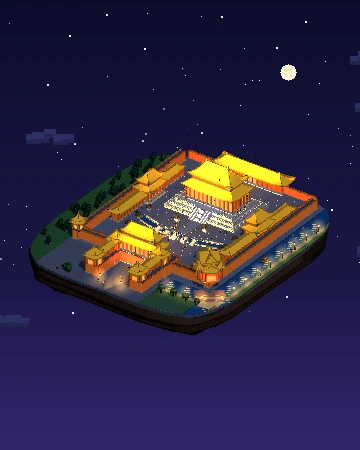
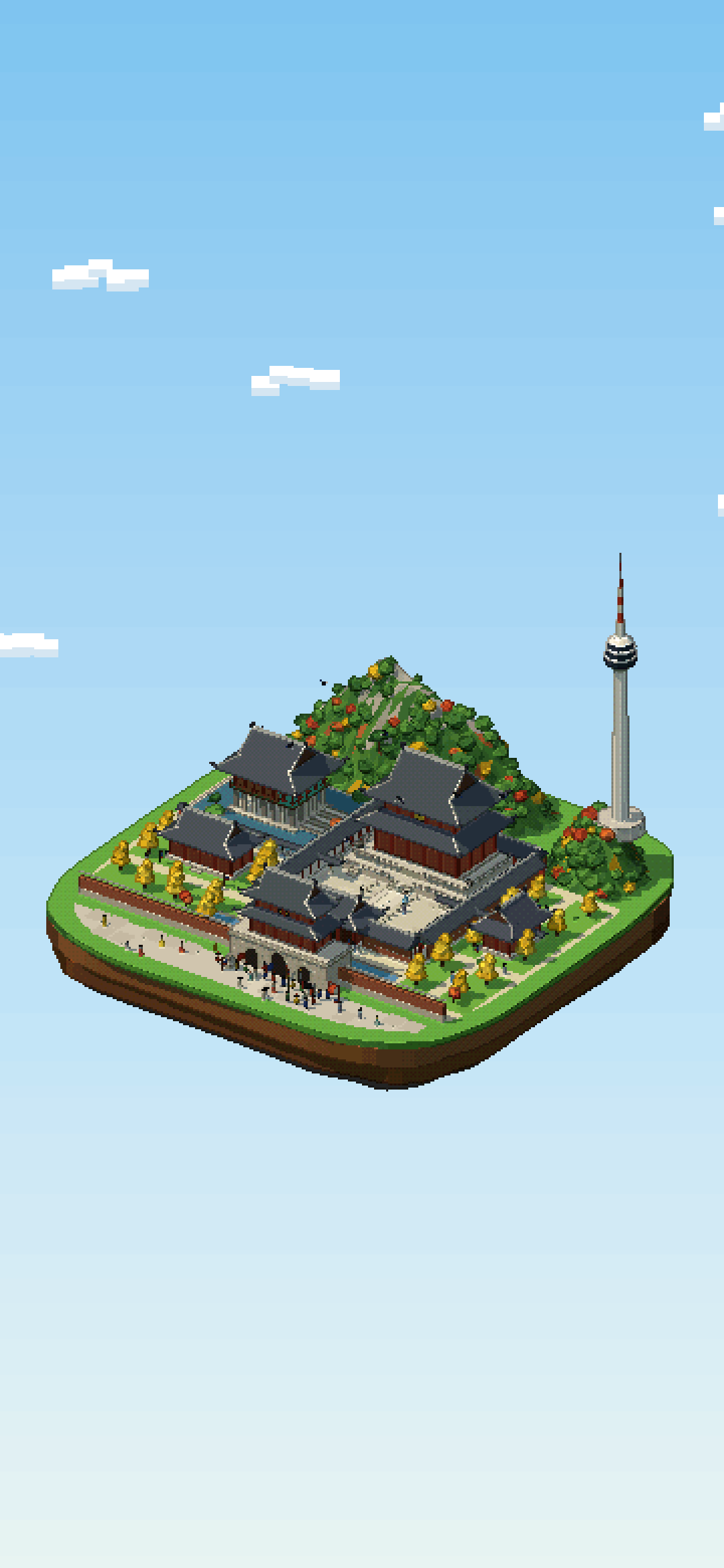
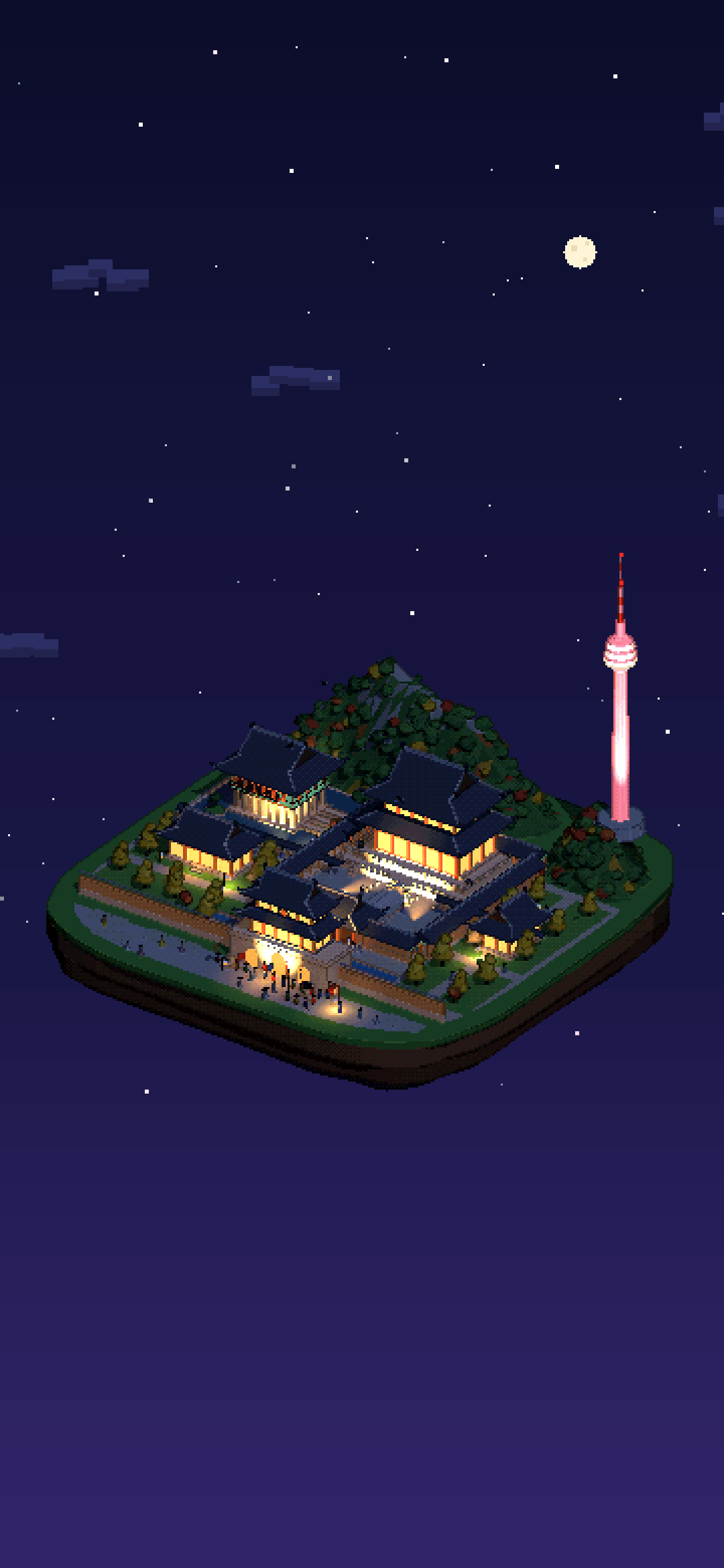
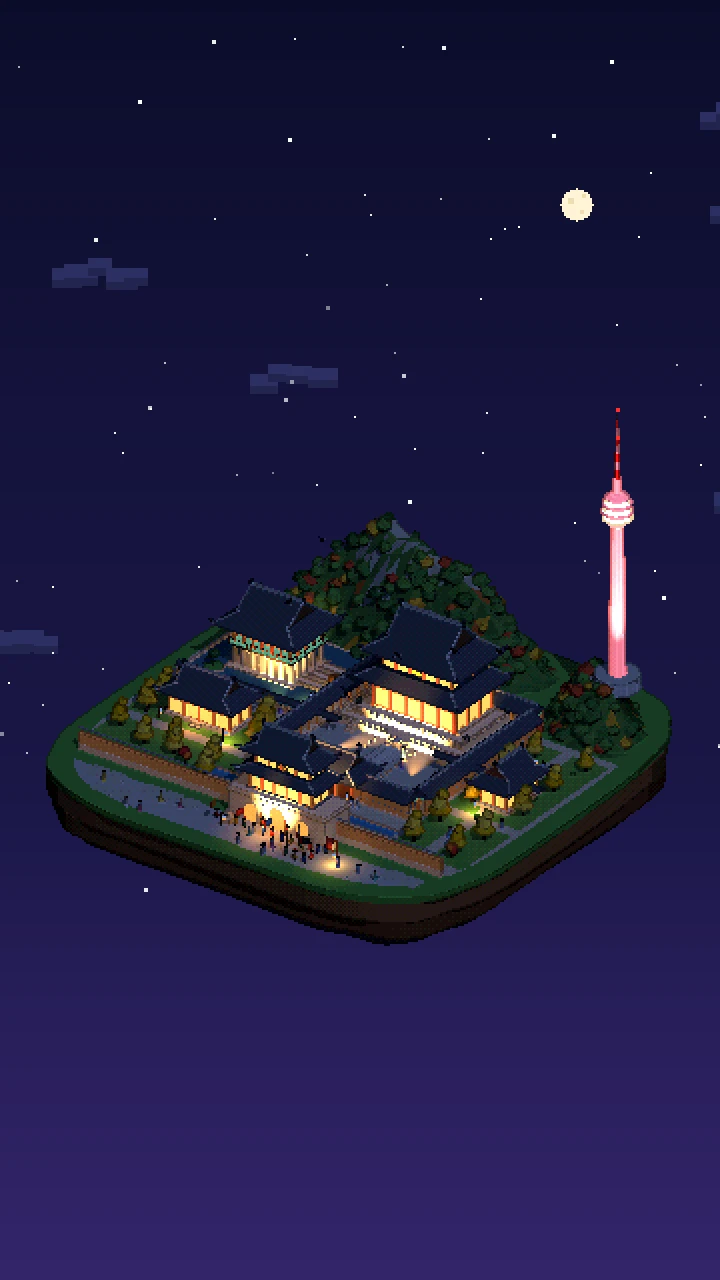
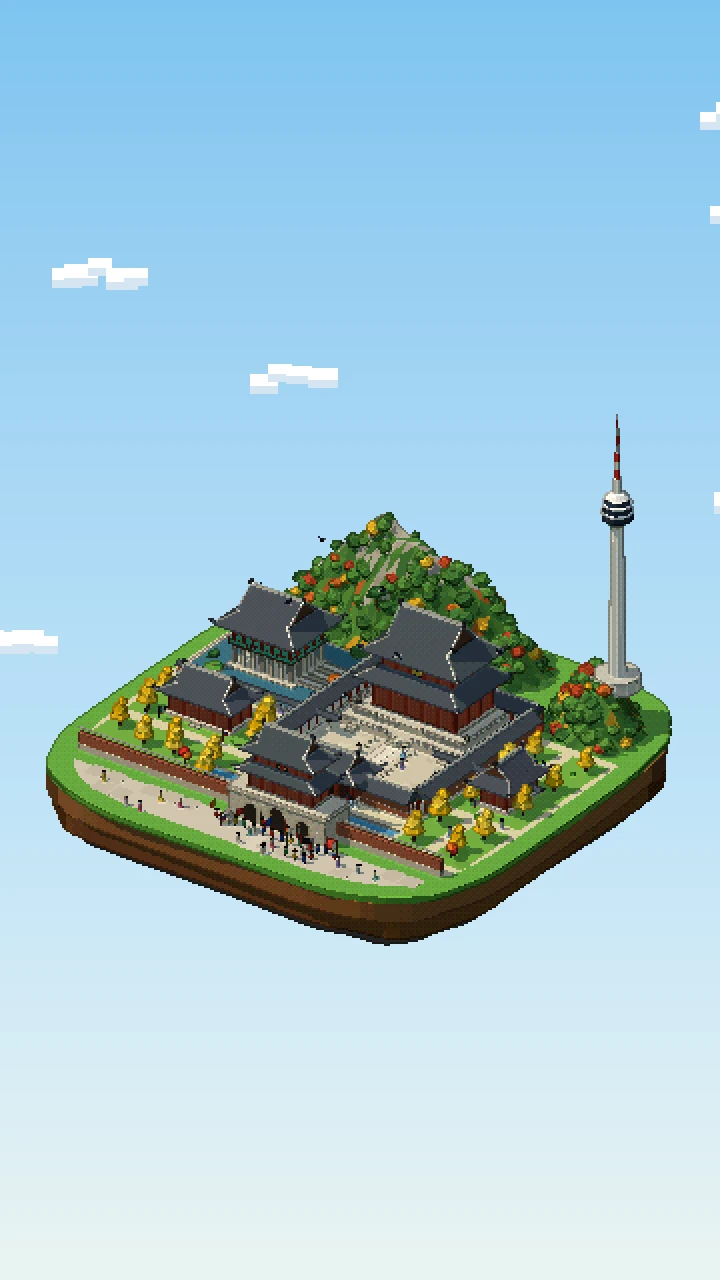
The diorama puts the palace on a floating island, built in Three.js and rendered as pixel art: the scene is drawn at a low resolution, every edge gets a dark outline, the colours are reduced to a small palette, and the result is scaled up without smoothing. Gwanghwamun stands at the front, a granite base with three arched openings under a two-storey gate house. Behind it, a stone bridge crosses a stream, a gate leads into a cloistered courtyard of rough granite with two rows of rank stones, and Geunjeongjeon rises on its two-tier terrace with a double roof of dark tiles, white ridges and painted green, red and blue eaves.
To the west, Gyeonghoeru stands on its pond on rows of stone pillars, joined to the bank by three bridges, with two little pine islands. Bugaksan rises behind in autumn colours, and on a forested hill at the corner stands N Seoul Tower. Guards in red, blue, yellow and green march in front of the gate with five-colour banners while a drummer keeps time, visitors in hanbok stroll between yellow ginkgo trees and magpies circle overhead. At night the palace glows warm and the tower slowly changes colour.
Things to spot
- The guard ceremony marching in front of Gwanghwamun, banners waving
- The drummer beating the big drum beside the gate
- Two rows of rank stones in the throne hall courtyard
- Bronze cauldrons on the corners of the stone terrace
- Magpies hopping on the lawns and circling the palace
- Red aviation lights blinking on N Seoul Tower’s mast at night
What we simplified
- N Seoul Tower and Namsan really stand about three kilometres south of the palace; here they are moved to a corner behind it and shrunk so the whole skyline fits on one island.
- The palace is heavily compressed: Heungnyemun and many halls are left out, the gates and courtyards are much closer together than in reality, and Gyeonghoeru has fewer pillars than its real 48.
- The guard ceremony is shown as a simple marching loop rather than the real choreography of the changing of the guard.
Questions
When was Gyeongbokgung Palace built?
Gyeongbokgung was established in 1395 as the first royal palace of the Joseon dynasty. It burnt down in 1592 during the Imjin War and was rebuilt from 1865 under King Gojong, who moved in in 1868.
What is Geunjeongjeon?
Geunjeongjeon is the throne hall of Gyeongbokgung, where kings were crowned and great state ceremonies were held. The present hall was rebuilt in 1867, is a National Treasure, and is the largest main hall of any Joseon palace.
When is the changing of the guard at Gyeongbokgung?
The royal guard changing ceremony usually takes place at 10:00 and 14:00 at Gwanghwamun and lasts about 20 minutes. There is no ceremony on Tuesdays, when the palace is closed, and it may be cancelled in bad weather.
How tall is N Seoul Tower?
N Seoul Tower is 236.7 metres tall and stands on the summit of Namsan, so its top is about 480 metres above sea level. Work began in 1969, and the tower opened to the public in 1980. At night its lights change colour.
How was this pixel-art diorama of Gyeongbokgung made?
It is a real-time Three.js scene running on this page, drawn at 360 × 640 pixels with dark outlines and a small palette, then scaled up without smoothing. Gwanghwamun, Geunjeongjeon and Gyeonghoeru are modelled with their curved tiled roofs and painted eaves. Press “Explore in 3D” to drag it round and switch between day, dusk and night.
Isometric maps of Seoul
Seoul also has an isometric pixel-art map made by the community: the whole city drawn tile by tile in the same SimCity-like style. See the map of Seoul →