About Palacio de Bellas Artes
The Palacio de Bellas Artes stands at the east end of the Alameda Central, in the historic centre of Mexico City. President Porfirio Díaz laid the first stone on 1 October 1904: the old National Theatre had been torn down, and the new one was meant to open for the centenary of independence in 1910. It did not. By 1913 only the shell stood, and the Mexican Revolution stopped the work for almost two decades.
The Italian architect Adamo Boari designed the building in a mix of neoclassical and Art Nouveau, wrapped in white marble from Carrara in Italy and from Guerrero, over a base of beige marble from Morelos. When work restarted in 1932, Federico Mariscal finished the interior in Art Deco instead, so the palace looks like two eras at once. It opened on 29 November 1934.
The Hungarian artist Géza Maróti made the bronze sculptures of the dome and the glass ceiling over the auditorium, and the Catalan sculptor Agustí Querol made the four Pegasus groups on the esplanade. Inside, the stage is closed by a folding curtain of nearly a million pieces of iridescent glass made by Tiffany in New York, and the upper floors hold murals by Diego Rivera, José Clemente Orozco, David Alfaro Siqueiros and Rufino Tamayo.
The heavy marble building sits on the soft old lakebed of the city and has sunk about four metres since construction began. It is still the country’s leading stage for opera, music and dance, where the Ballet Folklórico de México performs regularly, and the gardens, fountains and white Hemiciclo a Juárez of the Alameda in front are one of the busiest public spaces in the city.
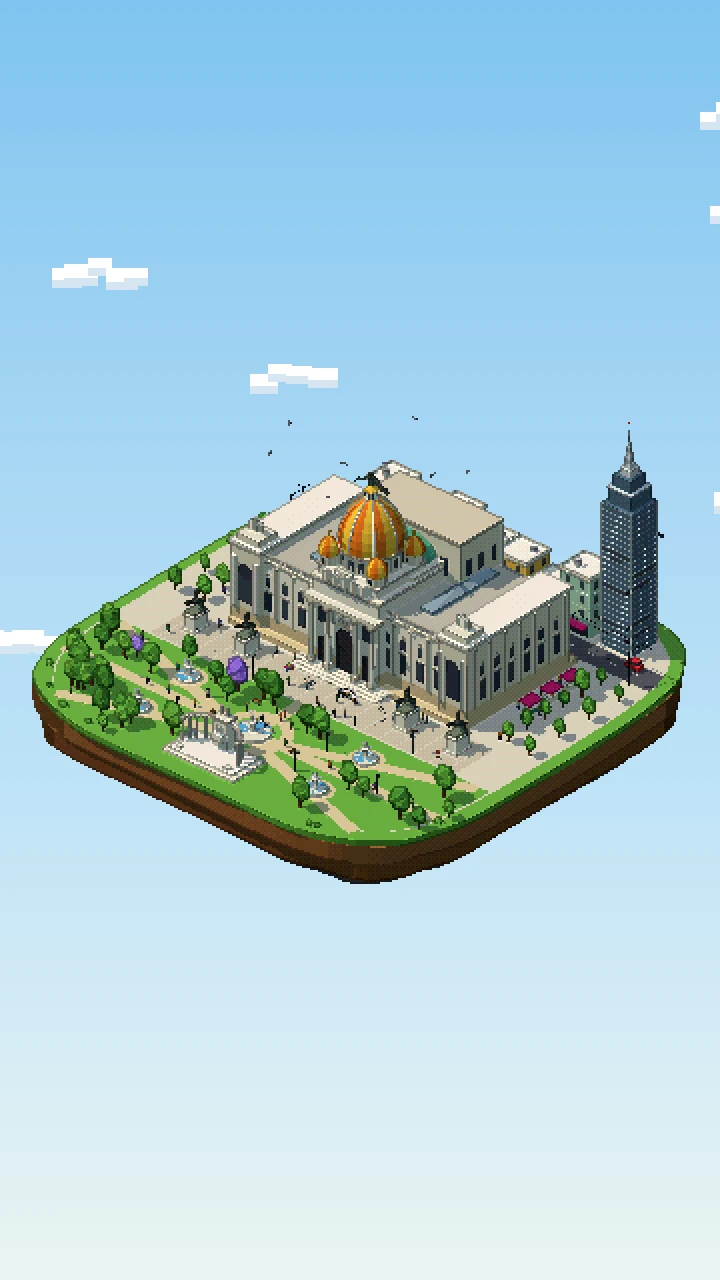
The diorama
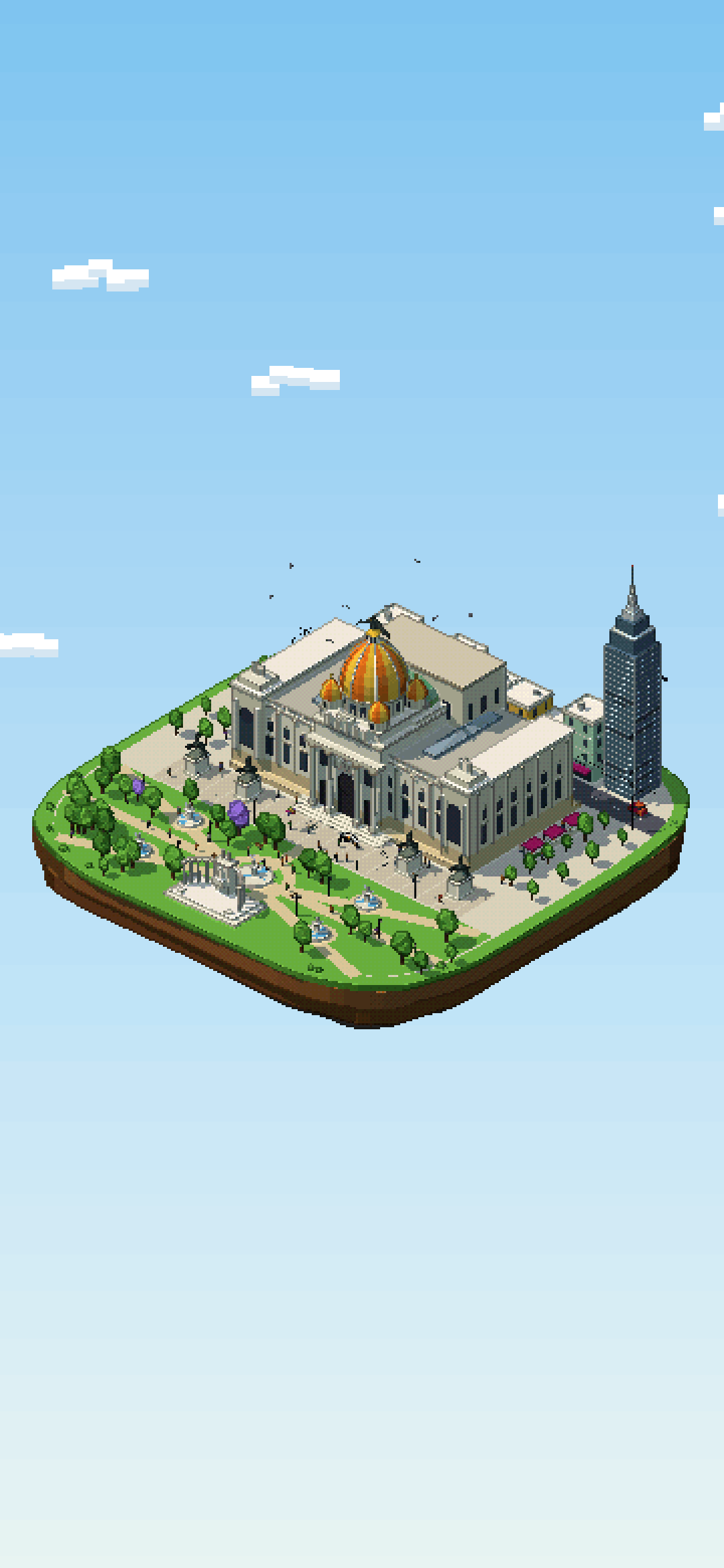
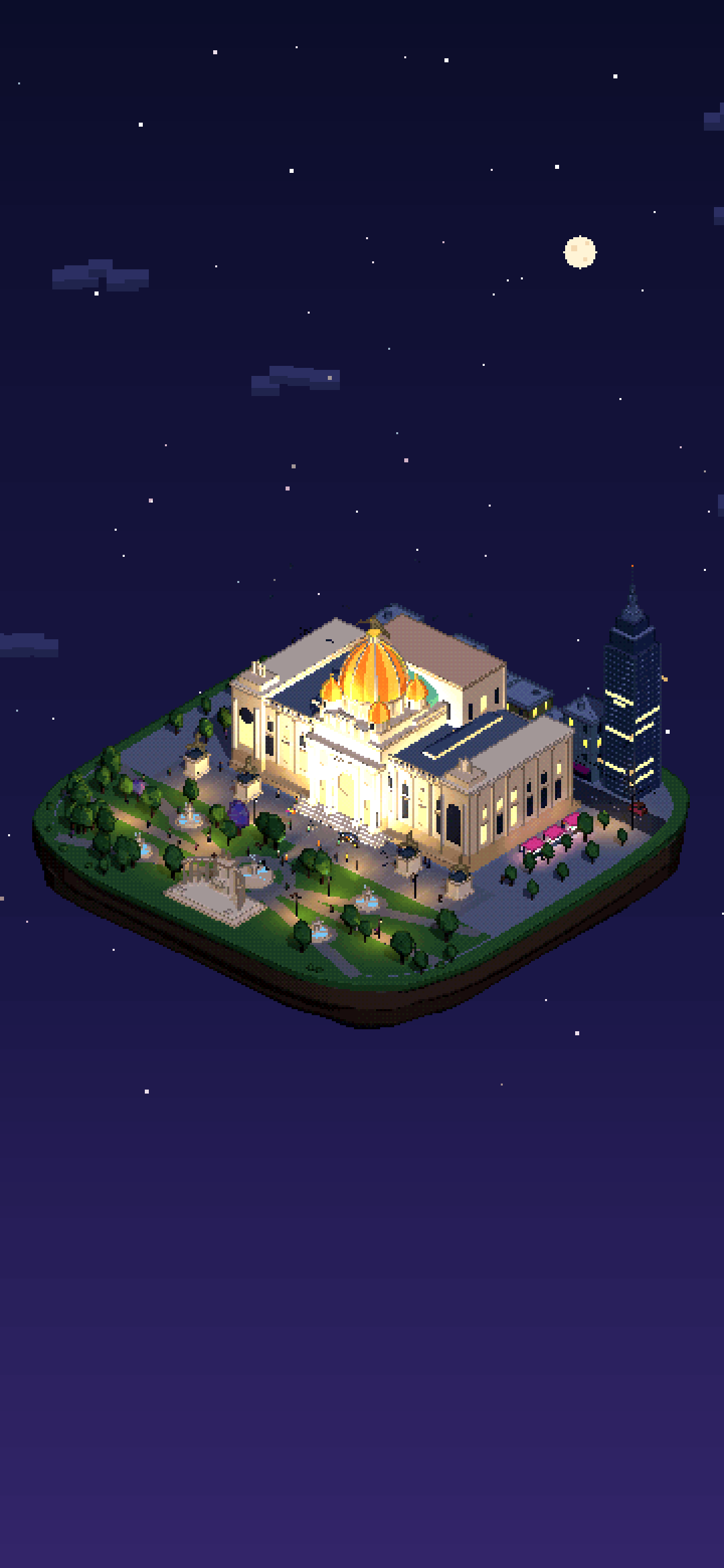
The diorama puts the palace on a floating island of the city centre, built in Three.js and rendered as pixel art: the scene is drawn at a low resolution, every edge gets a dark outline, the colours are reduced to a small palette, and the result is scaled up without smoothing. The palace is a white marble block with columned bays and sculpture groups, a three-arched portal behind four free columns, and the cluster of domes over the vestibule: a big dome in orange and gold gores with white ribs, four smaller domes around it and a bronze eagle on top, with the tall stage house behind.
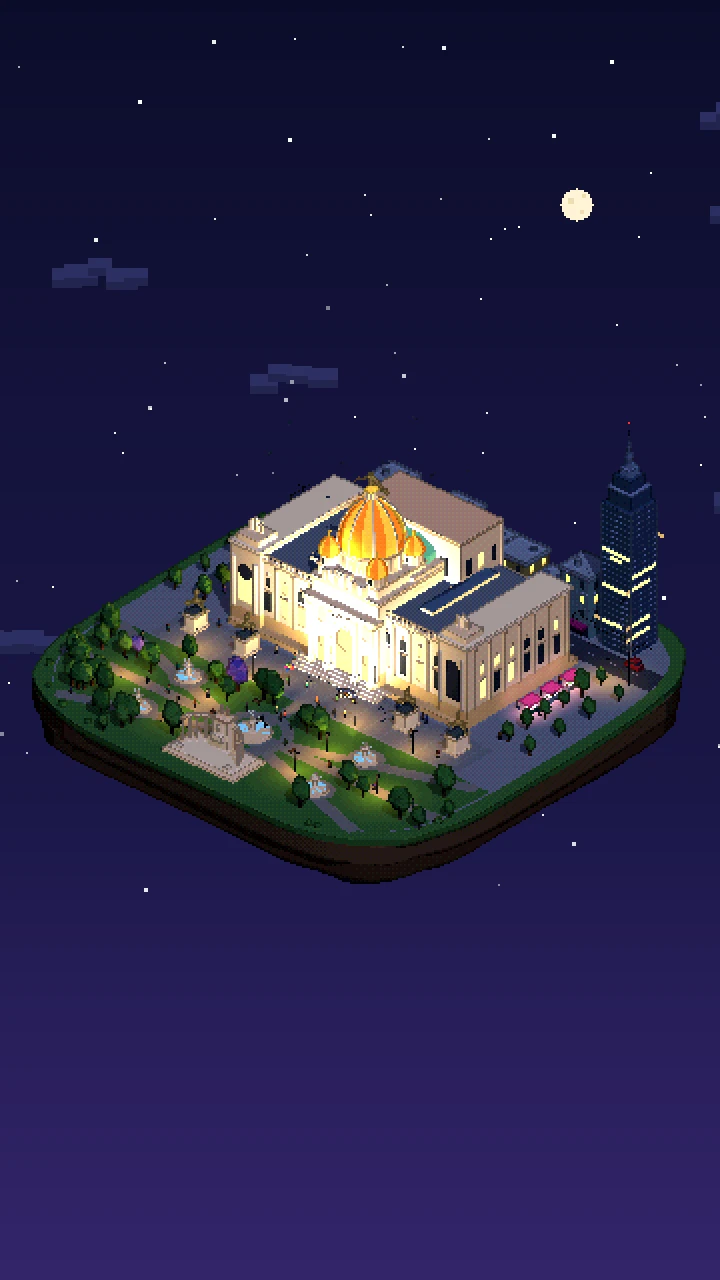
In front, four Pegasus groups stand on the esplanade, where a mariachi band plays, a balloon seller waits and pigeons peck. Beyond them the Alameda opens with diagonal paths, fountains, ash trees, a few purple jacarandas and the white colonnade of the Hemiciclo a Juárez. Behind the palace a trolleybus runs under its wires along the Eje Central, past pink-roofed food stalls and the Torre Latinoamericana. At night the marble is floodlit and the dome glows orange and gold.
Things to spot
- A mariachi band in black and silver on the esplanade
- The bronze eagle on top of the dome
- A trolleybus with its poles on the wires
- Food stalls under pink tarps
- A balloon seller and a flock of pigeons
- The Torre Latinoamericana in the corner
What we simplified
- The palace is shortened and the dome cluster drawn a little larger so it reads at pixel size; the facade sculpture is reduced to simple blocks.
- The Alameda, the Eje Central and the Torre Latinoamericana are squeezed much closer together than in the real city, and the houses are generic.
Questions
When was the Palacio de Bellas Artes built?
Construction began on 1 October 1904 under the architect Adamo Boari, but stopped during the Mexican Revolution with only the shell standing. Federico Mariscal resumed the work in 1932 and the palace opened on 29 November 1934.
What is the Palacio de Bellas Artes made of?
The facades are white marble from Carrara in Italy and from Guerrero in Mexico, over a base of beige marble from Morelos. The building is so heavy, and the old lakebed under Mexico City so soft, that it has sunk about four metres since construction began.
What is inside the Palacio de Bellas Artes?
A 1,590-seat theatre with a folding Tiffany glass curtain of nearly a million pieces, exhibition halls, and murals by Diego Rivera, José Clemente Orozco, David Alfaro Siqueiros and Rufino Tamayo on the upper floors.
Why does the Palacio de Bellas Artes look like two different styles?
Adamo Boari designed the outside in neoclassical and Art Nouveau style before the Revolution. When work restarted in 1932, Federico Mariscal finished the interior in Art Deco, the fashion of the time.
How was this pixel-art diorama of the Palacio de Bellas Artes made?
It is a real-time Three.js scene running on this page, drawn at 360 × 640 pixels with dark outlines and a small palette, then scaled up without smoothing. The palace, its tiled domes, the Pegasus groups and the Alameda are modelled from simple blocks. Press “Explore in 3D” to drag it round and switch between day, dusk and night.
Isometric maps of Mexico City
Mexico City also has an isometric pixel-art map made by the community: the whole city drawn tile by tile in the same SimCity-like style. See the map of Mexico City →