About Christ the Redeemer
Christ the Redeemer stands on the summit of Corcovado, a granite peak inside the Tijuca forest that rises straight up from the middle of Rio de Janeiro. The Brazilian engineer Heitor da Silva Costa designed the statue, the French sculptor Paul Landowski modelled it, and the face was sculpted by Gheorghe Leonida. The first stone was laid in 1922, the centenary of Brazilian independence, the statue itself was built from 1926, and it was inaugurated on 12 October 1931.
It is built of reinforced concrete, the only practical way to put something so large on such an exposed peak, and covered with a mosaic of thousands of small triangular tiles of soapstone, a stone that is easy to carve and stands up well to the weather. The figure is 30 metres tall and its open arms span 28 metres. Being the highest point around, it is often struck by lightning, and pieces of the fingers and head have had to be repaired.
The 8-metre pedestal holds a small chapel. Most visitors come up on the Corcovado Railway, a cog railway that has climbed the mountain since 1884, and then walk or take the escalators up to the terraces around the base. From there the view takes in Sugarloaf Mountain, Guanabara Bay, Copacabana and the lagoon.
In 2007 the statue was voted one of the New Seven Wonders of the World. The terrace at its feet is almost always crowded, and the classic photo is of a visitor standing in front of it with their arms spread wide in the same pose.
The diorama
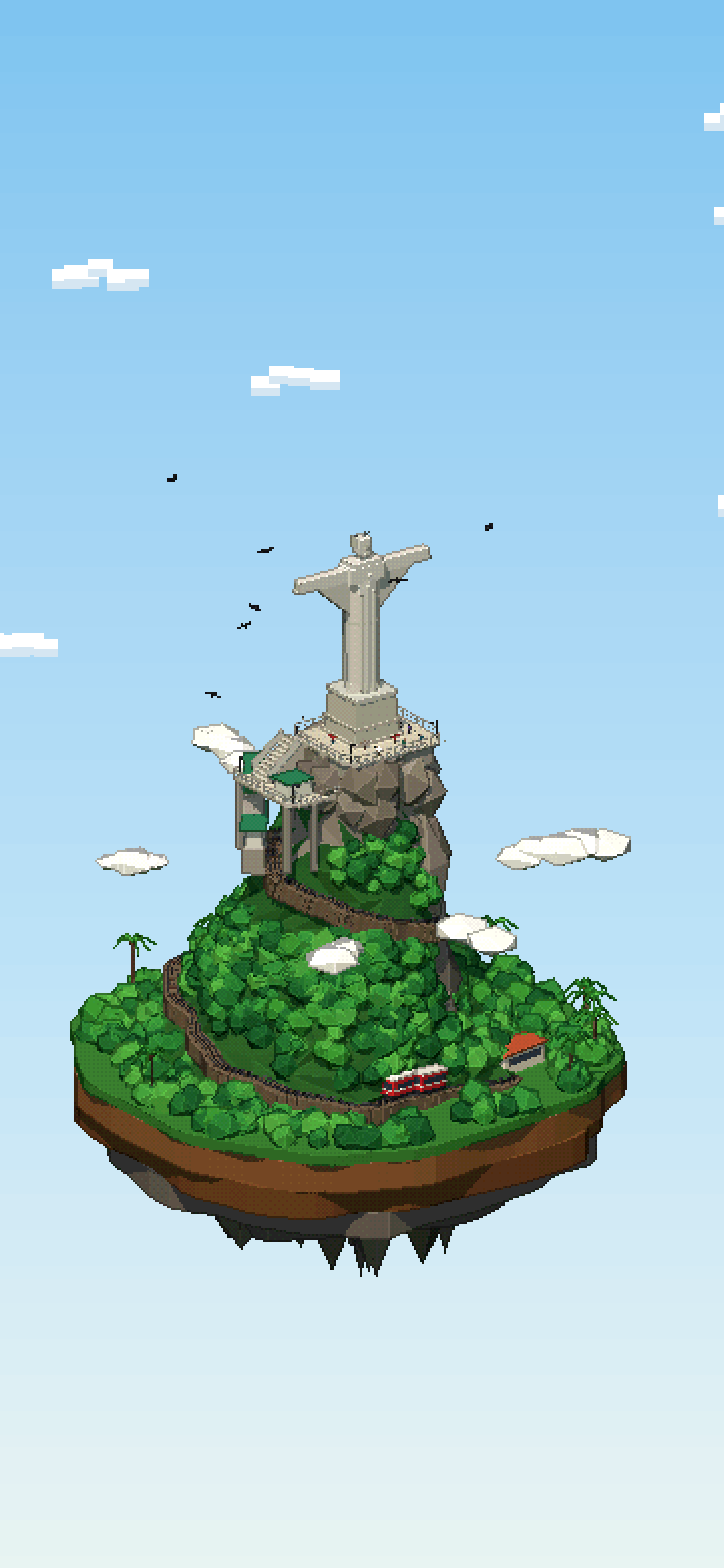
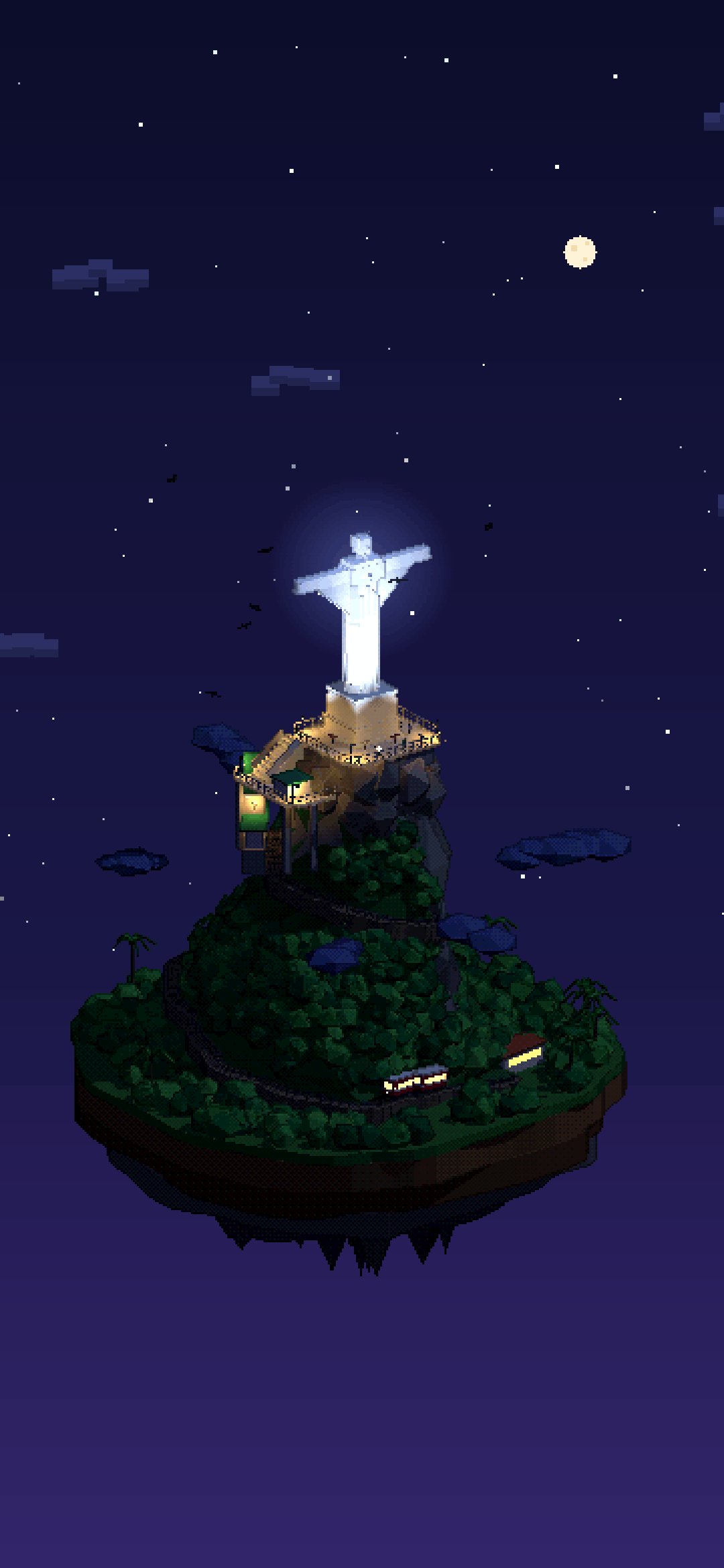
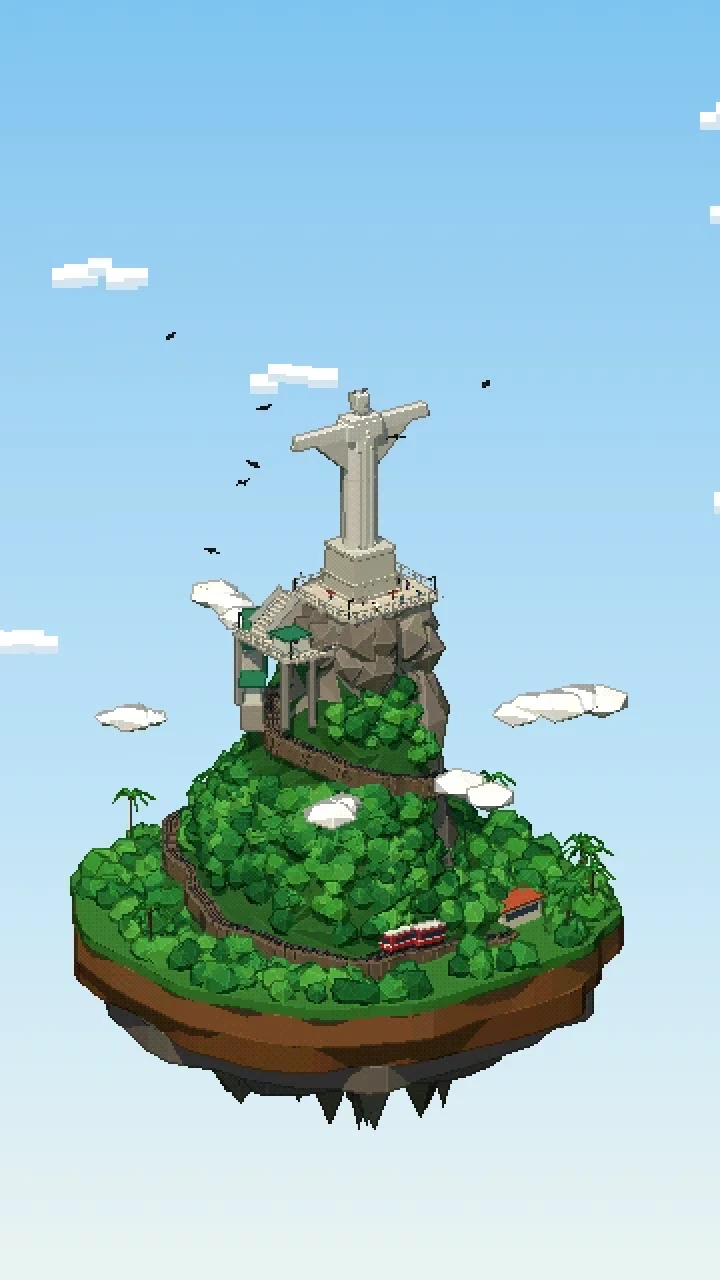
The diorama turns Corcovado into a steep granite pinnacle rising from a floating island of rainforest, with a sheer cliff on one side, built in Three.js and drawn as pixel art. The statue is made from simple blocks: a tapering robe with vertical folds and a belt cord, the heart on the chest, outstretched arms with drooping sleeves, the bearded head and the small lightning rods on top. It stands on its pedestal, which has the chapel door and windows at the back.
Below the statue, the upper terrace with its white railings steps down to a lower terrace with a kiosk, and a covered escalator on pillars leads down to the upper station of the railway. The red cog train climbs the track through the jungle, from the lower station at the foot of the mountain to the top, and waits there. Clouds drift round the mountain below the summit and black vultures circle above it. At night the statue is floodlit cool white and camera flashes pop on the terrace.
Things to spot
- Tourists on the terrace striking the open-arms pose
- Their friends taking the photo, with the occasional flash
- The red cog train climbing up through the jungle
- Black vultures circling the summit
- Clouds drifting below the statue
- The chapel door at the back of the pedestal
What we simplified
- The mountain is toy-sized: the statue is roughly to scale, but Corcovado is shrunk to a fraction of its 700 m, and the city, the bay and Sugarloaf Mountain are left out.
- The terraces, the escalators and the station are simplified and rearranged to fit around the summit.
Questions
How tall is Christ the Redeemer?
Christ the Redeemer is 30 metres tall and stands on an 8-metre pedestal. Its open arms span 28 metres.
When was Christ the Redeemer built?
The first stone was laid in 1922, the statue itself was built from 1926, and it was inaugurated on 12 October 1931.
Who designed Christ the Redeemer?
The Brazilian engineer Heitor da Silva Costa designed the statue and the French sculptor Paul Landowski modelled it. The face was sculpted by Gheorghe Leonida.
What is Christ the Redeemer made of?
It is built of reinforced concrete and covered with a mosaic of thousands of small triangular soapstone tiles. Soapstone is easy to carve and stands up well to the weather.
How was this pixel-art diorama of Christ the Redeemer made?
It is a real-time Three.js scene running on this page, drawn at 360 × 640 pixels with outlines and a small palette, then scaled up without smoothing. Press “Explore in 3D”, drag to turn it, and switch between day, dusk and night.
Isometric maps of Rio de Janeiro
Rio de Janeiro also has an isometric pixel-art map made by the community: the whole city drawn tile by tile in the same SimCity-like style. See the map of Rio de Janeiro →