About Caminito, La Boca
Caminito is a short, curved pedestrian lane in La Boca, the old port neighbourhood of Buenos Aires where the Riachuelo bends at the Vuelta de Rocha. Its curve is older than the houses. A stream once ran here down to the river, and later a branch of the freight railway followed the same line. After the trains stopped in 1928, the strip became an abandoned path and dump known locally as La Curva.
In 1959 the painter Benito Quinquela Martín, the neighbourhood’s best-known artist, led the campaign to turn it into a “calle museo”, a street museum open to the sky. He pushed to name it after the tango Caminito, sat on the commission that chose the facade colours and helped prepare the walls. The street museum opened that year, and sculptures and murals along it have drawn visitors ever since.
The houses along it are conventillos, tenements of wood and corrugated iron built for the immigrants who worked in the port, many of them from Liguria, the region around Genoa. Families rented single rooms around shared yards, with outside stairs and balconies. Each wall panel is painted a different bright colour; local tradition says the first coats were paint left over from the boatyards, a story the neighbourhood loves to tell.
The song that gave the lane its name dates from 1926, with music by Juan de Dios Filiberto, a son of La Boca, and lyrics by Gabino Coria Peñaloza. Tango, which UNESCO added to its list of intangible cultural heritage in 2009 for Argentina and Uruguay, is still danced for visitors on the cobbles. A few blocks away stands La Bombonera, the stadium of Boca Juniors, the club founded in the neighbourhood in 1905.
The diorama
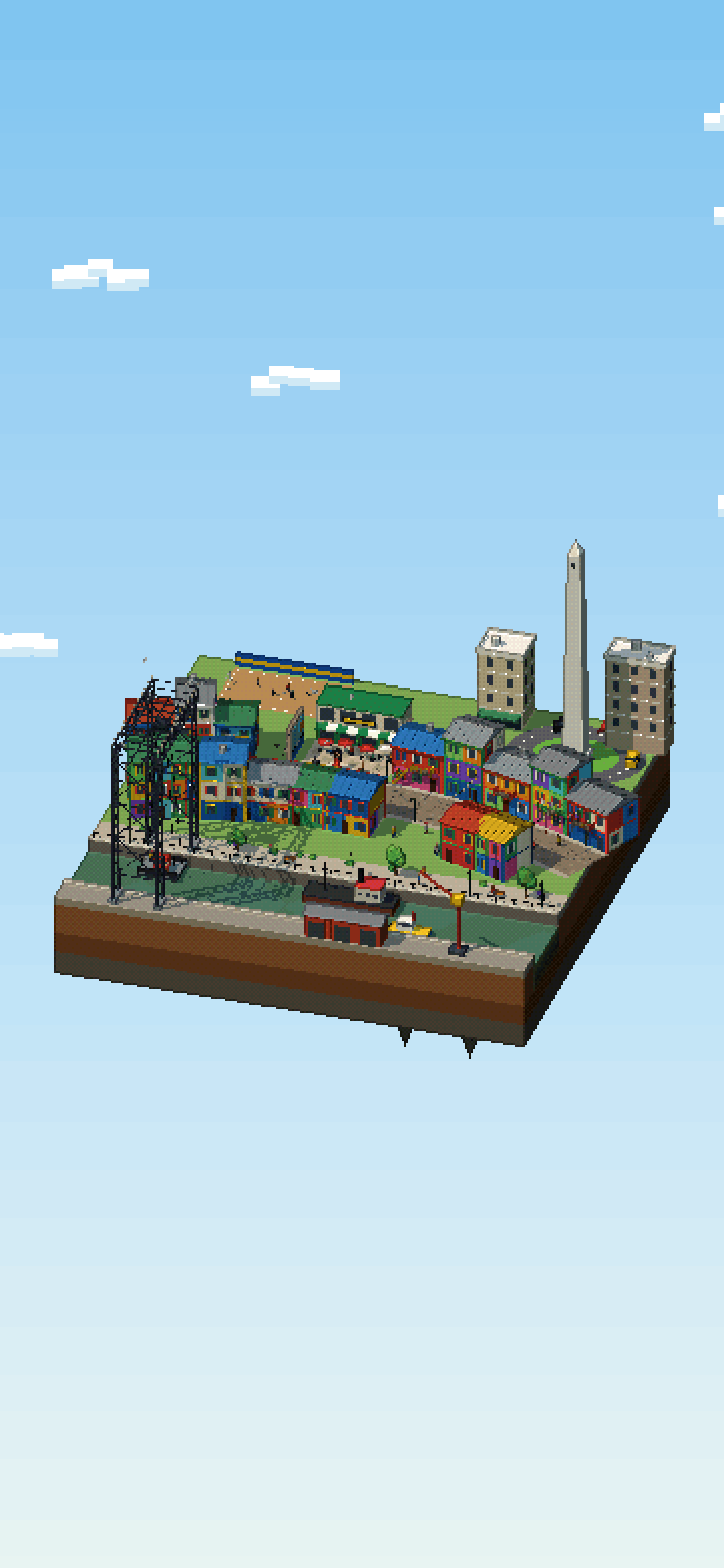
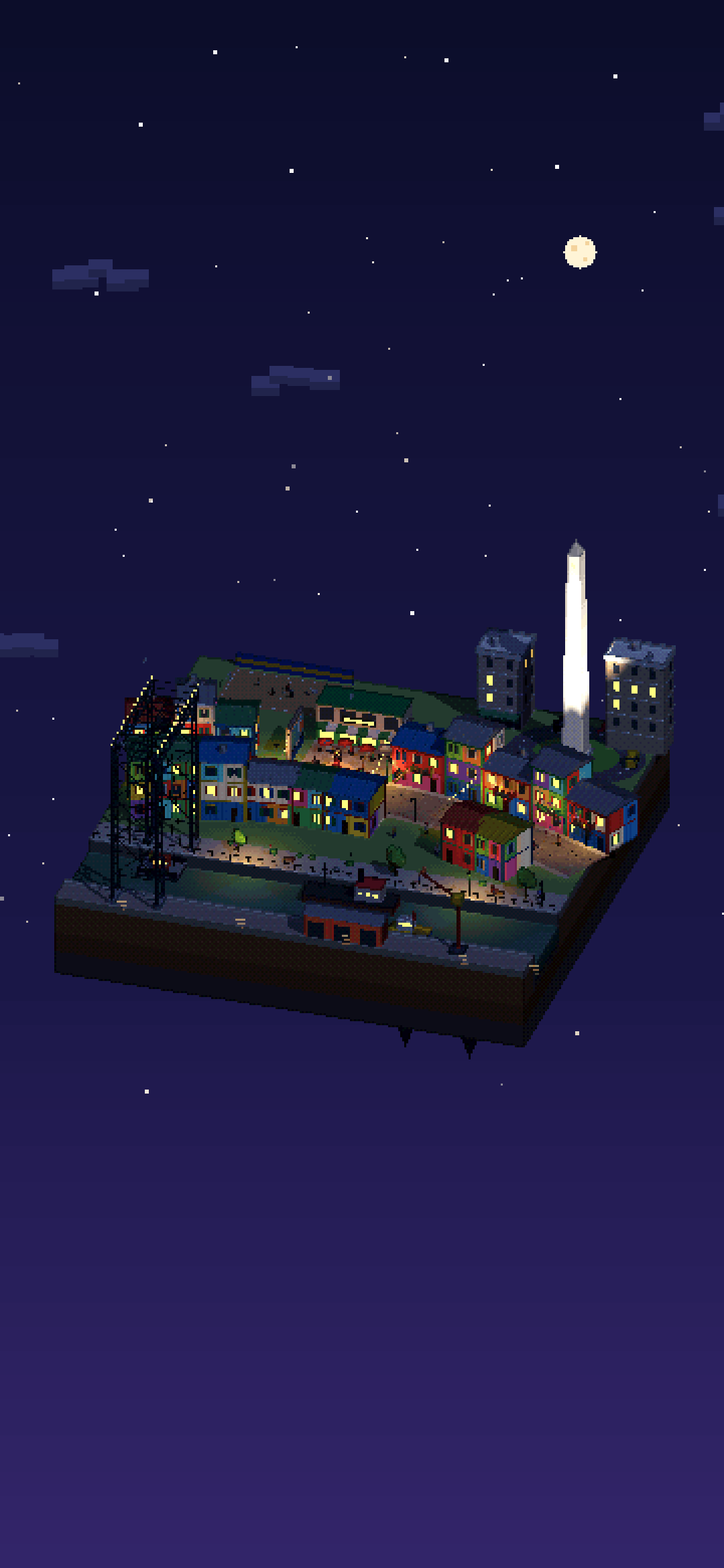
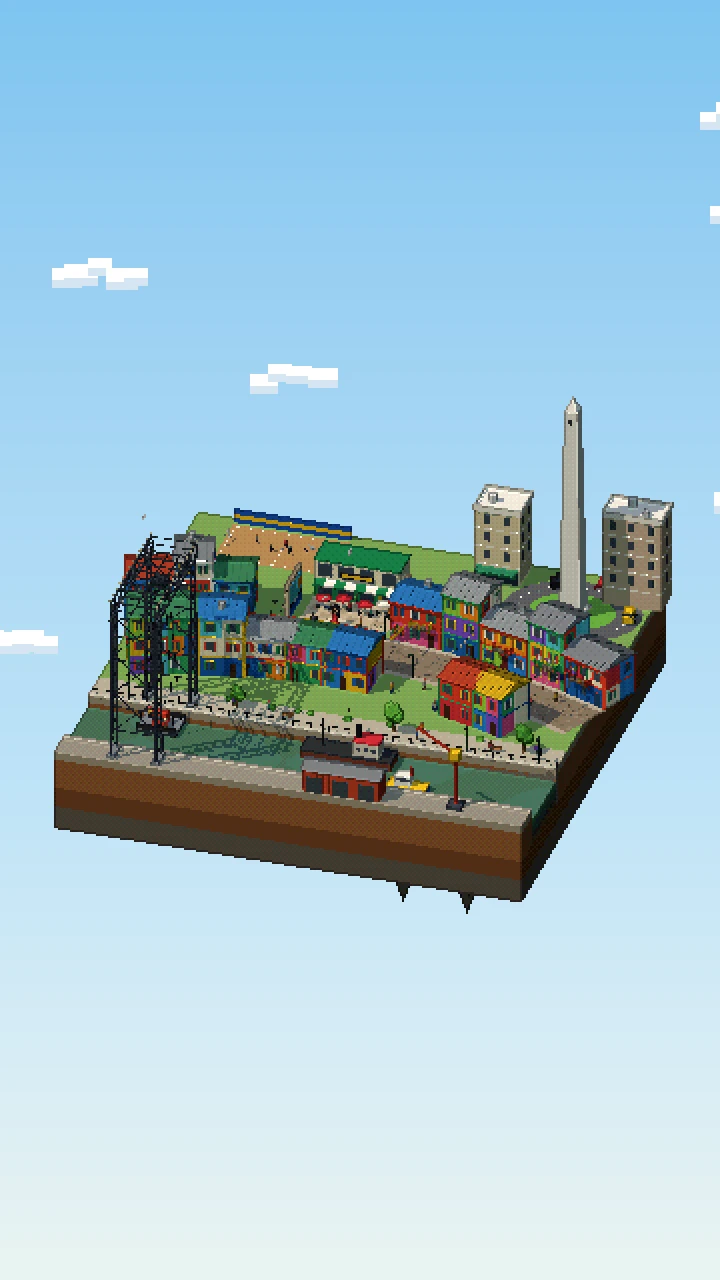
The diorama sets Caminito on a floating block cut through the Riachuelo, built in Three.js and rendered as pixel art: the scene is drawn at a low resolution, every edge gets a dark outline, the colours are reduced to a small palette, and the result is scaled up without smoothing. The curved cobbled lane is lined on both sides with two-storey conventillos whose chapa walls are pieced together from panels in yellow, blue, red, green and pink, with coloured shutters, iron balconies, outside stairs, laundry lines and figures leaning over the rails.
Halfway along, a small plaza opens on one side with a café, its tables under parasols, a bandoneón player and a tango couple turning on a ring of pale cobbles. Murals cover the side walls. On the river edge, a tug passes an old moored hulk and the gondola of the transporter bridge shuttles between its two steel towers. In the far corner the white Obelisco stands as a nod to the city centre. At night the farolas, string bulbs and windows come on, the Obelisco is floodlit and the tango goes on.
Things to spot
- The tango couple, she in red, he in a fedora
- A bandoneón player whose bellows breathe in and out
- The gondola of the transporter bridge crossing the Riachuelo
- Kids kicking a ball in front of a blue-and-yellow wall
- Laundry hanging across the lane
- Taxis circling the Obelisco
What we simplified
- The Obelisco is really about 4 km away in the city centre, and it is shown at roughly half scale; it is here only as a hint of Buenos Aires.
- The transporter bridge is compressed to fit a narrow river, and the houses are generic conventillos, not the actual buildings along the lane.
- The lane is drawn wider than the real one so the dancers and visitors read at pixel scale.
Questions
What is Caminito in Buenos Aires?
Caminito is a short, curved pedestrian lane in La Boca, lined with brightly painted houses of wood and corrugated iron. It was turned into an open-air street museum in 1959, led by the painter Benito Quinquela Martín, and is one of the most visited spots in Buenos Aires.
Why are the houses in La Boca so colourful?
The conventillos were built of wood and corrugated iron by immigrant port workers, many from around Genoa, and their walls were painted in many colours. Local tradition says the first coats were leftover paint from the boatyards. When Caminito became a street museum in 1959, Quinquela Martín helped choose and paint the facade colours.
Where does the name Caminito come from?
It comes from the 1926 tango Caminito, with music by Juan de Dios Filiberto, a son of La Boca, and lyrics by Gabino Coria Peñaloza. Quinquela Martín proposed the name when the lane became a street museum in 1959.
What is the big steel bridge near Caminito?
It is the Puente Transbordador Nicolás Avellaneda, a transporter bridge over the Riachuelo that opened in 1914. A gondola hanging from its high steel girder carried people and vehicles across the river. It was declared a National Historic Monument in 1999 and has since been restored.
How was this pixel-art diorama of Caminito made?
It is a real-time Three.js scene running on this page, drawn at 360 × 640 pixels with dark outlines and a small palette, then scaled up without smoothing. The lane, the patchwork houses, the tango couple and the transporter bridge are all modelled from simple shapes. Press “Explore in 3D” to drag it round and switch between day, dusk and night.
Isometric maps of Buenos Aires
Buenos Aires also has an isometric pixel-art map made by the community: the whole city drawn tile by tile in the same SimCity-like style. See the map of Buenos Aires →