About Gamla Stan
Gamla Stan, “the old town”, is where Stockholm began. Its core is the island of Stadsholmen, between Lake Mälaren and the Baltic, and the old town also takes in the small islets of Riddarholmen, Helgeandsholmen and Strömsborg. Stockholm first appears in writing in 1252, in letters linked to Birger Jarl, which is why that year is treated as the city’s founding date. The medieval street plan survives: long, curving lanes such as Västerlånggatan and Österlånggatan, and Mårten Trotzigs gränd, an alley less than a metre wide.
At the heart of it lies Stortorget, the oldest square in Stockholm. In November 1520 it was the scene of the Stockholm Bloodbath, when the Danish king Christian II had about ninety people executed over three days. Today it is known for its tall, narrow merchant houses in red, ochre and orange. The red one at No. 20, the Schantz house, has a stepped gable and 82 white stones set in its front in 1628. On the north side stands the Stock Exchange building of 1773–76, which houses the Swedish Academy and the Nobel Prize Museum.
Two churches rise over the rooftops. Storkyrkan, Stockholm’s cathedral and its oldest church, was first mentioned in 1279; its 60.4 m tower got a new spire in the 18th century, and inside stands the late-medieval sculpture of Saint George and the Dragon, unveiled in 1489. Crown Princess Victoria was married here in 2010. On Riddarholmen, the red-brick Riddarholmen Church, begun as a Franciscan friary church in the late 13th century, is the burial church of most Swedish monarchs. Its openwork cast-iron spire replaced one destroyed by lightning in 1835.
On the north shore stands the Royal Palace, built after the old Tre Kronor castle burned down in 1697. Nicodemus Tessin the Younger designed it as a square baroque block around a courtyard; Carl Hårleman finished much of it after Tessin’s death, and the royal family moved in in 1754. It has 1,430 rooms. Around 3,000 people still live in Gamla Stan, above the shops, cafés and, every December, the Christmas market on Stortorget.
The diorama
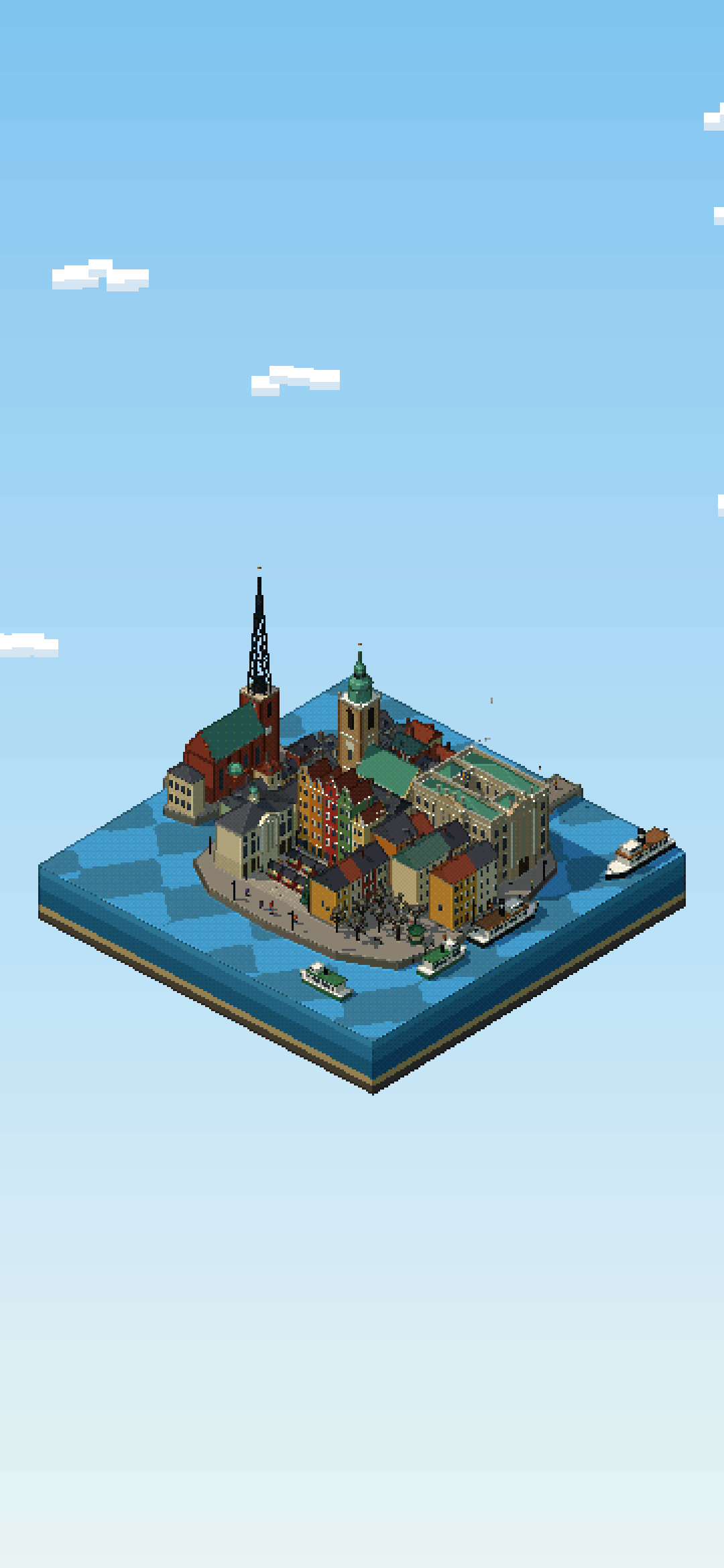
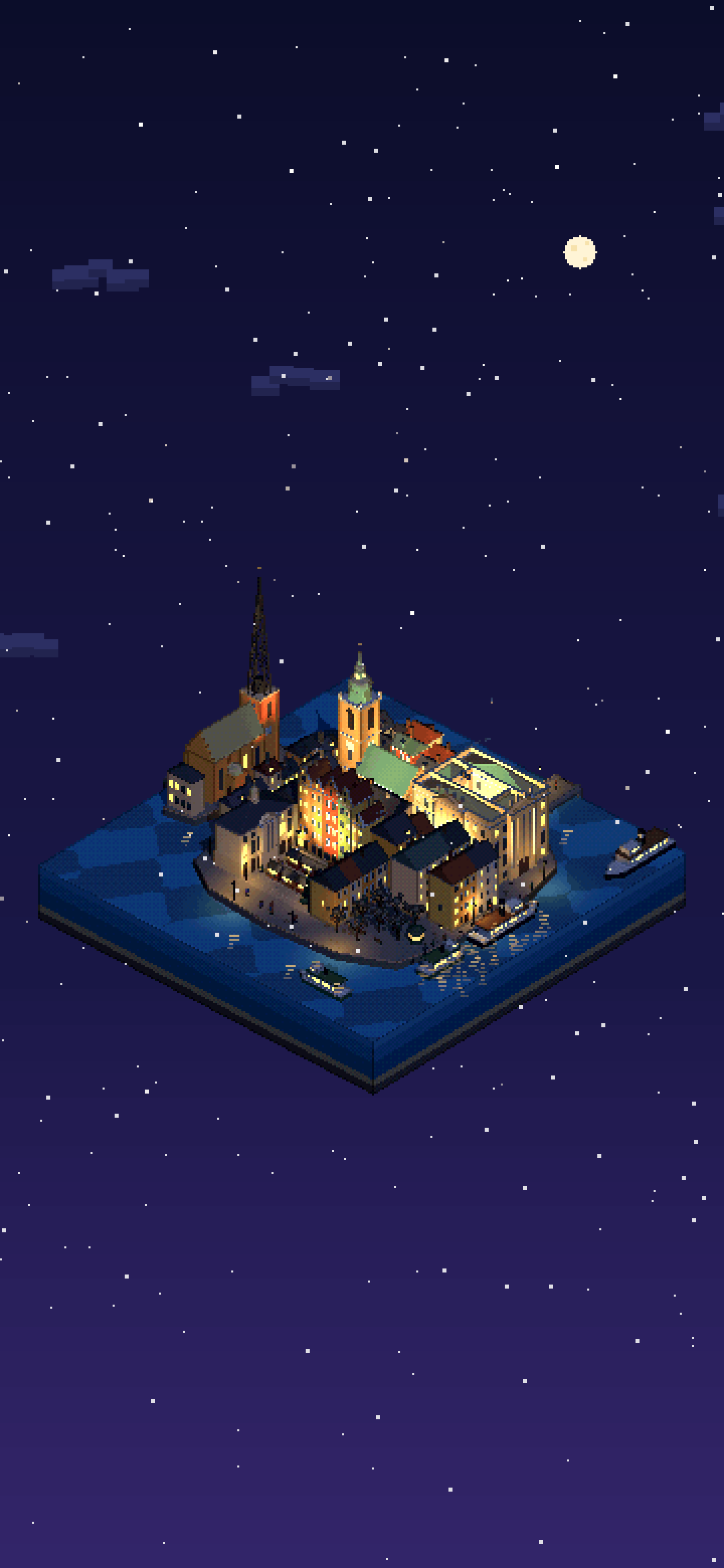
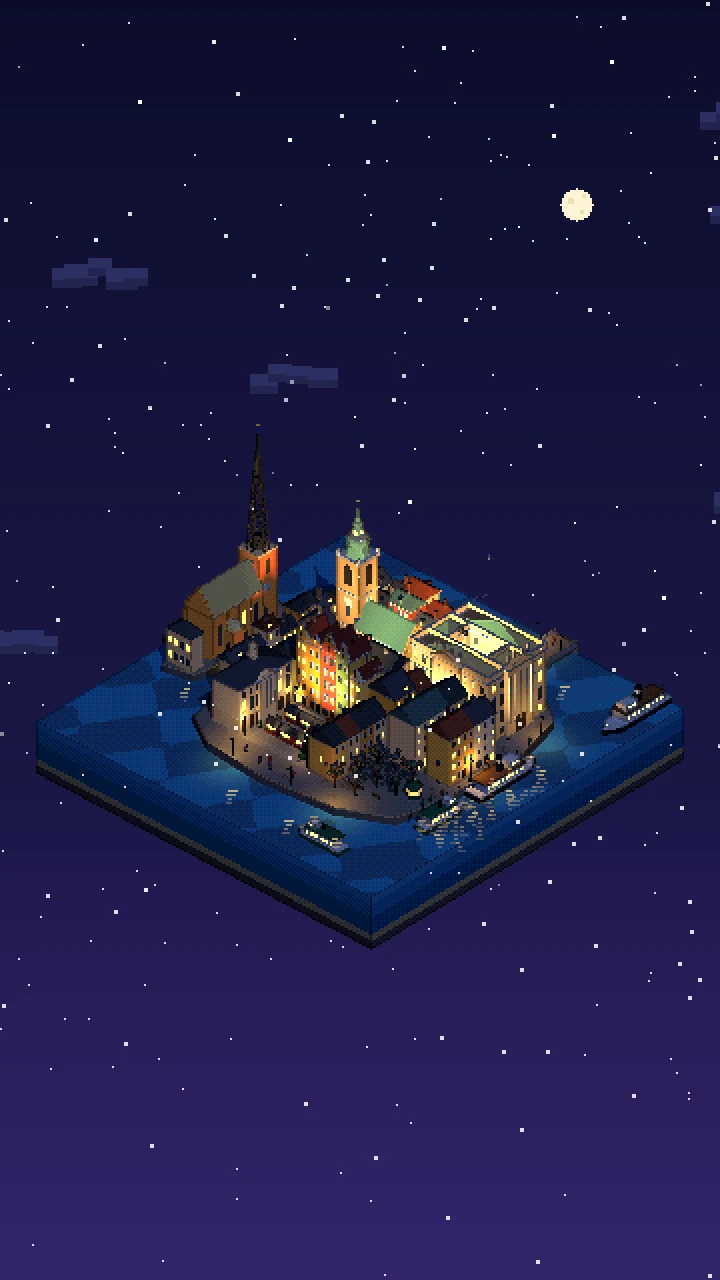
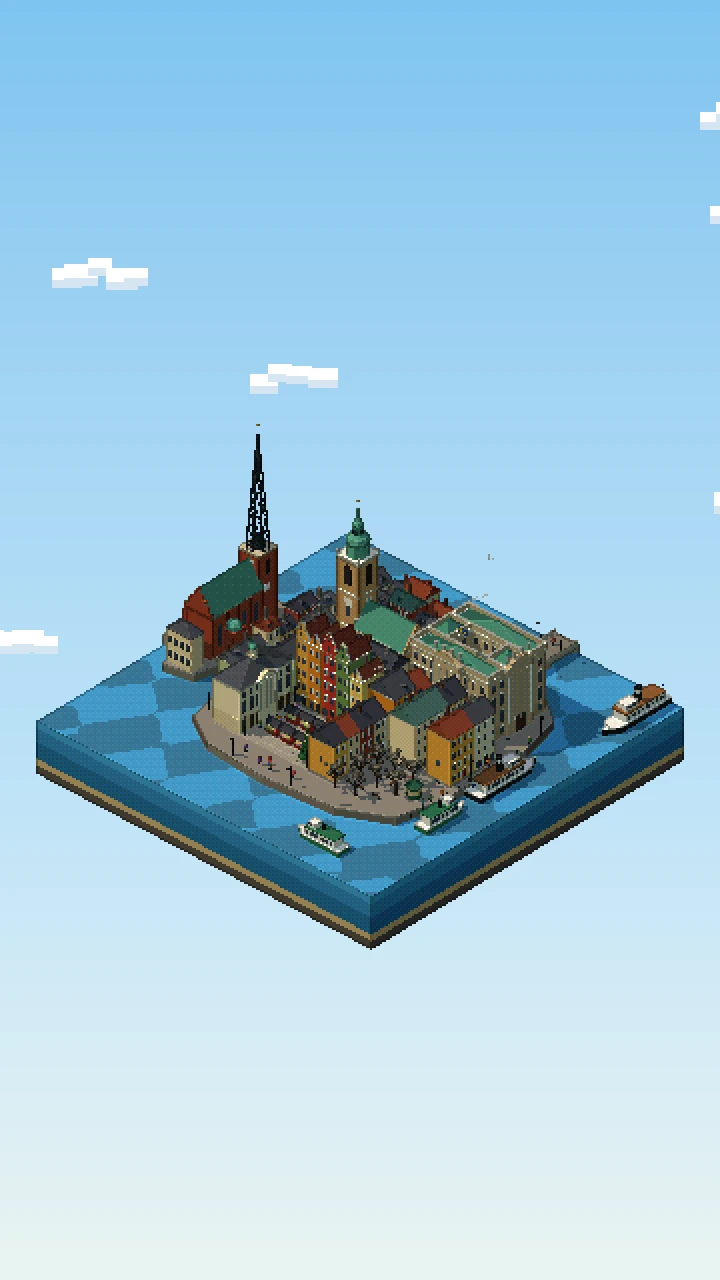
The diorama puts Gamla Stan on a floating block of water, built in Three.js and rendered as pixel art: the scene is drawn at a low resolution, every edge gets a dark outline, the colours are reduced to a small palette, and the result is scaled up without smoothing. Stortorget sits in the middle with its row of tall gabled houses in ochre, orange, red and green, the red Schantz house with its stepped gable and white stones, the Stock Exchange beside the square, the old well and a Christmas market of red huts around a lit tree.
Behind them rise the ochre tower of Storkyrkan with its copper lantern, the square Royal Palace around its courtyard with copper roofs and the Swedish flag, and, on its own islet across a narrow channel, Riddarholmen Church with its black openwork cast-iron spire. Steamers and ferries cross the water and two boats lie moored along the quay. When the light turns from day to golden hour to night, the windows come on, lamps light the cobbles, the reflections ripple on the water and a light snow starts to fall.
Things to spot
- The 82 white stones on the red Schantz house
- The black lattice of the Riddarholmen spire
- A lit Christmas tree among the market huts
- The Swedish flag on the Royal Palace
- An old archipelago steamer with its tall funnel
- Snow falling over the square at night
What we simplified
- The layout is rearranged so the famous row faces the open quay and stays in view; in reality it lines the west side of Stortorget, with the Stock Exchange on the north side.
- The Royal Palace and the two spires are scaled down so everything fits on one island, and the other houses are generic old-town buildings.
- Helgeandsholmen and most bridges are left out, and the water channels are idealised.
Questions
What is Gamla Stan?
Gamla Stan is the old town of Stockholm, the place where the city began. It consists mainly of the island of Stadsholmen, plus the islets Riddarholmen, Helgeandsholmen and Strömsborg, and keeps its medieval street plan of narrow, winding lanes.
How old is Gamla Stan?
Stockholm is first mentioned in writing in 1252, which is taken as the city’s founding year, and the town on Stadsholmen grew from the 13th century onwards. Storkyrkan, its oldest church, was first mentioned in 1279.
What are the colourful houses on Stortorget?
They are 17th- and 18th-century merchant houses on Stortorget, Stockholm’s oldest square. The red house at No. 20, known as the Schantz house, has a stepped gable and 82 white stones that were set in its front in 1628.
What happened on Stortorget in 1520?
In November 1520 Stortorget was the scene of the Stockholm Bloodbath, when the Danish king Christian II had about ninety people executed over three days.
How was this pixel-art diorama of Gamla Stan made?
It is a real-time Three.js scene running on this page, drawn at 360 × 640 pixels with dark outlines and a small palette, then scaled up without smoothing. It shows Stortorget with its gabled houses and Christmas market, Storkyrkan, the Royal Palace and Riddarholmen Church on a block of water. Press “Explore in 3D” to drag it round and switch between day, dusk and night.
Isometric maps of Stockholm
Stockholm also has an isometric pixel-art map made by the community: the whole city drawn tile by tile in the same SimCity-like style. See the map of Stockholm →