About Golden Gate Bridge
The Golden Gate Bridge crosses the strait between San Francisco Bay and the Pacific Ocean, linking the city to Marin County in the north. For a long time engineers thought a bridge there was impossible: the strait is deep, the currents are strong and the wind and fog come straight in from the ocean. Work finally began in January 1933 and the bridge opened to pedestrians on 27 May 1937, with cars following a day later.
Joseph Strauss was the chief engineer and the public face of the project, but much of the structural design was done by Charles Ellis, using the deflection theory of Leon Moisseiff. The architect Irving Morrow gave the towers their stepped Art Deco shape and chose the colour, International Orange, which stands out against the fog and blends with the hills. With a main span of 1,280 metres it was the longest suspension bridge in the world until 1964.
The two towers rise 227 metres above the water and carry two main cables, each almost a metre thick and made of tens of thousands of steel wires. At the San Francisco end, rather than demolish Fort Point, a brick fort completed in 1861, the designers added a steel arch that carries the roadway over it.
The bridge is famous for vanishing. In summer a thick sea fog pours in through the Golden Gate in the afternoons and hides the deck while the tops of the towers stick out above it; the fog has even been nicknamed Karl. The best-known viewpoints are Vista Point at the Marin end, the hills of the Marin Headlands and the shore by Fort Point.
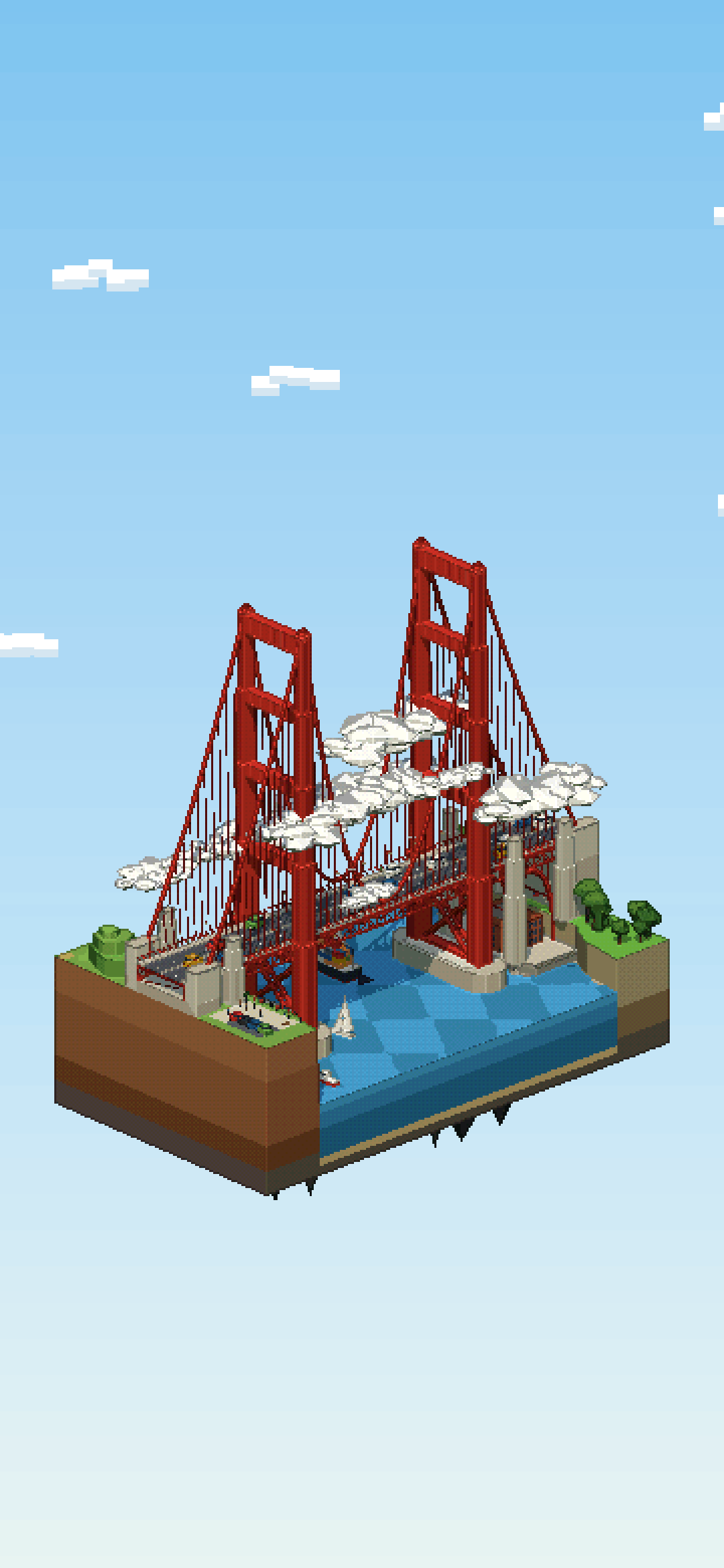
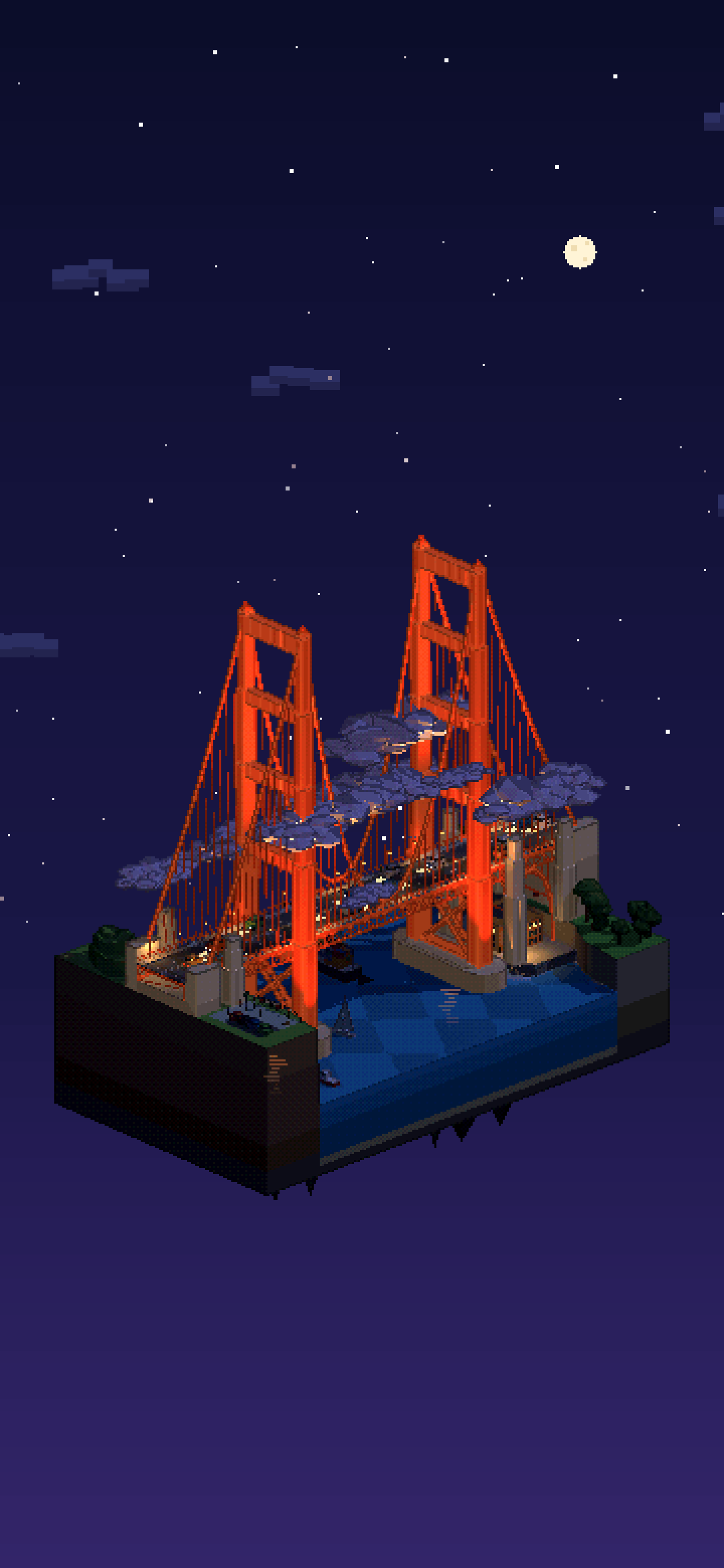
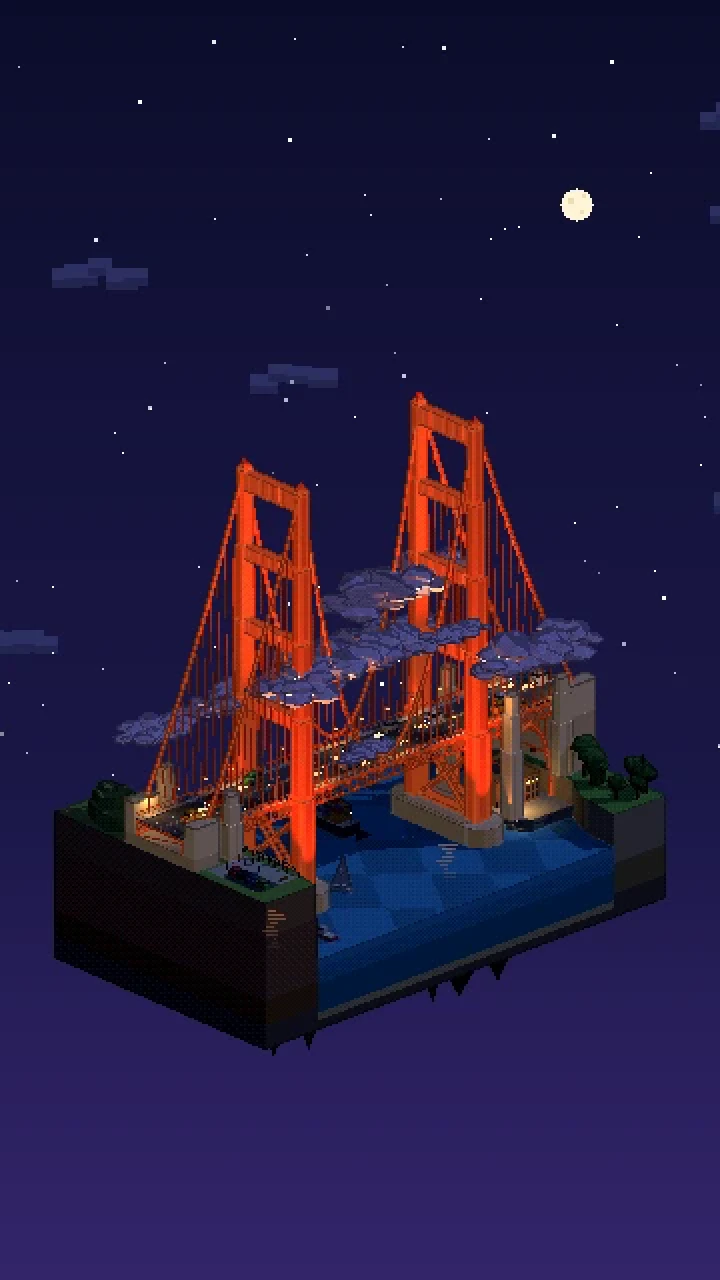
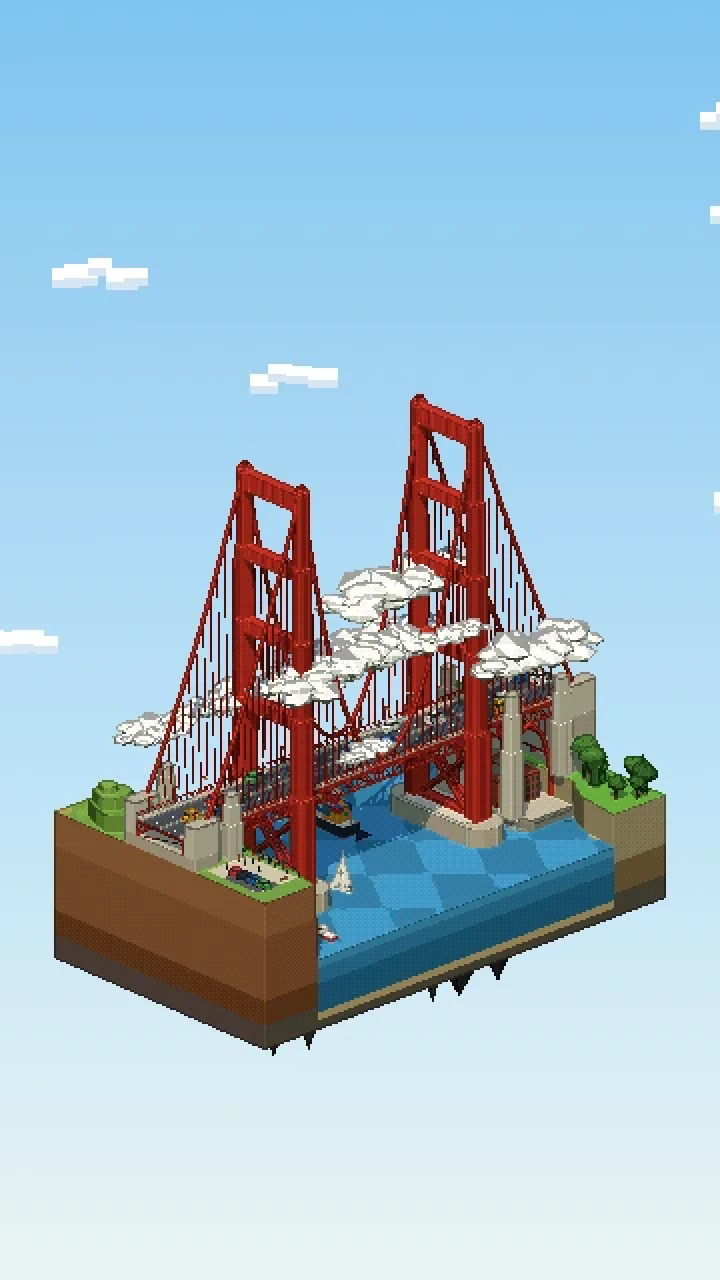
The diorama
The bridge in the diorama is compressed so the towers dominate: the main span is much shorter than in reality, but the towers keep their proportions. Each tower is a stack of portal frames with fluted panels, four struts above the deck and cross bracing below it, and the legs step in as they rise to a stepped crown with red aviation lights. The deck has stiffening trusses on both sides, a railing, a row of lamp standards and traffic in both directions, and the two main cables sag between the towers on vertical suspenders down to the anchorages.
The north end lands on the reddish cliffs of the Marin Headlands, with Hawk Hill and the Vista Point car park full of people taking photos. The south end vaults over Fort Point on its steel arch, below the cypress-covered bluff of the Presidio. Banks of fog roll through the Gate between the towers. At night the towers are floodlit orange, the lamps on the deck glow amber and the cars carry their headlights across.
Things to spot
- A container ship sailing in under the main span
- Sailboats and a tug in the bay
- Fort Point, with its little lighthouse and flag, under the arch
- Tourists holding up their phones at Vista Point
- Fog banks drifting between the towers
- Red aviation lights on top of the towers
What we simplified
- The main span and the side spans are shortened a lot, so the towers look much closer together than they are.
- The Marin Headlands and the Presidio are reduced to two small blocks of cliff, and the city of San Francisco itself is not shown.
Questions
How long is the Golden Gate Bridge?
The Golden Gate Bridge is 2,737 metres long in total. Its main span of 1,280 metres was the longest in the world until 1964.
When was the Golden Gate Bridge built?
Work on the Golden Gate Bridge began in January 1933, and the bridge opened to pedestrians on 27 May 1937, with cars following a day later.
Who designed the Golden Gate Bridge?
Joseph Strauss was the chief engineer, but much of the structural design was done by Charles Ellis, using the deflection theory of Leon Moisseiff. The architect Irving Morrow gave the towers their stepped Art Deco shape.
Why is the Golden Gate Bridge orange?
The colour, International Orange, was chosen by the architect Irving Morrow because it stands out against the fog and blends with the hills.
Can I turn the Golden Gate Bridge diorama around?
Yes. It is a real-time Three.js scene running on this page, drawn at 360 × 640 pixels with dark outlines and a small palette, then scaled up without smoothing. Press “Explore in 3D” to drag it round and switch between day, dusk and night.
Isometric maps of San Francisco
San Francisco also has 4 isometric pixel-art maps made by the community: the whole city drawn tile by tile in the same SimCity-like style. See the maps of San Francisco →