About Space Needle
The Space Needle was built for the 1962 World’s Fair, the Century 21 Exposition, as a symbol of the space age. Work started in April 1961 and the tower opened on 21 April 1962, the fair’s first day, after about 400 days of construction. It cost $4.5 million. Hotel executive Edward E. Carlson made the first sketch in 1959; John Graham proposed the flying-saucer top, and Victor Steinbrueck gave it the slim hourglass shape on three pairs of legs.
The tower rises 605 feet (184 metres) to the top of its spire. Below ground, a foundation 30 feet deep and 120 feet across keeps its centre of gravity low, and the structure was designed for winds of 200 miles per hour. Three elevators run up the central core to the observation deck at 520 feet in about 43 seconds; on foot, it is 848 steps.
The top house was a revolving restaurant for more than fifty years, from the Eye of the Needle in 1962 to SkyCity, which closed in 2017. A renovation known as the Century Project then opened the top up with floor-to-ceiling glass, outdoor glass walls and, in August 2018, the Loupe: the world’s first revolving glass floor, about 500 feet up.
In 1962 the tower wore Astronaut White, Orbital Olive, Re-entry Red and Galaxy Gold; for its 50th birthday in 2012 the roof was painted Galaxy Gold again. Seattle made it a city landmark in 1999. At its foot lies Seattle Center, the old fairground, with the Monorail, the International Fountain, Chihuly Garden and Glass and Frank Gehry’s Museum of Pop Culture.
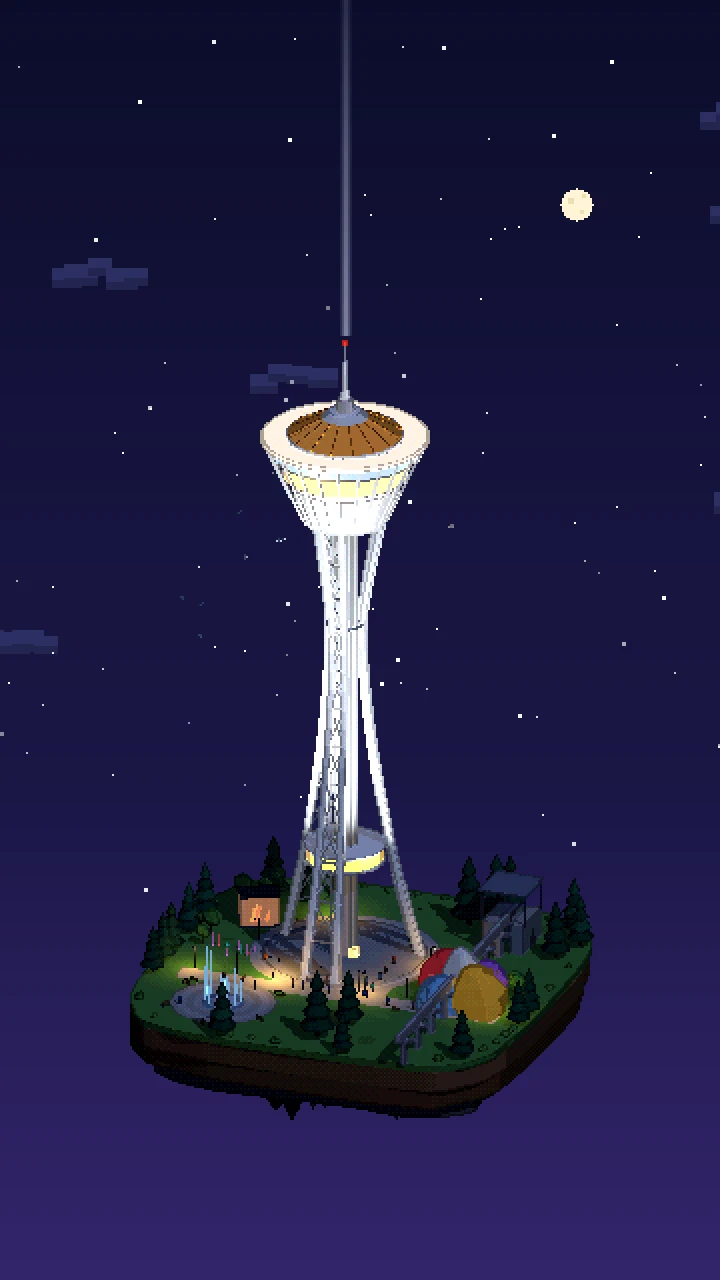
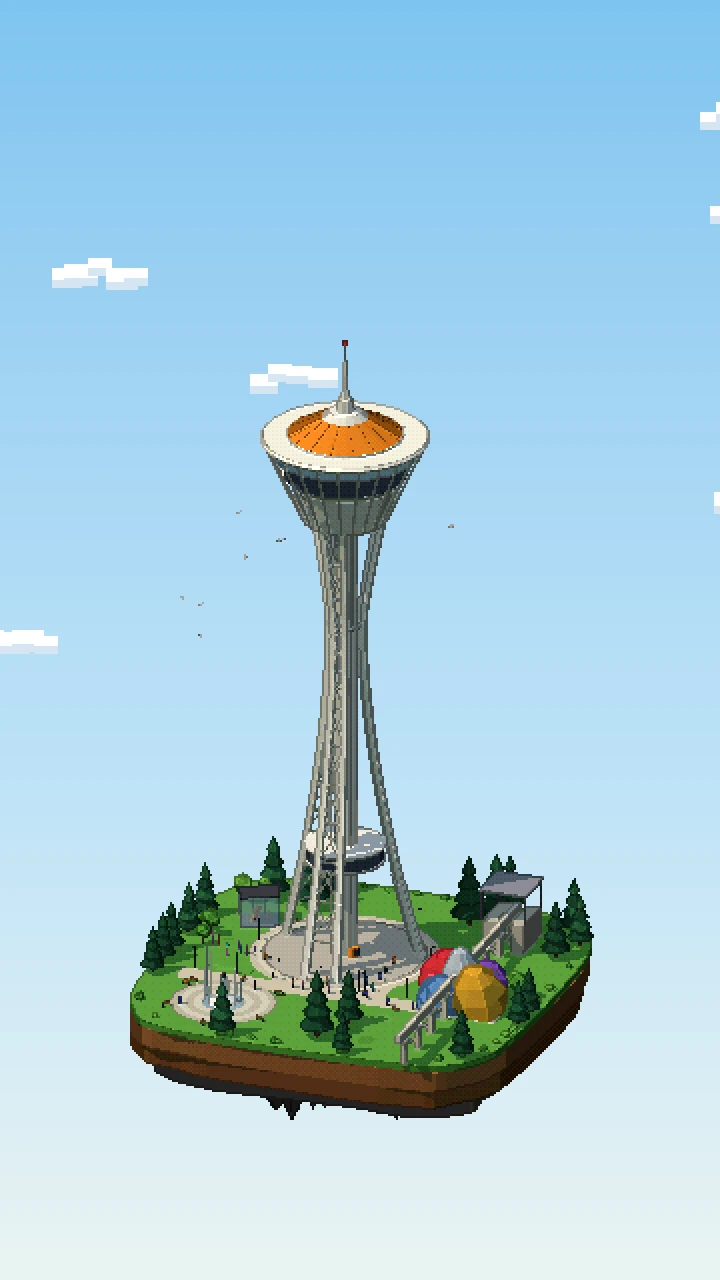
The diorama
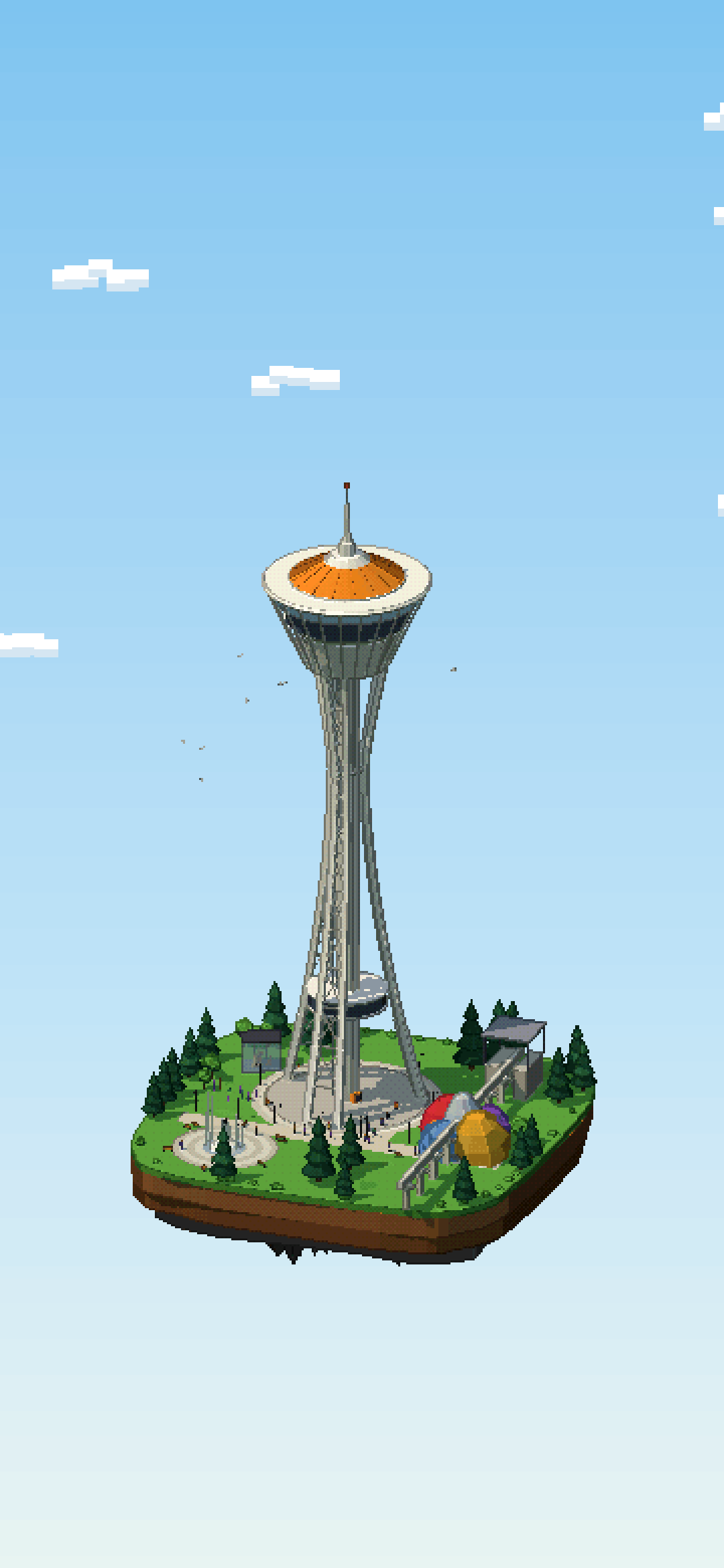
The diorama puts the Space Needle on a floating island of Seattle Center, built in Three.js and rendered as pixel art: the scene is drawn at a low resolution, every edge gets a dark outline, the colours are reduced to a small palette, and the result is scaled up without smoothing. The tower follows its real profile: three pairs of white steel legs that pinch to a waist and flare out again, the central core with an elevator cab riding up and down, the small ring at the 100-foot level, the saucer with its glass levels, the halo and the Galaxy Gold roof, and the spire with its beacon.
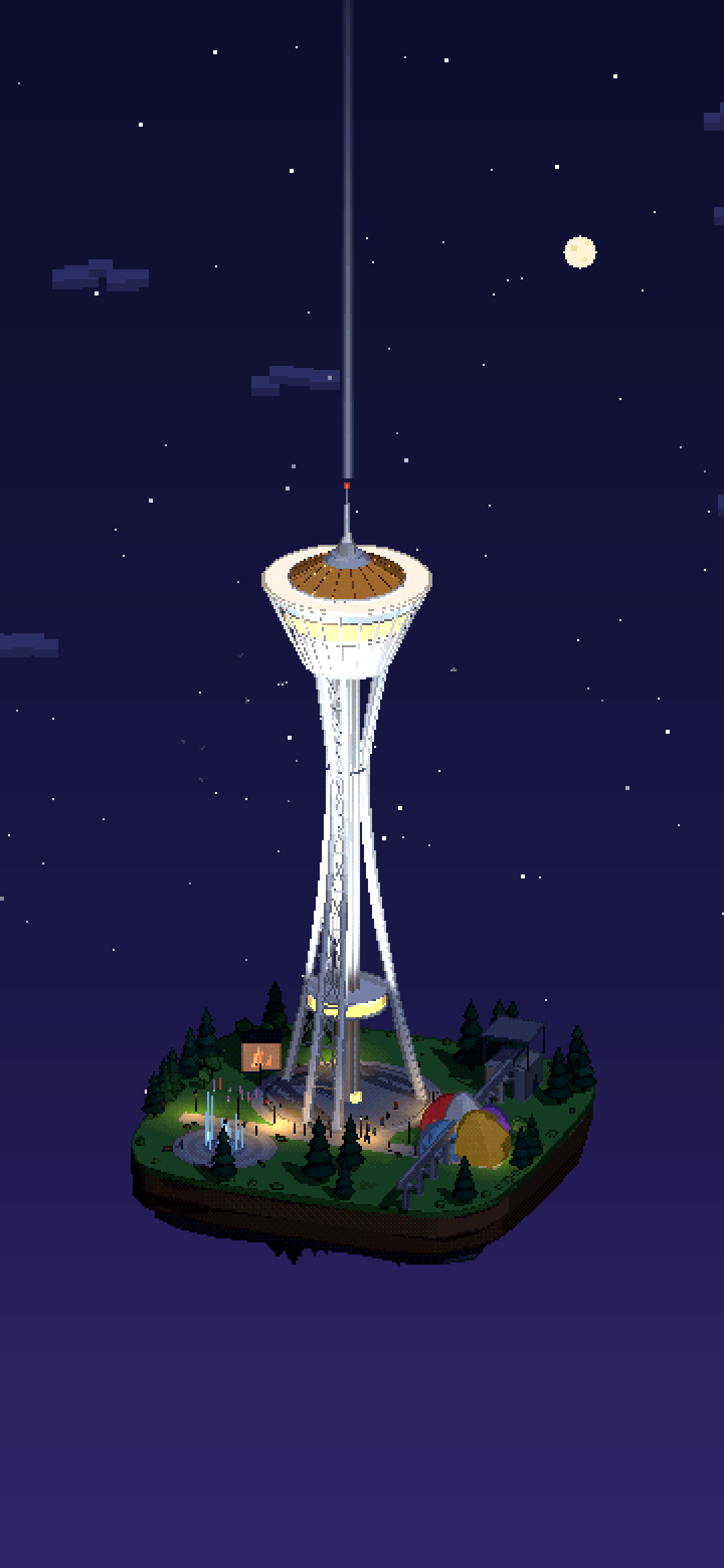
At its foot, MoPOP’s crumpled red, purple, gold, silver and blue shapes sit astride the Monorail beam, and a two-tone train glides in to the station and out again. The International Fountain plays in its bowl around a white dome, Douglas firs fill the lawns, and a glasshouse glows with orange glass. Midway through, a Seattle shower rolls in; at night the halo and top house light up, the legs are floodlit, the beacon blinks and a beam of light rises from the spire.
Things to spot
- The Monorail running right through MoPOP
- An elevator cab climbing the core
- The dancing jets of the International Fountain
- Umbrellas coming out when the rain starts
- The blinking red beacon on top of the spire
- Gulls circling the saucer
What we simplified
- Seattle Center is squeezed together: MoPOP, the fountain and the glasshouse sit much closer to the tower than in reality, and the Monorail beam is shortened to a straight stub.
- The top house is simplified to a few rings of glass and steel, and the halo and legs are drawn slightly bolder than real so they read at pixel size.
- The beam of light from the spire stands in for the Legacy Light, which in reality is switched on only on a few nights a year.
Questions
How tall is the Space Needle?
The Space Needle is 605 feet (184 metres) tall to the top of its spire. The observation deck is at 520 feet (160 metres), and the Loupe, with its revolving glass floor, is at about 500 feet.
When was the Space Needle built?
Construction started in April 1961 and the Space Needle opened on 21 April 1962, the first day of the Century 21 Exposition, the Seattle World’s Fair. It took about 400 days to build and cost $4.5 million.
Does the top of the Space Needle rotate?
Yes. The Loupe, opened in August 2018, is the world’s first revolving glass floor, turning slowly about 500 feet above the ground. For decades before that, the top house held a revolving restaurant.
What colour is the Space Needle’s roof?
The roof is Galaxy Gold, an orange tone from the tower’s original 1962 colour scheme of Astronaut White, Orbital Olive, Re-entry Red and Galaxy Gold. It was repainted in Galaxy Gold for the 50th anniversary in 2012.
How was this pixel-art diorama of the Space Needle made?
It is a real-time Three.js scene running on this page, drawn at 360 × 640 pixels with dark outlines and a small palette, then scaled up without smoothing. The tower follows its real hourglass profile, with three pairs of legs, the saucer, the halo and the spire. Press “Explore in 3D” to drag it round and switch between day, dusk and night.
Isometric maps of Seattle
Seattle also has an isometric pixel-art map made by the community: the whole city drawn tile by tile in the same SimCity-like style. See the map of Seattle →