About Hollywood Boulevard
The stretch of Hollywood Boulevard between Orange Drive and Highland Avenue is the busiest block of the Hollywood Walk of Fame. The Walk runs for fifteen blocks along the boulevard, from Gower Street to La Brea Avenue, and three blocks along Vine Street. Each star is a five-pointed, coral-pink terrazzo star rimmed in brass, set in a charcoal terrazzo square, with the honoree’s name in brass letters and an emblem for their field: a film camera, a television set, a record, a radio microphone, theatre masks and, since 2023, a trophy for sports entertainment. The first permanent star was set on 28 March 1960, and today there are more than 2,850. The Hollywood Chamber of Commerce chooses the honorees each year.
On the north side of the block stands the TCL Chinese Theatre, opened as Grauman’s Chinese Theatre on 18 May 1927 with the premiere of Cecil B. DeMille’s The King of Kings. Its principal architect was Raymond M. Kennedy of Meyer & Holler, and its 90-foot (27 m) pagoda front, with two huge coral-red columns, a bronze roof turned green and a 30-foot stone dragon on the wall between the columns, is one of the most famous cinema fronts in the world. The forecourt holds nearly 200 sets of handprints, footprints and autographs in concrete; the first were Mary Pickford and Douglas Fairbanks, on 30 April 1927.
Next door is Ovation Hollywood, the shopping and entertainment complex that opened as Hollywood & Highland, with the Dolby Theatre inside. It opened on 9 November 2001 as the Kodak Theatre, was designed by David Rockwell with the Academy Awards in mind, and has hosted the Oscars since 2002; Art Deco columns along the hall to its grand stairway list every Best Picture winner. For years its Babylon Court recreated the gate from D. W. Griffith’s 1916 film Intolerance, with white elephants on top of its columns, until the elephants were taken down in 2021 during the renovation that turned the complex into Ovation Hollywood.
Across the street is the El Capitan Theatre, which opened on 3 May 1926 as a live theatre, hosted the world premiere of Citizen Kane in 1941 and reopened as a Disney cinema in 1991, with its bulb marquee and tall vertical sign. Beside it, the old Hollywood Masonic Temple of 1921 became the studio of Jimmy Kimmel Live!, which started there in 2003. On a clear day the Hollywood Sign looks down on all of it from Mount Lee, in the hills to the north.
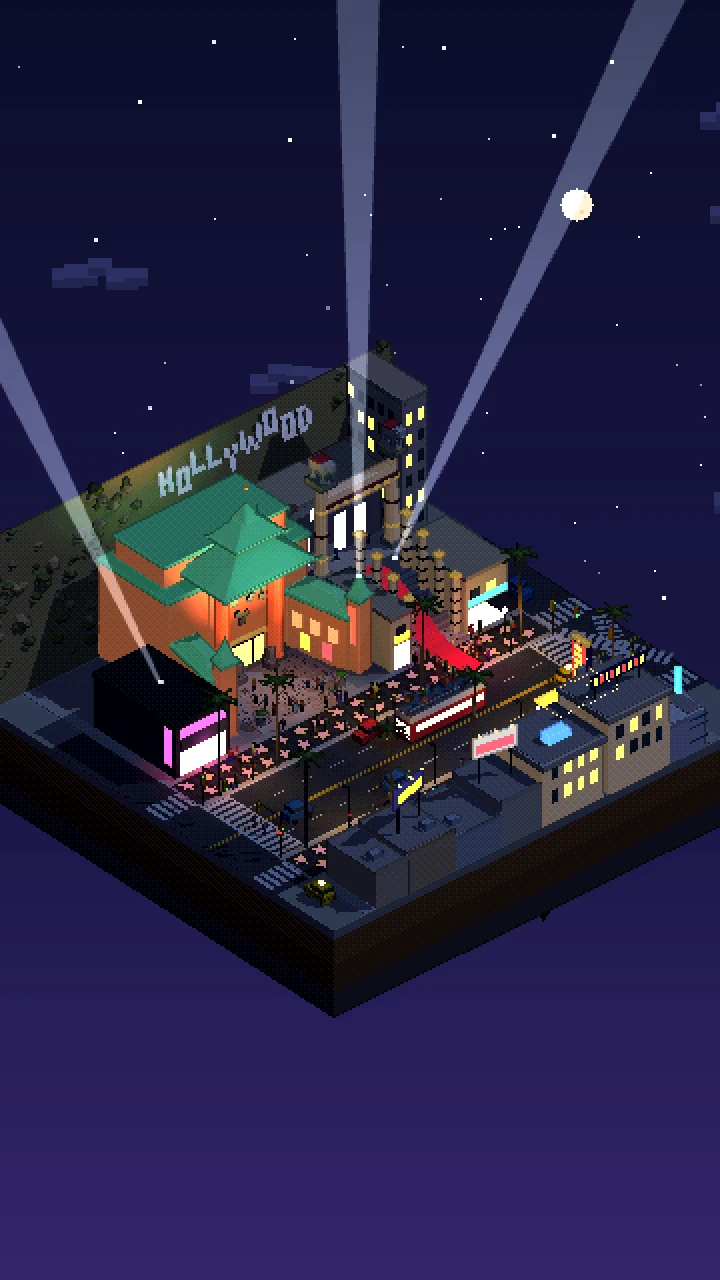
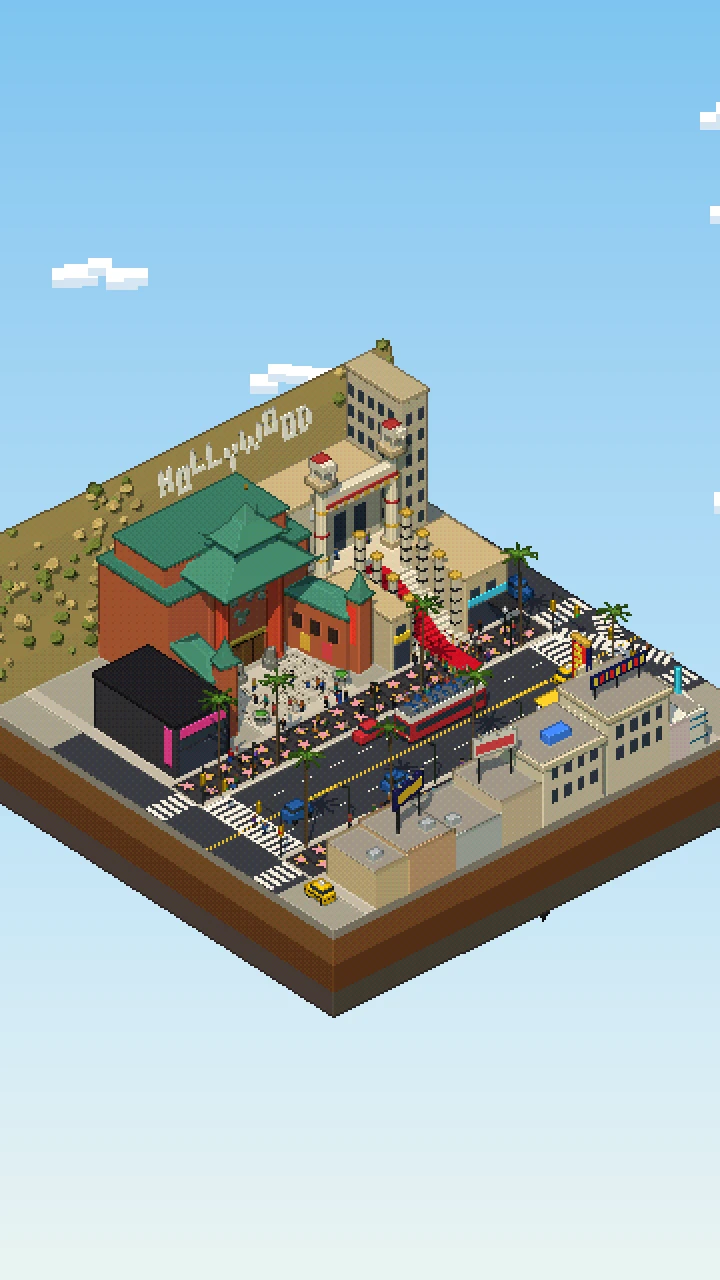
The diorama
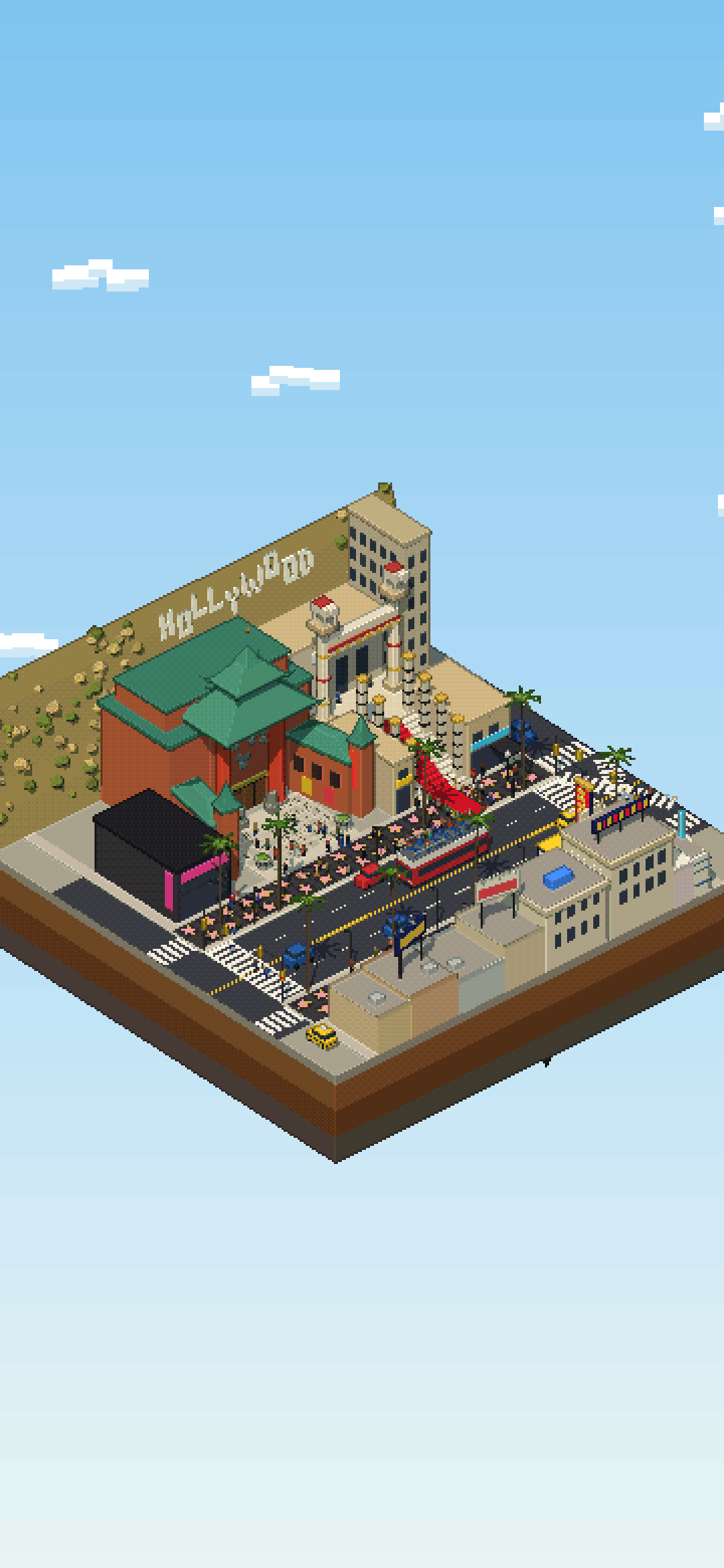
The diorama turns the block into a floating island, built in Three.js and rendered as pixel art: the scene is drawn at a low resolution, every edge gets a dark outline, the colours are reduced to a small palette, and the result is scaled up without smoothing. Both pavements carry the Walk of Fame, charcoal strips with two staggered rows of pink stars rimmed in brass. On the north side, from Orange Drive, come Madame Tussauds, then the Chinese Theatre with its coral-red columns, the green, square-cut pagoda roof, the stone dragon, the two stone Heaven Dogs at the doors and the forecourt of handprint slabs, then the grand stairs up to the Dolby with a red carpet, the Best Picture columns, the Babylon gate with its elephants and the hotel tower behind.
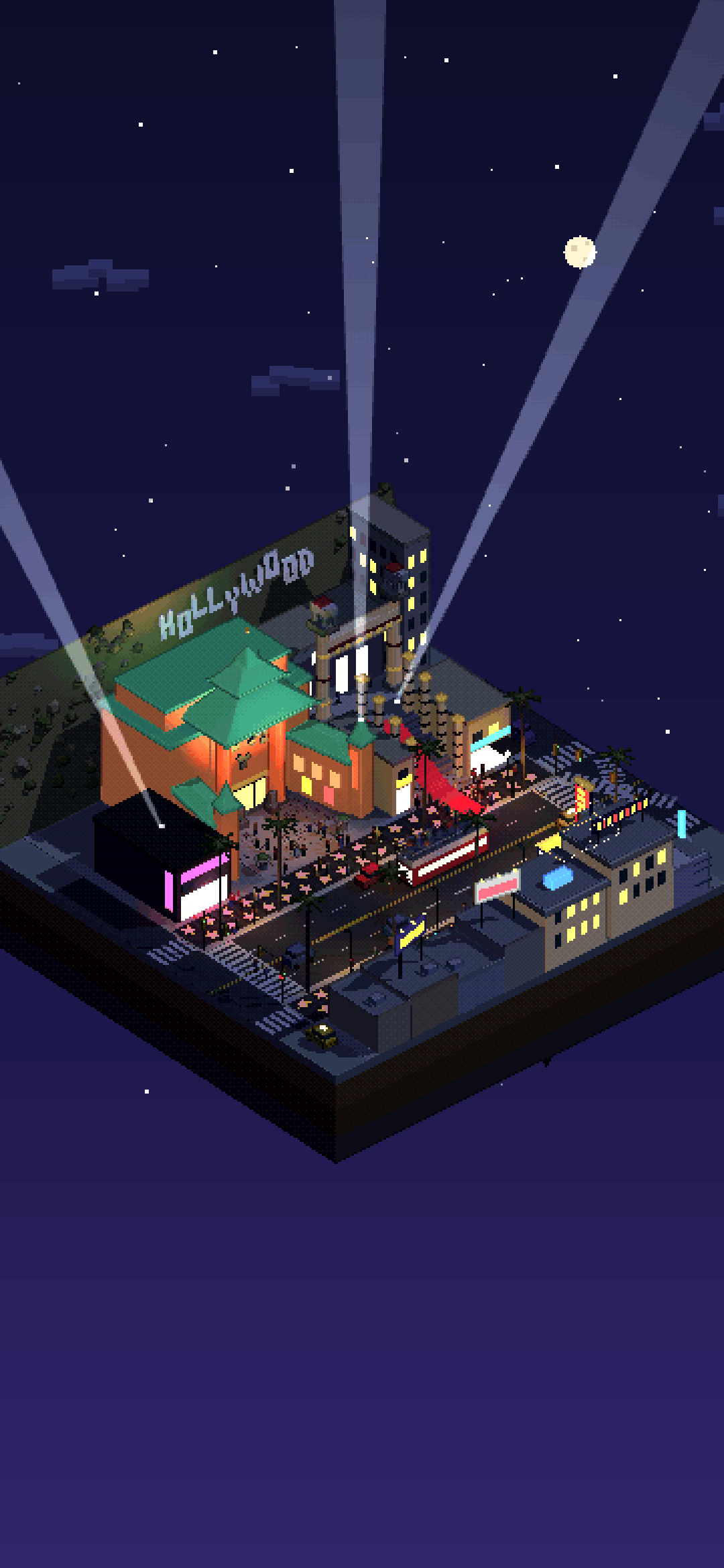
On the south side stand souvenir shops with neon blade signs and rooftop billboards, the columned Masonic Temple, the El Capitan with its marquee, vertical sign and roof sign, and a streamline drugstore at the Highland corner, with a diagonal scramble crossing in front. Yellow cabs and an open-top tour bus roll down the boulevard, and behind the block the dry Hollywood Hills rise with a small Hollywood Sign on the slope. At golden hour a warm haze settles over the street; on premiere night the neon comes on, the marquee bulbs chase and searchlights sweep the sky.
Things to spot
- Costumed performers posing for photos: Spider-Man, Superman, Marilyn, Darth Vader and a pirate captain
- Tourists crouching to photograph a star on the pavement
- People kneeling at the handprints in the Chinese Theatre forecourt
- A couple posing on the red carpet halfway up the stairs
- The open-top double-decker tour bus
- Searchlights sweeping the sky on premiere night
What we simplified
- The block is about 300 metres long in reality; here it is compressed and the buildings are shortened so everything fits on one island.
- The Hollywood Sign is moved much closer: in reality it stands on Mount Lee, a few kilometres north of the boulevard, not on a hill right behind the block.
- The stars are drawn larger than life and in neat rows so they read as pixels.
- The Babylon gate keeps its elephants, which were removed in 2021, and the Best Picture columns are moved out onto the grand stairs.
- The south-side buildings face away from the camera, so they are kept low and their roofs, signs and marquee carry the colour.
Questions
How many stars are on the Hollywood Walk of Fame?
There are more than 2,850 stars on the Hollywood Walk of Fame: 2,857 as of September 2026, and new ones are added every year. They run along fifteen blocks of Hollywood Boulevard and three blocks of Vine Street.
When did the Chinese Theatre open?
Grauman’s Chinese Theatre, now the TCL Chinese Theatre, opened on 18 May 1927 with the premiere of Cecil B. DeMille’s The King of Kings. The first handprints in its forecourt, by Mary Pickford and Douglas Fairbanks, were made on 30 April 1927.
Where are the Oscars held?
The Academy Awards are held at the Dolby Theatre on Hollywood Boulevard, inside the Ovation Hollywood complex at the corner of Highland Avenue. It opened as the Kodak Theatre in 2001 and has hosted the Oscars since 2002.
Can you see the Hollywood Sign from Hollywood Boulevard?
Yes, on a clear day you can see it in the hills to the north, but it is a few kilometres away on Mount Lee, so it looks small. In the diorama it is moved much closer.
How was this pixel-art diorama of Hollywood Boulevard made?
It is a real-time Three.js scene running on this page, drawn at 360 × 640 pixels with dark outlines and a small palette, then scaled up without smoothing. The Chinese Theatre, the Dolby stairs and the El Capitan are built from code, and at night the neon, the chasing marquee bulbs and the searchlights switch on. Press “Explore in 3D” to drag it round and switch between day, dusk and night.
Isometric maps of Los Angeles
Los Angeles also has an isometric pixel-art map made by the community: the whole city drawn tile by tile in the same SimCity-like style. See the map of Los Angeles →