About Grand Canyon
The Grand Canyon is a gorge in northern Arizona carved by the Colorado River. It runs for about 446 km, is up to 29 km wide and is more than 1.8 km deep at its deepest. The river set its course through the area about 5 to 6 million years ago, and it has been cutting down into the rising Colorado Plateau ever since, while rain, frost and side streams widened the canyon into the maze of cliffs, slopes and side canyons seen today.
What makes the view famous is the rock. The walls are a stack of layers, each laid down in a different ancient world: the pale Kaibab Limestone on the rim is about 270 million years old, the white Coconino Sandstone below it is made of old wind-blown dunes, the Redwall Limestone forms a huge red-stained cliff, and at the bottom of the inner gorge lies the dark Vishnu Schist, close to 2 billion years old. Because the softer layers erode into slopes and the hard ones into cliffs, the walls step down like a staircase.
Most visitors see the canyon from the South Rim. Mather Point, near the main visitor centre, is the classic first view; it is named after Stephen Mather, the first director of the National Park Service. Further east, the Desert View Watchtower is a round stone tower about 70 feet (21 m) tall, designed by the architect Mary Colter and finished in 1932. The Bright Angel Trail switchbacks down from Grand Canyon Village, and mules have long carried riders and supplies to Phantom Ranch, the lodge Colter designed by the river in 1922.
The area became a national monument in 1908 and Grand Canyon National Park on 26 February 1919. UNESCO listed it as a World Heritage Site in 1979, among the first natural sites on the list. In 2019 the park was certified as an International Dark Sky Park after most of its lights were replaced with night-sky-friendly fittings. California condors, released in northern Arizona from 1996 onwards, now soar over the canyon again.
The diorama
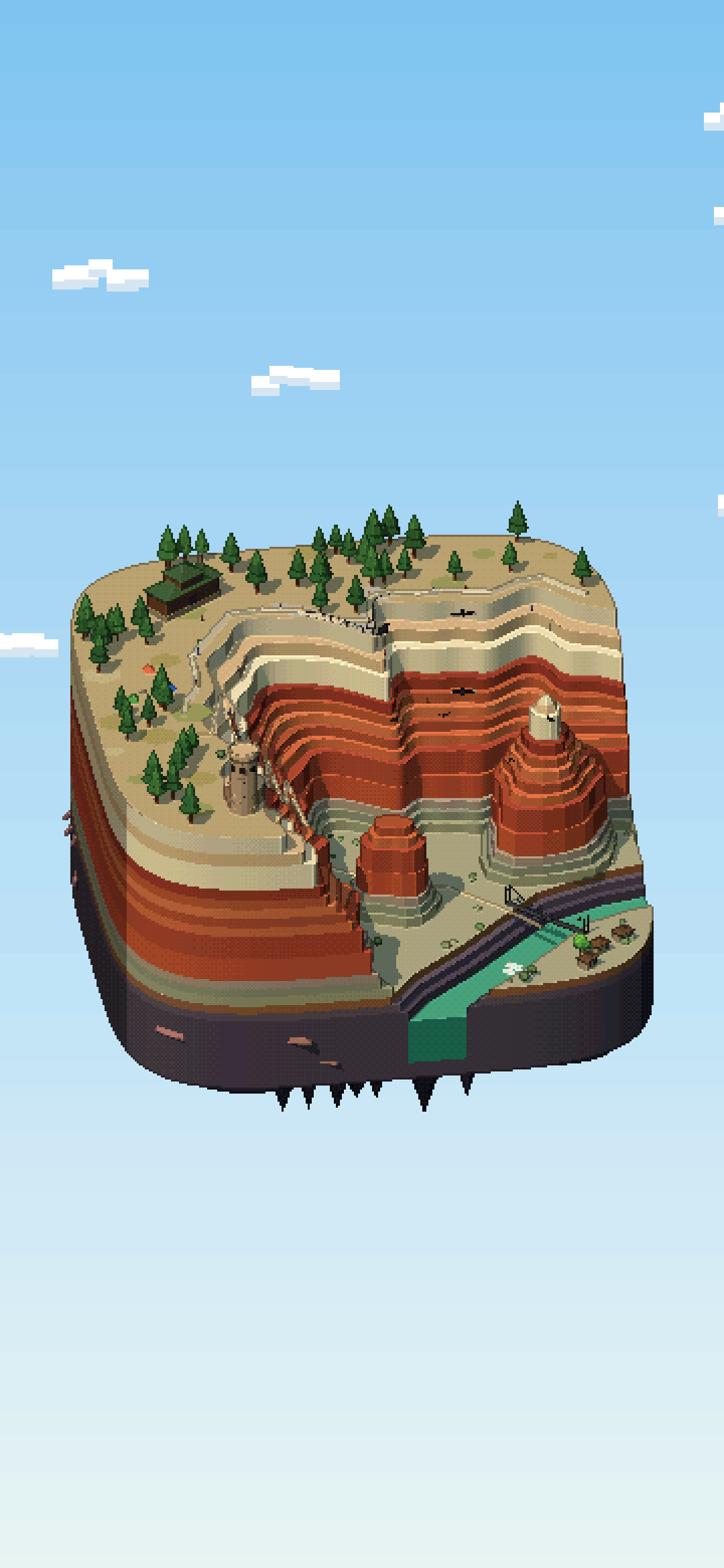
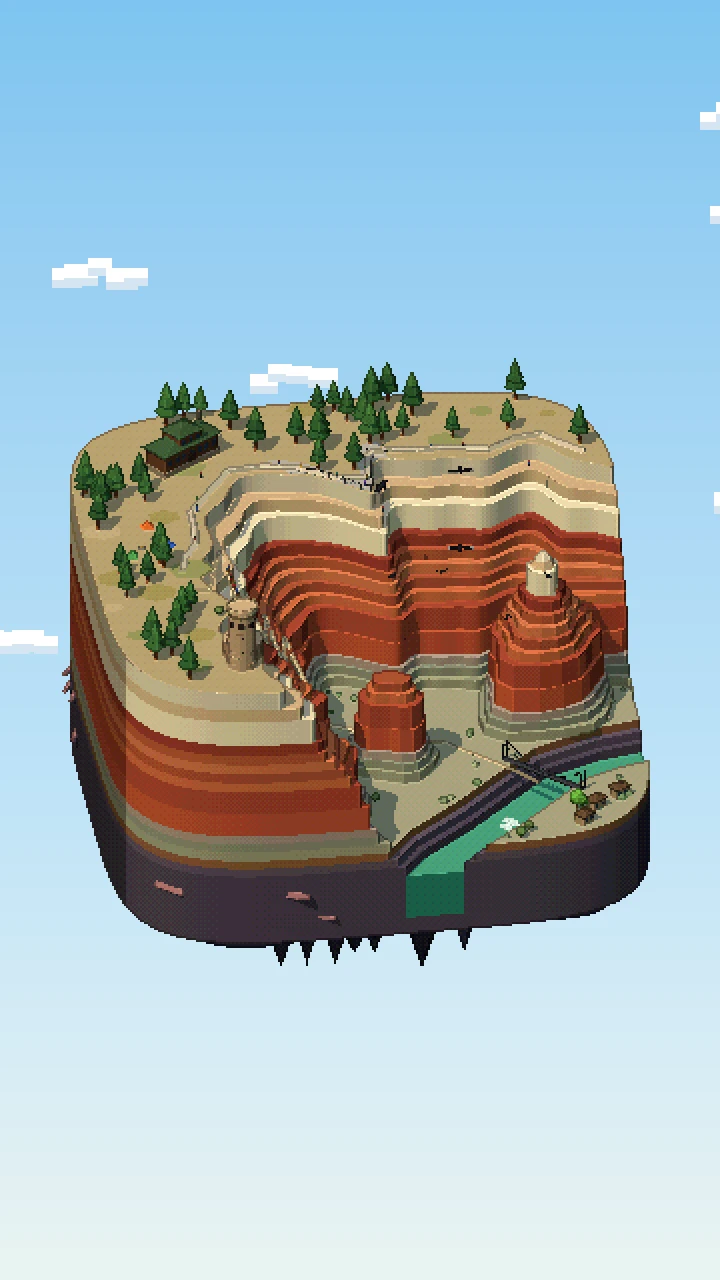
The diorama turns a slice of the canyon into a floating island, built in Three.js and rendered as pixel art with dark outlines and a small palette. Every rock layer is its own band that runs through the walls, the buttes and the sides of the island: the cream Kaibab cap, the white Coconino band, the deep red Hermit and stepped Supai ledges, the red Redwall cliff, the grey-green slopes of the Tonto Platform, brown Tapeats and the dark Vishnu Schist of the inner gorge, cut by the green Colorado River. Two temples rise from the canyon floor like stepped wedding cakes.
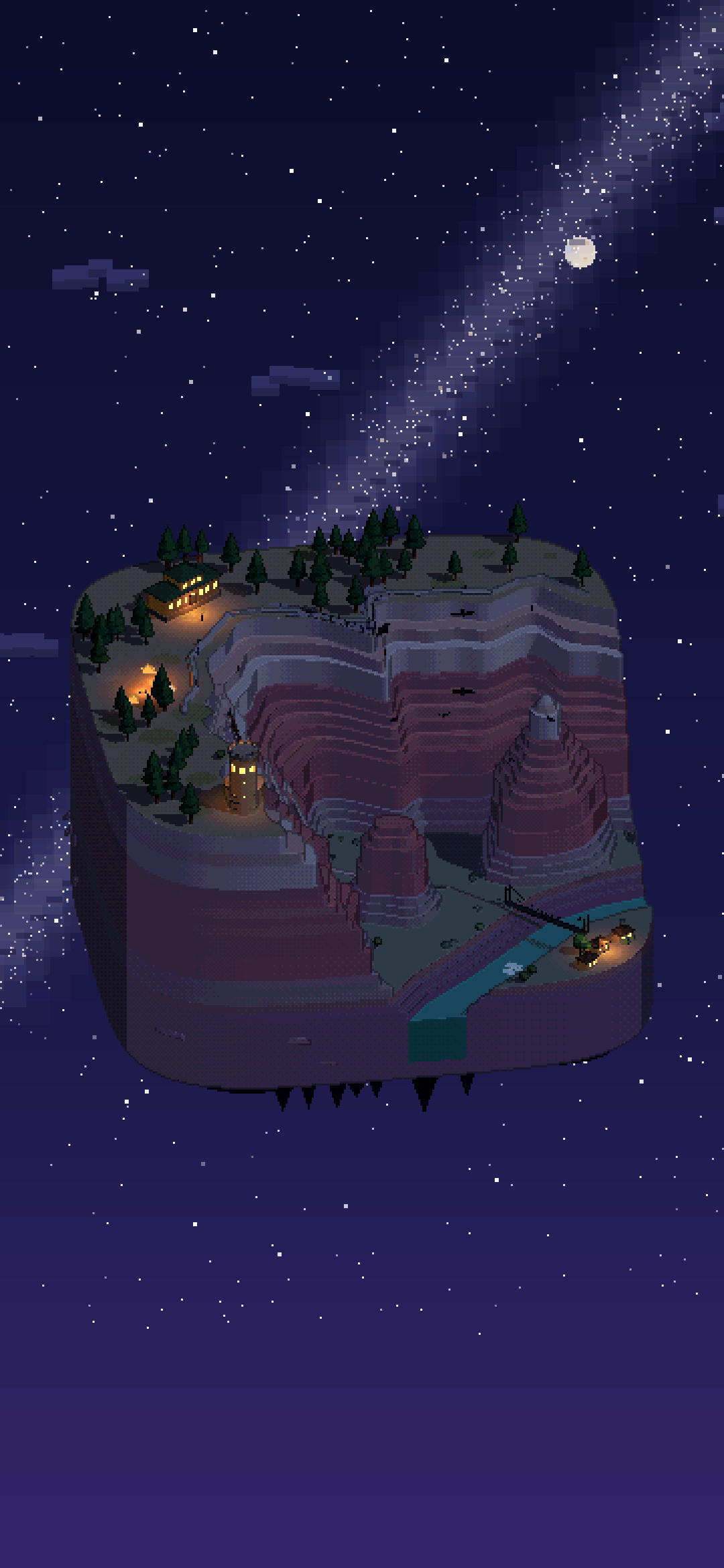
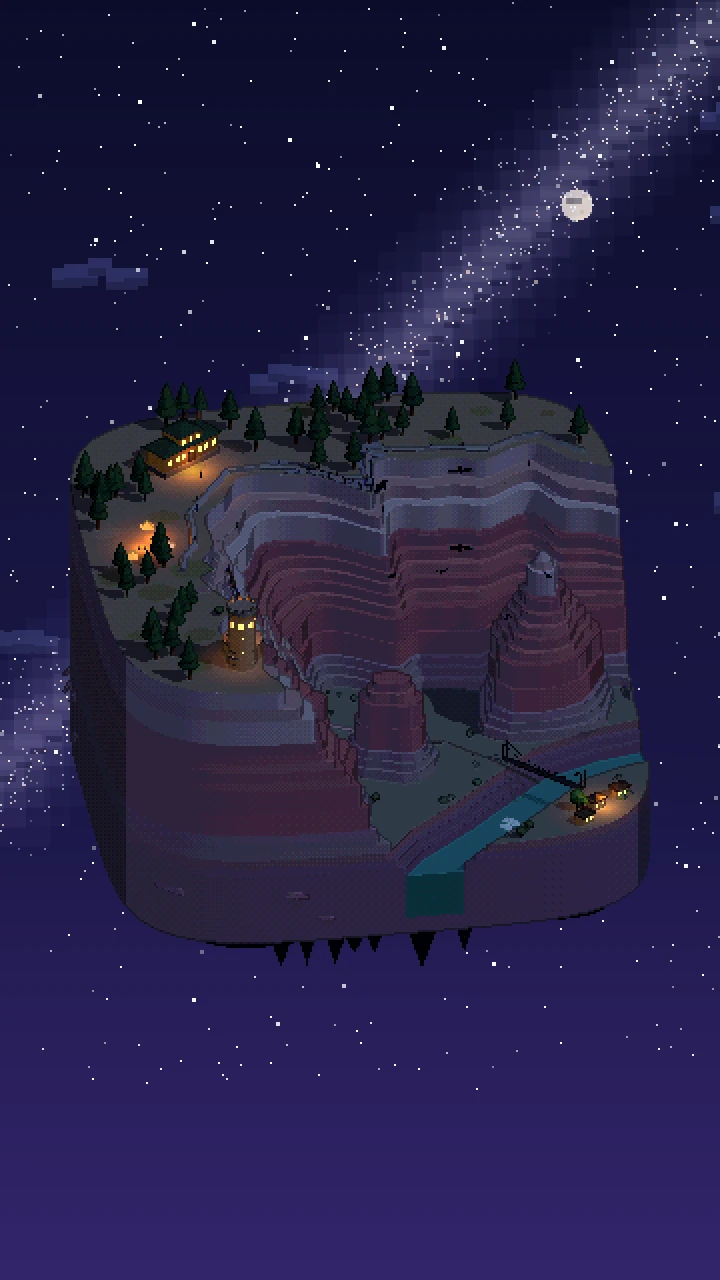
On the rim there are ponderosa pines, a lodge, a small campground, the railed overlook of Mather Point with visitors at the railing, and the round stone Desert View Watchtower on its own point. A mule train rides down the switchbacks of the Bright Angel Trail and back up, a raft runs the river under a suspension bridge by the cabins of Phantom Ranch, and condors and ravens circle overhead. At golden hour the walls glow red and orange; at night the sky fills with stars and the Milky Way, and camp fires, lodge windows and the tower light up.
Things to spot
- The mule train on the Bright Angel switchbacks
- Visitors at the Mather Point railing
- The round Desert View Watchtower on its point
- A yellow raft running the Colorado River
- Condors with white wing patches circling the canyon
- The Milky Way over the canyon at night
What we simplified
- The canyon is squeezed enormously: the real one is more than 1.8 km deep and up to 29 km wide, so the walls here are far steeper and the layers far thinner than in life.
- Mather Point, the Desert View Watchtower, the Bright Angel Trail and Phantom Ranch are kilometres apart in reality; here they share one small stretch of rim and canyon floor.
- The watchtower and the lodge are drawn much smaller than the rest of the scale would allow, so they stay toy-sized next to the rock.
Questions
How deep is the Grand Canyon?
At its deepest the Grand Canyon is more than 1.8 km (6,093 ft) deep. It is about 446 km long and up to 29 km wide.
Why are the walls of the Grand Canyon striped?
Each stripe is a different rock layer, laid down in seas, deserts and swamps over hundreds of millions of years. Hard layers such as the Redwall Limestone and Coconino Sandstone form cliffs, while softer shales wear back into slopes, which gives the walls their stepped look.
What is Mather Point?
Mather Point is a viewpoint on the South Rim near the main visitor centre, and for many people their first view of the canyon. It is named after Stephen Mather, the first director of the US National Park Service.
Can you see stars at the Grand Canyon?
Yes. Grand Canyon National Park was certified as an International Dark Sky Park in 2019, and on clear nights away from the lights the Milky Way is easy to see from the rim.
How was this pixel-art diorama of the Grand Canyon made?
It is a real-time Three.js scene on this page, drawn at 360 × 640 pixels with outlines and a small palette and scaled up without smoothing. Every rock layer is a separate band, so the strata line up through the walls, the buttes and the island sides, but the canyon is much steeper and shallower than the real one. Press “Explore in 3D”, drag to turn it, and switch between day, dusk and night.