About Tokyo Tower
Tokyo Tower rose in Shiba Park in Minato in barely a year and a half: work began in June 1957 and the tower opened on 23 December 1958. Post-war Tokyo needed one tall mast to carry the signals of its new television stations, and the architect Tachū Naitō, working with Nikken Sekkei, drew a four-legged steel lattice tower openly inspired by the Eiffel Tower. At 333 metres it was taller than its Paris model and became the symbol of Japan’s recovery.
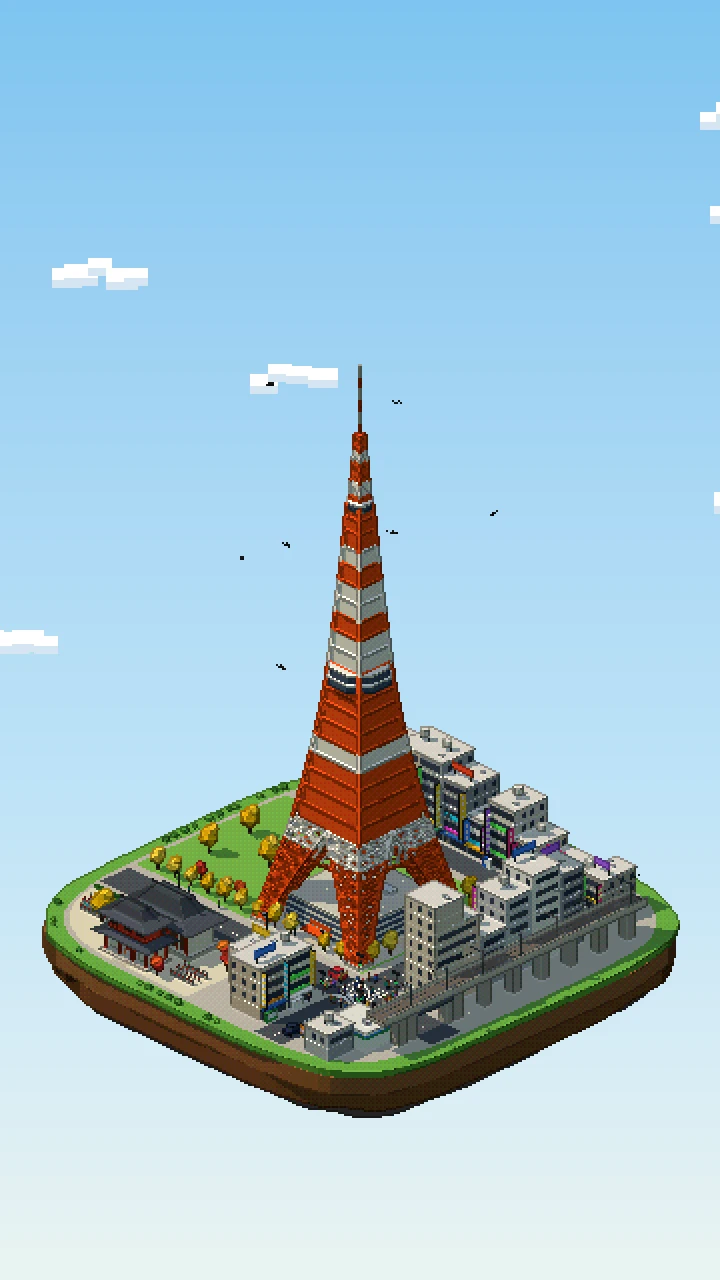
The tower weighs about 4,000 tonnes, much less than the Eiffel Tower, and some of its steel is said to have come from scrapped tanks. Its colours are not decoration: Japanese air safety rules required a structure this tall to be painted in bands of white and international orange, and about 28,000 litres of paint go on every time it is repainted, a job that comes round every five to seven years.
Two observation decks look out over the city. The two-storey Main Deck sits at 150 metres and the smaller Top Deck at about 250 metres. Between the legs stands FootTown, a low building full of shops, cafés and attractions. Since 2012 the city’s digital TV signals have come from the much taller Tokyo Skytree, but Tokyo Tower still carries radio antennas and remains the city’s favourite landmark.
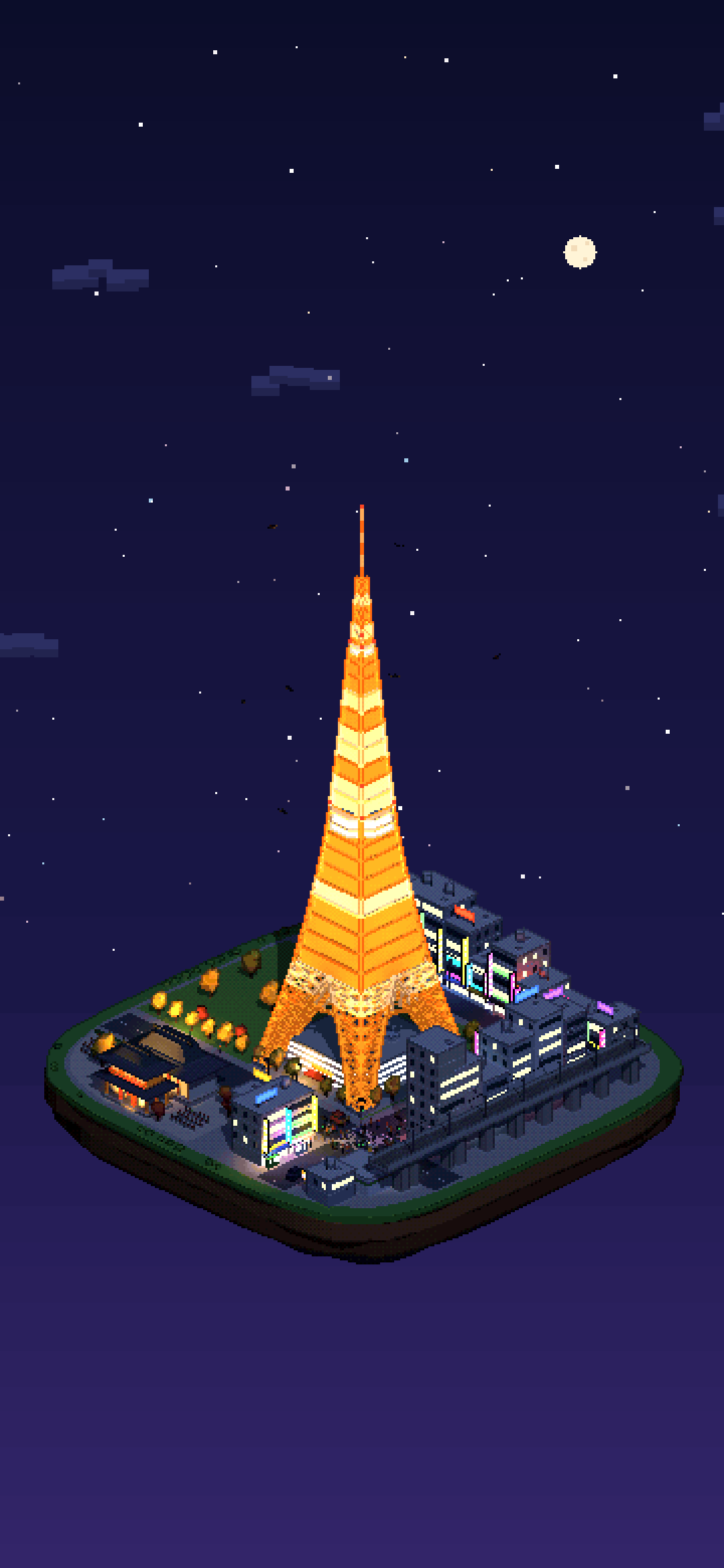
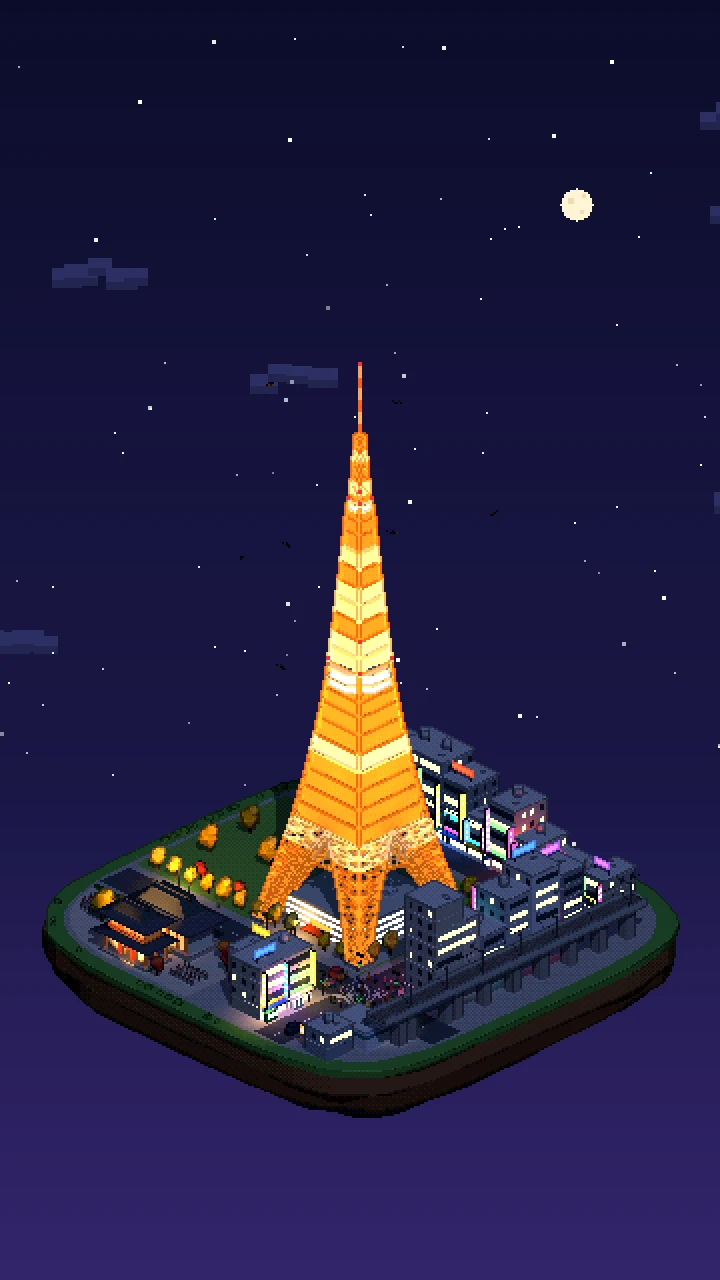
At night the tower is lit by the Landmark Light, designed by Motoko Ishii and unveiled in 1989: floodlights at its base turn the whole lattice warm orange for most of the year and cool white in summer. Right next to it is Zōjō-ji, the great Jōdo temple founded in 1393, whose red Sangedatsumon gate of 1622 is the oldest wooden building in Tokyo.
The diorama
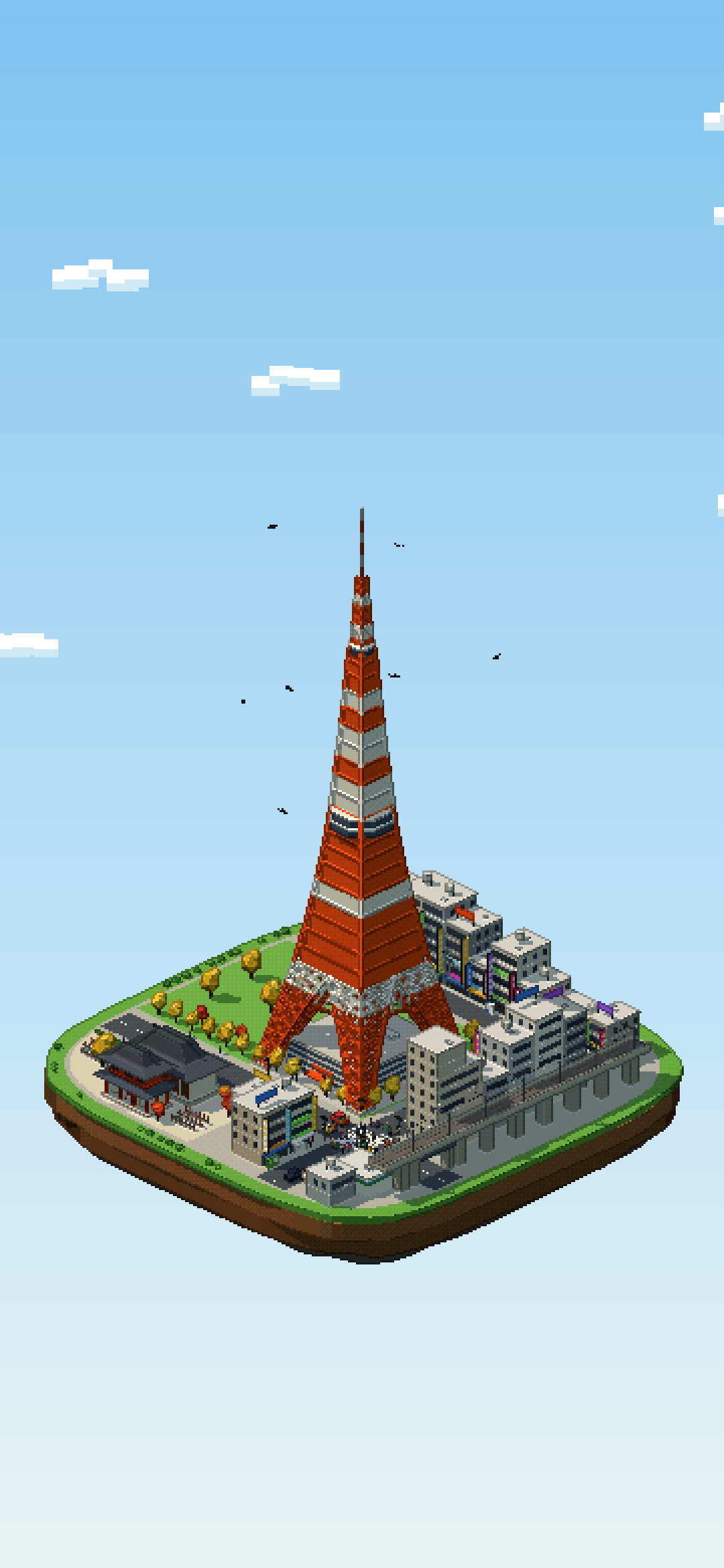
The diorama puts the tower on a floating island of Minato, built in Three.js and rendered as pixel art: the scene is drawn at a low resolution, every edge gets a dark outline, the colours are reduced to a small palette, and the result is scaled up without smoothing. The tower is modelled from its real profile: four lattice legs joined by arches, a square shaft banded in orange and white, the two-storey Main Deck with its glass band, the small Top Deck and the striped antenna mast. FootTown sits between the legs.
In front of it stand Zōjō-ji’s red two-storey Sangedatsumon gate and main hall under grey tiled roofs, with rows of small stone jizo statues in red caps and spinning pinwheels. On the other side is a dense street of narrow buildings with vertical neon signs, vending machines and a big screen, a scramble crossing where cars wait while the crowd crosses in every direction, and a silver and green Yamanote-line train on an elevated viaduct. Yellow ginkgo and red maples mark the autumn. At night the tower glows orange and the street lights up in every colour.
Things to spot
- The scramble crossing: cars stop and everyone crosses at once, diagonals too
- A Yamanote-line train running along the viaduct
- Rows of jizo statues in red caps with spinning pinwheels
- Vending machines glowing on the pavement
- Red aviation lights blinking on the tower at night
- Crows circling the tower
What we simplified
- The street, the crossing and the railway are a compressed picture of Tokyo, not the real streets around Shiba Park; the scramble crossing is a nod to Shibuya.
- Zōjō-ji is shrunk and moved right in front of the tower; the real temple grounds are much larger and the gate faces away from it.
- The lattice is simplified: the shaft is shown as solid bands with horizontal ribs so the colours read at pixel size.
Questions
How tall is Tokyo Tower?
Tokyo Tower is 333 metres tall. Its two-storey Main Deck is at 150 metres and its smaller Top Deck at about 250 metres.
When was Tokyo Tower built?
Construction began in June 1957 and Tokyo Tower opened on 23 December 1958. It was designed by Tachū Naitō with Nikken Sekkei as a broadcasting tower for Tokyo’s television stations.
Why is Tokyo Tower orange and white?
Japanese air safety rules required a structure this tall to be painted in bands of white and international orange so pilots can see it. The colours stayed, and at night the Landmark Light, designed by Motoko Ishii in 1989, turns the tower warm orange for most of the year and white in summer.
Is Tokyo Tower taller than the Eiffel Tower?
Yes. Tokyo Tower was inspired by the Eiffel Tower but is taller, at 333 metres, and much lighter, at about 4,000 tonnes of steel. Today Tokyo’s tallest tower is the Tokyo Skytree, which opened in 2012 at 634 metres.
How was this pixel-art diorama of Tokyo Tower made?
It is a real-time Three.js scene running on this page, drawn at 360 × 640 pixels with dark outlines and a small palette, then scaled up without smoothing. The tower follows its real profile, with four lattice legs, the orange and white bands and both observation decks. Press “Explore in 3D” to drag it round and switch between day, dusk and night.
Isometric maps of Tokyo
Tokyo also has an isometric pixel-art map made by the community: the whole city drawn tile by tile in the same SimCity-like style. See the map of Tokyo →